Every Australian investor building an international allocation eventually arrives at the same fork. On one side sits a fund that buys virtually everything across the developed world for next to nothing. On the other sits a fund that buys only a few dozen US companies it considers structurally advantaged and undervalued, at nearly three times the fee. The names on the labels, VGS and MOAT, suggest a clean choice between breadth and selectivity.
The reality is messier. The Australian share market’s heavy concentration in banks, miners, and supermarkets means international exposure is not optional for most serious portfolios; it is structural. The question is not whether to hold something like VGS or MOAT, but what role each plays, whether they can coexist, and what you are actually giving up when you pick one over the other. These are not cheap and expensive versions of the same product. They reflect genuinely different investment philosophies that produce meaningfully different portfolios.
Here is a framework for making that decision based on your own priorities, tax situation, and beliefs about markets, rather than someone else’s generic recommendation.
Why the Australian share market makes international ETFs a structural necessity
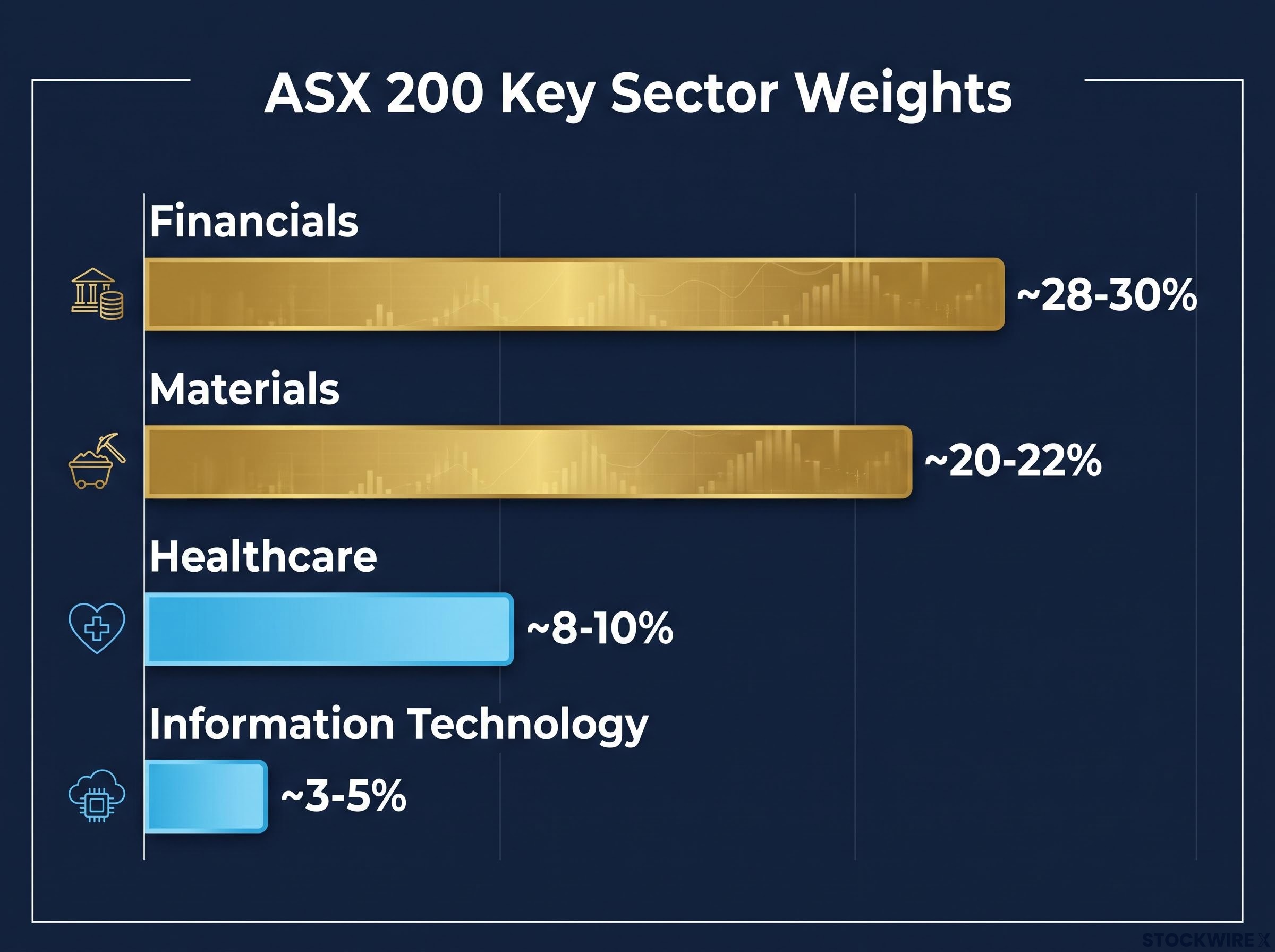
The ASX 200 is one of the most concentrated major indices in the developed world. Financials and materials together account for roughly half of the index by weight. Add in consumer staples, and three sectors dominate what most Australians hold in their domestic equity allocation.
That is not a criticism of Australian stocks. It is a structural observation: if your portfolio is heavily weighted to the ASX, you are almost certainly overexposed to credit cycles and commodity prices and underexposed to the sectors that have driven global wealth creation over the past two decades.
ASX 200 concentration risk is more acute than most portfolio comparisons acknowledge: financials and materials alone have historically consumed more than 50% of the index by market-cap weight, meaning the structural case for international ETFs rests less on return-chasing than on basic sector diversification.
Technology, healthcare innovation, and industrials carry meaningful weight in international indices but are marginal on the ASX. Both VGS and MOAT hold no Australian-listed securities, which makes them clean tools for filling this gap, each in a very different way.
| Sector | ASX 200 approximate weight | International ETF exposure |
|---|---|---|
| Financials | ~28-30% | VGS and MOAT both provide exposure, but at lower relative weights within diversified global or US holdings |
| Materials | ~20-22% | Significantly lower weight in both VGS and MOAT; neither is commodity-heavy |
| Information Technology | ~3-5% | VGS’s largest sector (~22-25%); MOAT holds tech selectively via moat-rated names |
| Healthcare | ~8-10% | Meaningful weight in both VGS (global pharma, devices) and MOAT (US healthcare names) |
When big ASX news breaks, our subscribers know first
VGS in plain terms: what the MSCI World ex-Australia index actually delivers
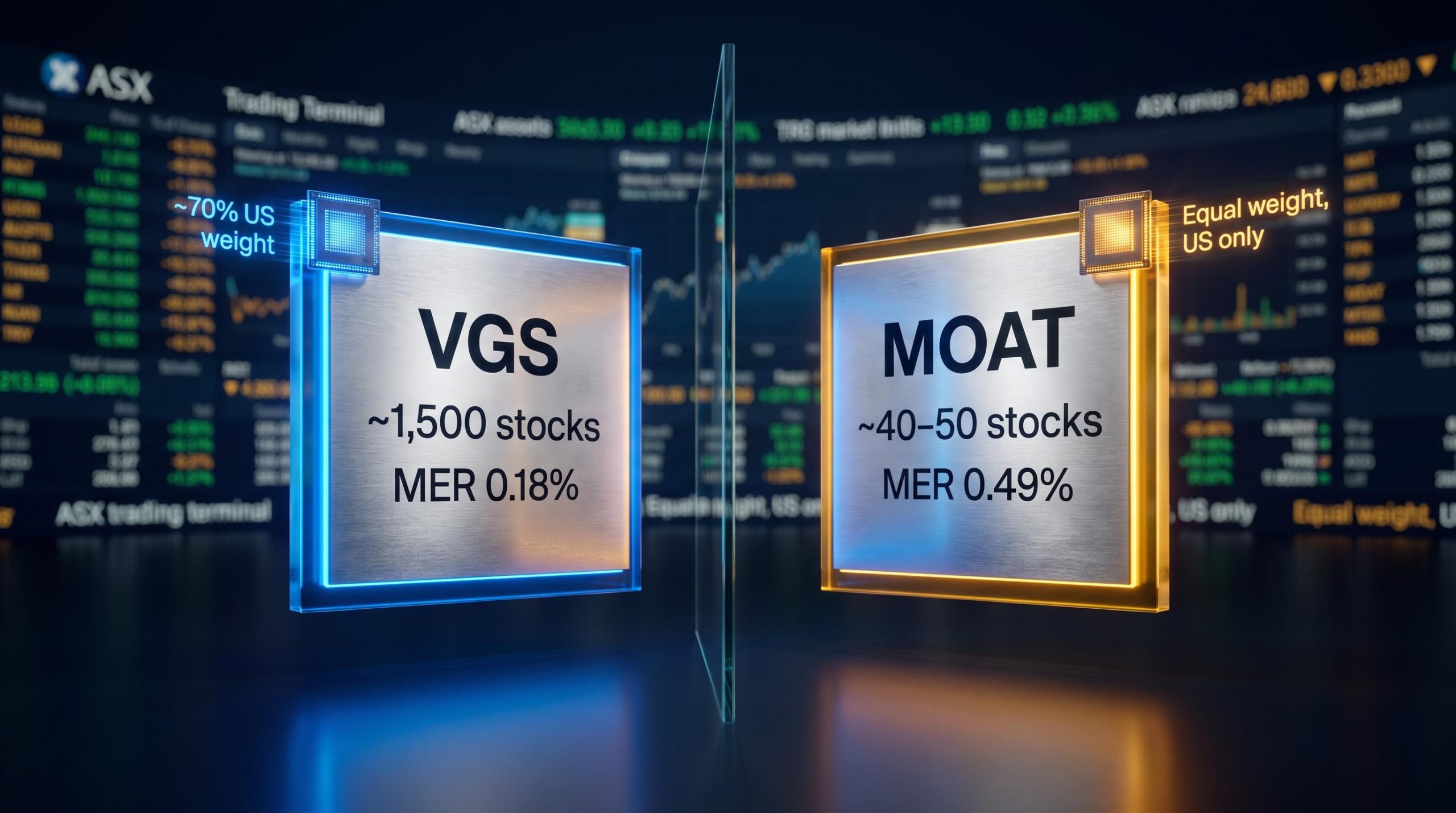
VGS tracks the MSCI World ex-Australia Index using physical replication. It holds approximately 1,500-1,600 companies across 23 developed markets, charges a management expense ratio (MER) of approximately 0.18% per annum, and manages roughly $15-17 billion in assets, making it one of the largest internationally focused ETFs on the ASX.
The fund weights its holdings by market capitalisation, which means it automatically owns more of whatever companies have grown largest. In practice, that produces a portfolio dominated by US mega-cap technology. Apple, Microsoft, NVIDIA, Amazon, and Alphabet sit at the top of the holdings list, and the approximate five-year annualised return of 13-16% per annum (in AUD) has been substantially driven by their performance.
Approximate country weights tell the real story:
- United States: ~70-72%
- Japan: ~6%
- United Kingdom: ~4%
- Canada: ~3-4%
- Remaining developed markets make up the balance
When you buy VGS, approximately 70% of your money goes to US equities. That is not a deliberate investment call by Vanguard. It is a structural outcome of market-cap weighting. Understanding this distinction matters before treating VGS as a genuinely balanced world portfolio.
The word “world” in the index name is technically accurate. But the portfolio’s behaviour will track US large-cap equities far more closely than it tracks a balanced basket of international economies.
What MOAT’s methodology actually does (and what it cannot guarantee)
MOAT tracks the Morningstar Wide Moat Focus Index and applies a two-stage filter that is fundamentally different from anything VGS does.
First, Morningstar’s equity research team must assess a company as having a “wide economic moat,” meaning a durable structural competitive advantage. Morningstar identifies six sources of moat:
Morningstar’s wide moat designation requires analysts to assess that a company’s competitive advantages can sustain excess returns on invested capital for 20 years or more, a threshold fewer than 20% of covered companies typically meet, which explains why MOAT’s qualifying universe is far smaller than the broader US market.
- Recognisable and defensible brand power that commands pricing authority
- Structural cost advantages derived from scale or operational efficiency
- Exclusive ownership of intellectual property, including patents and proprietary technology
- Network effects that increase a platform’s value as more users participate
- High barriers to customer departure due to embedded switching costs
- Efficient scale in markets where only a limited number of competitors can operate profitably
Second, the stock must be trading below Morningstar’s fair value estimate at the time of the quarterly rebalance. This valuation filter is what distinguishes MOAT from a simple quality screen. The fund does not just buy good businesses; it buys good businesses that Morningstar’s analysts believe are cheap.
The result is a concentrated portfolio of approximately 40-50 stocks, all US-listed, equally weighted among qualifying names, with a MER of approximately 0.49% per annum. Holdings change quarterly as valuations shift. This means MOAT will often not hold the S&P 500’s largest constituents when they trade above Morningstar’s fair value estimates, which creates meaningful tracking difference versus standard US indices.
Where the methodology introduces genuine risk
The equal-weight and valuation-screen design means MOAT will behave very differently from a standard US index ETF in momentum-driven markets. When expensive stocks keep rising, MOAT systematically avoids them. That discipline can protect capital in corrections, but it can also mean prolonged underperformance during sustained rallies.
Morningstar’s fair value estimates are subjective analyst judgements. They can be wrong. And the quarterly rebalancing generates portfolio turnover that can produce distributed capital gains, a material consideration for Australian investors in taxable accounts.
Side-by-side: the six dimensions that actually separate these two funds
The comparison is not about which fund is “better.” It is about which trade-offs you are willing to accept.
| Feature | VGS | MOAT | Trade-off implication |
|---|---|---|---|
| Index tracked | MSCI World ex-Australia | Morningstar Wide Moat Focus | Passive replication vs rules-based, research-informed selection |
| Holdings count | ~1,500-1,600 | ~40-50 | Broad diversification vs concentrated conviction |
| MER | ~0.18% p.a. | ~0.49% p.a. | On a $100,000 allocation, the annual fee difference is approximately $310 |
| Geographic scope | 23 developed markets | US only | Multi-country diversification vs single-country concentration |
| Weighting method | Market capitalisation | Equal weight among qualifiers | Mega-cap dominance vs balanced position sizing |
| Rebalancing | As index changes | Quarterly | Lower turnover vs higher turnover with potential tax consequences |
The fee gap between approximately 0.18% and 0.49% is not large in absolute dollar terms for most retail portfolios. But over a decade of compounding on a meaningful allocation, that spread becomes material. The question is whether MOAT’s additional discipline justifies it in your specific case.
ETF management fees compound silently against returns because they are deducted daily from a fund’s net asset value and never appear as a separate line item, a mechanic that makes the 0.31 percentage point gap between VGS and MOAT look modest in the short term but consequential across a decade of growth.
Australian tax and structure considerations that affect the comparison
Both funds are ASX-listed and accessible through standard brokerage accounts and self-managed superannuation funds (SMSFs), removing any access barrier as a comparison variable. Both are structured as Attribution Managed Investment Trusts (AMITs) under Australian tax law, and neither distributes Australian franking credits, as all underlying holdings are international.
The ATO guidance on managed fund distributions covers how AMITs are treated for income tax purposes, including how unitholders declare foreign income, apply foreign income tax offsets, and report capital gains arising from internal fund activity.
Key tax points to consider:
- The 50% CGT discount applies to Australian individual investors who hold units for more than 12 months on disposal
- Foreign income included in distributions may be eligible for foreign income tax offsets
- Neither fund carries Australian franking credits, which matters if your portfolio relies on franked income from domestic shares
- MOAT’s quarterly rebalancing creates higher internal portfolio turnover, which can generate taxable capital gains distributed to unitholders, even if you have not sold your units
This section is general information only and is not a substitute for personal tax advice. Consult a qualified tax professional for guidance on your specific situation.
For a tax-sensitive investor in a high marginal bracket holding in a taxable account rather than super, MOAT’s higher internal turnover could reduce after-tax returns in a way that meaningfully narrows its apparent edge in gross performance comparisons.
Constructing a portfolio position: when to hold one, the other, or both
Three investor scenarios map cleanly onto three allocation decisions:
- Core simplicity: VGS alone
- Suits the investor building a low-cost, broad international allocation with minimal complexity
- Allocation logic: VGS as the single international equity building block alongside Australian equities and fixed income
- Caveat: you are accepting approximately 70% US concentration without a quality or valuation filter
- Quality-tilted US satellite: MOAT alone (as the international component)
- Suits the investor who specifically wants US exposure filtered for competitive advantage and valuation discipline
- Allocation logic: MOAT as a concentrated US quality holding, potentially paired with a non-US international fund for geographic balance
- Caveat: you are giving up all non-US developed market exposure and accepting higher fees plus higher turnover
- Combined approach: VGS as core, MOAT as satellite
- Suits the investor comfortable with higher overall US exposure who wants MOAT’s quality-value discipline layered on top of VGS’s breadth
- Allocation logic: VGS for the global foundation, MOAT for a targeted US quality tilt
- Caveat: holding both significantly increases total US equity weight; audit your full portfolio before adding both to avoid unintended concentration
The “hold both” approach is not automatically superior to holding just VGS. You need to honestly assess whether MOAT’s additional quality and valuation discipline justifies the higher fee, the reduced geographic diversification, and the increased tax complexity. For many investors who prioritise simplicity, it does not.
This article is for informational purposes only and should not be considered financial advice. Investors should conduct their own research and consult with financial professionals before making investment decisions.
What the choice ultimately reveals about your investment philosophy
The VGS versus MOAT decision is, at its core, a question about what you believe about markets. VGS represents the view that markets price assets efficiently enough that the best strategy is to own everything at the lowest possible cost. MOAT represents the view that disciplined, research-driven filtering can identify an edge in quality and valuation that justifies its additional cost and concentration.
Situating VGS and MOAT within the broader global ETF peer group reveals how much the two funds diverge from both each other and from alternatives such as IOO and IVV, with fee, liquidity, and return data across 12 major ASX-listed international funds providing a fuller basis for the allocation decision.
Neither belief is wrong. What matters is that you hold one consistently rather than switching between approaches based on whichever fund had the better year. The investor who chooses VGS over MOAT, or vice versa, based purely on recent returns is making the decision for the wrong reason. The durable question is which investment belief you actually hold and can stick with through a period when your chosen approach underperforms.
Both philosophies have merit. The decision is yours. Whichever direction you take, verify all fund-specific figures directly from Vanguard Australia and VanEck Australia before making any allocation decision, and consider personal financial advice for your specific situation.
Before acting on any comparison in this article, verify current MER, holdings, and performance data directly from Vanguard Australia and VanEck Australia. Fund characteristics change over time.