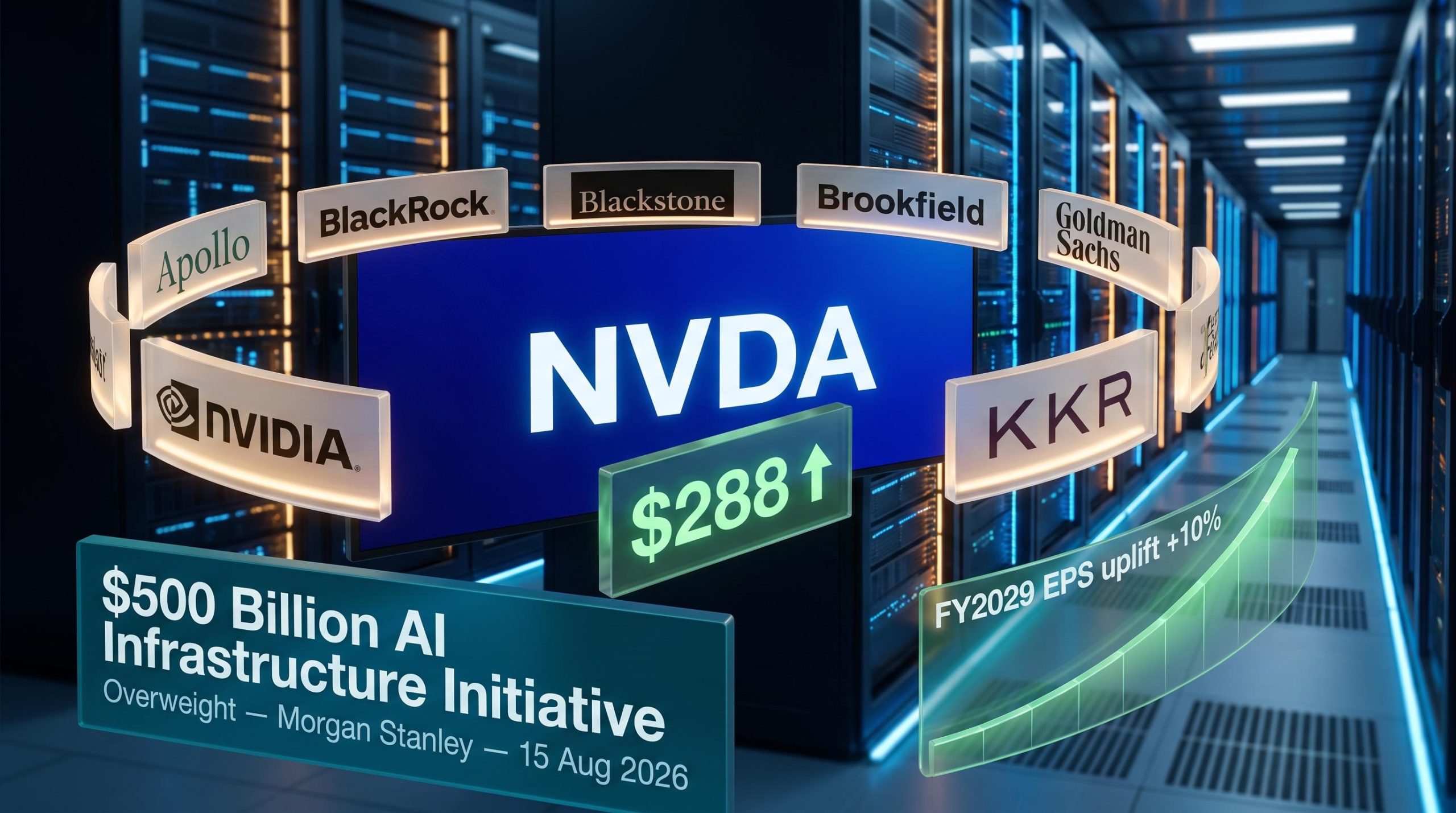
Morgan Stanley did not simply reiterate its Nvidia rating last week. It used the company’s $500 billion infrastructure financing plan, announced around 10 August 2026, as evidence that Nvidia is reshaping how AI capacity gets financed, not just built. That reframing is the news.
The Overweight reaffirmation and $288 price target, current as of 15 August 2026, land against a specific concern: whether Nvidia had been quietly funding its own future GPU sales through circular financing arrangements. The $500 billion initiative, structured around six independent Wall Street institutions, is Nvidia’s structural answer to that concern.
The distinction matters. Investors who understand why Morgan Stanley views this structure as genuinely additive are in a different position than those who see only the headline dollar figure. Here is what determines whether this initiative strengthens or complicates Nvidia’s investment case, and which variables you need to monitor before acting on the rating.
What Nvidia’s $500 billion initiative actually puts in place
Nvidia has entered into memorandums of understanding with six major financial institutions, with each agreeing to build its own independent compute financing platform. The partners are:
- Apollo
- BlackRock
- Blackstone
- Brookfield
- Goldman Sachs
- KKR
Each institution will operate its own platform, evaluating AI infrastructure projects on a case-by-case basis rather than drawing from a single centralised fund. The $500 billion figure represents a potential deployment target rather than a pre-committed pool of capital. Every dollar requires an independent credit decision by the partner providing it.
PE Hub’s reporting on the six-partner initiative confirmed that each institution is building its own independent platform rather than participating in a single pooled vehicle, a structural detail that underpins the independent credit decision logic Morgan Stanley cited in its reaffirmation.
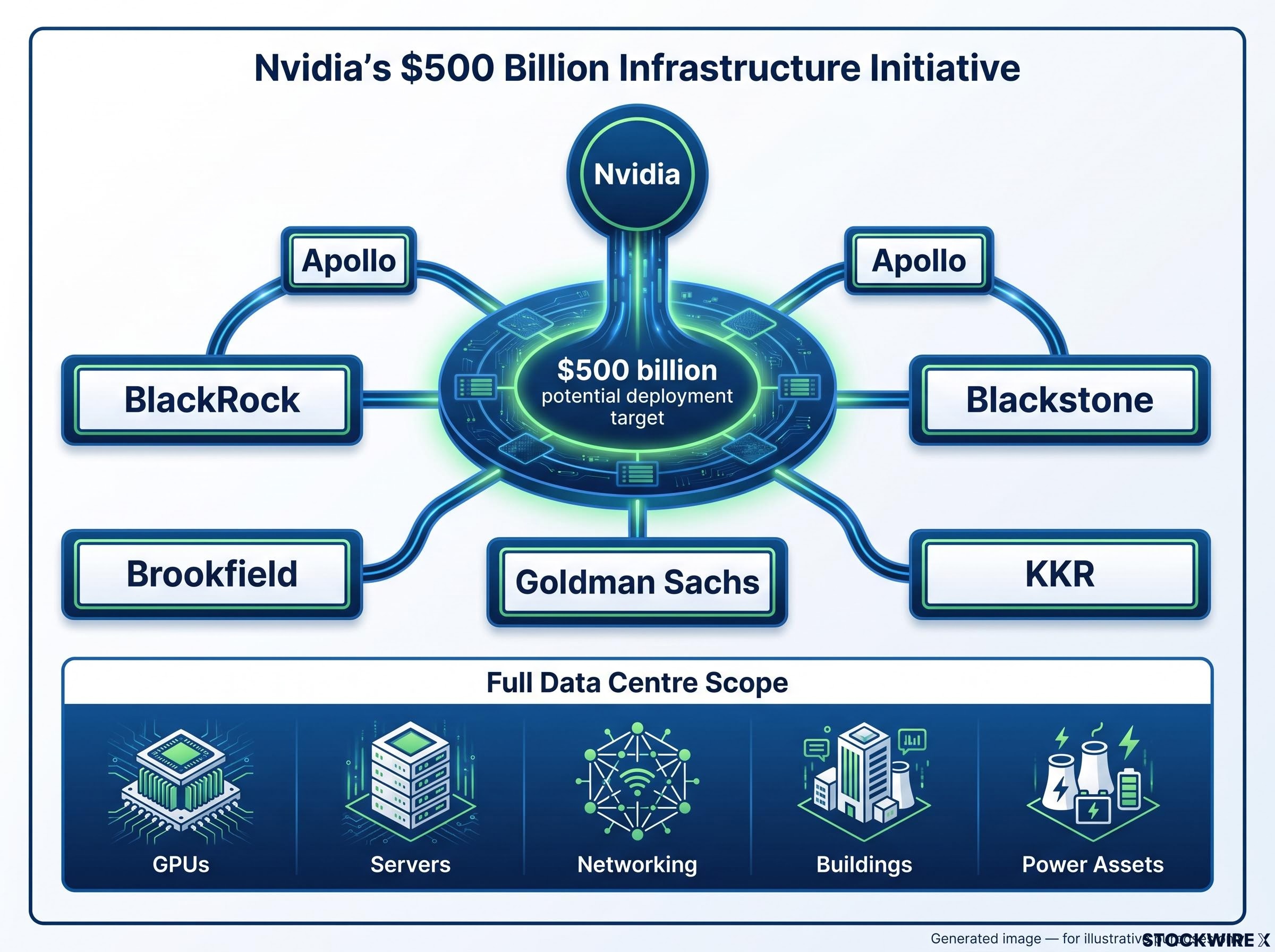
The scope covers the full data centre stack: GPUs, servers, networking, buildings, and power assets. This is infrastructure financing, not a chip purchase programme.
The six-partner financing network covers the full data centre stack including power assets, a scope that places it inside a broader capital reallocation from software-centric assets toward physical infrastructure: AI infrastructure investment is redirecting hundreds of billions of dollars annually toward power generation, grid interconnection, and hardware supply chains that underpin GPU utilisation assumptions.
| Partner Institution | Role | Capital Type |
|---|---|---|
| Apollo | Independent compute financing platform | Structured financing |
| BlackRock | Independent compute financing platform | Structured financing |
| Blackstone | Independent compute financing platform | Structured financing |
| Brookfield | Independent compute financing platform | Structured financing |
| Goldman Sachs | Independent compute financing platform | Structured financing |
| KKR | Independent compute financing platform | Structured financing |
That decentralised architecture is the detail that separates this from a marketing headline. You are not looking at a single pooled vehicle that Nvidia controls; you are looking at six independent capital allocators each making their own risk decisions, which changes how the demand this generates should be read.
When big ASX news breaks, our subscribers know first
How the structure directly addresses Nvidia’s self-financing problem
The concern was specific. Nvidia’s earlier financing experiments raised questions about whether the company was effectively funding its own future GPU sales, a circular arrangement that could mask real organic demand. If the same company selling the chips is also financing the purchases, the demand signal gets distorted.
The six-partner structure targets that weakness directly. Each institution applies its own return thresholds and underwriting standards before committing capital. Nvidia’s involvement is capped: the company may offer residual value backing on up to 25% of any given transaction, with the bulk of capital exposure sitting on external balance sheets.
According to Morgan Stanley’s analysis, having independent parties make capital allocation decisions and provide external funding addresses the concern that Nvidia could otherwise be engineering its own revenue growth through self-directed financing.
That 25% cap is the number worth holding onto. It is the structural boundary that separates Nvidia as a technology supplier from Nvidia as a demand creator. For anyone assessing whether the initiative represents genuine third-party conviction or subsidised volume, the cap is where the answer sits.
What the revenue-sharing model could mean for Nvidia’s earnings
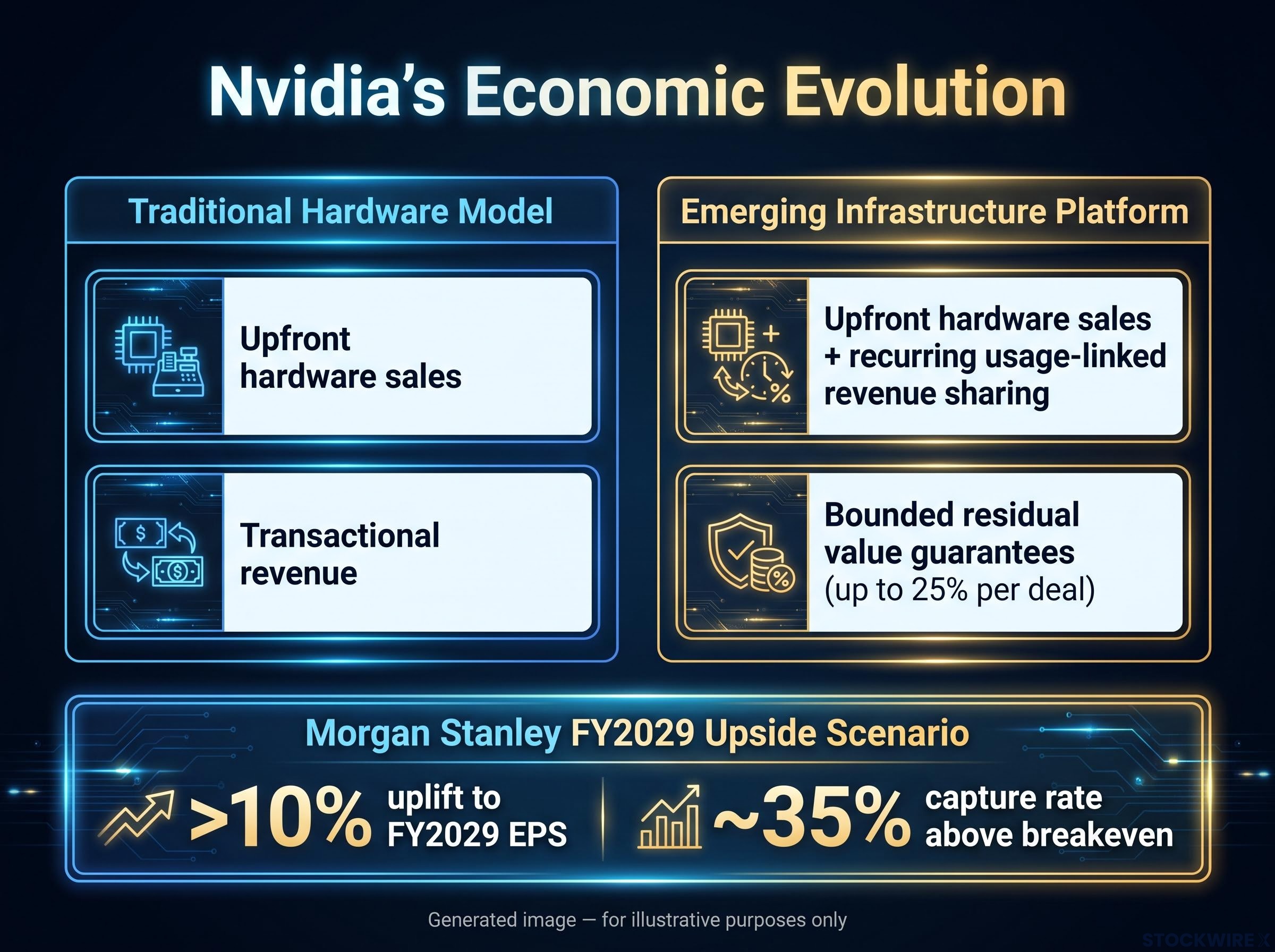
The structural mechanics lead somewhere financially specific. Alongside the financing initiative, Nvidia has begun rolling out a model where it earns standard margins on hardware sales plus a recurring, usage-linked share of cloud service revenue generated by that hardware over time.
Morgan Stanley modelled one scenario for how this plays out. The conditions underpinning the upside estimate are worth stating clearly:
- Revenue-sharing capture rate: a capture of roughly 35% of revenues generated above the breakeven threshold
- GPU pricing assumptions: supportive pricing sustained through the deployment cycle
- Deployment volume scale: partner platforms achieve sufficient scale to generate meaningful recurring revenue
Under those conditions, Morgan Stanley’s modelling points to a potential uplift of over 10% to FY2029 earnings per share (EPS, the portion of a company’s profit allocated to each outstanding share) beyond what current consensus forecasts assume.
The EPS upside thesis is anchored around FY2029, not the next few quarters. This is a medium-term structural argument, not a near-term earnings catalyst.
That distinction matters. The 10%-plus figure is conditional on pricing and utilisation assumptions that are not guaranteed. Treat it as an upside scenario with defined dependencies, not a base case revision. If those conditions hold, however, the shift from transaction-based hardware revenue toward recurring infrastructure-linked cash flows would represent a meaningful change in Nvidia’s earnings profile.
Understanding Nvidia’s role in the AI infrastructure financing ecosystem
Something larger is happening beneath the deal mechanics. Nvidia is positioning itself as a co-architect of how AI capacity gets financed and monetised, not only as a chip vendor. That places the company inside both the technology and capital stacks of the AI economy simultaneously.
The traditional hardware model
Under the old model, Nvidia sold GPUs and systems to customers who built their own data centres. Revenue was transactional. Once the hardware shipped, Nvidia’s economic relationship with that infrastructure was largely complete.
The emerging infrastructure platform model
The new model looks different across three dimensions:
- Revenue type: Upfront hardware sales plus recurring, usage-linked revenue sharing
- Balance sheet exposure: Bounded residual value guarantees (up to 25% per deal) create ongoing financial linkage to deployed infrastructure
- Ecosystem role: Nvidia acts as technology supplier, residual value backstop, and co-beneficiary of AI compute utilisation, all simultaneously
The six-partner network is the institutional scaffolding for treating AI compute as a financial asset class, a category of investment that institutions can underwrite, price, and trade. For investors conducting any serious analysis of Nvidia stock, this repositioning changes the relevant comparison set. Nvidia is no longer purely a semiconductor peer; it increasingly behaves like a platform company with recurring infrastructure economics.
The SoftBank SB Energy talks, reported the same week, reinforce this positioning: Nvidia’s emerging identity as a capital partner in AI infrastructure extends beyond the six-institution financing framework to include direct equity stakes and lease backstops tied to specific hardware deployments.
Four risks investors need to monitor as the platforms scale
Morgan Stanley is not ignoring the risks. It is rating through them, which means you need to decide whether your own risk tolerance matches that posture before treating the Overweight rating as a simple green light.
- Credit and counterparty risk: Even with the 25% cap, Nvidia carries contingent exposure if financed projects underperform or if partner platforms face stress. The realised risk depends on how rigorously partners screen projects.
- Systemic leverage risk: Aggregating hundreds of billions of dollars in debt across specialised hardware, power assets, and data centres increases cyclicality in the AI infrastructure stack. Morgan Stanley explicitly acknowledged this as a named risk.
- Execution and governance risk: The model requires sustained coordination across six large financial institutions with potentially divergent risk tolerances and timelines. Misaligned incentives could weaken the earnings uplift.
- Policy and regulatory risk: Treating AI compute as a financial asset class at this scale may attract scrutiny focused on systemic risk, data security, and infrastructure concentration.
| Risk Category | Description | What to Monitor |
|---|---|---|
| Credit and counterparty | Contingent exposure if financed projects underperform | Nvidia’s disclosed guarantee levels and any impairments |
| Systemic leverage | Concentrated debt across AI infrastructure increases cyclicality | Total financed deployment volumes relative to AI workload demand |
| Execution and governance | Coordination challenges across six partner institutions | Revenue-sharing contract terms and partner deployment pace |
| Policy and regulatory | Potential scrutiny of AI compute as a financial asset class | Regulatory actions targeting systemic risk or infrastructure concentration |
A structured risk inventory is not a reason to dismiss the investment case. It is what allows you to build a position with clear monitoring triggers rather than an undifferentiated bet.
BofA’s framework for sizing contingent balance sheet exposure, including the modelled impact of ecosystem equity commitments relative to projected free cash flow, provides a quantified lens for assessing whether the risks Morgan Stanley acknowledges are adequately priced into current consensus estimates.
What the Morgan Stanley reaffirmation actually tells you about the investment case
Morgan Stanley confirmed its Overweight rating on Nvidia (NASDAQ: NVDA) alongside a $288 price target as of 15 August 2026, identifying the company as the firm’s preferred name within the semiconductor sector.
Morgan Stanley considers Nvidia the standout choice among semiconductor companies, with the $500 billion infrastructure initiative reinforcing the structural case underpinning the Overweight rating.
The reaffirmation is a thesis clarification, not a new call. Morgan Stanley held the Overweight position before the announcement. The initiative gives the firm additional structural conviction that demand quality is improving, that a medium-term recurring revenue layer is forming, and that Nvidia’s role in AI infrastructure is deepening.
Three variables will determine whether the upside or risk scenario materialises:
- GPU pricing sustainability: Whether Nvidia can maintain pricing power as financed infrastructure scales and competition evolves
- Utilisation rates: Whether the AI workloads deployed on financed hardware generate sufficient revenue to sustain the sharing model
- Partner platform deployment pace: How quickly the six institutions move from memorandums of understanding to funded, operational projects
The reaffirmation tells you Morgan Stanley sees the structural logic as sound. It does not tell you the outcome is certain. Hold both of those things simultaneously when sizing a position.
Morningstar’s fair value estimates for Nvidia sit close to Morgan Stanley’s $288 price target at the headline level, but the underlying frameworks differ materially: Morningstar anchors its $280 figure to switching costs embedded in the CUDA ecosystem rather than the financing-driven recurring revenue layer Morgan Stanley is now modelling.
This article is for informational purposes only and should not be considered financial advice. Investors should conduct their own research and consult with financial professionals before making investment decisions. Past performance does not guarantee future results. Financial projections are subject to market conditions and various risk factors.
—