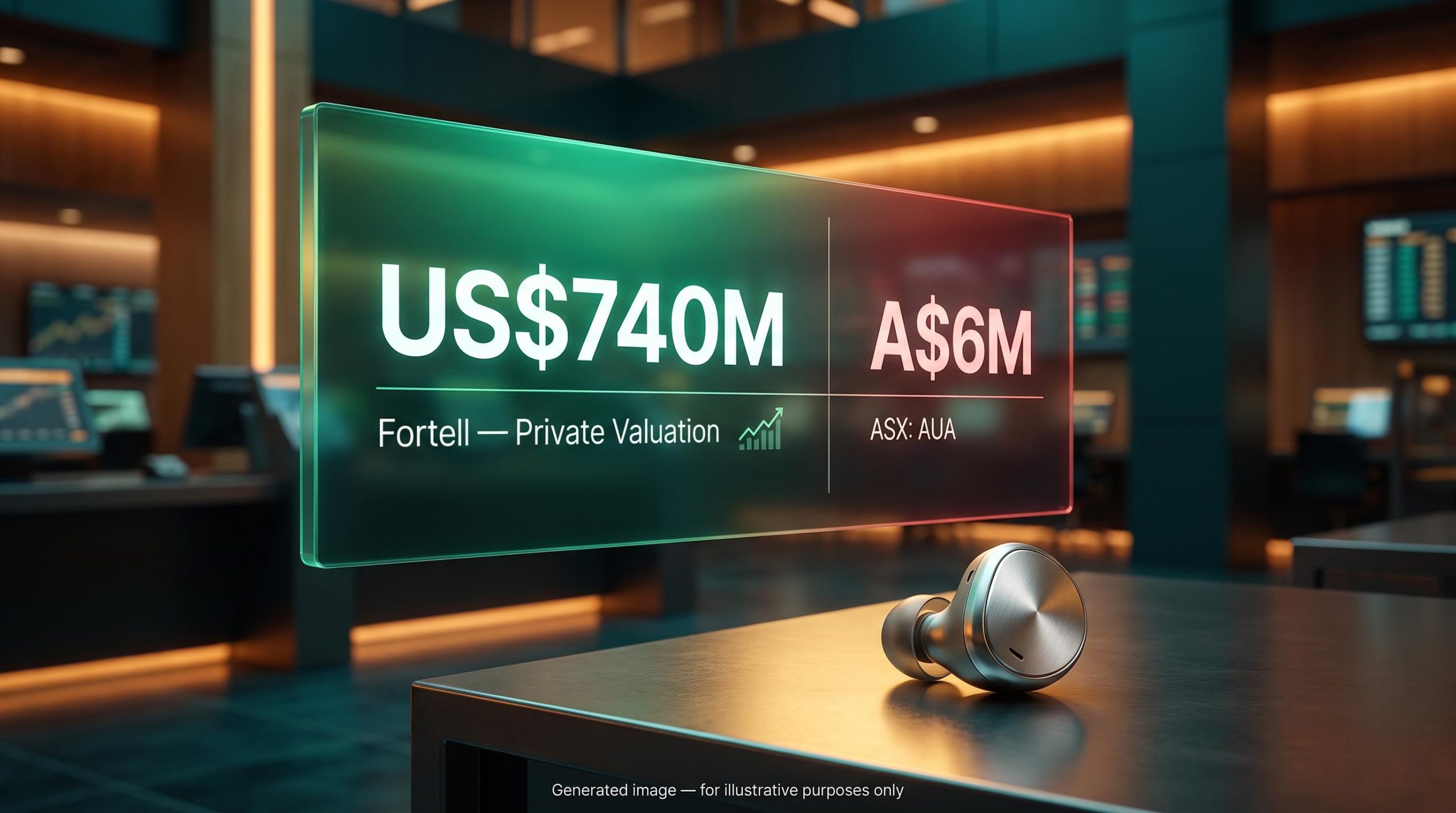
A New York startup that has barely begun selling hearing aids just attracted a valuation of approximately US$740 million, according to Forbes reporting from July 2026. A Brisbane company that has spent years building comparable technology, and already has it inside more than 3,000 clinics worldwide, is valued by the ASX at less than A$6 million.
That contrast is not a quirk. It is the kind of pricing gap that forms when public markets treat an entire technology category as too niche to price confidently, and then private capital steps in with a number that forces a recalibration. The category in question is AI-driven speech enhancement, specifically the ability to isolate a target voice in a noisy room in real time. It is a problem that conventional hearing aids have failed to solve for decades, and sophisticated investors just signalled they believe AI can solve it at scale.
Here is what you need to understand: why the Fortell raise reprices the category rather than just one company, what the underlying technology problem actually is, how Audeara Limited (ASX: AUA) is positioned within it, how its licensing model works, and what specific milestones would need to materialise before the category signal translates into anything meaningful on the ASX. You will also get a framework for reading offshore private-market raises as analytical tools for niche ASX tech stocks, rather than as direct valuation comparisons.
Why a US$740 million valuation for a hearing-aid startup is a signal worth reading
Fortell, a New York-based AI hearing-aid company, raised approximately US$163 million in total funding, with the latest round supporting a valuation of approximately US$740 million, according to Forbes reporting from July 2026. When the raise occurred, Fortell had only just begun selling through a small selection of high-end clinics and had not yet achieved meaningful commercial scale. The valuation was built almost entirely on category conviction rather than demonstrated revenue scale.
That is what makes the round analytically important. The capital was not backing a single hardware product. It was backing a thesis: that real-time AI speech enhancement is a foundational technology, not a niche feature, and that the market of frustrated hearing-aid users willing to pay a premium for genuine improvement in noisy environments is large enough to justify serious early-stage investment.
According to Forbes (July 2026), Fortell attracted a valuation of approximately US$740 million while still in the early stages of commercial sales, a figure that reflects investor conviction in the AI speech-enhancement category itself.
For you, the analytical read is straightforward. Whenever institutional capital assigns this level of value to a category at such an early commercial stage, it shifts the reference point against which all other companies tackling the same underlying problem must be measured. Before this raise, public markets had no external reference point for what AI hearing technology might be worth. Now they do.
When big ASX news breaks, our subscribers know first
What the cocktail party problem actually is, and why solving it attracts large capital
If you have ever tried to follow a conversation in a crowded restaurant and given up, you have experienced the cocktail party problem. It is the inability to isolate a target speaker’s voice when surrounded by competing noise, and it is the single biggest reason hearing-aid users report dissatisfaction and ultimately abandon their devices.
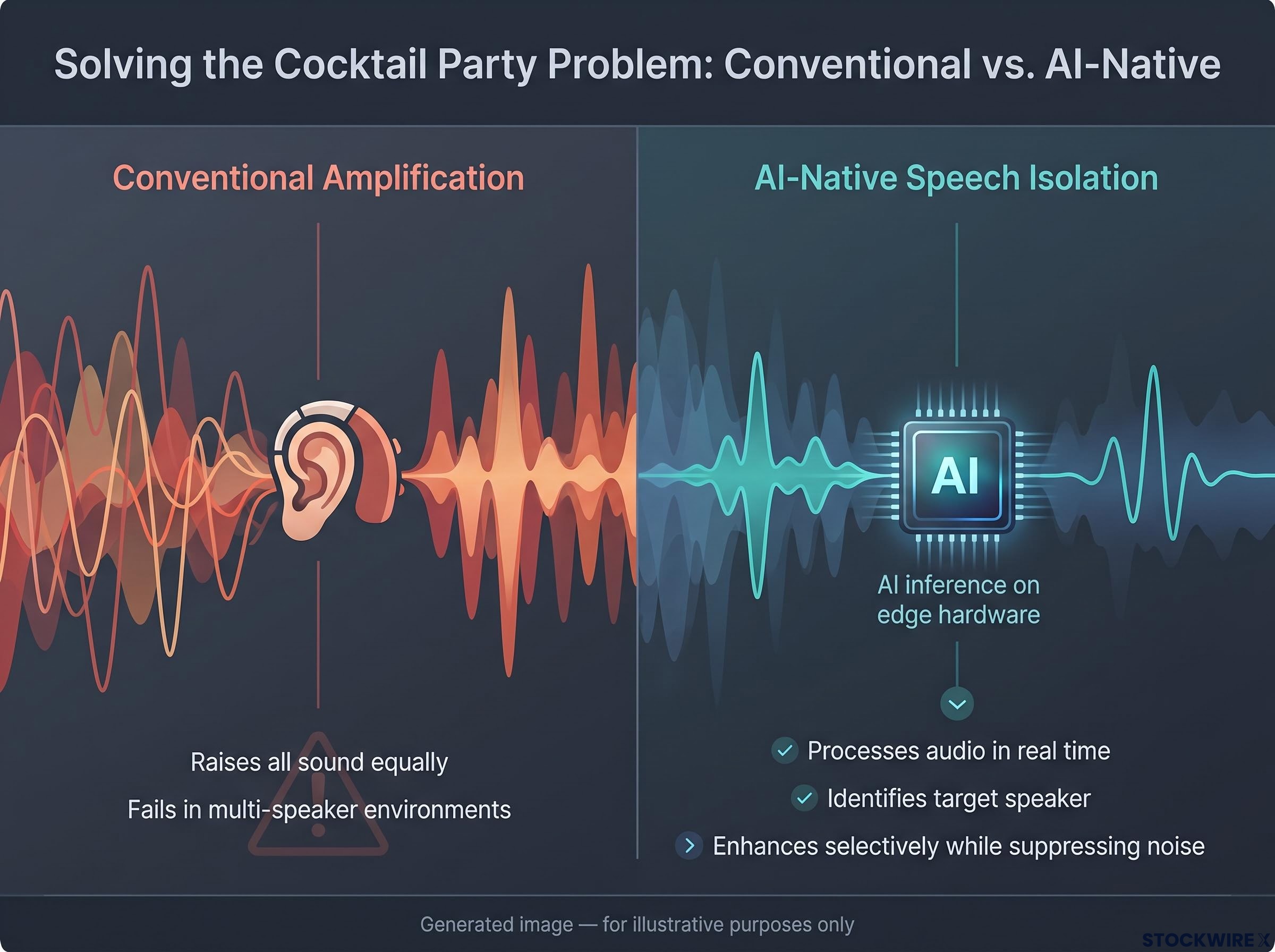
Conventional hearing aids fail at this because their core architecture is amplification. They raise volume indiscriminately, boosting both the voice you want to hear and every other sound in the room. That is not a calibration problem you can tune away. It is a fundamental limitation of the approach.
What makes noise environments so hard to solve
Your brain performs cocktail party filtering automatically, using neural processing that integrates spatial awareness, vocal familiarity, lip-reading cues, and contextual prediction in real time. Replicating that in a microprocessor small enough to fit in your ear has historically required more computational power than wearable hardware could deliver.
What changed is AI inference on edge hardware. Chips embedded directly in hearing aids have only recently become fast and power-efficient enough to run real-time speech isolation outside a laboratory. This is what AI-native speech enhancement does differently: it selectively identifies and enhances a target voice within milliseconds, without proportionally amplifying background noise.
The contrast matters for your understanding of the category:
- Conventional amplification: raises all sound equally; fails in any multi-speaker environment; the harder the environment, the worse the performance
- AI-native speech isolation: processes incoming audio in real time; identifies the target speaker; enhances that voice selectively while suppressing competing noise
- Why the gap persisted: edge-device AI processing was too slow and too power-hungry until recent chip advances made real-time inference viable in wearable form factors
If this problem has resisted conventional engineering for decades and AI is the first plausible path to solving it at consumer scale, then the technology category is not speculative in the way public markets have historically priced it. There is a proven, large, and frustrated market waiting for a product that actually works. That is why serious capital showed up.
Why Audeara’s global clinic footprint puts it ahead of where Fortell is starting
Founded in Brisbane, Audeara Limited (ASX: AUA) builds AI audio and hearing personalisation technology. Its current ASX market capitalisation sits below A$6 million. The company’s origin was personalised headphones that adapted audio output to individual hearing profiles, a product that served a specific purpose: it was the vehicle for building clinical relationships rather than the end goal itself.
That sequencing matters. The typical early-stage medical technology company completes its product development and then faces the hard work of finding clinical partners and distribution channels. Audeara reversed that sequence, securing its clinical and distribution network before that challenge became the bottleneck. According to company-reported figures, on a global basis more than 3,000 clinics carry its products or underlying technology, with roughly 1,500 of those located in Australia, among them the network served by Hearing Australia. These figures have not been independently confirmed.
Where Fortell is said to be constructing its clinic-by-clinic commercial infrastructure across a small number of US premium practices, Audeara describes that same foundation as already operating at worldwide scale. For you, trying to understand why the ASX valuation looks surprising relative to the category signal, that gap in distribution readiness is the most concrete place to start.
| Dimension | Fortell | Audeara (ASX: AUA) |
|---|---|---|
| Market status | Private, venture-backed (US) | Public micro-cap (ASX-listed) |
| Primary model | Own-brand AI hearing-aid devices via premium clinics | IP licensing into third-party devices |
| Clinic footprint | Limited number of premium US clinics | 3,000+ clinics globally (company-reported) |
| Geography | United States | Australia, Taiwan, China (via partners) |
| Revenue stage | Early commercial sales commenced | Early commercialisation via licensing |
All Audeara figures are company-reported and have not been independently confirmed. All Fortell figures are attributed to Forbes, July 2026. This table is a structural comparison for category context, not a financial equivalence.
For investors evaluating niche ASX tech stocks, distribution infrastructure is often the hardest and most expensive thing to build after the technology itself. A company that describes itself as already having it in place while the category is being repriced by offshore capital is in a structurally different position to one building both simultaneously.
The licensing model that changes what scale could look like for Audeara
Audeara’s AUA Technology division is built on a premise that differs from Fortell’s approach. Rather than manufacturing and selling its own devices, Audeara makes its hearing personalisation and AI noise-reduction algorithms available to device makers, who embed them into their own products across categories such as hearing aids, headphones, and televisions. The company earns per-unit or per-licence revenue without manufacturing or retailing the hardware itself.
Here is how a chip-level licensing deal works in practice:
- Audeara develops and refines its AI audio algorithms for speech enhancement and hearing personalisation
- A semiconductor partner (in this case, OPTEK Microelectronics) embeds those algorithms directly onto system-on-chip platforms, according to Audeara ASX announcements
- Device manufacturers who adopt the OPTEK chip platform receive Audeara’s technology as an integrated feature, without needing a direct relationship with Audeara
- Every chip shipped by OPTEK to any manufacturer who adopts the platform carries Audeara’s algorithms, meaning the technology’s reach scales with the semiconductor partner’s commercial success
The chip-level approach is strategically important because it means the algorithm travels with every chip sold. Audeara does not need to negotiate with each individual manufacturer; the semiconductor partnership does the distribution work.
The chip-level licensing model entered its first revenue-generating phase when Audeara’s OPTEK agreement progressed into commercial production across two customer programs, generating initial purchase orders of approximately A$31,000, a financially small but technically significant validation that its algorithms can run on third-party semiconductor platforms.
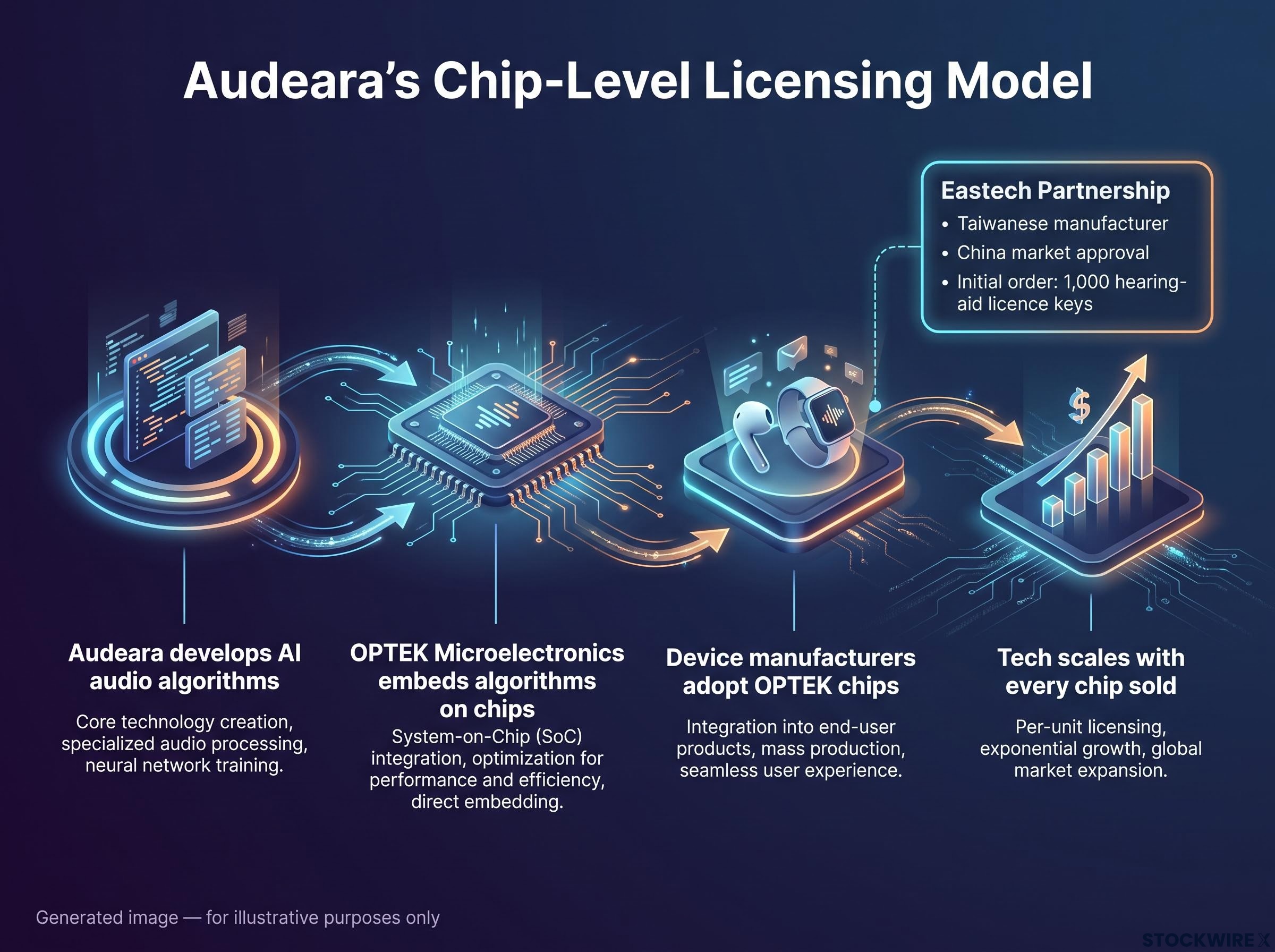
Separately, Audeara has an arrangement with Eastech, a Taiwanese manufacturer that holds regulatory certification for hearing-aid sales in China. Under that arrangement, Eastech has taken a licence to Audeara’s technology for hearing aids approved for the Chinese market, giving Audeara access to a regulatory pathway in that geography without needing to obtain the approvals independently.
According to Audeara ASX announcements, Eastech placed an initial order of 1,000 hearing-aid licence keys, marking the programme’s move from development into early commercialisation.
The OPTEK and Eastech agreements tell you that Audeara’s technology is already embedded in semiconductor and manufacturing supply chains in two different regions. That is a different kind of early traction than a company with a product but no partners. It remains early-stage evidence rather than proven revenue at volume, and an initial order is commercial proof of concept, not proof of scale.
If the licensing model scales as intended, revenue can grow across large device volumes carried by partners’ factories and brands, without Audeara replicating the full cost structure of a device manufacturer. Understanding those mechanics matters before you assess whether the ASX valuation reflects the company’s actual position. These partnerships carry genuine commercial potential, but that potential remains unproven until repeat orders arrive and licence volumes demonstrate sustained growth.
What the valuation gap is, and what it is not telling you
Private-market valuations routinely compress when companies transition to public markets. The most instructive precedent for understanding why is Cloudera.
In May 2014, Intel invested in Cloudera at a valuation of approximately US$4.1 billion. When Cloudera listed publicly in April 2017, it opened at a valuation of approximately US$1.79 billion, roughly half the private-round valuation, according to CNBC reporting.
Category enthusiasm in private markets is real and can still compress sharply in public markets. The Fortell raise is genuinely useful information about the AI hearing technology category without being a reliable pricing template for any ASX-listed company in the same space.
Earnings quality divergence among ASX tech stocks became acutely visible during the sector’s 2025-2026 correction, when companies with demonstrated profitability and positive cash flow recovered materially faster than high-growth but unprofitable peers, a pattern directly relevant to how micro-cap licensing businesses are likely to be repriced as category signals emerge.
The structural differences between the two situations extend beyond valuation methodology. Comparing a US private venture-backed company with an ASX-listed micro-cap involves gaps in regulation, liquidity, investor base, and governance expectations that are not quantifiable in a simple ratio. Fortell’s approximately US$740 million valuation (Forbes, July 2026) is a category signal. Audeara’s sub-A$6 million ASX valuation reflects public-market pricing of a micro-cap with early-stage licensing revenue. The gap between those numbers is not a measure of mispricing; it is a measure of structural difference.
You also need to hold the following qualifications:
- Fortell’s fundraising and valuation figures are attributed to Forbes and have not been independently verified
- Audeara’s clinic reach and partnership figures are company-reported and have not been independently confirmed
- An initial order of 1,000 licence keys is not recurring revenue
- Micro-cap ASX shares carry significant volatility and risk of capital loss
- Cross-jurisdictional comparisons between US private companies and Australian micro-caps involve structural gaps not fully captured in any single analysis
Audeara’s clinic reach, OPTEK agreement, and Eastech initial order are early-stage indicators rather than demonstrated revenue scale. Whether these partnerships translate into sustained commercial outcomes depends entirely on execution, specifically on whether agreements convert into follow-on orders and expanding licence volumes over time.
Four indicators that would turn Audeara’s early positioning into a credible repricing story
You now understand the category, the company, the model, and the caveats. Here are four specific, observable things that would confirm the thesis is converting from positioning into commercial reality:
- Eastech repeat orders: Whether the initial 1,000 licence-key order (Audeara ASX announcements) leads to follow-on volume is the most immediate signal that the Chinese-market licensing programme has commercial traction beyond proof of concept
- OPTEK deployment evidence: Evidence of device manufacturers actively integrating Audeara’s algorithms via the OPTEK chip platform would confirm that the semiconductor licensing pathway is generating downstream adoption, not just a signed agreement
- Licensing revenue trajectory: Measurable growth in licensing revenue across reporting periods in Audeara’s ASX filings would demonstrate that the model is producing financial results, not just partnerships
- New partnership agreements: Additional semiconductor, manufacturer, or distribution agreements that extend the licensing model’s geographic or product reach would signal that the category interest validated by the Fortell raise is translating into commercial demand for Audeara’s specific technology
Beyond the hearing-aid and semiconductor channels, a bone conduction distribution deal secured exclusive Australian rights to ShokzHear technology targeting an estimated 600,000 school-aged children with functional listening challenges, with deployment funded through pre-existing government and charitable programs rather than direct consumer acquisition.
If you are assessing Audeara’s financial readiness, consult ASX filings directly for current revenue figures, gross margin, cash balance, and runway. These figures are necessary context that this article does not provide.
ASX continuous disclosure obligations, set out in ASX Listing Rules Guidance Note 8, require listed entities to immediately announce material contracts and partnership developments that could reasonably influence investor decisions, which is why ASX filings are the most reliable primary source for verifying company-reported partnership and licensing figures.
All forward-looking statements about licensing revenue and partnership outcomes are speculative. The Fortell raise did not create Audeara’s thesis. It made the thesis easier to explain to a market that previously lacked a reference point for what real-time AI speech enhancement is worth.
When the category catches up to the signal
A major offshore raise has repriced the AI hearing technology category in private markets. That repricing has not yet flowed through to ASX-listed companies addressing the same problem. Whether it does depends on execution milestones that are observable and specific, not on the offshore signal alone.
For niche ASX tech stocks broadly, category signals from offshore private markets are most useful when they validate a technology thesis that a local listed company has been pursuing for years without an external reference point. They are least useful when treated as direct valuation comparisons. The framework applies well beyond hearing technology: identify the category that public markets have not priced, monitor for the offshore event that reprices it, then assess the local company against distribution readiness, partnership traction, and execution risk rather than against the headline number.
For readers wanting to apply a structured framework to identifying technology companies before analyst coverage catches up, our dedicated guide to reading early adoption signals examines how developer and enterprise adoption patterns precede price moves by one to two stages, with concrete tools for building a watchlist from technology usage data.
This article is for informational purposes only and does not constitute financial advice or a recommendation to buy or sell any security. Figures relating to Fortell’s raise and valuation are sourced from Forbes (July 2026) and have not been independently confirmed. Audeara’s clinic network, partnership details, and licence-key order volumes are drawn from company reporting and have not been independently verified. Agreements at an early stage do not constitute recurring revenue. Investments in ASX micro-cap companies involve meaningful volatility and a real possibility of losing capital. Investors should conduct their own research and consult with financial professionals before making investment decisions.