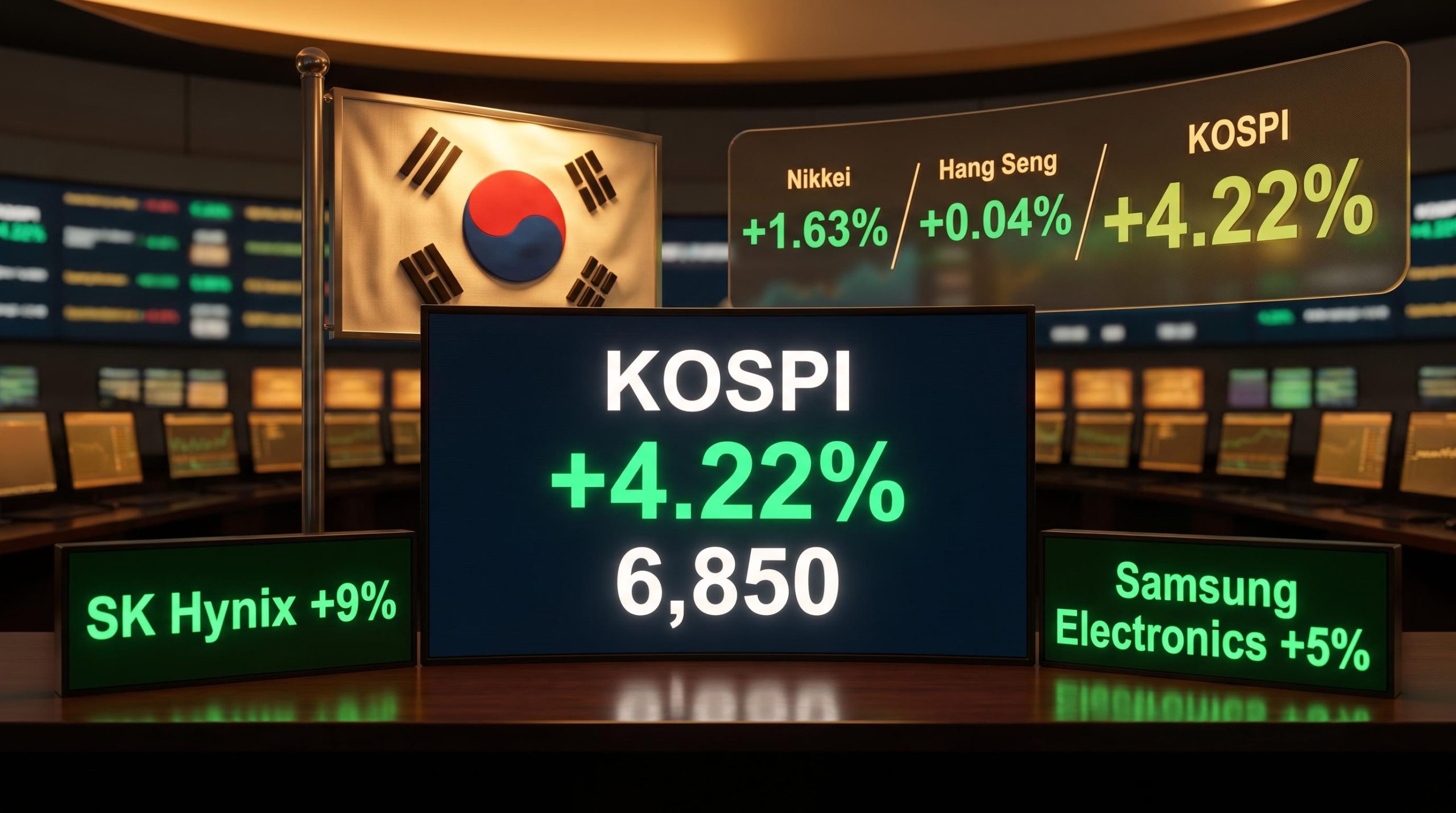
South Korea’s benchmark KOSPI surged 4.22% on 13 August 2026, trading above 6,850 on a day when most of Asia barely moved. Two names explain almost all of it: SK Hynix and Samsung Electronics.
This was not a broad risk-on session. Two sovereign wealth fund reports, a memory chip cycle inflection, and easing U.S. inflation data converged in a single August trading day to push the South Korea stock market to levels not seen in over two weeks. Korea has been the most direct equity proxy for AI infrastructure demand in global public markets this year, and today’s move is either a confirmation of that thesis or another chapter in one of 2026’s most volatile market stories.
Here is what today’s session tells you about the AI memory cycle, what sovereign wealth fund interest actually signals for long-term positioning, and whether Korea’s dramatic swings are a feature of this market or a warning about it.
The numbers behind the session
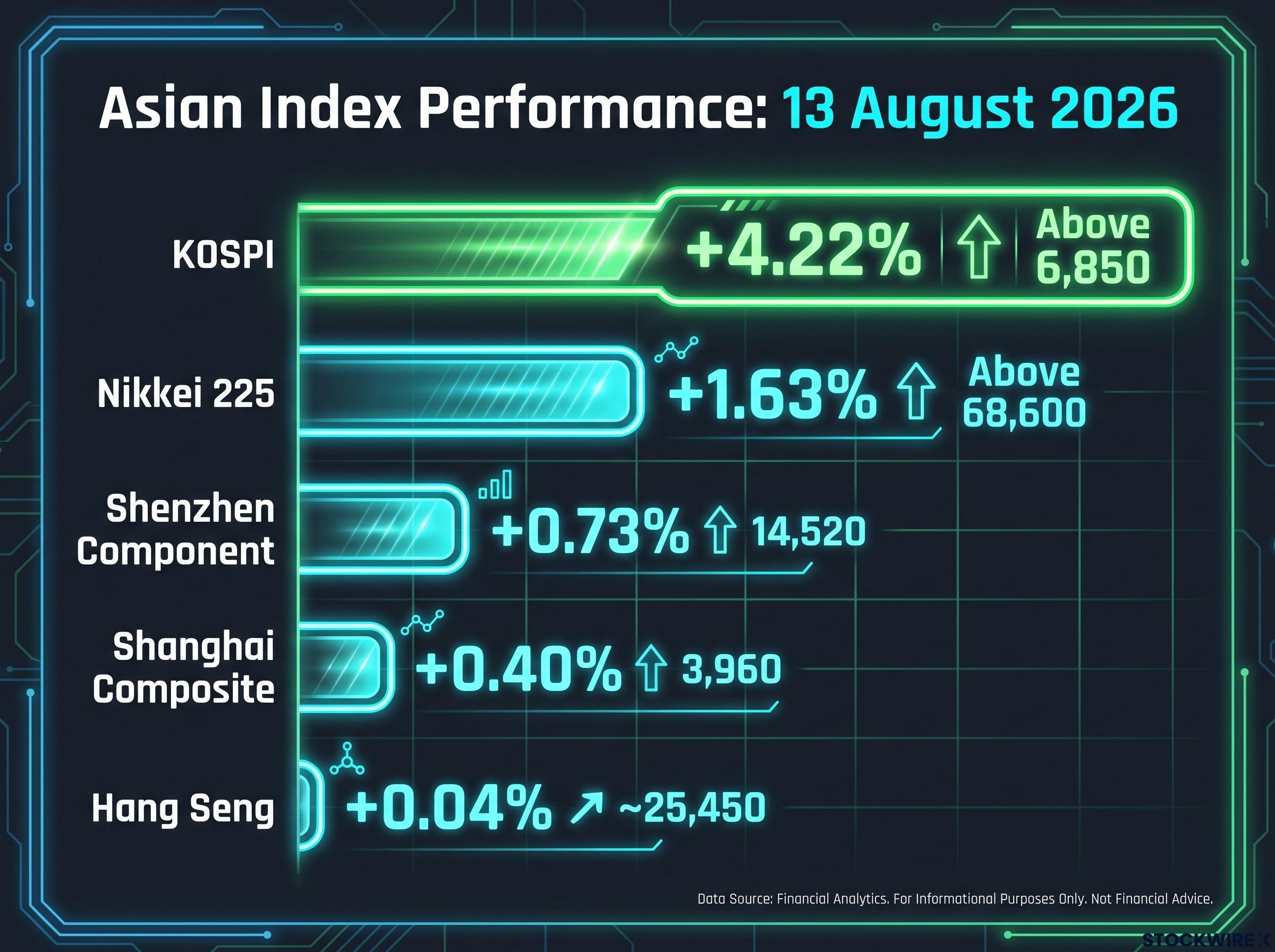
The KOSPI’s 4.22% advance reclaimed the 6,800 level for the first time in roughly 15 sessions. That alone would be notable. Set it against what the rest of Asia did on the same day, and the story sharpens considerably.
| Index | Move (%) | Level |
|---|---|---|
| KOSPI | +4.22% | Above 6,850 |
| Nikkei 225 | +1.63% | Above 68,600 |
| Shanghai Composite | +0.40% | 3,960 |
| Shenzhen Component | +0.73% | 14,520 |
| Hang Seng | +0.04% | ~25,450 |
Hong Kong gained 0.04%. Korea gained 4.22%. That gap tells you this was not a regional rising tide. It was a targeted re-rating of Korea’s specific positioning in the AI supply chain.
The macro backdrop helped set the table: slowing U.S. consumer price inflation eased rate-hike concerns, overnight strength in U.S. technology stocks carried into Asian hours, and solid results from major U.S. technology companies gave investors renewed assurance that capital commitments to AI hardware are holding firm.
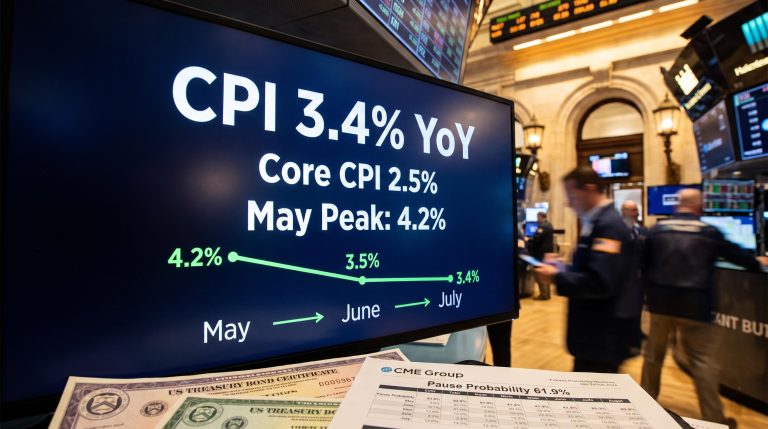
July 2026 U.S. CPI data showed headline inflation edging up just 0.1% month-on-month with the annual rate slowing to 3.4%, a reading soft enough to ease rate-hike concerns and lift risk appetite across U.S. technology equities before Asian markets opened.
BNY analyst Wee Khoon Chong noted that technology-sector capital flows were adding further momentum to the broader improvement in regional risk appetite, with reports of sovereign wealth fund interest in South Korean chipmakers lending institutional credibility to the market’s recent recovery.
When big ASX news breaks, our subscribers know first
SK Hynix and Samsung: how two stocks moved an entire index
The KOSPI’s headline number looks like a broad rally. It was not. SK Hynix jumped more than 9% and Samsung Electronics gained approximately 5%, and because both companies carry outsized weight in the KOSPI, their combined strength mathematically explains most of the index’s move. This is not a weakness in the rally’s construction; it is a signal that markets are making a precise bet on AI memory demand, not a broad bet on Korea’s economy.
KOSPI index weighting mechanics mean that Samsung Electronics and SK Hynix together have represented well over 40% of the benchmark’s total market capitalisation, a structural feature that transforms any sell-off in either name into a broad market event through passive ETF redemption mechanics that operate independently of fundamentals.
SK Hynix and the HBM trade
SK Hynix is concentrated in high-bandwidth memory (HBM), the specialised memory chips required in AI accelerator hardware, and high-performance DRAM. These are not optional components in AI computing stacks; they are bottleneck inputs. That production concentration gives SK Hynix outsized leverage to every dollar of AI capital expenditure globally.
Citi’s HBM demand outlook projects a 434% surge in system-level capacity requirements as AI infrastructure scales out, with per-chip memory rising 3.6x across successive GPU generations, making both supply vectors additive tailwinds that compound the case for Korean memory producers.
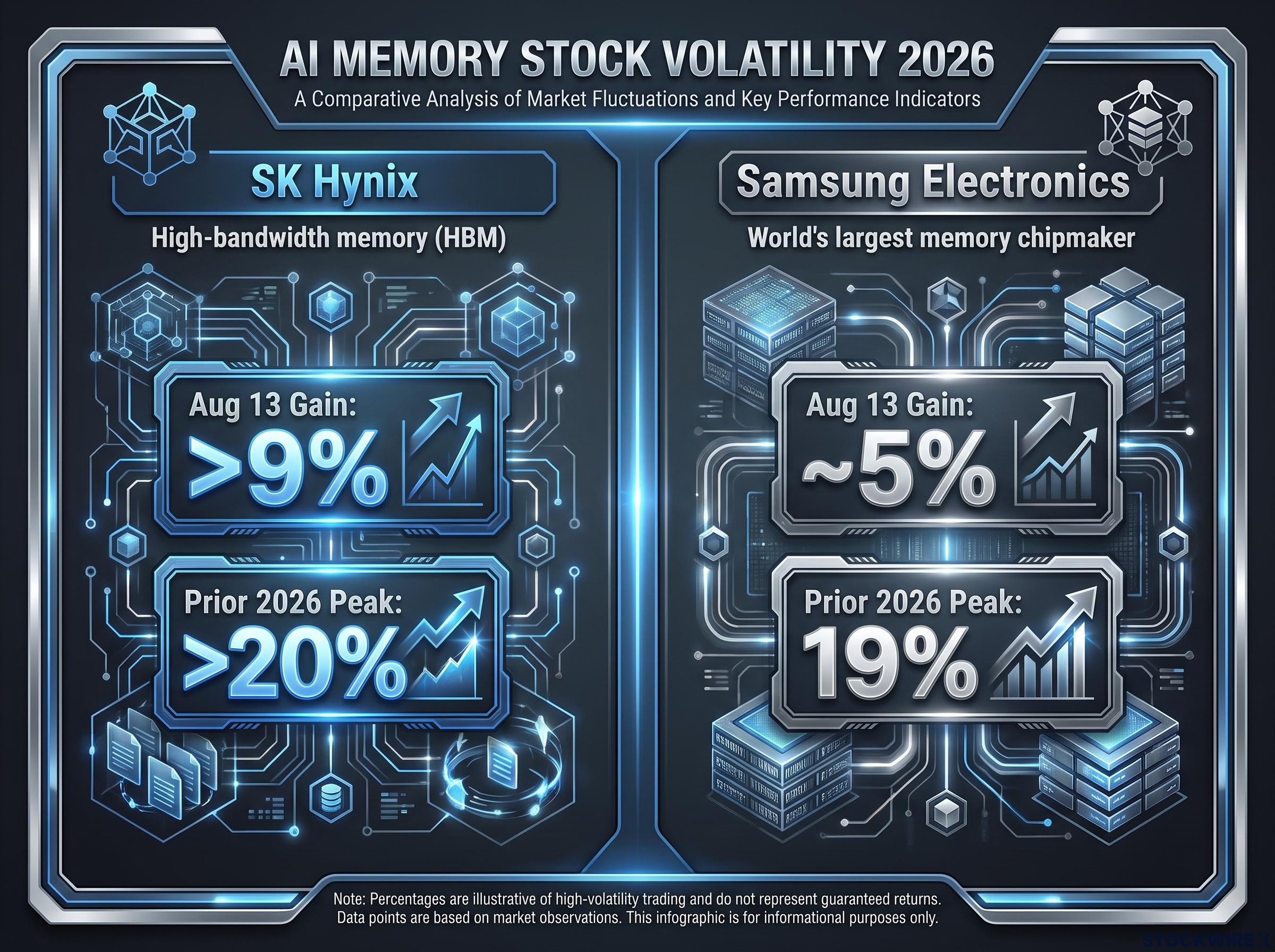
- Today’s gain: more than 9%
- Notable prior 2026 session peak: above 20% in an earlier AI-driven rally
Samsung’s broader footprint and today’s catalyst
Samsung Electronics is the world’s largest memory chipmaker by revenue, with a dual role spanning both logic and memory semiconductors. Today’s gain was driven by expectations of sustained AI-related demand alongside speculation about Temasek Holdings potentially increasing its direct stake.
- Today’s gain: approximately 5%
- Notable prior 2026 single-day AI rally gain: 19%
For any investor tracking AI infrastructure spending through equities, these two companies are the most direct hardware-level exposure available in public markets, which is why their moves command attention well beyond Korea’s borders.
How to read a sovereign wealth fund signal
Reports that Singapore’s Temasek Holdings is considering direct investments in Samsung Electronics and SK Hynix added fuel to today’s session. Both stocks extended gains after the report surfaced. But understanding why this matters requires understanding how sovereign wealth funds (SWFs) operate, and why their interest carries a different informational weight than a typical analyst upgrade.
A sovereign wealth fund is a state-owned investment vehicle that manages national capital. What distinguishes SWF behaviour from other institutional investors comes down to three characteristics:
- Investment horizon: SWFs invest over decades, not quarters. A position taken today may be held for ten or twenty years.
- Due diligence depth: Before deploying capital, SWFs conduct rigorous internal analysis that often takes months. A report that one is “considering” a position means the research is already well advanced.
- Structural conviction: SWF interest signals a belief in a durable industry advantage, not a cyclical trade. They are not chasing momentum; they are positioning for where the world will be in 2035.
Temasek had previously invested in both Samsung and SK Hynix more than two years ago. The new report concerns potential additional direct investments via its internal team. Specific transaction details or sizes remain unconfirmed as of today.
Even without a confirmed deal, the fact that a long-horizon state fund is conducting due diligence on Korean memory names tells you that at least one of the world’s most sophisticated institutional investors believes the AI memory cycle has years, not quarters, of runway ahead.
Korea’s market as the clearest AI infrastructure trade in Asia
Today’s session fits a thesis that has been building across all of 2026. Memory chips, specifically DRAM and HBM, are foundational inputs for AI computing. Every AI model, every training run, every inference workload runs through memory hardware. Korea dominates global supply of both.
That gives the KOSPI a structurally distinct investment profile. Where software-centric AI bets require you to assess competitive moats, platform lock-in, and adoption curves that remain speculative, Korea’s hardware exposure offers something different:
- Revenue linkage clarity: Memory revenue is directly measurable against rising AI workloads. When AI capex increases, memory shipments increase.
- Competitive moat measurability: Samsung and SK Hynix’s combined share of global memory supply is a verifiable market position, not a forward projection.
- Exposure to AI capex, not AI adoption: You are betting on infrastructure spending, which is already happening, rather than downstream application revenue, which is still proving out.
DRAM supply constraints have become structurally self-reinforcing: SK Hynix projects the shortage persisting through 2030, HBM inventory sits at just 3-4 weeks industry-wide, and all three major producers are fully sold out through 2026, a supply configuration that no amount of capital expenditure can resolve before 2027-2028.
Technology equity flows bounced back in August after July’s sharp correction, with U.S. technology companies posting results that gave markets fresh conviction around the durability of AI infrastructure spending. For a global investor who wants exposure to AI infrastructure spending without betting on which software platform wins, the Korean memory complex offers a fundamentally different kind of thesis: all roads to AI compute run through memory, regardless of who wins the application layer.
The volatility context investors cannot ignore
The same forces driving today’s gains have also produced sharp losses this year. At the end of July 2026, the KOSPI posted a 13% single-day jump driven by surging chip stocks. Within weeks, the index reversed roughly 5% as funds rotated and leveraged ETF flows amplified the selloff.
Three structural factors explain why this volatility is likely to persist:
- Concentrated index weighting: When two stocks dominate an index, their idiosyncratic moves, earnings surprises, and sentiment shifts become index-level events. Diversification within the benchmark is limited.
- Foreign institutional profit-taking: Non-Korean investors have repeatedly booked gains in Samsung and SK Hynix after sharp rallies, creating abrupt reversals that domestic flows cannot always absorb.
- Leveraged ETF flow amplification: Regulations on leveraged products and the mechanics of daily-rebalancing ETFs mean that sharp moves in either direction attract momentum flows that make the next day’s move larger, not smaller.
Analysts have characterised today’s 4.22% advance as a combination of bargain hunting after July’s plunge, renewed AI optimism, and supportive global macro data. That framing matters. This is a recovery session within a volatile pattern, not standalone bullish momentum.
A market that produced a 13% single-day gain and then a 5% reversal within the same month is not simply an AI trade. It is a high-conviction, high-volatility market structure that demands position-sizing discipline regardless of the underlying thesis.
Position-sizing discipline in chip stocks is not a passive default; Jefferies has documented that reactive trading decisions made during volatile stretches negatively affect returns measured weeks later, making pre-committed rules an operational necessity for Samsung and SK Hynix holders facing a market that produced a 13% single-day gain and a 5% reversal within the same month.
What the August 13 session changes, and what it does not
Today’s move confirms two things and leaves several questions open.
What today confirms:
- The structural AI memory demand thesis remains intact, validated by stock-level gains in the two companies most directly exposed to AI hardware spending
- Institutional interest from long-horizon sovereign capital is building around Korean chipmakers, adding a layer of validation beyond analyst upgrades
- The KOSPI reclaimed the 6,800 level for the first time in 15 sessions, reversing a meaningful portion of July’s correction
What remains unresolved:
- No confirmed Temasek transaction details or investment sizes have been disclosed
- The KOSPI remains below its 2026 peak levels; today’s gain is a recovery, not a new high
- The volatility structure has not changed: the same concentrated weighting and flow dynamics that produced today’s gain can reverse it within days
Today’s session does not resolve the tension between the structural AI bull case for Korean memory and the high-volatility trading environment. It confirms the former while doing nothing to reduce the latter. Your decision on whether to act should hinge on that distinction.
This article is for informational purposes only and should not be considered financial advice. Investors should conduct their own research and consult with financial professionals before making investment decisions. Past performance does not guarantee future results.