
The Trump administration is actively floating capital gains tax relief for investors, but the gap between the promise and the policy is wide. No bill has been written. The federal deficit sits at $1.8 trillion. A Supreme Court ruling earlier in 2026 overturned the majority of Trump’s tariffs, obliging the administration to return those collected revenues and squeezing the fiscal headroom available for additional tax relief.
These proposals are not arriving in a policy vacuum. They are arriving in a midterm election campaign. National Economic Council director Kevin Hassett told Fox Business that Republicans intend to lay out what they could achieve with stronger congressional numbers, with a steady stream of policy rollouts planned through to November 2026. What gets promised in a campaign and what gets enacted are two distinct events with very different timelines.
Here is what the proposals actually contain, what is standing in their way, and the one question every investor needs to answer before adjusting anything: is this current law, or is it a campaign pledge?
Three ideas on the table, and how far along each one actually is
The Trump capital gains tax proposals are not a single legislative package. They are three separate ideas at different stages of development, with different legal pathways and different beneficiaries.
- Larry Kudlow reported that he had recently raised the topic of inflation-indexing of capital gains with Trump during a conversation, and that the president indicated a strong interest in pursuing it
- Senators Ted Cruz and Tim Scott formally urged Treasury Secretary Scott Bessent in March 2026 to implement indexing via regulation rather than legislation
- Kevin Hassett indicated on Fox Business that voters should expect a series of policy announcements to follow in the months leading up to the November 2026 midterms
- Kudlow has specifically floated an exemption for homes sold for $2 million or less
No drafted legislative text exists for any of the three proposals. That is not a technicality. It is the single most important fact separating a campaign pledge from a policy you need to act on.
| Proposal | Current law | What would change | Legislative status |
|---|---|---|---|
| Inflation-indexing of capital gains | Taxable gain = sale price minus original cost basis (nominal, no inflation adjustment) | Cost basis adjusted for inflation, reducing taxable portion of nominal gains | No bill introduced; Cruz and Scott urging Treasury to act via regulation |
| Expanded home-sale exemptions | $250,000 exclusion (single) / $500,000 (married filing jointly) | Possible exemption for homes sold at $2 million or below | No bill introduced; no legislative text defining thresholds or eligibility |
| Top rate reduction | 20% top long-term capital gains rate | Potential cut from 20% to 15% | Floated by Trump in prior tax discussions; no current legislative action |
When big ASX news breaks, our subscribers know first
What inflation-indexing actually means for your gains
Under current law, your taxable capital gain equals the sale price of an asset minus what you originally paid for it. There is no adjustment for inflation. If you bought shares for $50,000 fifteen years ago and sell them for $150,000 today, you owe tax on the full $100,000 gain, even though a significant portion of that nominal increase simply reflects the declining purchasing power of the dollar.
Inflation-indexing would adjust your original cost basis upward to reflect cumulative inflation over the holding period. The longer you held the asset, the larger the adjustment, and the smaller the taxable gain. That makes the biggest difference for investors holding highly appreciated equities, real estate, or closely held businesses in taxable brokerage accounts over many years.
The Committee for a Responsible Federal Budget estimates that inflation-indexing capital gains could add up to $1 trillion to the national debt over a decade.
The distributional picture matters. The Institute on Taxation and Economic Policy finds the benefits are heavily concentrated among the top 1% of households by income and wealth.
- Most affected: Investors with long-held, highly appreciated positions in taxable accounts
- Minimally affected: Tax-deferred account holders (401(k)s, IRAs), short-term traders, and investors whose gains are mostly recent
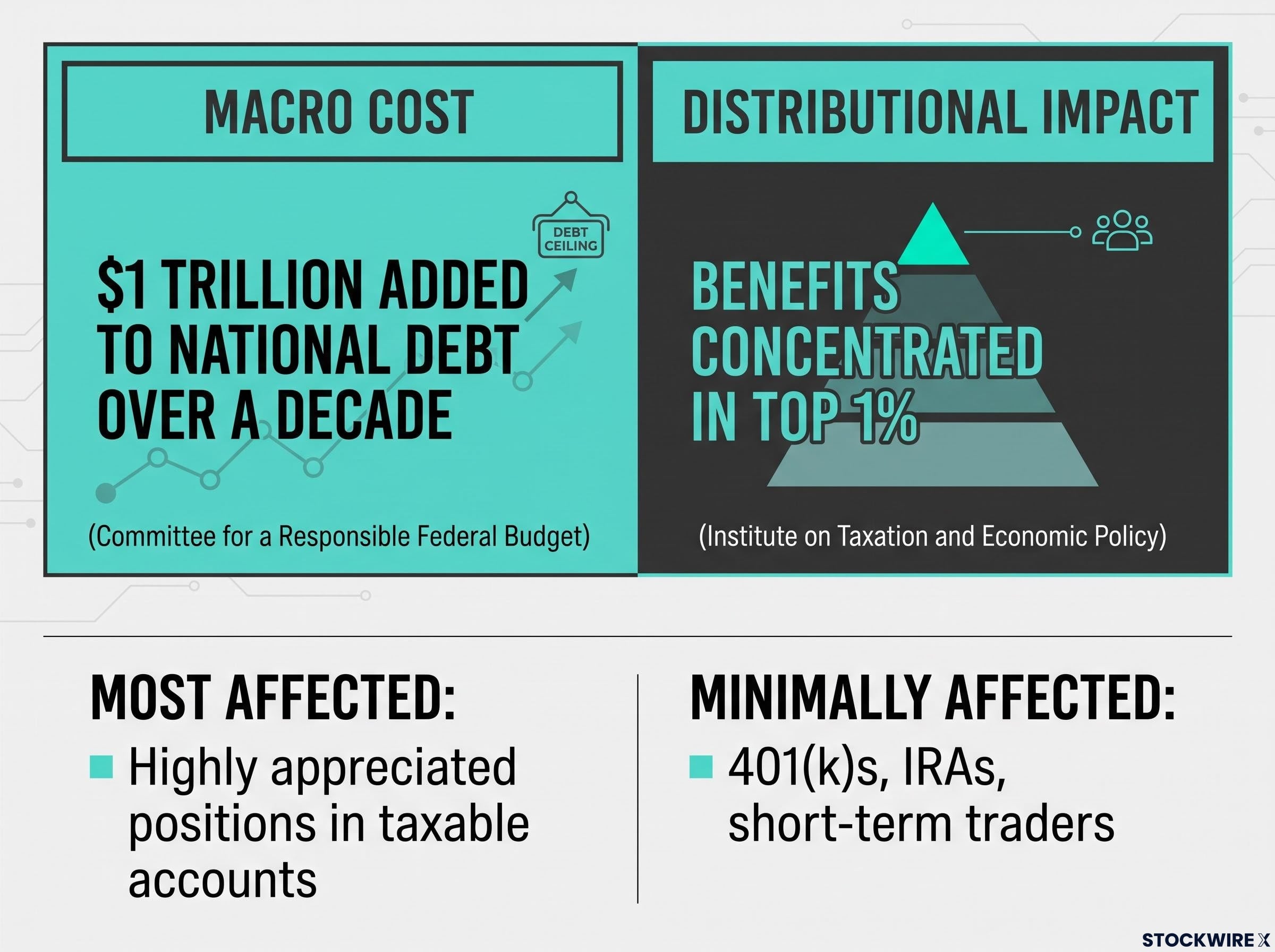
If your portfolio sits primarily in a 401(k) or IRA, inflation-indexing does nothing for you directly. The benefit is almost entirely concentrated among high-net-worth investors with large taxable brokerage positions held for many years.
Why Congress and the courts are the real bottleneck
Even if the political will exists, the legal and fiscal obstacles are substantial enough that investors should treat these proposals as structurally difficult rather than imminent.
Can Treasury act without Congress?
Senators Cruz and Scott have urged Treasury to implement indexing by redefining “cost” or “basis” in existing statutes through regulation, bypassing the need for new legislation entirely. The argument is that Treasury already has the authority to interpret these terms in inflation-adjusted terms.
Legal scholars and the Institute on Taxation and Economic Policy describe this path as legally dubious, arguing that existing statutory language and precedent treat “cost” as nominal. A regulatory move would likely face immediate litigation, adding another layer of uncertainty before any investor would see a change on their tax bill.
The fiscal math that complicates congressional action
According to the Congressional Budget Office, the federal fiscal deficit stood at roughly $1.8 trillion across the first ten months of fiscal year 2026. Adding to that pressure, the Supreme Court’s decision to strike down the bulk of Trump’s tariff measures earlier in 2026 required the administration to return revenues already collected, further straining the budget outlook.
The US fiscal deficit backdrop against which these proposals are being floated has drawn increasingly stark assessments from institutional analysts, with Piper Sandler, BlackRock, JPMorgan, and Bridgewater independently converging on reduced long-duration Treasury exposure as the structural response to a borrowing trajectory that neither political party has shown willingness to reverse.
Within the Republican caucus itself, there is a genuine split between pro-tax-cut members who frame indexing as pro-growth and deficit-focused legislators who are wary of backing a proposal that independent analysts estimate could cost $1 trillion over a decade without offsetting measures.
The three obstacles, ranked by weight:
- Legal authority questions around whether Treasury can act unilaterally, with near-certain litigation if it tries
- The $1.8 trillion deficit environment, which makes large revenue-losing tax changes politically costly for any legislator facing voters
- GOP internal fragmentation between growth-oriented and deficit-hawk factions, creating a floor-vote risk even in a favourable Senate
The deficit context is not abstract political noise. It is the concrete fiscal reason why even sympathetic Republican legislators have reason to pause.
What current capital gains rules actually say in 2026
After the noise of the proposals and the obstacles, here is the firm ground. These are the rules that govern your next investment decision today.
For the 2026 tax year, long-term capital gains (assets held longer than one year) are taxed at 0%, 15%, or 20%, depending on taxable income. Higher-income investors may also owe the 3.8% Net Investment Income Tax (NIIT), a surcharge that applies on top of the standard rate. Short-term gains (assets held one year or less) are taxed as ordinary income at your marginal rate.
The IRS Net Investment Income Tax rules set the 3.8% surcharge thresholds at $200,000 for single filers and $250,000 for married filing jointly, meaning higher-income investors holding appreciated positions in taxable accounts face a combined top federal rate of 23.8% on long-term gains under current law.
| Rate | Single filers | Married filing jointly |
|---|---|---|
| 0% | Up to approximately $47,025 | Up to approximately $94,050 |
| 15% | $47,026 to $518,900 | $94,051 to $583,750 |
| 20% | Above $518,900 | Above $583,750 |
The existing principal-residence exclusion shields $250,000 of gain for single filers and $500,000 for married couples filing jointly on the sale of a primary home.
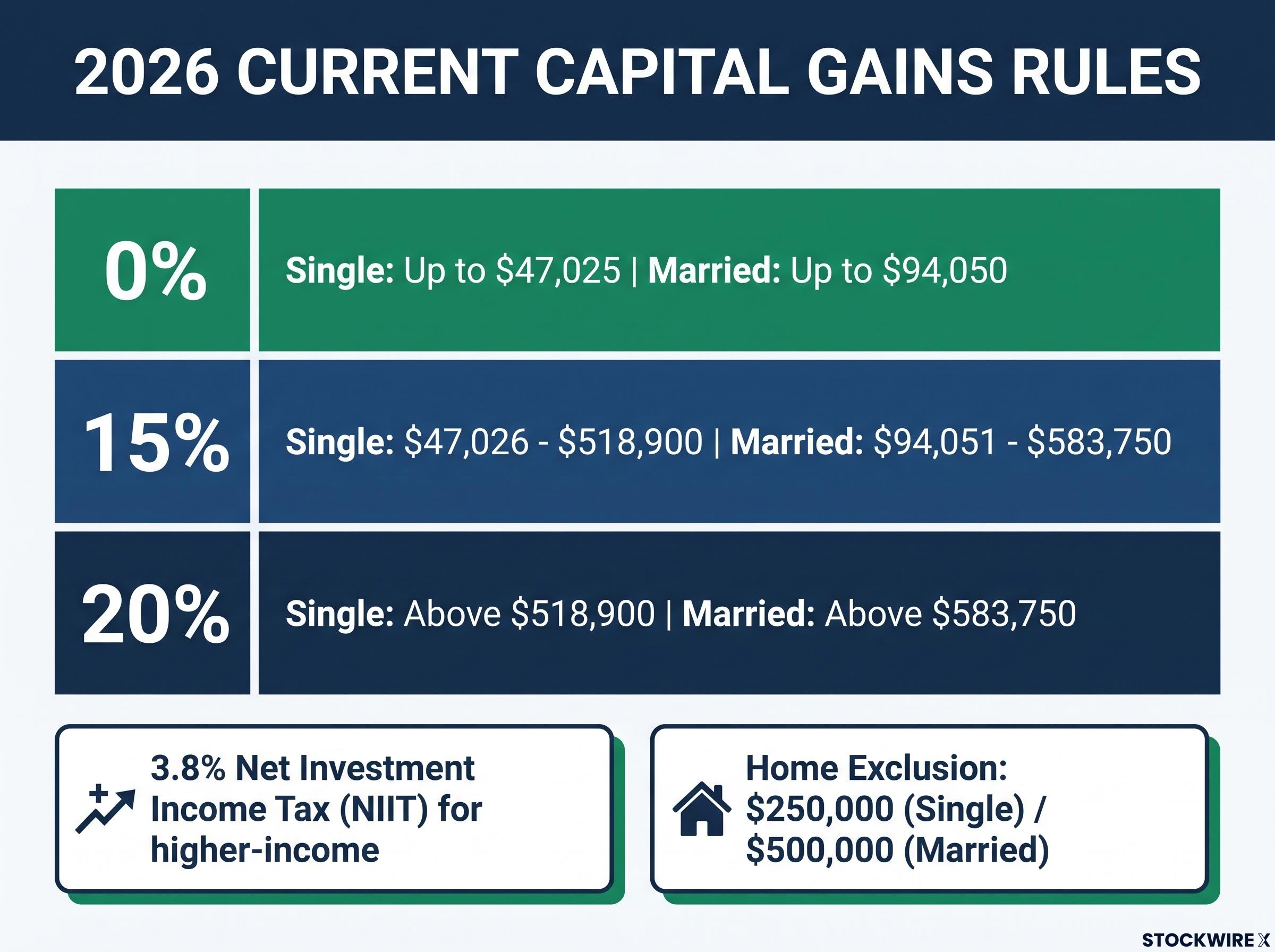
No Trump-specific capital gains changes have been enacted as of August 2026. The One Big Beautiful Bill Act (enacted July 2025) permanently extended the TCJA rate structure but did not alter capital gains rates, introduce indexing, or create new home-sale exemptions.
Every planning decision you make today, from timing an asset sale to evaluating a rebalancing move, should be anchored to this rate structure, not to proposals that have not cleared a committee.
What investors should and should not do while proposals remain speculative
The most expensive mistake an investor can make right now is restructuring their tax position around a proposal that may never become law, or may become law in a form quite different from what was promised.
The discipline of separating tax policy noise vs signal is one the current proposal environment tests directly: markets in South Korea, the Netherlands, and Australia each produced instructive cases in 2026 where announcement-stage rhetoric triggered outsized reactions that partially reversed as legislative substance failed to materialise.
Behaviours to avoid:
- Delaying planned asset sales solely on the assumption of future capital gains relief
- Accelerating or bunching transactions based on unlegislated tax cuts
- Abandoning current-law strategies like tax-loss harvesting in anticipation of changes that do not yet exist
What to do instead:
- Plan all capital gains recognition under the current 0%/15%/20% rate structure and NIIT rules
- Monitor introduced bills from the House Ways and Means Committee and the Senate Finance Committee, not campaign rhetoric, as the signal for genuine policy movement
- For homeowners, recognise that the existing $250,000/$500,000 exclusion already shields many primary-residence sales from federal capital gains tax; any new exemption’s relevance depends on details (home value cap, stacking versus replacement, state tax treatment) that do not yet exist in legislative form
- Integrate capital gains decisions with your broader income, estate, and charitable giving considerations
- Consult a qualified tax professional or financial adviser to ensure your strategy is optimised under existing law, with flexibility to adapt if genuine legislative changes materialise
This article is for informational purposes only and should not be considered financial advice. Investors should conduct their own research and consult with financial professionals before making investment decisions.
The midterm variable: how November could change the math
Kevin Hassett’s Fox Business appearance positioned these proposals as a preview of the Republican agenda, signalling what the party intends to pursue should it secure a stronger grip on Congress after November. The administration has signalled it does not expect detailed tax legislation to move before the election.
Speaking on Fox Business, Hassett made clear that further policy announcements would follow before November 2026, with GOP advisers viewing investors and homeowners as key voter groups that are receptive to tax-cut commitments.
Republican gains in the November 2026 midterms would improve the legislative environment for capital gains relief, while a flat or negative result would likely deprioritise these proposals in 2027. Even in a favourable outcome, the legislative calendar for 2027 would determine when any capital gains bill could realistically move through committee, pass both chambers, and be signed. That makes investor-relevant changes a 2027 or 2028 story at the earliest.
Beyond tax policy, midterm election market dynamics carry their own historical pattern: the S&P 500 has posted positive returns in the 12 months following every midterm election since 1950, a streak that institutional analysts argue is driven by uncertainty resolution rather than which party wins or what legislation follows.
The November midterm result is the next genuine decision node on these proposals. Everything between now and then is messaging, and you should weigh it accordingly.
What the election decides, and what you can do before it does
These proposals are real as political signals and as previews of a potential 2027 legislative agenda. They are not real as actionable tax changes for 2026. The distinction matters for every portfolio decision you make between now and November.
The broader capital gains policy landscape extends beyond rate cuts: the unrealized capital gains tax debate, which centers on Moore v. United States constitutional ambiguity and active state-level experimentation in California, represents the opposite directional pressure that a future administration could revive if today’s deficit trajectory makes revenue-expansion proposals politically viable.
Current law governs. Professional advice matters. Committee-level legislative activity, not campaign announcements, is the correct trigger for reassessing your position. The November midterms set the next stage, and investors who understand the timeline are positioned to respond to actual developments rather than react to rhetoric.
Past performance does not guarantee future results. These statements are speculative and subject to change based on market developments and legislative outcomes.