
Your ETHA position looked very different yesterday morning. The share count had shrunk to a third, the price had roughly tripled, and the options chain was quoting premiums that looked like bargains. Did anything about your investment change, or was your screen showing the same holding in different units?
BlackRock’s iShares Ethereum Trust (ETHA) began split-adjusted trading on 6 October 2026 after a one-for-three reverse split, with a record date of 5 October 2026. Every three shares you held became one.
That makes ETHA a clean, live case for understanding stock splits. The arithmetic is the same whether a split runs forward or in reverse, and this one happened this week.
Once you have worked through it, you will be able to look at any split and quickly sort what moved (share count, per-share price, option deliverable) from what stayed put (your total value and your proportional exposure).
What actually changes when a stock splits, and what the ETHA numbers show
You probably already know the forward version. A company’s shares run up, and management splits them so each one costs less.
ETHA ran that same logic backwards.
Forward versus reverse splits
A forward split raises the number of shares and lowers the price of each one by the same proportion. Companies often do this after a big rally, because some investors prefer lower-priced shares. In a two-for-one split, 100 shares at $300 become 200 shares at $150.
A reverse split combines existing shares into fewer, higher-priced ones. Low-priced stocks often use it to lift the share price and attract more trading interest. In a one-for-three reverse split, 300 shares at $100 become 100 shares at $300.
| Scenario | Before | After | Total value |
|---|---|---|---|
| Two-for-one forward split | 100 shares at $300 | 200 shares at $150 | $30,000 before and after |
| One-for-three reverse split | 300 shares at $100 | 100 shares at $300 | $30,000 before and after |
| ETHA (one-for-three) | Close near $20.43 | Reference price near $61.29 | Unchanged, apart from fractional cash-outs |
The ETHA timeline and numbers
The sponsor approved the split on 31 July 2026, and it was disclosed in a Form 8-K dated 4 August 2026. Split-adjusted trading started at the open on 6 October on Nasdaq. A CUSIP change, which is a new identifying code for the security, was confirmed in Nasdaq Trader notice ECA2026-713.
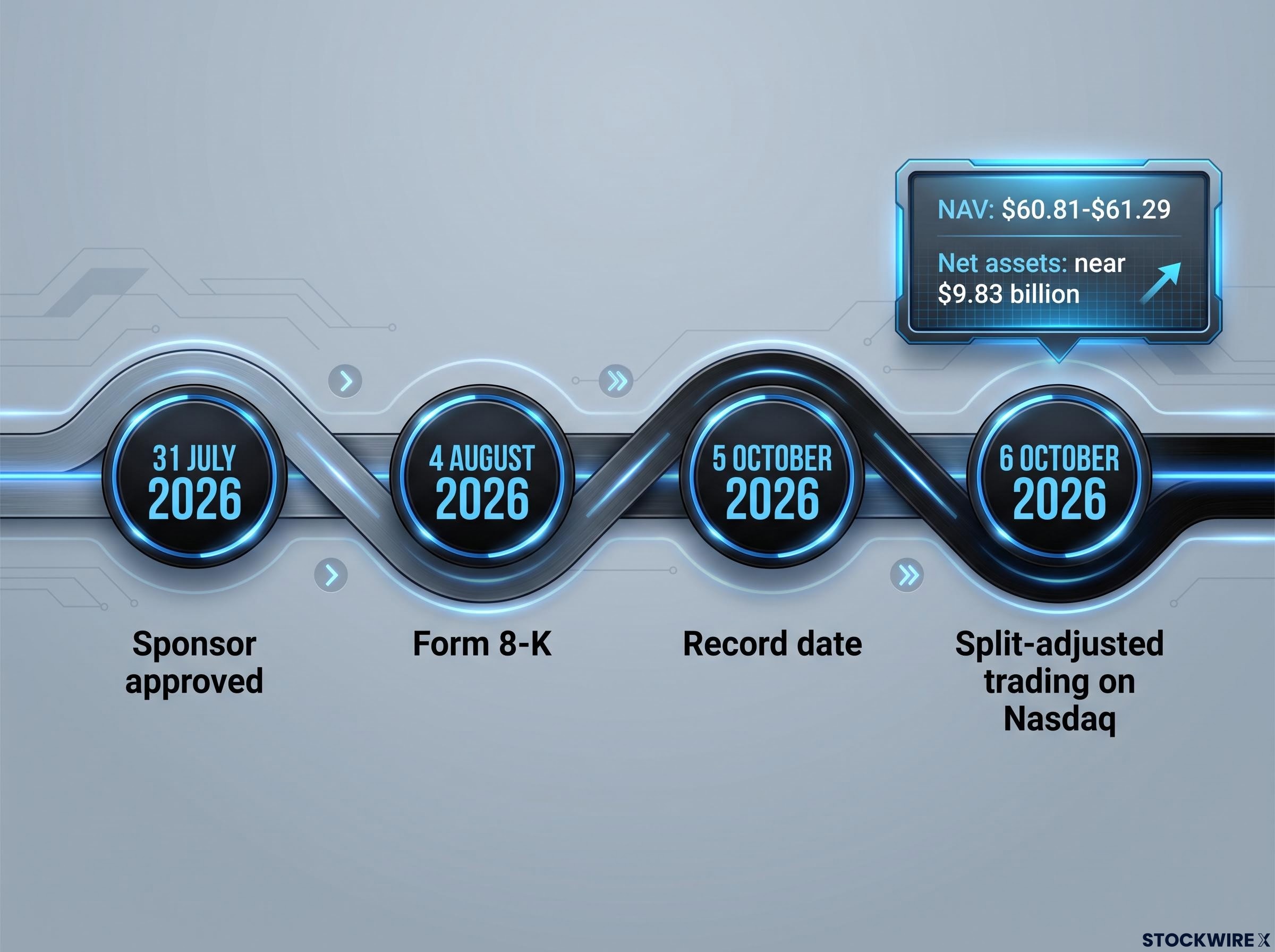
According to the iShares product page, NAV (net asset value, the per-share value of the trust’s holdings) sat at roughly $60.81-$61.29 on 6 October, with net assets near $9.83 billion. Your price chart will show no sudden jump, because historical prices are adjusted for the split.
That gives you the first check to run on any split: multiply your new shares by the new price. If the total matches your old position, the change was arithmetic.
When big ASX news breaks, our subscribers know first
Why a split cannot create or destroy value
The reason the totals match comes down to one invariant. When the share count changes, the price moves by the exact offsetting amount, so market capitalisation and the value of your holding stay where they were.
BlackRock spelled this out in the filing.
From the 8-K The split “will not change the total value of a shareholder’s investment or the aggregate value of the Trust’s assets.”
Here is how that breaks down for you:
- What changes: your share count, the price per share, the NAV per share, and the option deliverable
- What does not change: your total investment value, the trust’s ether holdings, and your proportional exposure to ether
A split is not share dilution, because every holder receives the same proportional adjustment, whereas new issuance for stock-based compensation or capital raising genuinely shrinks your ownership percentage.
If ETHA moves after the split, that is a separate market event. The split itself did not cause it.
Why do it at all? BlackRock gave no reason in its filing. The prospectus allows a split if the sponsor believes the price has drifted outside a desirable trading range. Bloomberg Senior ETF Analyst Eric Balchunas, as cited by CoinMarketCap Academy, reads it as a way to reduce the proportional bid-ask spread (the gap between buying and selling prices) that investors pay.
Fractional shares and tax
This is the one place a split touches real money. If you held 100 shares, you now hold about 33.33, and the 8-K states that no fractional shares will be issued. The 0.33 is redeemed and the cash goes to your brokerage account of record.
The filing warns that this payment “may have tax consequences.” Under general IRS guidance in Publication 550, cash in lieu of a fractional share is typically treated as proceeds from selling that fraction, which produces a small capital gain or loss. Broker-specific reporting details were not available, so check your own broker’s corporate-action notice.
Fund reverse splits versus operating-company reverse splits
You may have heard that reverse splits signal trouble. Academic research on operating companies has linked them with distress and later underperformance, although you should treat that as general commentary rather than a rule.
A physically backed spot-ether trust with about $9.83 billion in net assets is a different case. For you as a holder, the right response is bookkeeping, not panic or celebration.
Why ETHA options look cheap (and why that is not a bargain)
Open the ETHA options chain and the first reaction is tempting. The stock trades around $61, yet a 28-strike call is quoting near $4. That looks like a mispricing you could take advantage of.
It is not. The low price reflects how much each contract covers.
After the split, the Options Clearing Corporation (OCC), the body that clears US-listed options, changed the affected symbols. ETHA became ETHA1, 2ETHA became 2ETHA1, and 4ETHA became 4ETHA1, effective with split-adjusted trading on 6 October 2026. These are now non-standard contracts, meaning their terms differ from the usual template.
A standard US equity option delivers 100 shares. According to the OCC memorandum, as described in EBC Financial Group’s coverage, each adjusted ETHA contract delivers about 33 shares, with cash in lieu of any fraction. Strikes were not changed in this case. Share positions shrank mechanically, for example 300 to 100 and 90 to 30.
| Feature | Standard contract | Adjusted ETHA1 contract | What it means |
|---|---|---|---|
| Shares delivered | 100 | About 33 | Each contract controls roughly a third of the exposure |
| Strike price | Standard | Unchanged in this case | Do not assume strikes moved by the split ratio |
| Symbol | ETHA | ETHA1 | A modified root flags non-standard terms |
| Quoted premium | Reflects 100 shares | Reflects about 33 shares | A lower quote is a unit change, not a discount |
Cheap premium, smaller contract: not a discount.
Market makers price these contracts on the smaller deliverable, so there is no free money waiting for you. The traps to watch for:
- Treating one contract as 100 shares when it covers about 33, which throws off your position size and risk
- Reading a low quote as a bargain when it only reflects a smaller deliverable
- Assuming the stock’s split ratio applies directly to the options without reading the official adjustment
- Overlooking liquidity, since adjusted series may carry wider spreads and thinner trading (this was not independently confirmed, so check it yourself)
Forward splits work differently. In cases such as NVIDIA and Apple, options were generally adjusted to keep 100-share deliverables, with strikes divided by the split ratio. The full OCC memo with ETHA’s exact formula was not accessible in research, so read the memorandum itself before you trade.
A low premium on an adjusted contract tells you about deliverable size and nothing about value. Size your positions on the shares you actually control.
What to check before you trade after a split
Understanding the mechanics only helps if it changes what you do at the order screen. Here is a routine you can run on your own account today:
- Confirm your new share count and price, and multiply them to check the total matches your pre-split value.
- Look for the fractional cash-in-lieu credit in your account.
- Read the OCC memorandum for the exact deliverable and strike on any adjusted option.
- Cross-check your broker’s corporate-action notice and the 8-K dated 4 August 2026.
- Recalculate position size and maximum loss using the true share count per contract.
- Contact broker support if you are unsure how to place orders in the affected products.
Reading unusual account figures
Odd-looking share counts, prices or option quotes do not by themselves mean your profit and loss has changed. If shares multiplied by price reconciles with your old total, less the small fractional payout, your position is intact.
The leftover effects are minor. One is the tax line from the cash-out. The other is perception, since a higher price tag can sway retail behaviour even though nothing underneath has moved.
Managing risk on adjusted options
Do not take on extra risk because a premium looks small. Ten adjusted contracts control about 330 shares, not 1,000, so build your hedge or exposure around that figure.
Check spreads before you trade and use limit orders if the market looks thin. As general context, leveraged and volatility products often reverse split as part of their lifecycle, and their risk comes from how those products are designed, not from the split. Verifying terms and resizing risk will protect you far more than any view on whether a split is bullish or bearish.
This article is for informational purposes only and should not be considered financial advice. Investors should conduct their own research and consult with financial professionals before making investment decisions. Tax treatment described here is general guidance only and may not apply to your circumstances.
Reading the next split without being fooled by the screen
Share count and price are labels. Total value and proportional exposure are what you own, and ETHA showed both sides clearly.
Three things changed: your share count, the per-share price, and the option deliverable. The trust’s ether holdings and your proportional exposure stayed the same.
Before the next split on any holding, read the notice, confirm the deliverable, and check the tax treatment of any cash-out. Then make your decision on fundamentals rather than the new price tag.