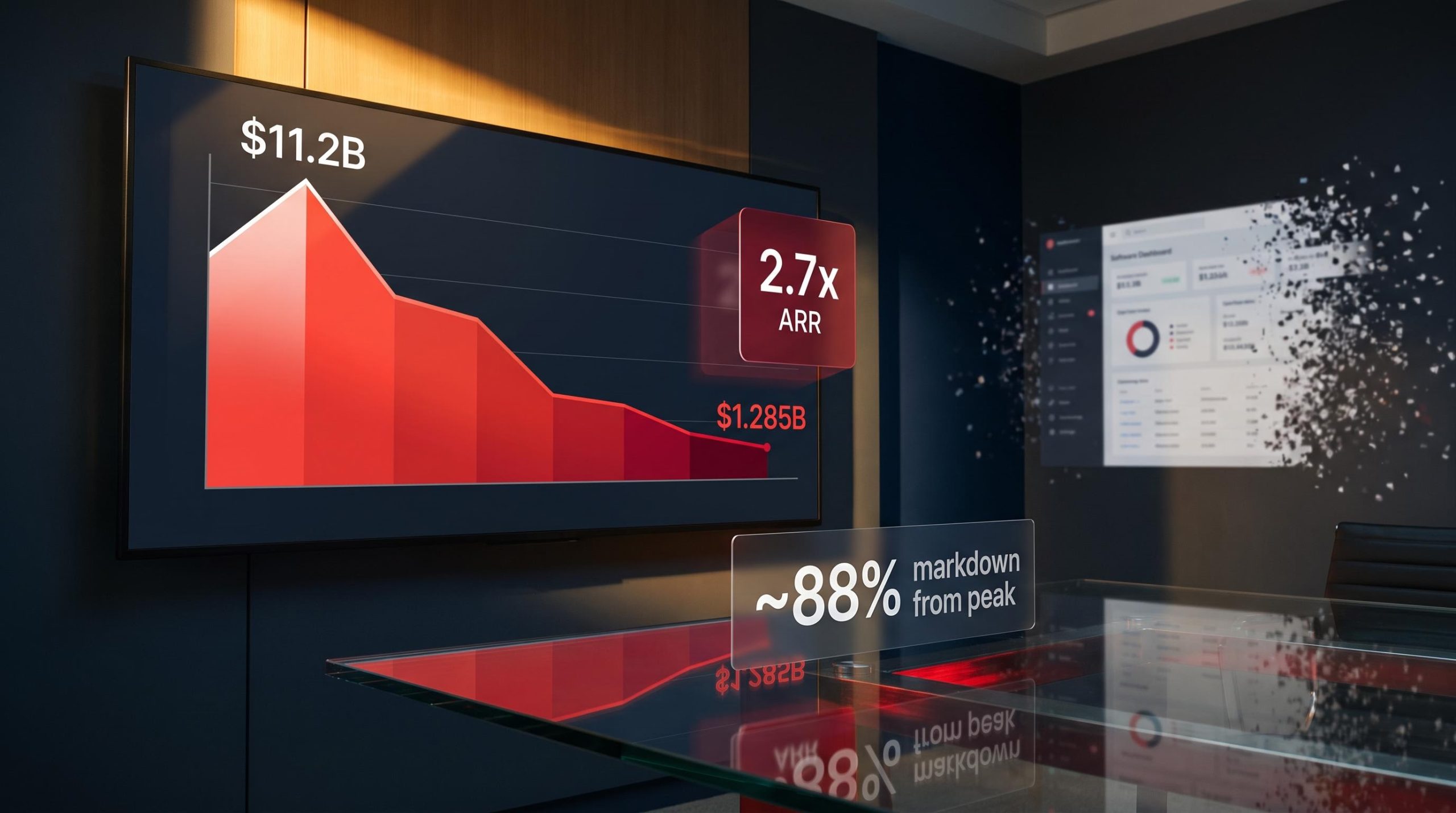
Airtable was valued at roughly $11 billion at its 2021 peak. Bending Spoons has now acquired it for an enterprise value of $1.285 billion. Every dollar of peak investor conviction has been reduced to approximately eleven cents.
One transaction has surfaced what two years of declining SaaS multiples only implied: certain software categories are not in a valuation cycle. They are in a structural unwinding. The AI-driven substitution of horizontal software tools is no longer a theoretical risk discussed on earnings calls; it has a price tag, and investors holding software ETFs or individual SaaS positions now face a categorisation problem that this deal has made impossible to defer.
The legacy software repricing that framed the early 2026 market environment involved approximately $2 trillion in wealth destruction concentrated in per-user licensing models, providing the macro backdrop against which the Airtable transaction should be read: the deal is not an idiosyncratic event but the most precisely priced data point yet in a repricing that was already well underway.
Here is a working framework for separating software companies that are structurally exposed to AI displacement from those whose regulatory entrenchment makes them largely immune, with Airtable as the clearest case study the market has yet produced.
What $1.285 billion actually reveals about Airtable’s collapse
Start with the enterprise value: $1.285 billion. Compare it to the peak valuation established in 2021, which most contemporaneous reporting puts in the $11-$11.2 billion range (some investor notes cite a figure as high as $11.7 billion). Dividing one by the other yields a recovery of roughly 11-12 cents on the dollar, with approximately $10 billion in enterprise value having been erased in the intervening years.
The “11 cents on the dollar” framing compares enterprise value at acquisition to peak valuation. When Airtable’s near-$1 billion cash position is factored in, total consideration rises to roughly $2.25 billion, which works out to somewhere between 19 and 20 cents on the dollar. Both figures represent a deeply damaging result for those who committed capital at the later funding rounds.
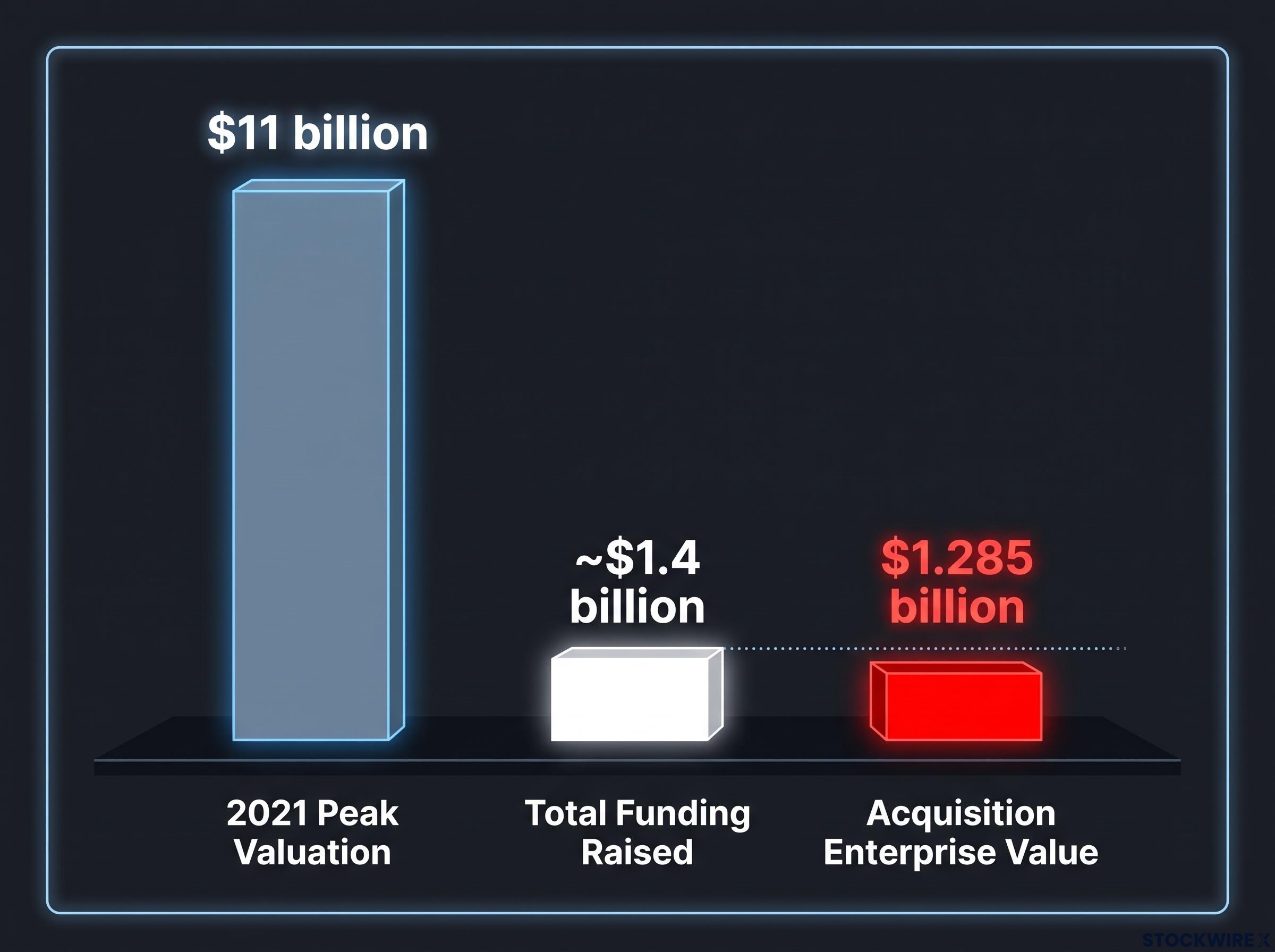
The equity figure softens the headline, but it does not change the investor arithmetic. Airtable raised approximately $1.4 billion in total funding. The enterprise value of this deal sits slightly below that total, meaning the company sold for less than it raised. Even the $2.25 billion equity value, while nominally clearing the funding threshold, likely just covers the preference stack, leaving common shareholders with a severe haircut.
The revenue multiple tells you what the market is actually pricing. With the company generating roughly $480 million in annual recurring revenue (ARR) and expanding at better than 20% year-over-year as of mid-2026, the transaction values it at approximately 2.7 times ARR. For a software business growing at that pace, a 2.7x multiple is not a growth discount. It is the market’s verdict that category demand is eroding, regardless of the top-line number. If you hold positions in structurally similar software companies, this multiple is now the reference point against which your holdings will be measured.
| Metric | Value | Significance |
|---|---|---|
| Peak valuation (2021) | $11-$11.2B | High-water mark set during no-code category expansion |
| Enterprise value at acquisition | $1.285B | 88-90% markdown from peak |
| Equity value at acquisition | ~$2.25B | Includes ~$1B cash; likely just clears preference stack |
| Revenue multiple | ~2.7x ARR | Market pricing category obsolescence, not growth deceleration |
| ARR (mid-2026) | ~$480M | Growing 20%+ YoY; growth rate did not prevent collapse |
| Total funding raised | ~$1.4B | Enterprise value fell below total capital invested |
When big ASX news breaks, our subscribers know first
How AI substitution mechanics undermine no-code platform value propositions
Understanding why Airtable collapsed requires understanding what no-code tools actually sold. The value proposition was specific: non-technical users could build workflows, lightweight applications, and database-driven processes without writing a single line of code. That bottleneck removal, the gap between what a business user needed and what required a developer to build, justified premium valuations across the entire no-code category during 2020-2021.
AI has targeted that same bottleneck, and it is removing it more completely. The substitution works in three stages:
- What no-code tools replaced: The need for a developer to build a custom workflow or application. Non-technical users could drag, drop, and configure instead of writing code.
- What AI now replaces instead: The need for any specific platform at all. AI coding assistants increasingly allow non-technical users to describe what they want in plain language and receive functional code or a working workflow directly, without the structural constraints of a particular no-code environment.
- What that means for platform stickiness: When the bottleneck a platform removes can itself be removed by AI, the platform’s moat disappears regardless of how many customers it has today. Users are no longer locked into one tool’s interface; they can generate alternatives on demand.
This is not a feature competition. It is a value-proposition replacement.
The enterprise build-versus-buy shift is already producing measurable licence cuts at named companies: Publicis Sapient reduced SaaS licences by approximately 50% in a single year by substituting AI tools, and Starbucks has publicly targeted $10 million in savings by building AI applications internally, confirming that Airtable is not an isolated case.
Reports from people with knowledge of the company’s operations indicate that quota attainment across Airtable’s sales organisation had fallen to around 30% in the period preceding the acquisition. That figure points beyond mere execution problems; it suggests the conventional enterprise sales motion was unable to deepen customer entrenchment before AI alternatives matured enough to slow new adoption.
The implication is directional and should be treated as an emerging thesis rather than a concluded empirical fact. But the direction is clear: if your portfolio includes horizontal SaaS positions whose core offering removes a technical bottleneck that AI can now remove instead, those positions carry the same structural exposure that priced Airtable at 2.7 times revenue.
The Bending Spoons playbook and what it signals about distressed SaaS
Bending Spoons is not the villain of this story. It is a rational actor whose entire business model only makes sense in a world where certain software assets have a predictable decay trajectory.
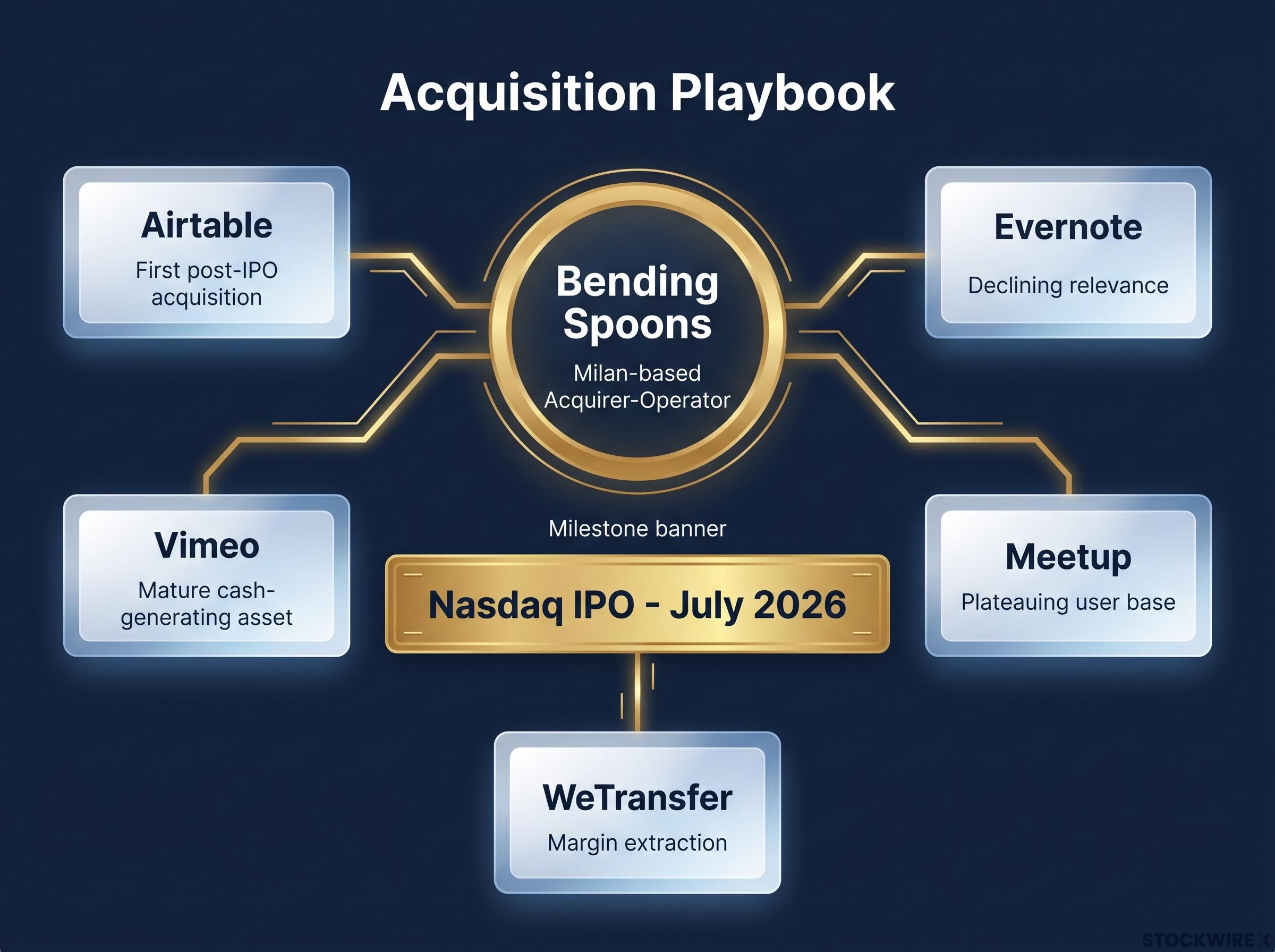
The Milan-based acquirer-operator completed its Nasdaq IPO in July 2026, making the Airtable deal its first post-IPO acquisition. Its portfolio tells you exactly what kind of buyer it is:
- Evernote: Once a dominant note-taking platform; acquired after years of declining relevance and user growth stagnation.
- Vimeo: A video hosting platform that struggled to compete with larger-scale alternatives; acquired as a mature cash-generating asset.
- Meetup: An events platform with a loyal but plateauing user base; acquired for its durable community revenue.
- WeTransfer: A file-sharing service with a simple, sticky product and limited growth ceiling; acquired for margin extraction.
The pattern is consistent. Bending Spoons acquires underperforming but viable software assets, implements aggressive cost discipline, and runs them lean to generate strong free cash flow. It is not a growth investor. It is a cash-harvesting operator.
What the deal economics look like if the playbook works
Analyst scenario modelling provides a window into the financial logic. If Bending Spoons retains approximately 80% of Airtable’s ARR (roughly $384 million) and operates at approximately 40% free-cash-flow margins, the deal implies a free-cash-flow multiple in the high-20s to low-30s range. These are conditional estimates under explicit assumptions, not disclosed Bending Spoons projections.
Even under that favourable scenario, the conclusion is the same: this is a cash-harvesting exit, not a growth investment. AI coding tools are broadly lowering the maintenance cost of legacy codebases, which likely improves the economics of this model further, though Bending Spoons has not publicly cited AI as a stated enabler of its Airtable strategy.
Paying 2.7 times revenue for a platform in evident structural decline is not a signal of category confidence from a disciplined acquirer-operator. It is a signal of confidence in cash extraction from a business whose growth narrative has run its course. When a buyer of this type becomes the destination for a once-celebrated unicorn, it tells you that both strategic acquirers and public markets have passed. That distinction in acquirer type is a leading indicator of category health, and one worth tracking whenever a comparable transaction surfaces in your software holdings.
Which software categories retain structural defensibility against AI
Not all software is Airtable. The distinction the market is drawing is precise, and it separates into three characteristics that determine whether a platform retains structural stickiness against AI substitution.
Compliance dependencies require certified systems of record. Regulated enterprises cannot simply swap their CRM or HR platform for an AI-generated substitute; the incumbent platform holds compliance certifications, maintains audit trails, and carries data governance obligations that would have to be reconstructed entirely from scratch if displaced.
Deep system integrations create switching costs measured in years, not months. Enterprise resource planning (ERP) platforms sit at the centre of interconnected architectures that span procurement, finance, HR, and supply chain; pulling one out would require renegotiating the dependencies across every adjacent system simultaneously, a task that takes years and considerable budget.
Regulatory obligations make ripping out an incumbent platform operationally and legally prohibitive. Salesforce is deeply embedded across U.S. federal government agencies and heavily regulated industries. SAP runs the financial backbone of a large share of the Fortune 500. Workday manages HR and payroll data subject to employment law compliance across multiple jurisdictions.
| Category | Representative Companies | AI Risk Level | Primary Defensibility Factor |
|---|---|---|---|
| Horizontal no-code/workflow | Airtable, similar platforms | High | None; bottleneck is directly replaceable by AI |
| CRM | Salesforce | Low | Compliance dependencies, government entrenchment |
| ERP | SAP | Low | Deep multi-system integration, financial backbone |
| HR platforms | Workday | Low | Regulatory obligations, payroll compliance |
| Data infrastructure | Snowflake | Beneficiary | AI workloads generate more data demand, not less |
Data infrastructure as a beneficiary, not a casualty
Data warehouses and lakehouses, the storage and processing layer that sits underneath AI and analytics workloads, sit on the opposite side of this equation. Large language models and AI-driven analytics do not replace data infrastructure; they create demand for it. Every AI workload generates data that requires storage, processing, and retrieval at scale. The more AI proliferates across enterprise workflows, the more data infrastructure is needed.
This makes the Snowflake category structurally different from the Airtable category. One is losing its reason to exist; the other is gaining customers from the same technology that is destroying its peer.
Systems of record defensibility rests on a dynamic the Airtable case makes concrete from the other direction: AI agents executing multi-step enterprise tasks depend on authoritative incumbent data sources, which means platforms like Salesforce and Workday are becoming infrastructure for AI deployment rather than targets for displacement, even as the horizontal no-code layer above them collapses.
What the market is pricing and where the mispricing risk still sits
Parts of the software market have already absorbed this re-rating. The iShares Expanded Tech-Software ETF (IGV), which tracks high-growth software companies, serves as a reference point for how broadly investors have repriced the sector. But the aggregate number disguises a composition problem.
Several prominent investors have explored variants of the “short SaaS, long semis” trade, betting that AI would compress software valuations while expanding semiconductor demand. The trade has proven difficult to execute cleanly, precisely because of the dispersion within SaaS between entrenched and vulnerable categories. Selling the category without discrimination means betting against Salesforce and Airtable simultaneously, yet those are fundamentally opposite wagers wearing the same sector label.
The mispricing risk that remains sits inside software ETFs that aggregate entrenched and exposed SaaS companies without distinguishing between them. Three specific risk vectors are worth examining:
- Direct holdings in no-code or horizontal workflow platforms, where the Airtable re-rating applies most directly.
- Software ETF exposure with an undifferentiated category mix, where a collapse in one holding can be masked by gains in a Salesforce-category position within the same fund.
- Pre-revenue or early-growth SaaS positions with horizontal positioning and no compliance moat, where the valuation has not yet been tested by an acquisition or down-round.
A software ETF that bundles entrenched systems of record alongside Airtable-category platforms does not provide genuinely diversified software exposure. What it provides is combined exposure to two demand trajectories that are moving in opposite directions, and the Airtable transaction has made the cost of conflating them too clear to continue ignoring.
The framework investors should apply before the next Airtable event
The analytical arc of this deal compresses into three questions you can apply to any software holding in your portfolio right now:
- Does the platform’s core value proposition remove a technical bottleneck that AI can now remove instead? If yes, the platform’s moat is dissolving. The no-code category existed because non-technical users could not write code. AI is eliminating that constraint directly.
- Does the platform carry compliance obligations or regulatory certifications that make switching operationally or legally prohibitive? If no, enterprise customers can evaluate alternatives on a normal procurement cycle rather than being locked in by regulatory inertia.
- Is the platform embedded in multi-system enterprise workflows where displacement would require renegotiating adjacent integrations? If no, the switching cost is measured in months, not years, and AI-generated alternatives can be tested in parallel without disrupting operations.
Applying the checklist to your current positions
Airtable fails all three tests. Its value proposition (building without code) is directly replaceable by AI. It carries no compliance certifications that lock in enterprise customers. Its integrations, while numerous, are horizontal and substitutable rather than deeply embedded in regulated workflows.
Salesforce and Workday pass all three. Their value sits in compliance dependencies, regulatory certifications, and deep system integrations that would take years and millions of dollars to displace. AI does not remove those barriers; if anything, it reinforces them by generating more data that flows through these systems of record.
The acquirer-operator signal adds a final filter. When a Bending Spoons-style buyer becomes the exit outcome for a software company, it is a lagging indicator that the market has already made its category determination. The growth story is over. The cash-harvesting phase has begun. If that type of acquirer is circling a company in your portfolio, the repricing has likely already started.
For investors wanting to translate the Airtable framework into a concrete portfolio weighting across hardware, cloud, and software layers, our dedicated guide to AI infrastructure allocation walks through a structured three-layer approach using Goldman Sachs capex projections and current valuation entry points for each segment.
What the Airtable deal changes for software investors going forward
The 2.7 times ARR multiple on a 20%-growth software business is no longer an isolated data point. It is now the market’s most precise public statement about what AI-exposed horizontal software is worth, and it will influence how investors, acquirers, and boards of other exposed SaaS companies think about exit timing and valuation.
Three forward-looking implications follow:
- 2.7 times ARR is the new reference multiple for AI-exposed horizontal SaaS. Any comparable company that has not yet been repriced is now being measured against this benchmark.
- The re-rating process is ongoing, not concluded. Airtable is the first high-visibility data point in what is likely a multi-year category unwinding, not the last.
- Institutionalised exit mechanisms mean the next events will move faster. Bending Spoons, now a publicly listed and well-capitalised acquirer following its Nasdaq debut, provides the market with a repeatable mechanism for absorbing and running down structurally exposed SaaS assets. The category’s decline is no longer an episodic phenomenon; it has an institutional home.
The question for investors is no longer whether AI will re-rate the no-code category. That question has been answered, and the answer has a price attached. The question now is which remaining platforms in the category will be repriced next, and whether you want to be holding them when that price discovery arrives.
This article is for informational purposes only and should not be considered financial advice. Investors should conduct their own research and consult with financial professionals before making investment decisions. Past performance does not guarantee future results. Financial projections referenced in this article are conditional scenario analyses subject to market conditions and various risk factors.