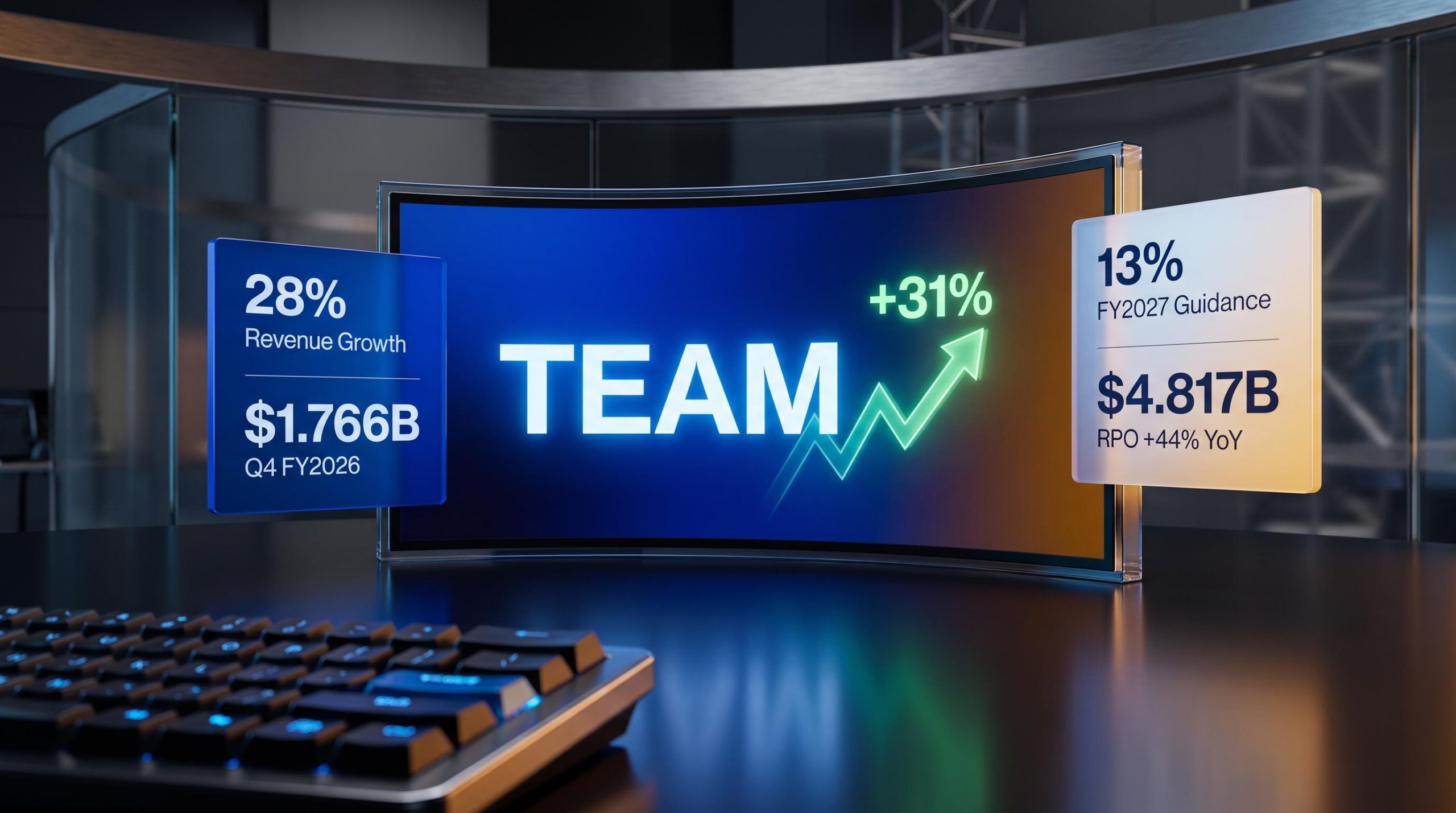
Atlassian just printed 28% revenue growth, earned its first GAAP operating profit in over two years, and sent TEAM stock up roughly 31% in pre-market trading. Then management guided to 13% growth for FY2027. That gap, between a quarter that exceeded every major estimate and a forward outlook that implies sharp deceleration, is the entire investment question compressed into one earnings report.
The timing sharpens the stakes. TEAM is trading at a dramatically higher price than it was 24 hours ago, and the decision investors face right now is whether that move reflects a genuine re-rating of Atlassian’s business quality or a euphoric overreaction to a single quarter’s outperformance.
Here is what the numbers actually show on both sides of that question, from the mechanics behind the guidance deceleration to the AI adoption signals that matter and the specific data points that will tell you which outcome is unfolding over the next two quarters.
The numbers that drove the beat
The scale of Atlassian’s Q4 FY2026 beat was not confined to one line item. Every major metric cleared consensus, and the margins expanded in a way that changes how the business quality reads.
Total revenue reached $1.766 billion, representing 28% year-on-year growth and clearing the analyst consensus of roughly $1.66 billion by a meaningful margin. Cloud revenue reached $1.213 billion on 31% year-on-year growth, accounting for the substantial majority of total revenue. Non-GAAP diluted EPS printed at $1.87, well above the approximately $1.50 consensus, with the outperformance exceeding 24%.
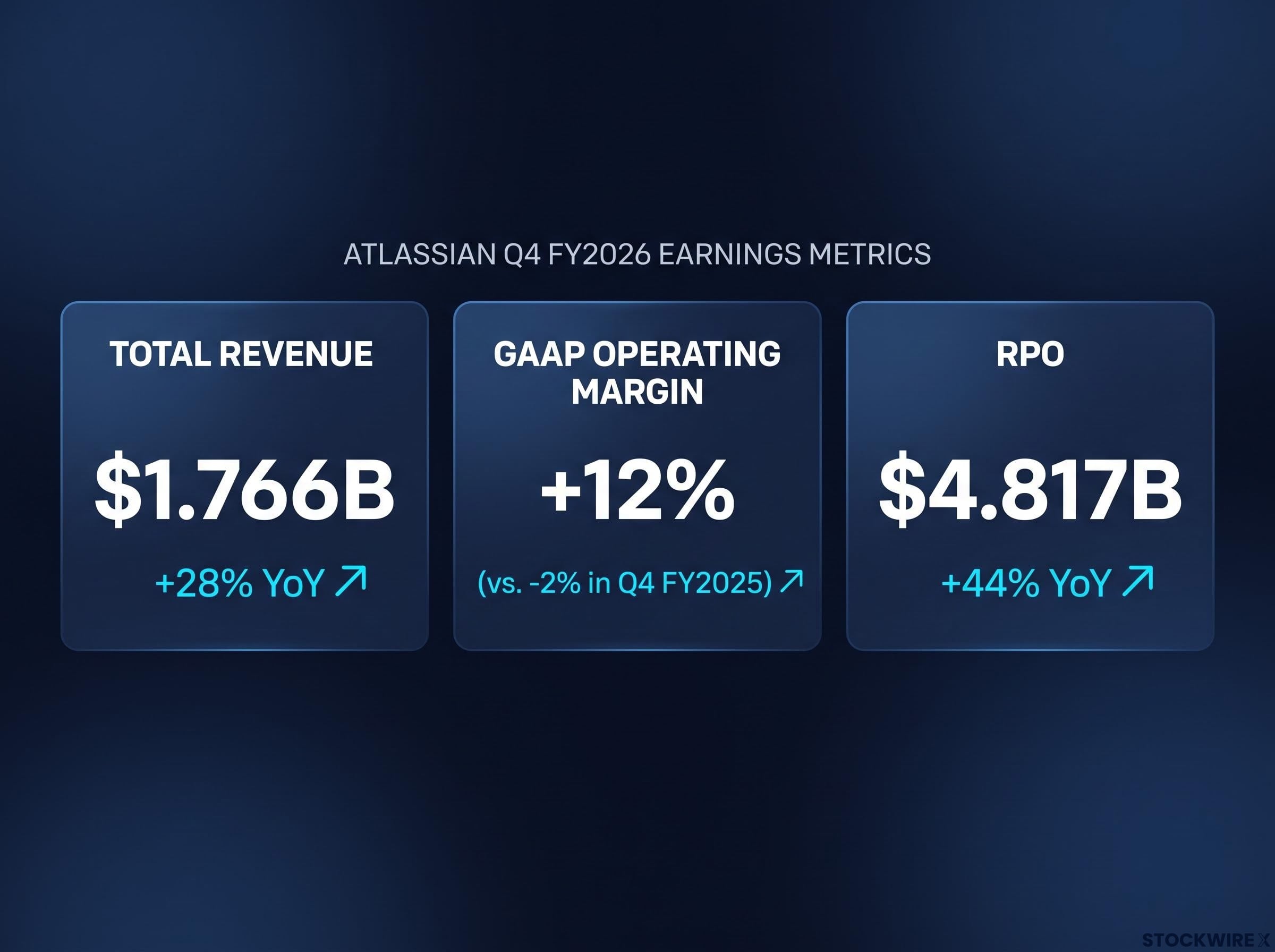
The GAAP margin shift: GAAP operating margin advanced from -2% in Q4 FY2025 to +12% in Q4 FY2026, representing Atlassian’s first positive GAAP operating result in more than two years and a swing of fourteen percentage points in a single year.
Non-GAAP operating margin expanded to 36% from 24% a year earlier. Free cash flow reached $475 million, a 27% FCF margin. And Remaining Performance Obligations (RPO), which captures the total contracted revenue not yet recorded on the income statement, climbed 44% year-on-year to $4.817 billion.
| Metric | Q4 FY2026 Actual | vs. Consensus / Prior Year |
|---|---|---|
| Total Revenue | $1.766B | Beat ~$1.66B consensus; +28% YoY |
| Cloud Revenue | $1.213B | +31% YoY |
| Non-GAAP Diluted EPS | $1.87 | Beat ~$1.50 consensus |
| GAAP Diluted EPS | $0.55 | vs. -$0.09 in Q4 FY2025 |
| GAAP Operating Margin | 12% | vs. -2% in Q4 FY2025 |
| Non-GAAP Operating Margin | 36% | vs. 24% in Q4 FY2025 |
| Free Cash Flow | $475M | 27% FCF margin |
| RPO | $4.817B | +44% YoY |
| Subscription ARR | $6.606B | +23% YoY |
That combination, mid-30s non-GAAP margin alongside high-20s FCF margin and 44% RPO expansion, tells you this is not a quarter where Atlassian pulled forward revenue recognition or sacrificed future commitments to dress up current results. The forward pipeline grew faster than the recognised revenue, and that distinction matters when you are evaluating whether the post-earnings rally has a foundation.
When big ASX news breaks, our subscribers know first
What Atlassian’s Rovo AI numbers actually signal
Atlassian’s AI thesis rests on a structural advantage that is easy to underestimate. Rovo, the company’s AI layer across Jira, Confluence, and its broader workflow platform, is not competing on model quality. It is competing on the proprietary data graph underneath: millions of Jira tickets, Confluence documents, and project histories that give Rovo contextual depth standalone AI tools cannot replicate. CEO Mike Cannon-Brookes has framed this data graph as Atlassian’s primary competitive advantage in the AI era.
Atlassian’s data graph moat, built on years of Jira tickets and Confluence documents, positions it as infrastructure for AI agent deployment rather than a displacement target; enterprise SaaS systems of record with deep workflow integration are increasingly the authoritative data layer that AI agents depend on to execute multi-step tasks.
The adoption figures that carry the most analytical weight support that thesis directly.
What the confirmed metrics show
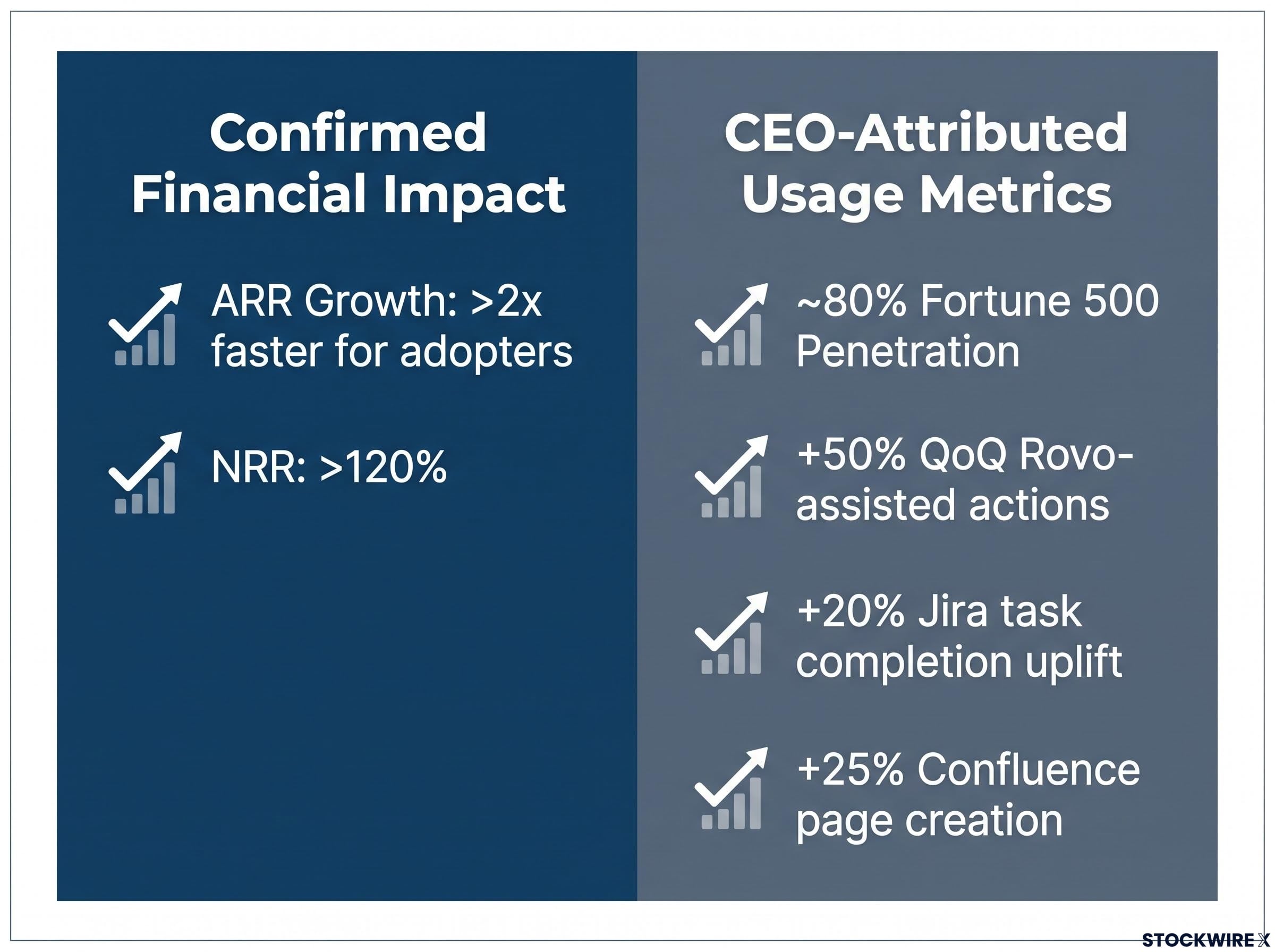
Rovo adopters are growing their Annual Recurring Revenue (ARR), meaning the annualised value of active subscriptions, more than 2x faster than non-adopters, according to Q4 FY2026 earnings materials. Net Revenue Retention (NRR), which measures how much existing customers spend year-over-year including expansions and churn, remains above 120%, with management linking that directly to AI adoption.
- Rovo adopters growing ARR more than 2x faster than non-adopters
- NRR above 120%, explicitly linked to AI adoption by management
- Data graph moat (Jira, Confluence, project history) as the structural differentiator
That 2x ARR growth differential is the figure that tells you whether Rovo is creating genuine lock-in or just adding a feature. Expansion revenue that correlates to product depth is the healthiest form of NRR in SaaS, because it signals that customers who go deeper spend more, which makes them harder to lose.
Per-seat pricing risk is the structural counterfactual to Rovo’s expansion story: AI-native competitors are entering enterprise markets with consumption-based models designed to undercut incumbent SaaS costs by 80-90%, and whether Atlassian’s platform depth can sustain seat-based expansion against that pressure is the bear case the NRR figure does not yet answer.
What the CEO cited and what requires verification
Cannon-Brookes has been attributed with additional Rovo metrics, including Fortune 500 penetration of roughly 80%, a 50% quarter-on-quarter increase in the volume of Rovo-assisted actions, a 20% uplift in Jira task completion rates for Rovo users relative to non-users, and a 25% increase in Confluence page creation among that same cohort. These figures appear in company materials attributed to the CEO but were not confirmed in official Q4 FY2026 filings reviewed during research. They should be treated as requiring additional verification rather than established facts.
Why 13% guidance does not mean what it appears to mean
Start with the headline number: Atlassian guided to approximately 13% total revenue growth for FY2027. After a 28% Q4, that looks like a wall.
Now look at the components. Cloud revenue is guided to grow approximately 25.5%. Data Center revenue is guided to decline approximately 17%. Marketplace and other segments are guided to approximately 12% growth.
The mechanics matter. Atlassian has been actively migrating enterprise customers from Data Center (its on-premises, self-hosted deployment model) to cloud. When a customer migrates, that revenue leaves the Data Center line and appears on the cloud line. But because Data Center is declining faster than cloud is growing in dollar terms relative to the total, the consolidated number compresses, even though the underlying demand from the same customers has not changed.
Cloud guiding to +25.5% while Data Center guides to -17%: two speeds, one company, and the slower one is dragging the headline.
| Segment | FY2027 Guided Growth Rate | Context |
|---|---|---|
| Cloud Revenue | ~25.5% | Core growth engine, absorbing migrations |
| Data Center Revenue | ~-17% | Planned decline as customers migrate to cloud |
| Marketplace & Other | ~12% | Ecosystem revenue, moderate growth |
| Total Revenue | ~13% | Blended figure compressed by DC drag |
| Subscription ARR | ~18% | Down from ~23% in FY2026 |
The $4.817 billion RPO figure, up 44% year-over-year, reinforces that committed future revenue is growing far faster than the 13% headline implies. For investors, the critical read is that 13% is not Atlassian’s organic demand growth rate. It is the residual of two forces moving in opposite directions, and the size of the Data Center drag is the variable that matters as it shrinks toward irrelevance over the next 12-18 months.
Bull case, bear case, and the valuation question after a 31% move
The quarter was strong. That is settled. The question that matters now is whether the price reflects the quarter’s quality or a forward bet that has not been earned yet.
Atlassian’s Q4 combination of 28% revenue growth and 36% non-GAAP operating margin produces a Rule of 40 benchmark score comfortably above 60, placing it in the cohort that commands 8-15x revenue multiples and where each additional 10-point improvement has added 1.1x EV/Revenue since Q4 2025.
The bull case rests on five points:
- Data Center contraction is a temporary headwind; consolidated growth converges toward cloud growth (mid-20s) once migration completes
- RPO at $4.817 billion (+44% YoY) confirms forward demand is running well ahead of recognised revenue
- NRR above 120% and the Rovo adoption differential signal durable expansion dynamics
- FY2028 re-acceleration toward 20%-plus consolidated growth is structurally set up if cloud sustains its trajectory
- Cannon-Brookes disclosed a $250 million Rule 10b5-1 share purchase plan concurrent with earnings, a signal of personal conviction in the long-term thesis that was independently referenced in a Mizuho analyst note as one of the quarter’s most notable developments
The bear case is equally specific:
- Cloud growth of 25.5% may itself be partially elevated by migration tailwinds that exhaust as the Data Center customer pool shrinks
- Subscription ARR guidance stepping down from 23% to 18% signals moderation independent of the Data Center dynamic
- GAAP operating margin is guided to compress from Q4’s 12% to approximately 4.5% for the full FY2027 year, as investment spending continues
- Rovo’s monetisation has not been formally broken out in revenue terms; AI remains a narrative with strong but unquantified financial contribution
- The stock at post-earnings levels prices in a re-acceleration that has not yet occurred
The $250 million insider purchase plan is the kind of signal that typically accompanies management conviction in a multi-year thesis. It is a meaningful data point on insider assessment of whether the post-earnings price is justified. But it does not change the valuation arithmetic; it adds conviction context.
What you are actually pricing at current levels is not FY2027 execution. It is FY2028-plus, and that is a forward bet on migration completion and AI conversion.
Understanding the Data Center migration and why it matters for Atlassian’s business model
If the guidance deceleration feels alarming, the mechanics of Atlassian’s business model transition explain why it should not be, at least not on the surface.
Data Center is Atlassian’s on-premises deployment model, where enterprise customers host the software on their own servers. For years, many large organisations preferred it for data sovereignty or compliance reasons. Cloud is the hosted model where Atlassian runs the infrastructure and customers access the software remotely.
The migration process works in three steps:
- A customer operates on Data Center, generating revenue in that segment
- Atlassian migrates the customer to cloud, which creates a recognition gap during the transition period
- The customer is now generating cloud revenue; Data Center revenue drops by the same amount
Because this is happening at scale, Data Center revenue is shrinking (guided to -17% in FY2027) while cloud absorbs those customers and grows (guided to +25.5%). The consolidated number captures both forces and lands at 13%, which understates the actual demand trajectory.
What migration completion would signal for FY2028
Once Data Center shrinks to a low-single-digit percentage of total revenue, its decline no longer materially drags the consolidated growth rate. At that point, total company growth converges toward cloud growth, which is currently running in the mid-20s. That makes FY2028 the potential re-acceleration year, but it is a condition to monitor, not a guaranteed outcome. If cloud growth itself decelerates as migration tailwinds fade, the re-acceleration thesis weakens.
Five signals to watch before making a decision on TEAM at current levels
Rather than arriving at a verdict, here is the monitoring framework that will tell you which outcome is unfolding over the next two to three quarters:
- Cloud revenue sustainability: Watch whether cloud holds at approximately 25-30% growth in Q1 FY2027 against the guided ~25.5%. If it holds or exceeds, the underlying demand thesis is intact. If it decelerates meaningfully, the migration tailwind argument for the bear case gains weight.
- Rovo monetisation disclosure: Any formal revenue attribution, ARPU uplift, or seat growth tied explicitly to Rovo features would transform AI from a narrative advantage into a quantifiable one. Current disclosures remain high-level.
- RPO conversion rate: The pace at which the $4.817 billion RPO converts to recognised revenue will indicate whether the 13% guided growth rate is conservative or genuinely reflective of near-term demand. Faster conversion supports the bull case.
- Data Center revenue share trajectory: Track the point at which Data Center falls to low-single-digit percentage of total revenue. That milestone de-risks the consolidated growth convergence thesis and removes the primary mathematical drag on reported growth.
- GAAP margin trajectory: FY2027 guidance implies margins compressing to ~4.5% from Q4’s 12% as investment continues. Whether Atlassian can maintain positive GAAP margins and high-20s FCF margins through slower top-line growth will determine the quality-of-earnings picture during the transition year.
Each of these signals will arrive in sequential quarterly reports beginning with Q1 FY2027. Tracking them systematically will tell you well before the broader market whether 13% is a floor or a ceiling for this cycle.
What the Atlassian earnings picture says about paying a premium for the re-acceleration thesis
The Q4 FY2026 results are unambiguously strong. 28% revenue growth, 12% GAAP operating margin, 36% non-GAAP margin, $475 million in free cash flow, and $4.817 billion in RPO growing at 44% establish the business quality at a high level. That is the baseline, and it is clean.
The investment decision at post-earnings prices is a different question. Investors buying TEAM stock here are not paying for a company that just beat. They are paying for a company they believe will re-accelerate in FY2028, as Data Center shrinks to irrelevance and Rovo begins converting adoption into formally quantifiable revenue. The 13% FY2027 guidance, with Data Center declining 17% and subscription ARR growth stepping down to 18%, is the near-term headwind they are choosing to look through.
Forward thesis pricing, where a stock’s current multiple reflects future business lines that do not yet appear in the income statement, is the same valuation dynamic that produced Tesla’s 359x trailing earnings multiple; in both cases, buyers are not paying for reported results but for a transformation scenario, and the entry price determines which outcomes generate positive returns.
Cannon-Brookes’ $250 million insider purchase plan adds conviction context, but it does not add a margin of safety. The premium is justified only if both the migration thesis and the AI monetisation thesis execute as management projects.
Investors who buy at current levels are not buying a quarter. They are buying a forward thesis, and the price premium they are paying is precisely the cost of that conviction.
This article is for informational purposes only and should not be considered financial advice. Investors should conduct their own research and consult with financial professionals before making investment decisions. Forward-looking statements regarding FY2027 guidance, FY2028 re-acceleration, and AI monetisation are subject to change based on market developments and company performance.