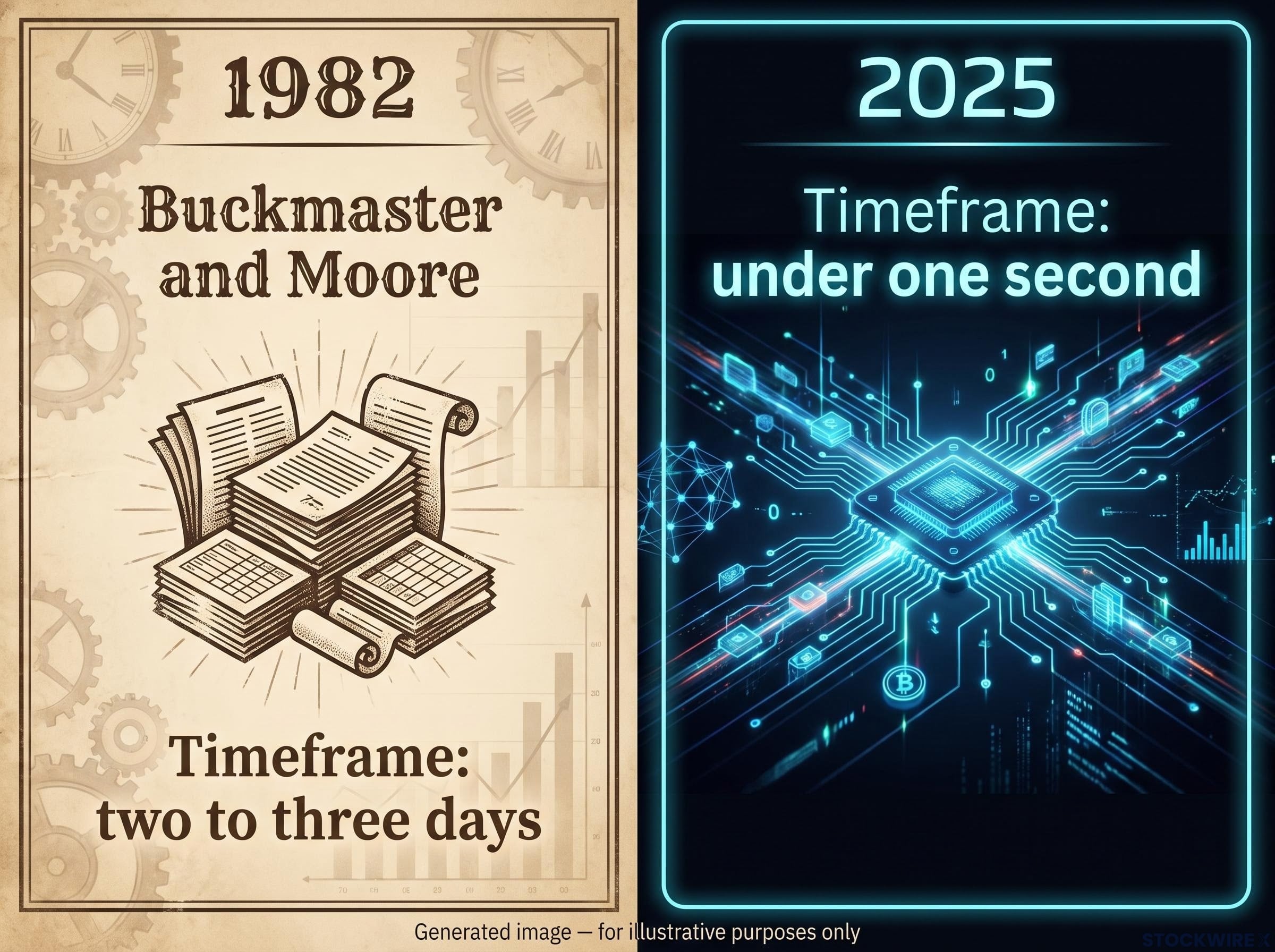
In 1982, a portfolio manager at Buckmaster and Moore started the day by waiting. Printed annual reports arrived from the companies considered worth covering. Research staff worked through the documents and relayed their findings through the typing pool before the finished notes were physically couriered across the city. The manager would then wait for views to come in from across the brokerage community before committing to any investment decision. That accumulation of input and deliberation consumed the better part of two to three days at a minimum.
In 2025, an algorithm completed the same analytical task, from data ingestion to trade execution, in under one second.
That is not a speed upgrade. It is a structural change in how markets process information, and it has rewritten what an earnings-day price move actually means. Here is what is driving those immediate moves when results hit the tape, why the mechanism behind them matters more than the headline number, and what it changes for anyone watching markets during earnings season.
What earnings season looked like before algorithms took over
The friction was physical. Before electronic trading and real-time data feeds, an earnings release moved through the market the same way a letter moved through the postal system: one hand to the next, with delays built into every transfer.
The workflow ran in a fixed sequence:
- A company released its results and circulated printed reports to a curated set of brokerage firms it judged worthy of receiving them
- Analysts reviewed the documents manually, page by page
- Findings were passed to the typing pool, formatted into research notes, and run through the in-house printing press
- Bound research reports were dispatched via each firm’s messenger department to fund managers across the city
- Fund managers gathered research from across their brokerage contacts, with the largest firms routinely receiving coverage from ten or more houses
- Only once that body of opinion had been absorbed and weighed did the manager act
That process was not inefficient through negligence. It was the structural reality of how information moved in a pre-digital market. A physical library of printed annual reports was a mark of professional credibility, not an anachronism.
The consequence was that prices adjusted gradually. Information diffused over days, giving every participant a roughly comparable window to read, interpret, and act. That window no longer exists.
The shift from days to seconds is legible only against a clear picture of how price discovery mechanics operate at the order book level, where passive limit orders contribute roughly 45% of price formation independent of completed trades.
When big ASX news breaks, our subscribers know first
How AI-powered systems process an earnings release in real time
The modern workflow is machine-first but human-designed. That distinction matters: the systems executing trades on earnings day do not arrive at independent conclusions. Instead, they run inside analytical frameworks that human analysts constructed well before the release appeared, sometimes weeks or months in advance.
The process runs in four stages:
- Instant data ingestion. Structured financials, including earnings per share (EPS), revenue, margins, and forward guidance, arrive via machine-readable feeds the moment the release is filed. The algorithm has the numbers before a human reader finishes the headline.
- Natural language processing (NLP) of unstructured text. NLP is a branch of artificial intelligence that enables computers to read and interpret human language. These systems parse the management discussion and analysis (MD&A), earnings call commentary, and Q&A transcripts to extract sentiment, risk language, and qualitative signals that structured data alone would miss.
- Model-based valuation update. The system applies pre-specified frameworks encoding growth assumptions, margin thresholds, cost of capital, valuation multiples, and scenario logic to recalculate fair value and score the surprise against expectations.
- Signal generation and execution. If updated fair value sits materially above the market price, the system emits a buy signal. If below, a sell. Execution engines then slice orders across venues, managing market impact in sub-second intervals.
The storage capacity of a single USB drive can exceed the volume of text a human being could read across an entire lifetime. Machines face no such constraint: an AI system can ingest and process that same volume in seconds. That gap in raw processing capacity is the limitation these systems are built to overcome.
From data to decision: the valuation update loop
The valuation update is where the analytical quality lives. The algorithm does not invent a thesis on the fly. It recalculates intrinsic value ranges based on frameworks a human analyst specified: what growth rate matters, which margin threshold triggers a re-rating, how to weight guidance quality versus headline numbers.
In this step, computational systems carry a clear advantage: they process hundreds of variables simultaneously without introducing the arithmetic errors that human analysts inevitably make. That precision compounds across every data point in the model.
Machine learning components then refine these parameters over many earnings cycles, adjusting what “matters” based on realised forecast errors. The system improves iteratively. But the quality of the output still traces directly back to the quality of the human-designed framework it is executing. A good framework plus AI execution produces high-quality, fast decisions. A poor framework plus AI execution produces bad decisions made very quickly.
What the numbers say about algorithmic speed and accuracy around earnings
The empirical evidence is not ambiguous. When you separate algorithmic trades from non-algorithmic trades around earnings announcements, the performance gap is stark.
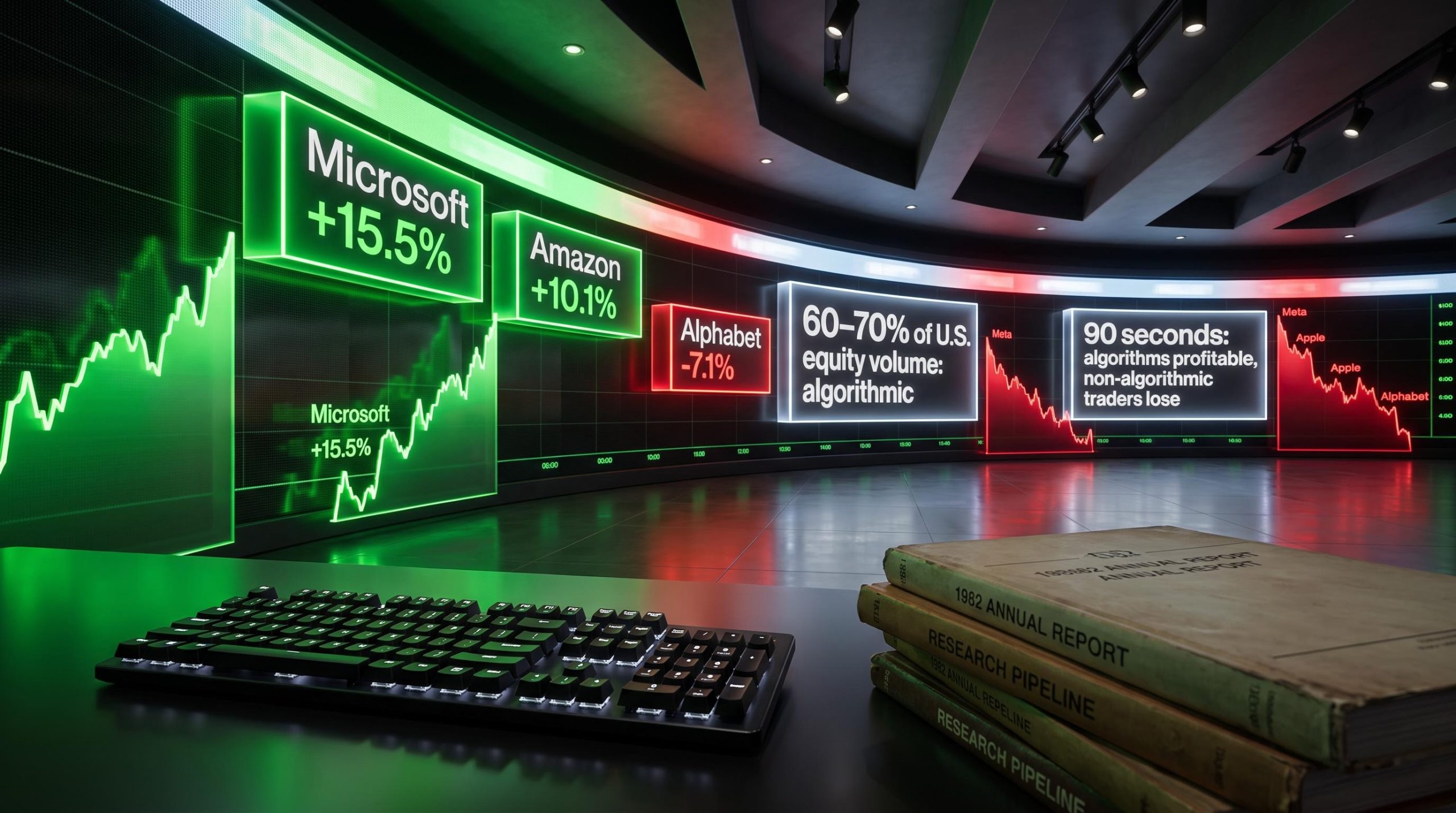
In the first 90 seconds after an earnings announcement, algorithmic traders time trades better and are, on average, profitable. Non-algorithmic traders lose money over the same window.
That finding alone reframes what “reacting to earnings” means in practice. Before the announcement, non-algorithmic volume tends to lead algorithmic volume. The moment the numbers hit, the relationship reverses: algorithms become the primary force pushing prices toward the new equilibrium.
The HFT price efficiency research documenting the 90-second profitability window uses multivariate tests of cumulative abnormal returns to isolate algorithmic performance from non-algorithmic performance, providing the empirical foundation for the directional split observed around announcement times.
The broader evidence confirms this pattern across multiple dimensions:
- A global study spanning 41 countries found a significantly negative relationship between algorithmic trading activity around earnings and post-earnings announcement drift (PEAD), the tendency for prices to keep drifting in the direction of the surprise for weeks after the release. More algorithmic activity means less drift, meaning the information gets priced in faster and more completely.
- An Australian study documented an approximately 30% reduction in PEAD in stocks with high algorithmic activity, consistent with faster assimilation of earnings signals.
- Generative AI and large language models (LLMs) are further reducing informational lag by rapidly summarising earnings reports, extracting sentiment, and delivering text analytics to investors.
The observable market behaviour matches the research. A set of major U.S. technology companies illustrates how completely prices can reprice within moments of results being published:
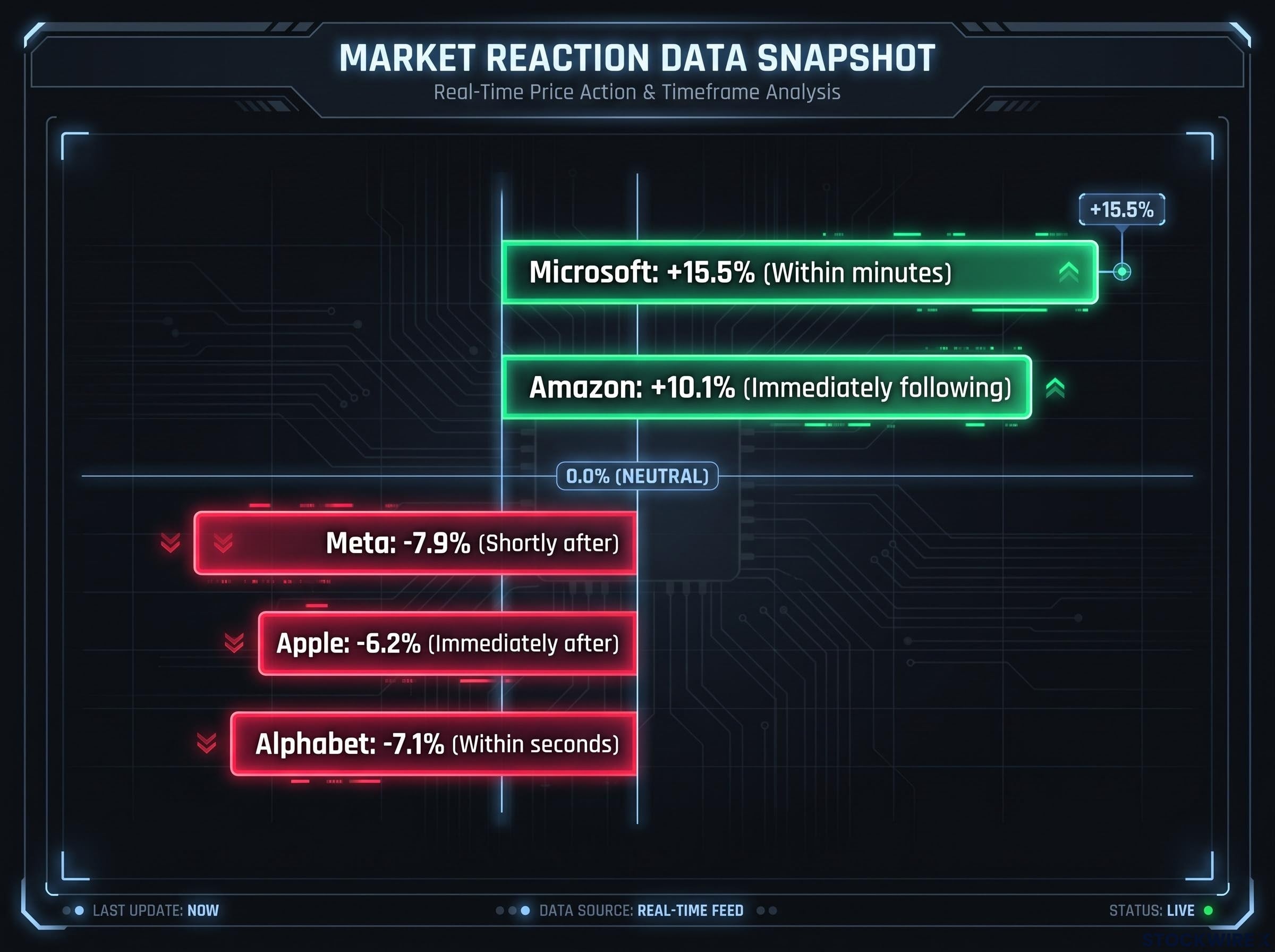
| Company | Direction | Magnitude | Timeframe |
|---|---|---|---|
| Microsoft | Up | +15.5% | Within minutes |
| Amazon | Up | +10.1% | Immediately following |
| Meta | Down | -7.9% | Shortly after |
| Apple | Down | -6.2% | Immediately after |
| Alphabet | Down | -7.1% | Within seconds |
By the time a human analyst finishes reading the first page of an earnings release, the price already reflects a sophisticated algorithmic consensus. The informational window for intraday reaction has functionally closed.
The efficiency gain and the volatility cost
Algorithmic trading has made earnings-day price discovery genuinely more informationally efficient. The evidence points in one direction: less persistent mispricing, faster assimilation of news, and deeper liquidity under normal conditions.
The efficiency gains are measurable:
- Smaller post-earnings announcement drift in high-algorithmic-activity stocks
- Faster price adjustment to new information, concentrated in the first seconds to minutes
- Deeper liquidity that helps markets digest large trades and information shocks more smoothly
But the same mechanism that makes markets smarter also makes them more fragile.
When algorithms agree too quickly
The costs run in parallel:
- Australian evidence shows algorithmic trading increases local volatility around earnings by approximately 15%, reflecting more intense, high-frequency order flow as algorithms compete to update prices first
- The International Monetary Fund (IMF) has linked automated and AI-driven trading to flash crash episodes, where prices swing violently in very short periods before rebounding
- With 60-70% of U.S. equity trading volume now algorithmic, correlated model errors can produce outsized reactions when homogeneous frameworks respond to the same signals simultaneously
The correlated-response risk is the one that regulators worry about most. When many algorithms are trained on similar data, use similar architecture, and react to the same inputs, their responses can amplify each other rather than cancel out. That convergence creates the conditions for sharp, fast dislocations that may partially or fully reverse once the algorithmic pressure exhausts itself.
Correlated model convergence, where many algorithms trained on similar data respond identically to the same earnings signal, is the mechanism regulators and researchers identify as the channel through which AI-driven efficiency flips into systemic fragility under stress.
Greater informational efficiency and greater microstructural fragility are two outputs of the same underlying mechanism. Anyone interpreting earnings-day volatility needs to distinguish between genuine price discovery and algorithm-on-algorithm noise before drawing conclusions about what the move actually means.
Who wins, who loses, and where human judgment still matters
The competitive divide is structural. Large institutions with the capital and expertise to build or buy advanced AI and low-latency systems can process full earnings reports, guidance, and textual nuance in real time, update valuation models, and execute size before slower participants react.
| Algorithmic institution advantages | Remaining edges for fundamental, longer-horizon participants |
|---|---|
| Full-report processing in real time | Longer-horizon analysis of strategy and competitive positioning |
| Instantaneous valuation model updates | Assessment of management quality over multiple cycles |
| Sub-second execution across multiple venues | Interpretation of noisy, qualitative, or not-yet-machine-readable data |
| NLP extraction of sentiment and risk language | Contrarian positioning when algorithmic consensus overshoots |
Retail investors and smaller firms relying on manual research pipelines face a competitive disadvantage during earnings periods. They typically encounter prices that already reflect a sophisticated consensus view by the time they act. That disadvantage is structural and unlikely to narrow meaningfully in the short term.
The performance dynamic is direct: a good human framework combined with AI execution produces high-quality, fast decisions. A poor framework combined with AI execution produces bad decisions made very quickly. The quality of human judgment has not become less important; it has moved upstream.
Where does that leave you? Your analytical effort is better directed away from trying to read the release faster and toward building better model assumptions, better qualitative frameworks, and longer-horizon views that algorithmic systems are not yet well-equipped to form. The input that drives AI performance comes from human decisions about assumptions, risk tolerances, system design, and objectives. That upstream design layer is where whatever advantage remains is now concentrated.
Rigorous earnings report analysis, covering revenue quality, GAAP versus non-GAAP divergence, free cash flow alignment, and forward guidance weighting, is precisely the upstream human framework that determines whether an AI-assisted valuation update produces insight or noise.
Where earnings-day price discovery goes from here
Three developments are already shaping the next phase:
- Broader diffusion of AI tools. As off-the-shelf large language models and analytics platforms become cheaper and more accessible, more firms, and some sophisticated retail participants, will gain access to AI-assisted earnings analysis. This may compress early-mover advantages but increase overall market efficiency.
- Next-generation modelling capabilities. The models coming next will integrate not just financials but tone of voice on earnings calls, cross-firm supply chain signals, and real-time macroeconomic context. The analytical scope of algorithmic systems is expanding, not plateauing.
- Heightened regulatory scrutiny. The IMF and other policymakers are increasingly concerned about correlated AI responses, opacity, cyber risk, and the potential for manipulation in AI-dominated markets. More scrutiny of how earnings-related algorithms are designed, tested, and controlled is coming.
The shift that has occurred in how quickly earnings information reaches prices is not a temporary condition. Results that once needed days to filter through the research and brokerage chain now reprice stocks within seconds, and that compression is a permanent feature of how modern markets function rather than a transitional phase.
The question closing for you is not whether to engage with AI-assisted analysis. That is already becoming less of a choice. The question becoming urgent is which frameworks and tools to build or access, and how to design the human-judgment layer that sits above them.
The question earnings season now forces every market participant to answer
The mechanism of price discovery around earnings has changed in kind, not in degree. The evidence confirms it is faster, more informationally efficient, and more concentrated. It also confirms it is more fragile, more unequal, and more dependent on model quality than execution speed.
What has shifted in earnings-driven markets is the source of competitive advantage. Raw access to information, once a meaningful edge, is now broadly commoditised. What separates outcomes is the rigour of the analytical framework brought to that information. For you, that means redirecting effort away from reacting faster and toward building more precise assumptions, stronger qualitative judgment, and an investment horizon that outlasts the initial algorithmic repricing.
For investors wanting to translate this structural context into a concrete action plan, our comprehensive walkthrough of post-earnings decision frameworks covers hold, trim, and wait criteria with predefined trigger rules designed to remove in-the-moment emotional interference from the decision.
This article is for informational purposes only and should not be considered financial advice. Investors should conduct their own research and consult with financial professionals before making investment decisions.
These statements are speculative and subject to change based on market developments and company performance. Past performance does not guarantee future results.
—