The Federal Reserve, the Bank of England, and the Bank of Japan all held or maintained their policy rate positions through their most recent meetings, and not one of them did so because inflation has been beaten. Each held because the risk of easing too early still outweighs the cost of holding too long.
When central banks hold, the fixed income market does not pause alongside them. Bond yields, prices, and the real income calculation for investors keep shifting in response to inflation data, forward guidance, and what markets expect next. The yield environment you are operating in today is fundamentally different from the one that defined the 2010s, and that difference changes how you should think about every bond in your portfolio.
Here is what these rate decisions actually mean for your fixed income positioning, including how to assess whether the yields you are earning right now justify the inflation and duration risk you are carrying.
What three central banks are telling you by standing still
A rate hold is a decision, not an absence of one. When three of the world’s most influential central banks choose to stay put in the same window, the signal is worth reading carefully.
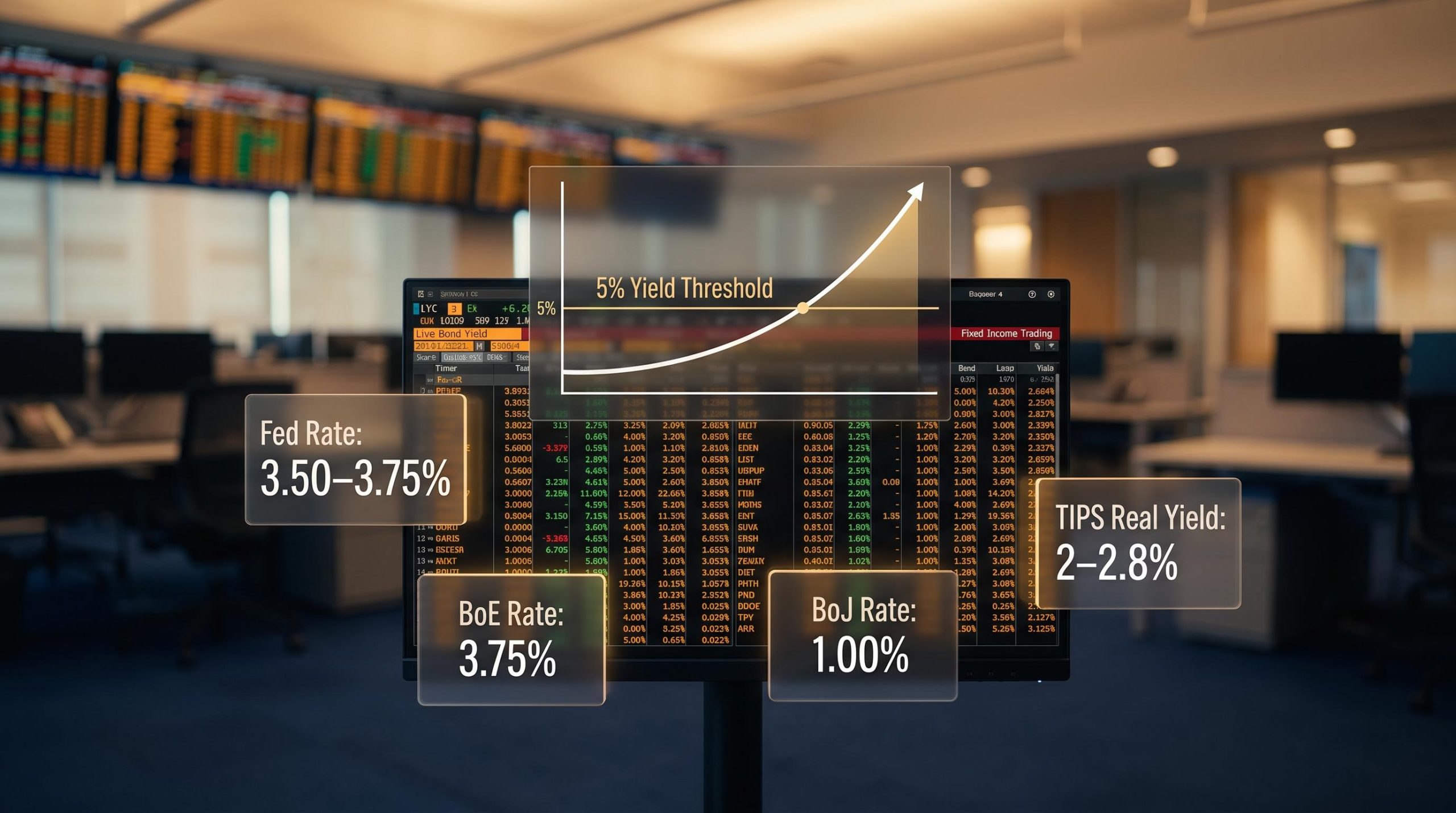
The Fed kept its federal funds rate at 3.50-3.75% at its June 2026 meeting, citing inflation still above its 2% target. Policymakers want sustained evidence that price pressures are contained before they cut. The Bank of England maintained its Bank Rate at 3.75%, holding restriction in place while UK consumer price inflation runs at 2.6%, still above the 2% target. And the Bank of Japan is sitting at 1.00% after a 25 basis point hike from 0.75% in June 2026, a move that would have been unthinkable from a central bank that spent years in negative-rate territory.
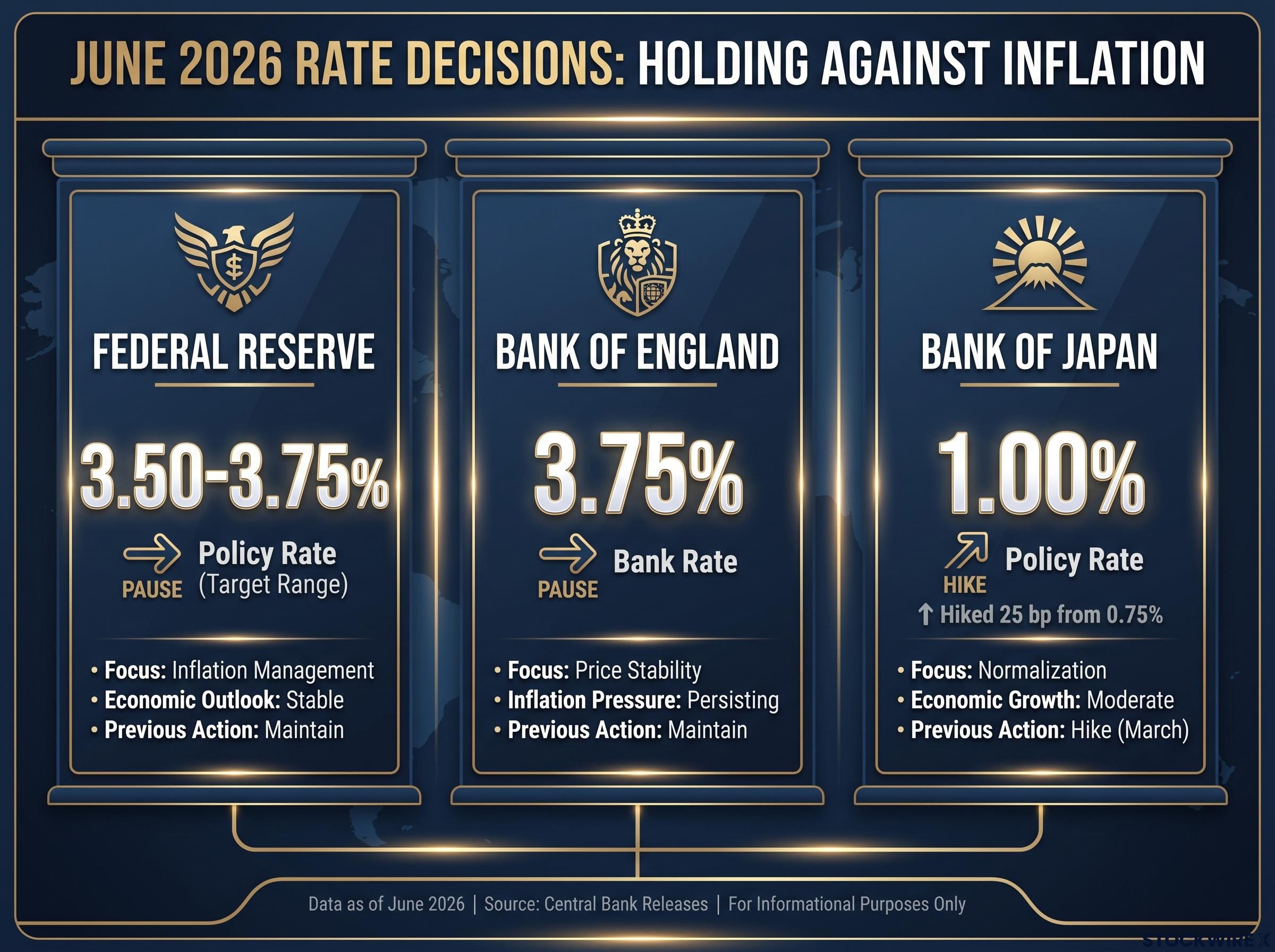
| Central Bank | Current Policy Rate | Inflation Rate | Rate Decision (June 2026) |
|---|---|---|---|
| Federal Reserve (US) | 3.50-3.75% | Above 2% target | Hold |
| Bank of England (UK) | 3.75% | 2.6% (target: 2%) | Hold |
| Bank of Japan | 1.00% | Above target | Hold (after 25 bp hike from 0.75%) |
Each bank is holding for a different specific reason, but the common thread is identical.
Inflation is not yet solved across any of these three economies. Policymakers have collectively concluded that the risk of easing prematurely still outweighs the cost of keeping rates elevated.
What this tells you is straightforward: the yield environment you see today is not a temporary anomaly. Central banks across three different economies have reached the same conclusion about inflation risk, and that consensus shapes how long current bond yield levels are likely to persist.
Central bank policy divergence across the three economies matters beyond the headline rate decisions: the Fed, ECB, and BOJ each face structurally different growth-inflation trade-offs, and those differences create distinct bond yield dynamics that affect cross-regional fixed income positioning even when all three appear to be holding simultaneously.
When big ASX news breaks, our subscribers know first
What bonds actually are and why the rate environment changes everything
A bond is a loan you make to a government or company. In return, they pay you a fixed amount of interest (called a coupon) at regular intervals, and they repay your principal at maturity. That fixed coupon is the key to understanding why bond prices move the way they do.
When interest rates rise, newly issued bonds come with higher coupons. Your older bond, with its lower coupon, becomes less attractive by comparison. Its price falls to compensate, which pushes its yield (the effective return a new buyer would earn) higher. The reverse is also true: when rates fall, older bonds with higher coupons become more valuable, and their prices rise.
How much a bond’s price moves for a given change in yield depends on its duration, which measures the bond’s sensitivity to interest rate changes. A long-duration bond (one with many years until maturity) moves more sharply in price than a short-duration bond. In a rate-uncertain environment, that distinction matters significantly for your portfolio.
Bond duration is the single number that quantifies this price sensitivity: every year of duration represents roughly 1% in price loss for each 1 percentage-point rise in rates, which means a long-duration fund can absorb a 17% capital loss from a single rate move that a short-duration fund would absorb at roughly 3%.
Why the 2010s comparison matters for how you think about bonds today
The decade after the global financial crisis gave investors a distorted picture of what bonds could do. With real and nominal yields close to zero for years, bonds served mainly as capital-preservation tools. Income was negligible. The strategic case for holding them was largely defensive.
That picture has changed materially:
- Income potential: With policy rates at 3.50-3.75% (US), 3.75% (UK), and 4.35% (Australia), bonds are genuine income assets again
- Price sensitivity: Higher yields mean more room for prices to move in both directions, making duration choices more consequential
- Diversification value: Bonds with meaningful yields have more room to rally during equity sell-offs, improving their ability to offset losses in other parts of your portfolio
As Bianca Rose, Senior Portfolio Manager at Morningstar Investment Management, has indicated, a yield level of around 5% and above is where bonds begin to look like reasonable value, with the zone just below that figure still considered an attractive entry point as of August 2026. The income function of bonds, effectively dormant for a decade, is back.
Why inflation is a risk to manage, not a number to predict
Your instinct might be to ask “when will inflation come down?” That is the wrong question. Even professional investors and central banks cannot reliably time inflation turning points, and directional bets on inflation are a weak basis for fixed income decisions.
Morningstar Investment Management’s framing, attributed to Bianca Rose, Senior Portfolio Manager, offers a more durable approach: treat inflation as a risk factor to manage, not a directional call to make.
“Does the yield I am earning compensate me for the chance that inflation does not fall as expected?” That reframed question, drawn from Morningstar Investment Management’s analytical approach, shifts your focus from prediction to compensation.
The practical difference between these two mental models is significant:
- The prediction model: You try to forecast inflation’s direction, and you position your portfolio accordingly. If you are wrong, you absorb losses.
- The compensation model: You assess whether the yield on each holding provides a sufficient margin of safety under a range of plausible inflation outcomes. Your portfolio works even if your inflation view is imperfect.
With policy rates and bond yields near multi-year highs, many high-quality bonds now offer income returns that can be positive in real terms even under scenarios where inflation proves stickier than expected. In the week of 4 August 2026, Australian bond yields retreated modestly as market participants revised their near-term inflation outlook downward, a reminder of how swiftly sentiment in fixed income can turn. The compensation framework helps you see through that noise.
For you, shifting from “predict inflation” to “am I compensated for inflation risk?” is not just a theoretical improvement. It is the framework professional managers actually use, and it removes the paralysis of waiting for certainty before acting.
Duration, diversification, and the practical mechanics of building a fixed income allocation
Understanding the theory is one thing. Building an allocation that actually works is another. The two structural decisions that matter most are how much duration risk you carry and what types of bonds you own.
Short-duration bonds (1-3 years) are more price-stable if yields rise. They mature sooner, which means you reinvest your principal at prevailing rates more frequently. That is an advantage if rates stay high or climb further. Long-duration bonds (5+ years) offer more upside if central banks eventually cut rates and yields fall, but they carry more downside if inflation persists and rates move higher. The price swings are larger in both directions.
The institutional consensus on managing duration exposure in a normalised rate environment points consistently toward the 1-5 year segment of the curve, where comparable yields to long bonds are available with materially less price sensitivity to rate moves.
A laddering approach, where you own bonds across a range of maturities, lets you manage this trade-off practically:
- Spread your fixed income allocation across short, intermediate, and longer-dated maturities
- As each bond matures, reinvest the proceeds at the prevailing yield for your longest target maturity
- This creates a rolling cycle that smooths the impact of any single rate change and avoids concentrating your reinvestment risk in one moment
Laddering, mixing, and why the blend matters more than any single bond choice
Maturity diversification is only half the picture. The other half is what types of bonds you hold. A three-layer mix gives you exposure to distinct risk and return characteristics:
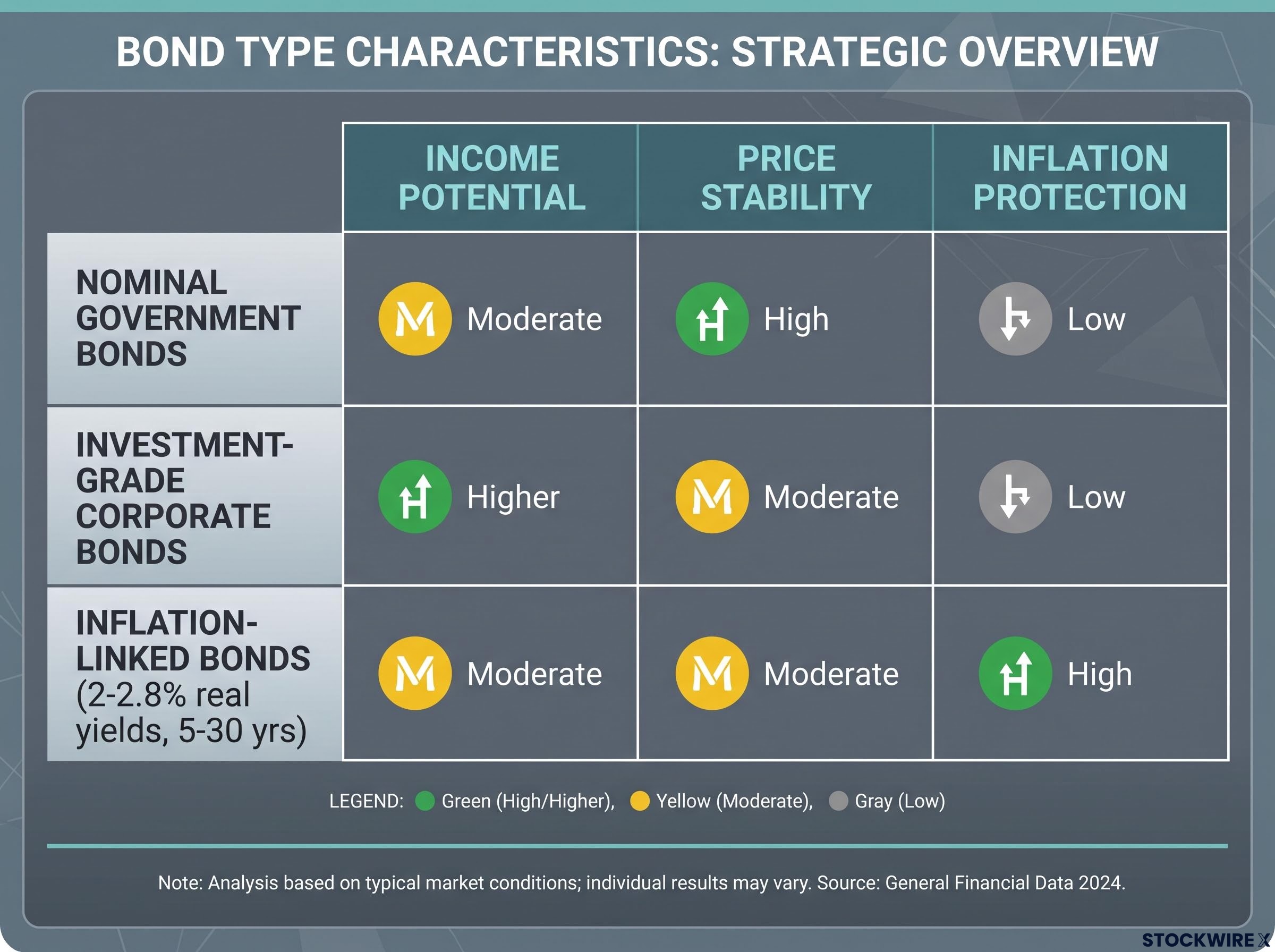
| Bond Type | Income Potential | Price Stability | Inflation Protection |
|---|---|---|---|
| Nominal Government Bonds | Moderate | High | Low |
| Investment-Grade Corporate Bonds | Higher | Moderate | Low |
| Inflation-Linked Bonds (e.g. TIPS, indexed Aus. govt bonds) | Moderate | Moderate | High |
Nominal government bonds give you stability and liquidity. Investment-grade corporate bonds add yield with managed credit risk. Inflation-linked bonds, such as indexed Australian government bonds or US Treasury Inflation-Protected Securities (TIPS), which currently offer real yields of approximately 2-2.8% across 5-30 year maturities, provide direct purchasing power protection if inflation proves stickier than expected.
The blend is the point. No single bond type does all three jobs. Combining them with a laddered maturity structure creates a fixed income allocation that generates income, manages your inflation exposure, and reduces the impact of any single rate move. You should be able to sketch what your own version of this blend looks like before your next portfolio review.
The four jobs bonds are doing in your portfolio right now
Bonds are not in your portfolio out of tradition or as a defensive afterthought. In the current rate environment, they are earning their place through four distinct, named functions:
- Income generation: With policy rates at 3.50-3.75% (US), 3.75% (UK), and 4.35% (Australia), bonds are genuine income assets again. The cash returns are meaningful, not symbolic.
- Diversification: Higher yield levels improve the potential for bonds to rally during equity drawdowns. When risk appetite falls, capital flows toward quality fixed income, and that dynamic works better when there is actual yield to attract it.
- Capital preservation: High-quality bonds still offer more price stability than equities over most short-to-medium horizons. Rate-driven price fluctuations exist, but they are smaller than equity drawdowns in most scenarios.
- Inflation management: Combining nominal and inflation-linked bonds provides purchasing power protection while still generating income. You do not have to choose between protection and return.
The income function of bonds, effectively eliminated during the 2010s when yields sat near zero, has been restored. That alone may be the most compelling argument for reassessing your fixed income allocation.
Bianca Rose, Senior Portfolio Manager at Morningstar Investment Management, has characterised the current environment as one where Australian fixed income offers genuine value for investors willing to position thoughtfully. The restoration of all four functions simultaneously is the key insight. If you are still running a minimal bond allocation based on the 2010s experience of negligible yields, the environment that justified that positioning no longer exists.
Navigating the rate-hold environment with a fixed income allocation built to last
Central bank holds are not a green light or a red light for bonds. They are a signal that the current yield environment is likely to persist for long enough to make thoughtful positioning worthwhile. Here is how to act on what you have just read.
The higher-for-longer rate regime confirmed by July 2026 central bank decisions sits against a backdrop of widening global growth divergences, with China’s manufacturing and services sectors both contracting simultaneously while the eurozone beat GDP consensus, a combination that complicates any single directional view on when global easing begins.
Four principles to carry into your next portfolio review:
- Assess compensation, not direction. For each bond holding, ask whether its yield compensates you for its specific inflation and duration risk. If it does not, it is earning a place in your portfolio through habit, not merit.
- Build across maturities. A laddered structure across short, intermediate, and longer-dated bonds spreads your reinvestment risk and reduces the impact of any single rate move.
- Include inflation-linked exposure. Even a modest allocation to indexed bonds acts as insurance rather than a bet. You are not predicting inflation; you are protecting against it.
- Revisit when yield levels shift materially. Morningstar Investment Management’s view, as articulated by Bianca Rose, Senior Portfolio Manager, is that bonds crossing the 5% yield level enter clearly reasonable-value territory, while those sitting somewhat below that figure remain worth holding. When yields move meaningfully relative to that marker, reassess your positioning.
Price volatility will still occur in fixed income, even in a higher-for-longer environment. Australian bond yields moved lower during the week of 4 August 2026 on easing inflation expectations, and they could easily move the other direction next week. The discipline is in holding a well-structured allocation through that noise, not in reacting to short-term yield moves.
The framework that works in this environment rewards patience and structure over prediction and timing. That is a more empowering position than waiting for certainty about inflation or rate direction before you act.
This article is for informational purposes only and should not be considered financial advice. Investors should conduct their own research and consult with financial professionals before making investment decisions. Past performance does not guarantee future results. Financial projections are subject to market conditions and various risk factors.