SpaceX just released its first-ever public earnings report, and the headline numbers tell two very different stories at once: a satellite internet business generating over $1 billion in quarterly operating profit, and an AI division burning through capital at a pace that swamps that profit entirely.
This is not a standard earnings beat-or-miss story. SpaceX had no prior public quarterly baseline before its Nasdaq listing, so investors are reading the internal architecture of the company’s finances for the very first time. The three-segment breakdown, covering Starlink, Space Launch, and AI, reveals a deliberate structure: one business is subsidising two others, and the scale of that subsidy is now a matter of public record.
The S-1 prospectus filing, submitted on 20 May 2026, was the document that made the segment-level disclosures public for the first time, replacing years of analyst estimates with audited figures that investors could assess directly.
Here is what the segment-level numbers actually show, what the Anthropic and Google compute leases mean for AI revenue durability, and what the subscriber growth trajectory tells you about Starlink’s staying power as SpaceX’s financial foundation.
Three segments, one profit centre: what SpaceX’s first earnings actually show
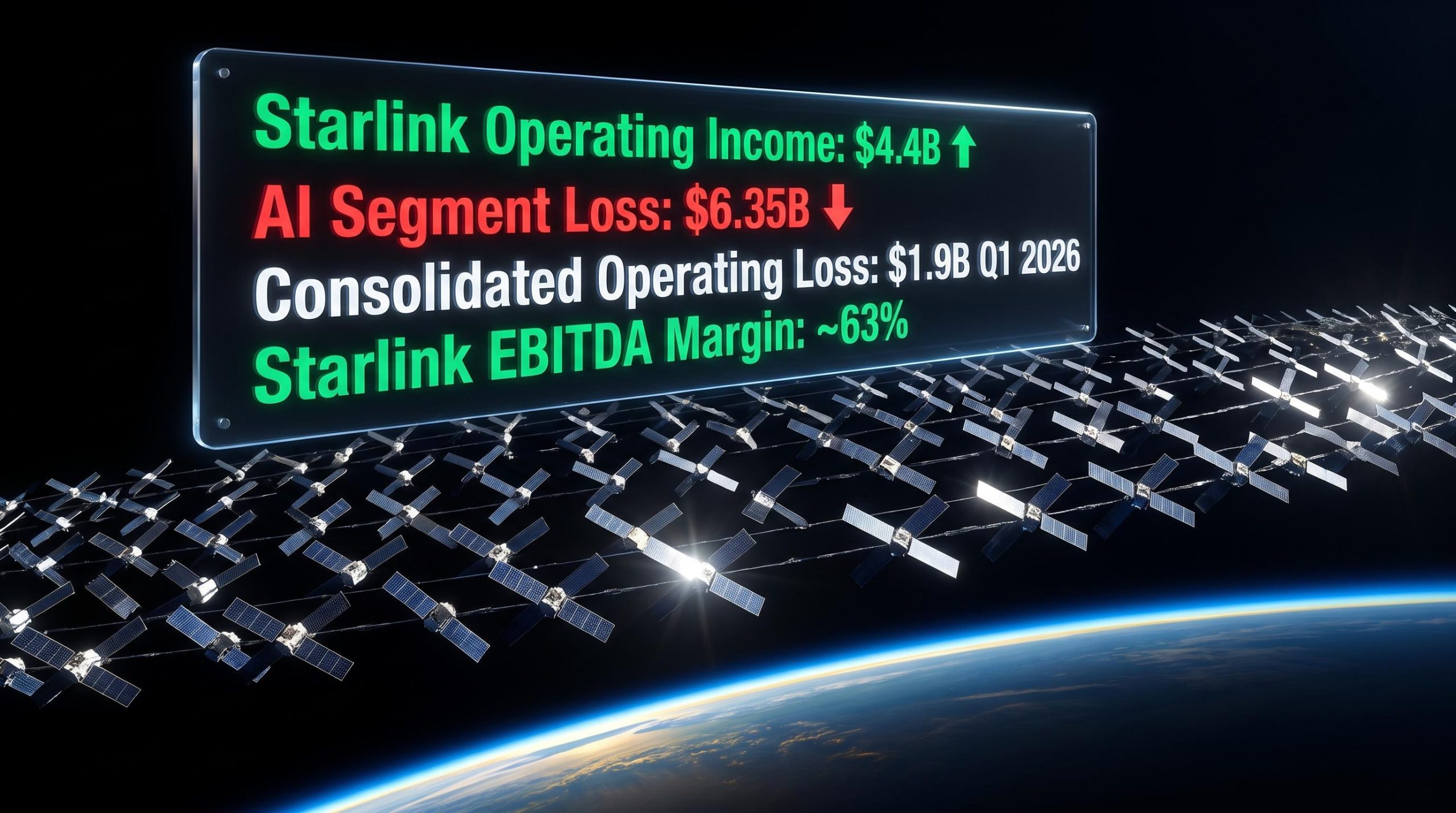
SpaceX posted a consolidated operating loss of $1.9 billion in Q1 2026. For the full year 2025, the company swung from a $791 million net profit to a net loss of approximately $5.0 billion. On the surface, that looks like a business moving sharply in the wrong direction.
It is not. The consolidated number is structurally uninformative without the segment breakdown underneath it, because the swing from profit to loss does not reflect a deteriorating operation. It reflects a deliberate capital deployment decision, primarily into AI infrastructure, that overwhelmed the earnings of a highly profitable satellite internet business. Until you see where the money is going, the headline loss tells you almost nothing about the health of what SpaceX actually does.
FY 2025 adjusted EBITDA: $6.6 billion (positive). Despite the net loss, SpaceX’s cash-generative core produced billions in operating cash flow, a figure that matters more than the headline loss for assessing the company’s financial resilience.
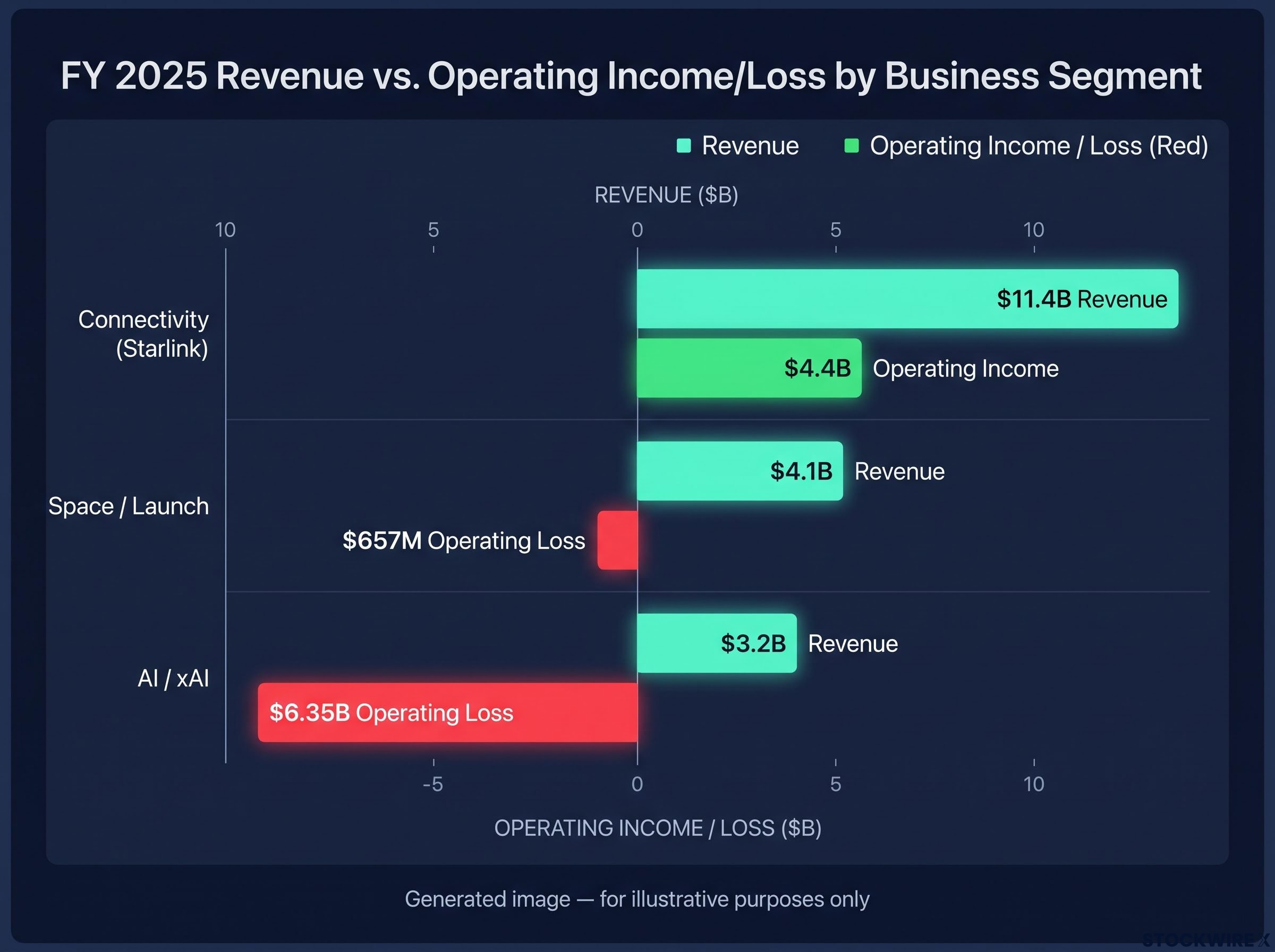
SpaceX reports three segments: Connectivity (Starlink), Space/Launch, and AI. Their profiles could not be more different.
Segment-level snapshot (FY 2025)
| Segment | 2025 Revenue | 2025 Operating Income / Loss | EBITDA Margin |
|---|---|---|---|
| Connectivity (Starlink) | $11.4B | $4.4B income | ~63% |
| Space / Launch | $4.1B | $657M loss | Near break-even |
| AI / xAI | $3.2B | $6.35B loss | Deeply negative |
One segment is enormously profitable. One is a modest drag. One is a capital furnace. Every number in this report reads differently once you know which segment produced it.
When big ASX news breaks, our subscribers know first
Starlink’s numbers: what a 63% EBITDA margin and 10 million subscribers mean
Start with the subscriber trajectory, because it establishes that Starlink has genuine market momentum, not just a margin story built on a small base. The service had approximately 4.5 million subscribers at the start of 2025. By early 2026, that figure exceeded 10.3 million, more than doubling in roughly 14 months.
The Q1 2026 segment financials confirm the growth is translating into profit:
- Revenue: $3.257 billion
- Operating income: $1.188 billion
- Adjusted EBITDA: $2.087 billion
For the full year 2025, Starlink generated $4.4 billion in operating income on $11.4 billion of revenue, producing an adjusted EBITDA margin (earnings before interest, taxes, depreciation, and amortisation as a percentage of revenue) of approximately 63%. For an infrastructure-heavy connectivity business that must launch, maintain, and replace thousands of satellites, that margin is striking. It tells you Starlink has both pricing power and scale leverage operating simultaneously, a combination that is rare in capital-intensive networks.
Starlink’s two-franchise structure, separating the direct-to-consumer rural broadband business from the wholesale direct-to-cell carrier play, explains much of why the segment carries such unusual margin characteristics for an infrastructure-heavy network.
Morningstar analyst Nicolas Owens has identified Starlink as the primary source of revenue and profit for SpaceX at present, and the segment he regards as the most important to watch for signs of sustained growth.
That matters because Starlink’s profitability is the condition that makes every other SpaceX capital expenditure programme financially sustainable.
What the AI division actually is (and why it loses so much money)
Before looking at the loss figures, it is worth understanding what SpaceX’s AI segment actually does. This is not a consumer AI product business competing with ChatGPT or Google Gemini. The AI/xAI division is primarily an infrastructure build-out. Revenue comes from leasing compute capacity, which is processing power housed in data centres, to third-party AI developers rather than from selling finished AI products.
The near-term monetisation model has two layers, ranked by current materiality:
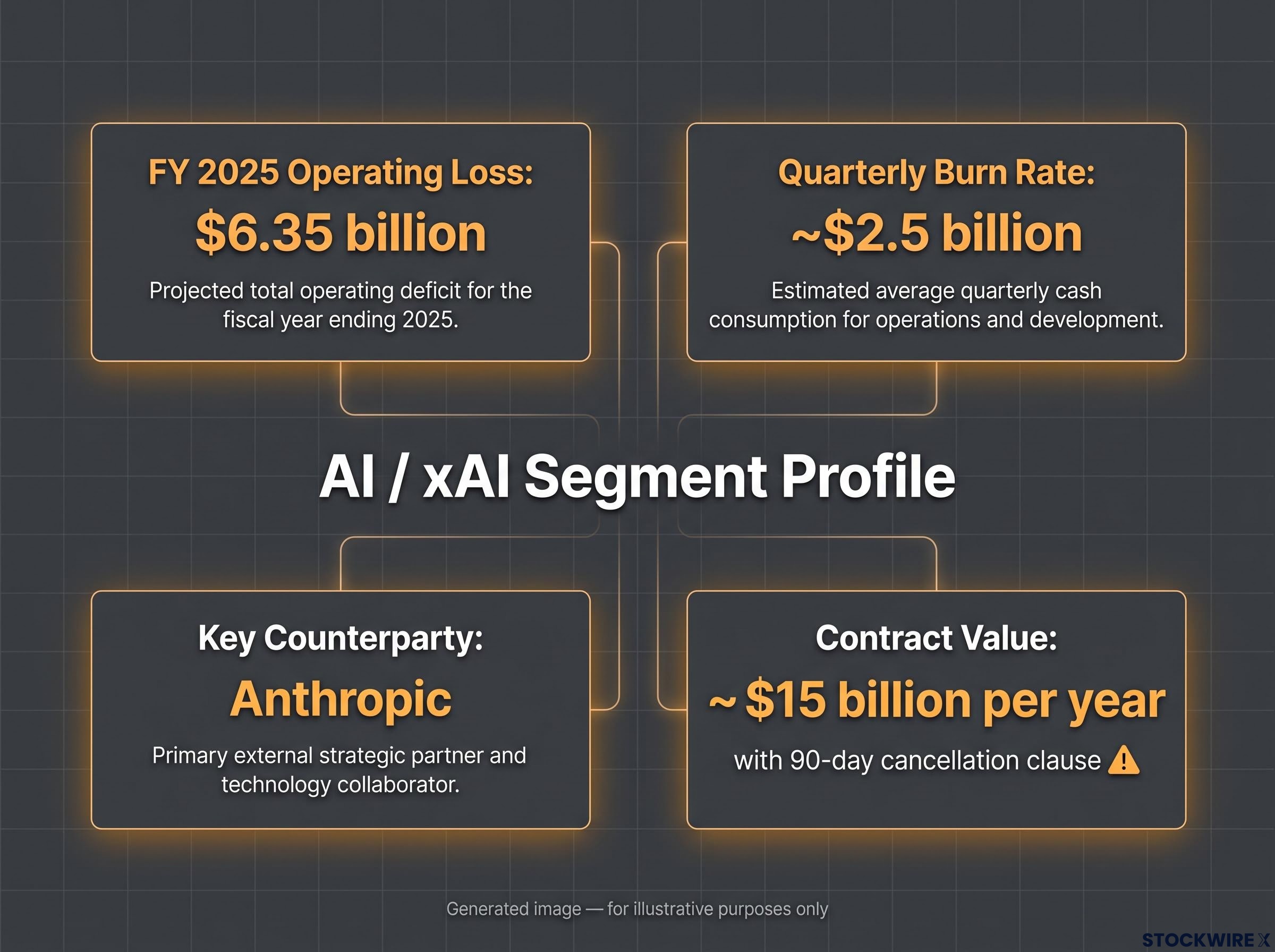
- Infrastructure leasing: Renting data centre compute capacity to firms including Anthropic and potentially Alphabet/Google, with the Anthropic contract alone valued at approximately $15 billion per year according to Morningstar analysis.
- Own AI products: Revenue from SpaceX’s own AI applications, currently a much smaller contributor.
The Anthropic contract carries a 90-day cancellation clause. That is the single most important risk factor for the AI segment: the contract is large enough to move results materially, and fragile enough that any counterparty shift would show up in the next quarterly report.
Where the AI losses come from
The segment recorded a $6.35 billion operating loss in FY 2025 on $3.2 billion of revenue, burning approximately $2.5 billion per quarter. Q1 2026 AI revenue reached $818 million (per Morningstar’s model), with operating losses ranging from $936 million to $2.47 billion depending on cost allocation methodology used in the filings.
Total company capital expenditure hit $20.7 billion in FY 2025, heavily driven by AI infrastructure investment. Analysts do not anticipate the segment turning profitable in the near term, given the continued expansion of compute and data centre capacity required to support the build-out. The losses are substantial, but they are a product of a construction phase rather than a fundamentally flawed business model.
Space Launch: profitable at the unit level, dragged by Starship development
The Space/Launch segment reported $4.1 billion in revenue and a $657 million operating loss for FY 2025. A reader seeing a multi-billion-dollar launch business with an operating loss might assume it cannot cover its costs. The underlying picture is different.
The distinction within the segment matters:
- Falcon 9 launches are profitable at the unit level. The reusable rocket programme generates positive economics on each mission.
- Starship development is the drag. The next-generation vehicle programme is a deliberate R&D investment consuming hundreds of millions in spending that shows up as a segment-level loss.
On an adjusted EBITDA basis, the segment produced approximately $653 million, near break-even once Starship R&D is contextualised as transitional investment. By Q1 2026, the quarterly operating loss had narrowed to approximately $70 million. A $70 million quarterly loss on a $4 billion annual revenue base, where the drag comes from a specific next-generation programme rather than failing unit economics, is a very different picture from a structurally unprofitable business.
The internal subsidy model: how Starlink is bankrolling SpaceX’s ambitions
The financial architecture revealed in the S-1 prospectus and first earnings report shows a deliberate internal subsidy structure, not a financial anomaly.
Starlink’s $4.4 billion in annual operating income and 63% EBITDA margin provide the primary internal cash generation. The Space/Launch segment is roughly neutral. The AI division and Starship together consume far more capital than they produce. Three sources fund the AI and Starship build-out:
- Starlink operating income (the internal profit engine)
- External capital raises (IPO proceeds and potential future offerings)
- AI infrastructure lease revenue from Anthropic, Google, and other counterparties
Analysts characterise SpaceX as a company using the cash flows from its profitable connectivity business to underwrite major development programmes, rather than one whose overall costs exceed its means.
The structure has a clear analogy in tech history: the way AWS subsidised Amazon’s retail expansion for years before retail reached self-sustaining margins (an analyst interpretive framing, not a company statement).
But the maths reveals a tension. Starlink generates $4.4 billion a year in operating income. The AI segment alone burns roughly $2.5 billion per quarter. Starlink is necessary but not sufficient; external capital is carrying a meaningful share of the AI build. Total company capex is projected by Morningstar to reach approximately $22.8 billion in FY 2026, up from $20.7 billion in 2025. Whether Starlink subscriber growth and AI lease revenue can scale fast enough to close that gap is the defining financial question for SpaceX over the next two to three years.
The gap between SpaceX’s fundamental value estimates and its $1.75-2 trillion IPO target is largely explained by priced-in optionality, the market’s assignment of a probability-weighted value to outcomes like commercial Starship operations, orbital compute, and AI infrastructure scale that have not yet been demonstrated in the financials.
What the first-ever earnings report tells investors about where SpaceX goes from here
Because SpaceX listed only recently, comparable quarterly figures from a year earlier did not exist at the time of reporting; historical results were disclosed alongside current-quarter data for the first time when the S-1 prospectus was filed. The familiar analyst exercise of measuring results against a prior-year baseline therefore cannot be applied here. Rather than functioning as a conventional performance verdict, this inaugural report serves primarily as a structural map: what investors are encountering is the layout of a long-range capital allocation strategy, not the final score of a mature and stable enterprise.
Analysts will monitor three metrics most closely in subsequent quarters:
- Starlink subscriber trajectory and EBITDA margin stability: Morningstar projects 93% subscriber growth for FY 2026. Whether margins hold as the base scales will determine the strength of the profit engine.
- AI segment capex and any signals on timeline to profitability: The burn rate is running at approximately $2.5 billion per quarter, and any guidance on when infrastructure lease revenue narrows the gap will move sentiment.
- Anthropic and Google contract durability: The $15 billion per year Anthropic contract with its 90-day cancellation clause is the single highest-impact variable for AI segment revenue. Morningstar’s Nicolas Owens has noted that AI infrastructure lease revenue could produce Q2 2026 results that exceed investor expectations, but the cancellation risk means that upside is fragile.
For anyone following SpaceX as a newly public company, knowing which metrics actually move the investment case is more valuable than any single quarterly number.
Post-listing performance factors, including the conservatism of initial guidance, investor base composition, and lock-up structure, are set before the first trade executes and shape aftermarket returns largely independently of how the underlying business performs in its first reporting periods.
A profitable satellite business, a capital furnace, and an open question about timing
The segment-level picture is clear. Starlink is profitable and scaling. Space Launch is near break-even with Falcon 9 as a profitable core. The AI division is the variable that will define whether SpaceX’s consolidated financials improve or worsen over the next two to three years.
The internal subsidy structure is coherent as a strategy, but it depends on two conditions holding simultaneously: Starlink’s growth continuing and AI infrastructure lease revenues maturing before the burn rate strains the company’s external capital access. Investors now have the segment-level data they could not access before the IPO. The work of interpreting it starts with understanding which segment is doing what, and this first report gives you exactly that.
This article is for informational purposes only and should not be considered financial advice. Investors should conduct their own research and consult with financial professionals before making investment decisions. Financial projections referenced are subject to market conditions and various risk factors. Forward-looking statements, including analyst projections from Morningstar, are speculative and subject to change based on market developments and company performance.