SpaceX became the largest IPO in history on 11 June 2026, and within six weeks its stock had shed more than 44% from its all-time high. Investors who bought at the peak are firmly underwater, and the decline raises an uncomfortable question: did the market price years of AI-infrastructure growth into a single afternoon of trading?
The selloff is not a SpaceX-specific story in isolation. It is unfolding inside a broader repricing of AI-adjacent equities, one that is testing whether companies supplying the infrastructure layer of the AI buildout can grow into the valuations the market assigned them during the boom. SpaceX, through Starlink, was one of the most prominent beneficiaries of that narrative. It is now one of the most prominent casualties of its reversal.
Here is what the numbers actually show, where Wall Street analysts disagree and by how much, and what the company’s first earnings report as a public company will need to deliver to resolve the uncertainty. After reading, you will have a clear framework for evaluating whether the current price reflects a buying opportunity or a stock still in the process of being fundamentally repriced.
From $135 to $112: how SpaceX’s record IPO became a record drawdown
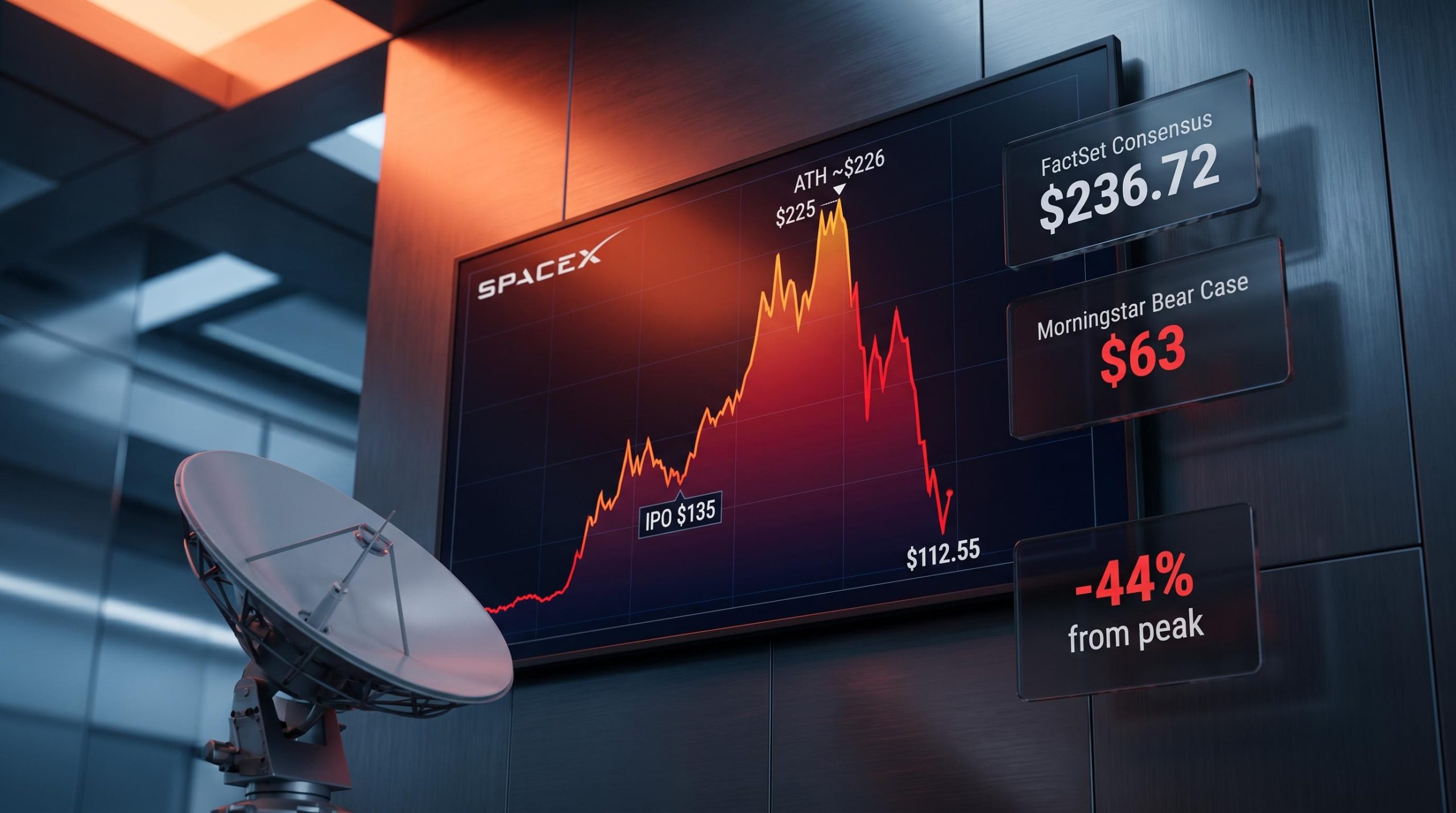
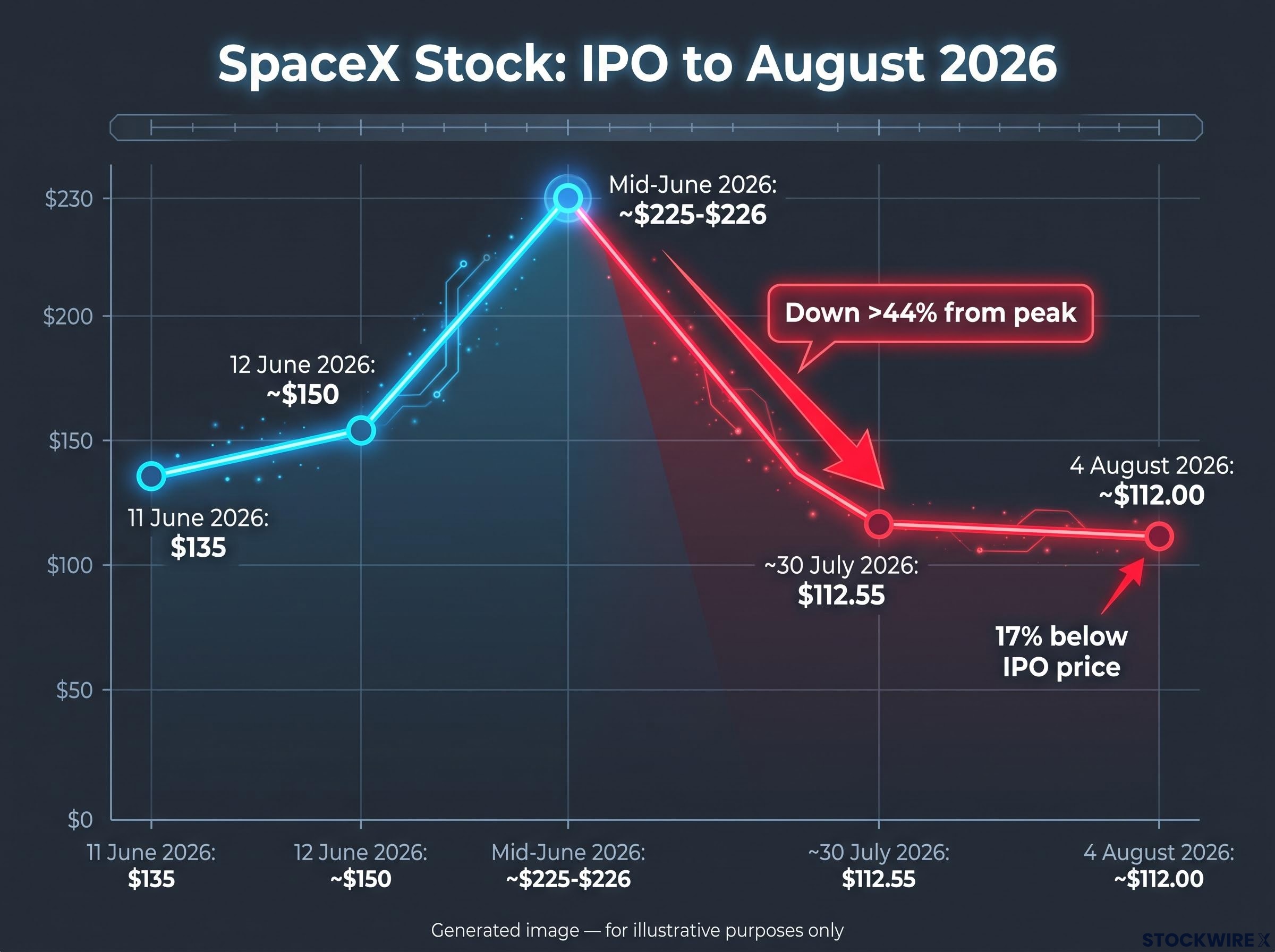
The timeline tells the story faster than any analysis can. SpaceX priced at $135 on 11 June 2026, opened at approximately $150 the following morning, and by mid-June had climbed to an intraday high near $225-$226. At its peak, the company’s market capitalisation touched approximately $2 trillion, placing it alongside Amazon and Microsoft among the most valuable public companies on earth.
Then the reversal began. Shares fell through $200, then $150, then broke below the $135 IPO price by mid-July and kept sliding. At its closing low of $112.55, reached on approximately 30 July 2026, the stock had fallen more than 44% from its peak closing level and stood about 17% beneath the original offering price. Intraday, shares have traded as low as the $104.83-$110.47 range.
The three demand forces behind the surge, pent-up access demand, a multi-theme narrative premium, and front-running of anticipated index inclusion, each contributed to a price level that required rapid Starlink scaling and AI contract conversion to justify on fundamentals.
As of 4 August 2026, the stock sits near $112.00.
| Date | Event | Price Level |
|---|---|---|
| 11 June 2026 | IPO priced | $135 |
| 12 June 2026 | First trading day open | ~$150 |
| Mid-June 2026 | All-time intraday high | ~$225-$226 |
| ~30 July 2026 | Closing low | $112.55 |
| 4 August 2026 | Current price | ~$112.00 |
The speed of this reversal matters. Peak to closing low in roughly six weeks is not a slow fade driven by deteriorating fundamentals. It is a violent repricing of sentiment, and that distinction is important when assessing whether a bottom is forming.
When big ASX news breaks, our subscribers know first
What the AI spending supercycle has to do with a rocket company
On the surface, SpaceX is an aerospace company. In the market’s pricing model, it was something else entirely: an AI-infrastructure play. Starlink’s broadband satellite network positioned SpaceX as a supplier of connectivity infrastructure to the same buildout that was lifting chipmakers, hyperscalers, and data centre operators to record valuations. That framing attracted capital that would not typically flow toward a rocket company.
The same macro force that lifted the stock is now pulling it down. Chip and hardware names that had posted gains running into the triple digits earlier in the year have sold off alongside SpaceX, as have major hyperscalers such as Alphabet and Meta Platforms, reflecting a broad retreat from AI-adjacent positions rather than any problem specific to SpaceX. This is a sector-wide repricing, not idiosyncratic underperformance.
The scrutiny extends well beyond SpaceX: analysis of hyperscaler capex and AI infrastructure returns published in August 2026 shows that Microsoft, Alphabet, Meta, and Amazon are all facing investor pressure to demonstrate that surging capital expenditures are generating measurable revenue returns, a standard that AI-adjacent equities across the sector are now being held to.
The categories of AI infrastructure spending now under investor scrutiny include:
- Data centres and associated power infrastructure
- Satellite connectivity (where Starlink sits)
- Undersea cables and terrestrial fibre networks
- Semiconductor and chip supply chains
The question driving the correction is whether massive AI infrastructure capital spending will translate into earnings on the timeline the market has priced in, or whether companies supplying that infrastructure have been overvalued relative to their near-term ability to monetise the buildout.
The fact that SpaceX’s decline tracks the broader AI infrastructure correction, rather than diverging from it, tells you the stock is being traded primarily as an AI-infrastructure thesis. That thesis, not rockets or launch cadence, is what needs to be evaluated before making any position decision.
Understanding why a $2 trillion valuation at IPO was always a high-wire act
When a company goes public, the market does not price what it earns today. It prices what it expects the company to earn across a multi-year horizon, discounted back to the present. The more growth the market expects, the higher the IPO valuation relative to current revenue and cash flow.
At $2 trillion, SpaceX was priced not just for growth but for perfection. That valuation required Starlink subscriber counts, average revenue per user, and margins to scale at a pace that justified capitalising years of future revenue into the stock on day one, all while the company remained loss-making and capital-intensive. The comparison set at that market cap was Amazon and Microsoft, both of which generate enormous free cash flow. SpaceX does not.
The three components the market was trying to price simultaneously:
- Starlink subscriber economics: how quickly user numbers, retention rates, and per-user revenue scale toward profitability
- Launch services profitability: whether the reusable rocket business generates enough margin to fund the broader ambitions
- AI and defence contract revenue: whether government and enterprise contracts tied to AI workloads and secure communications add a durable, high-margin revenue stream
Understanding that IPO pricing is forward-looking by design tells you that a 44% decline does not necessarily mean something went wrong with the company. It may simply mean the market overcapitalised the future and is now correcting back toward a more evidence-anchored present value. That is a rational market process, not a breakdown.
The $174 gap: why Wall Street is split more sharply on SpaceX than almost any stock
The FactSet consensus price target for SpaceX stands at $236.72. At the current price near $112, that implies the stock would need to more than double to reach the average analyst’s estimate of fair value. Most tracked coverage leans Buy or Overweight.
Then there is the outlier. Morningstar’s coverage of SpaceX is handled by analyst Nicolas Owens, whose fair value estimate of $63 per share makes him the only analyst in FactSet’s tracked universe to rate the stock as overvalued as of 4 August 2026.
Morningstar’s fair value estimate: $63 per share (analyst Nicolas Owens), grounded in a DCF-based framework that weights SpaceX’s losses, capital intensity, and uncertain AI monetisation timelines more heavily than the sell-side consensus does.
The spread between those two figures is approximately $173.72. That is not a normal range of disagreement. It signals that the two sides are modelling fundamentally different futures for Starlink and AI-infrastructure revenues. The consensus assumes rapid scaling. Owens assumes the monetisation timeline is longer than the market has priced, and that capital intensity will erode returns in the interim.
Sum-of-the-parts valuation applied with discipline about segment maturity is the methodology that separates the launch services business, which has a documented revenue ceiling, from the broadband and compute segments that carry the bulk of the $236.72 consensus price target.
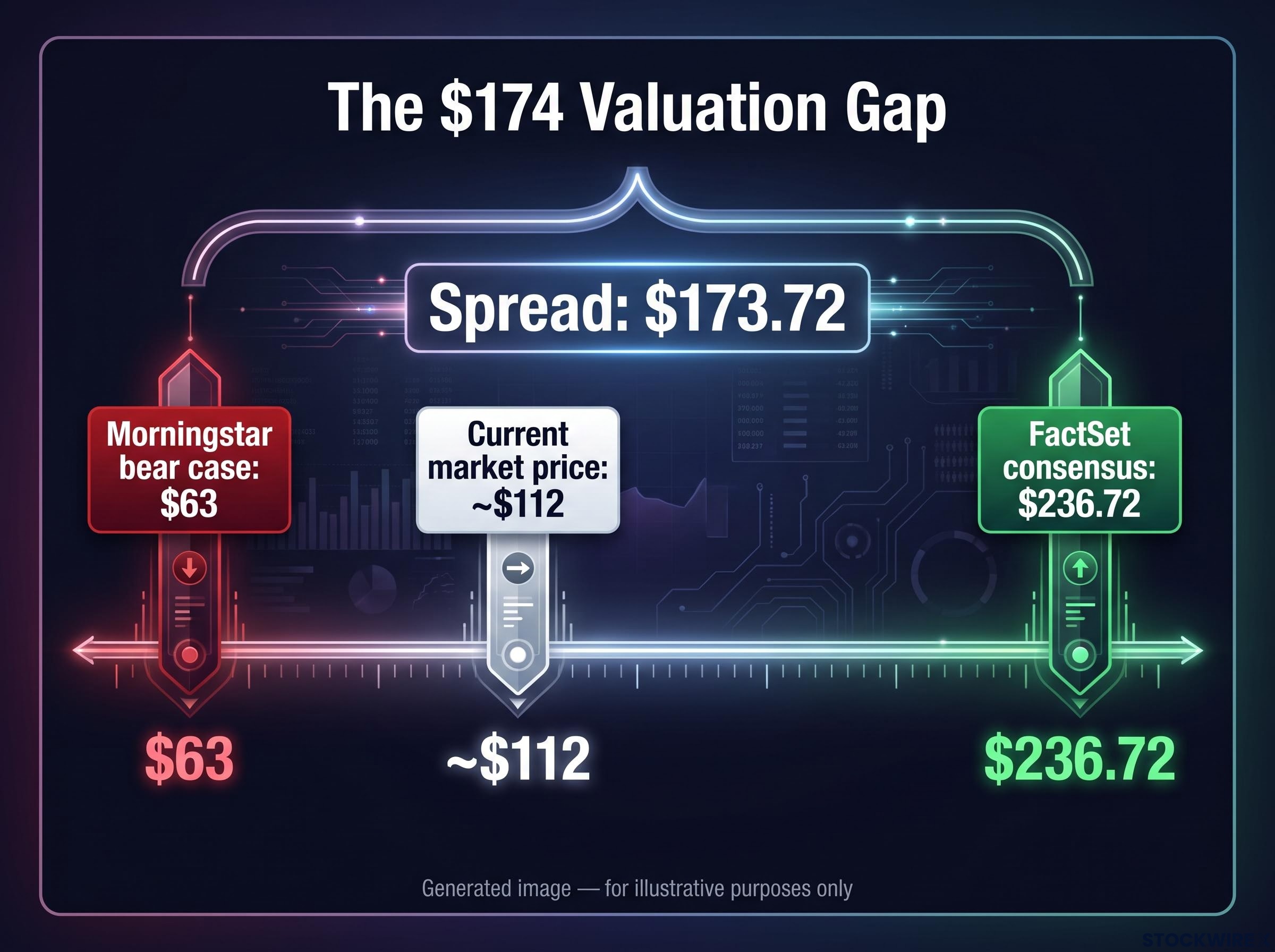
| Valuation Reference | Price | Implied Move from Current (~$112) |
|---|---|---|
| Morningstar bear case | $63 | -43.8% |
| Current market price | ~$112 | — |
| FactSet consensus | $236.72 | +111.4% |
The current price of approximately $112 sits far closer to the Morningstar bear case than the consensus target. Either the market is deeply wrong and presenting a major opportunity, or the majority of sell-side analysts are anchored to a narrative the market is actively rejecting. Both readings are defensible. That is precisely the problem.
What SpaceX’s first earnings report actually needs to show
SpaceX’s first quarterly report as a public company, expected in early September 2026, will be unlike any routine earnings release. It will provide the first standardised, audited look at metrics the market has until now been modelling from incomplete pre-IPO data. That changes the information environment materially.
Four categories of data will determine whether the stock stabilises or the decline accelerates:
- Starlink subscriber metrics: total subscriber count, churn rate, and average revenue per user. These numbers speak directly to the monetisation pace that underpins the bull case. If ARPU (the average dollar amount each subscriber generates per month) is growing, the scaling thesis holds. If churn is rising, it does not.
- Segment profitability trajectory: whether launch services, Starlink, and other business lines are moving toward operating profitability or remain deeply negative. The distance from breakeven matters as much as the direction.
- Capex and free-cash-flow guidance: management’s framing of how quickly investment translates into free cash flow, and whether additional debt or equity issuance may be needed. This tells you how long the capital-intensive phase lasts.
- AI and defence contract revenue detail: how much of the revenue story depends on contracted AI workloads, secure communications, or defence applications versus consumer broadband. This tells you whether the AI-infrastructure thesis has real revenue behind it or remains aspirational.
SpaceX’s Q1 loss profile, approximately $4.28 billion in net losses on $4.69 billion in revenue, is the fundamental data point that makes the capital intensity question in the September earnings report so consequential for investors modelling when free cash flow turns positive.
The timing is especially consequential. This first earnings release lands at a moment when investors have grown notably more sceptical of richly valued AI stocks, sharpening the scrutiny on everything SpaceX reports. Strong numbers and guidance that support the bull thesis could stabilise or partially recover the stock. Weaker results or heavier cash burn could validate the $63 Morningstar estimate and accelerate the decline.
The earnings report does not just update the financial model. It calibrates which of two fundamentally different futures is actually materialising. You should approach it as a thesis test, not a routine quarterly update.
Where the stock goes from here depends on which future you believe in
The core tension is clear. The consensus bull case rests on Starlink and AI-infrastructure revenues scaling rapidly enough to justify the IPO valuation. The Morningstar bear case rests on the premise that the monetisation timeline is longer than the market has priced, and that capital intensity will erode returns before the revenue arrives.
Three variables will determine which scenario prevails:
- Starlink subscriber and ARPU trajectory: the single largest driver of whether the revenue base can grow into a multi-hundred-billion-dollar valuation
- AI contract revenue conversion: whether AI-linked contracts generate real, recurring revenue, not just announcements and memoranda of understanding
- Capital structure risk: whether SpaceX can fund its programmes through operating cash flow and debt, or whether dilutive equity raises become necessary
At approximately $112, SpaceX stock is not obviously cheap or obviously expensive. It is priced between a $63 bear case and a $236.72 bull case, and the 44% drawdown from peak represents the market’s current stated view that the original narrative was overpriced. The appropriate response is not to default to the consensus. It is to form a view on the AI monetisation timeline before you act, because that timeline is what you are buying or selling at this price.
For investors ready to model a position at the current price, our comprehensive walkthrough of margin of safety stock valuation applies a 15% return hurdle and 30-50% discount to intrinsic value, with worked examples showing how the framework handles high-capex, loss-making growth companies.
This article is for informational purposes only and should not be considered financial advice. Investors should conduct their own research and consult with financial professionals before making investment decisions. Past performance does not guarantee future results. Financial projections are subject to market conditions and various risk factors.