The electricity bill for training a single large AI model can exceed the annual consumption of several thousand homes. Multiply that across thousands of data centres being built simultaneously, and you begin to see why utility companies, long dismissed as the most boring corner of the stock market, are quietly sitting at the centre of the AI investment story.
The AI infrastructure build-out requires physical power at a scale that is rewriting load forecasts across the U.S. and global grid. That demand does not flow to Nvidia or OpenAI. It flows to the companies that generate and deliver electricity, and to the ETFs that hold them. In 2026, that makes the utility sector a structurally different proposition from what it was three years ago.
Here is the case for why utility ETFs deserve a serious look from income-focused investors right now, how that exposure actually works in practice through vehicles like covered-call utility ETFs, and what the genuine risks are before you decide.
The numbers behind the AI power surge
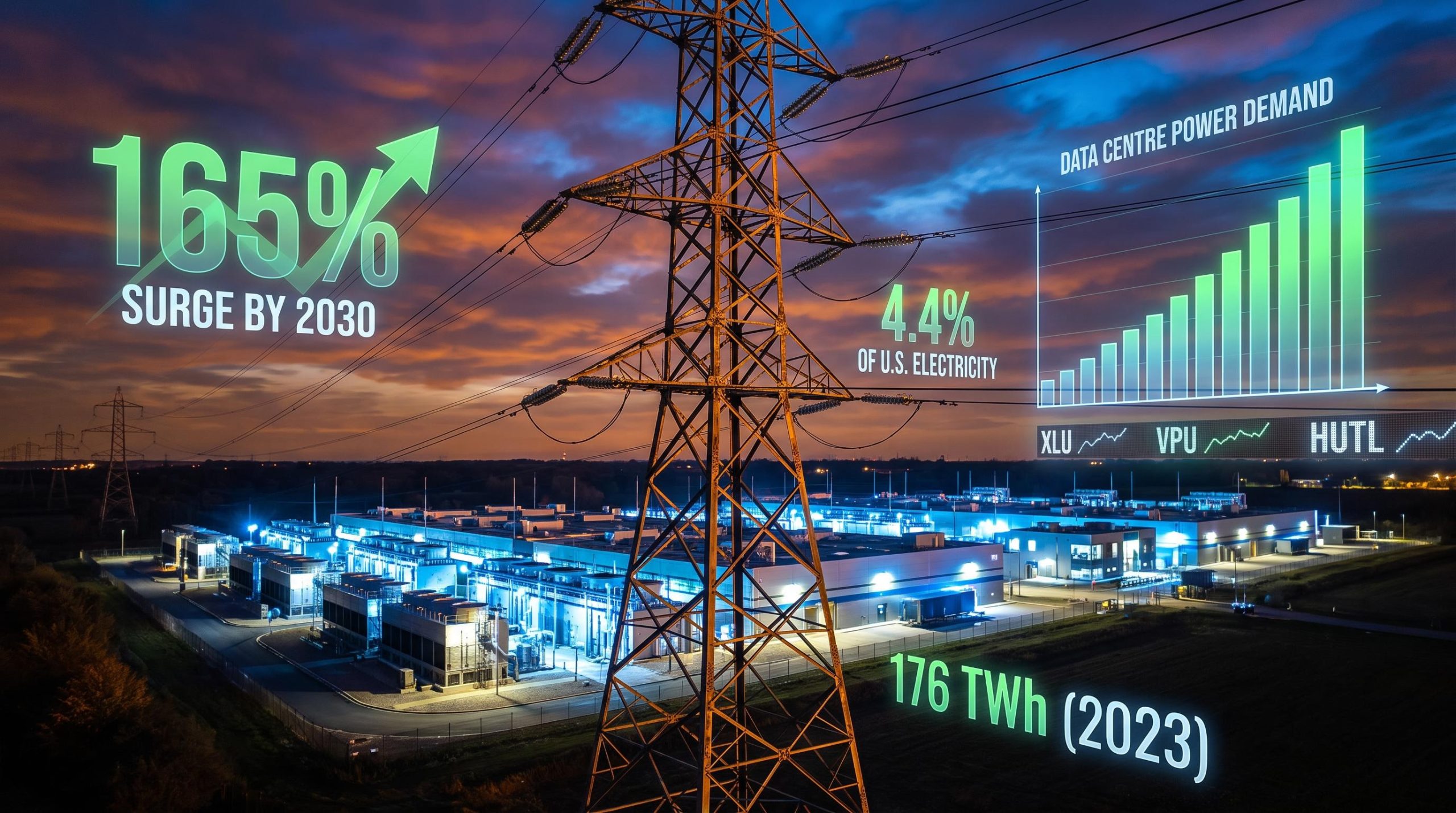
Start with the baseline. The International Energy Agency estimated that data centres consumed approximately 415 TWh of electricity globally in 2024, roughly 1.5% of worldwide electricity consumption. In the U.S. alone, data centres used approximately 176 TWh in 2023, representing about 4.4% of total U.S. electricity.
Those numbers are already large. The projections ahead are significantly larger.
- 2023 baseline: U.S. data centres consumed approximately 176 TWh, or 4.4% of total U.S. electricity
- 2028 projection: The U.S. Department of Energy projects data centres could consume 6.7-12% of total U.S. electricity
- 2030 projection: Goldman Sachs Research projects data centre power demand could surge by 165% or more versus 2023 levels, driven largely by AI workloads
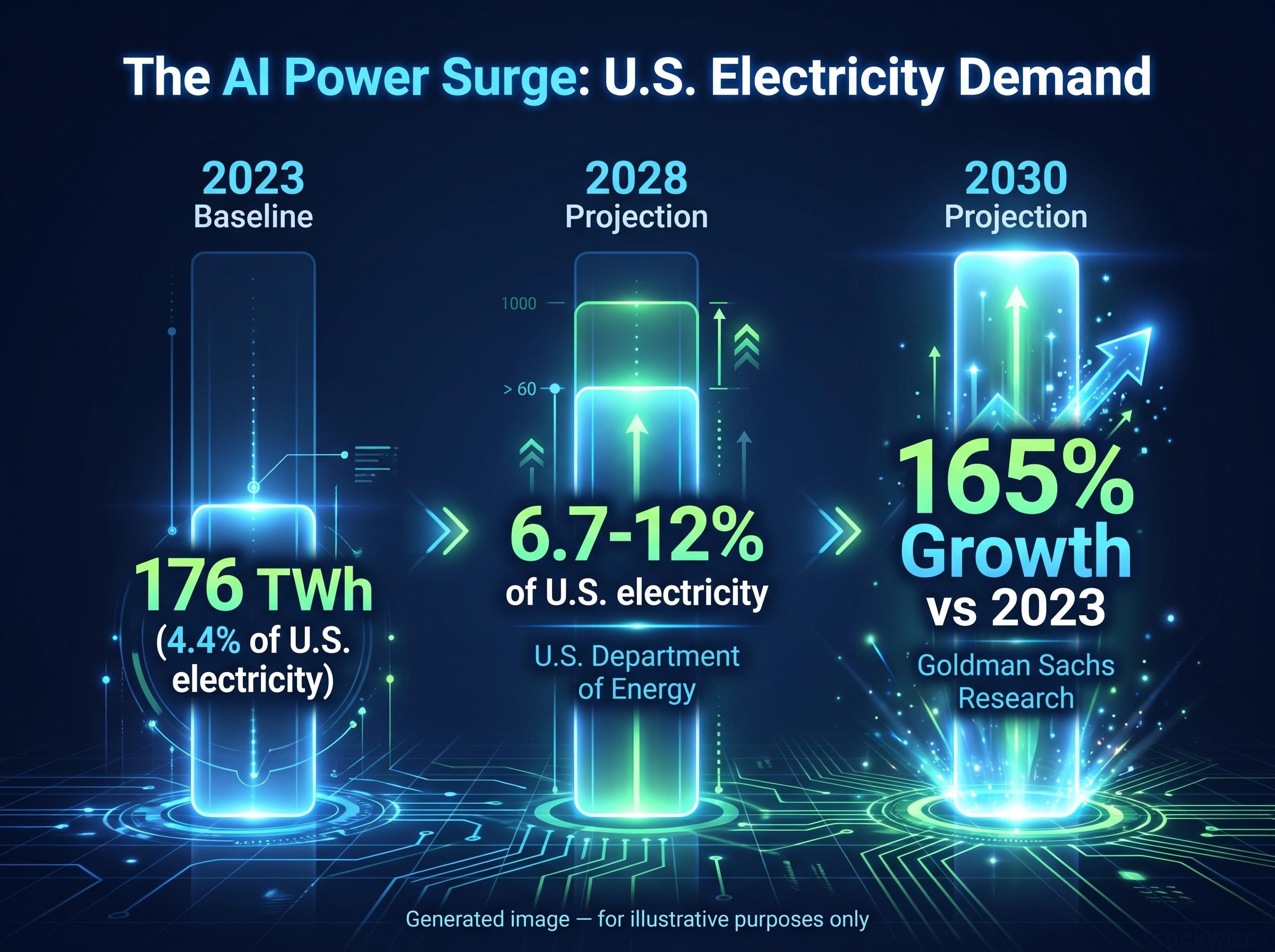
Goldman Sachs Research projects data centre power demand could grow by approximately 165% by 2030 relative to 2023 levels. This is one of the most widely cited institutional anchors for the AI electricity demand thesis.
Grid Strategies, in work cited by Colorado’s Legislative Council, identifies data centres as the single largest driver of incremental U.S. electricity demand in the current decade.
The IEA projects data centre and AI electricity consumption will exceed 1,000 TWh by 2026, a trajectory that analysts tracking the structural grid crisis have described as a national-scale infrastructure emergency rather than a cyclical demand bump.
The projections matter because they signal something specific: utility revenue and load growth are now tied to a decades-long infrastructure commitment from the world’s most capitalised technology companies. For an investor evaluating this sector, that represents a structural floor under demand, not a temporary spike that fades once the AI training cycle slows.
When big ASX news breaks, our subscribers know first
Why this changes the utility sector’s investment profile
For most of the past two decades, utilities were bond proxies. You bought them for yield, accepted slow growth, and understood that rising interest rates would compress their valuations. The ceiling was low, the floor was solid, and the sector rarely surprised anyone.
That characterisation is no longer complete. The utility sector now sits at the intersection of two simultaneous secular tailwinds that are rewriting its growth profile.
The first is AI infrastructure demand: fast-growing, long-duration additions to the electricity load base from data centres that, once operational, represent multi-decade consumption commitments. The second is economy-wide electrification, including electric vehicles, heat pumps, and industrial process conversions, all of which add incremental load on top of baseline essential-services demand.
A capex cycle not seen in fifty years
U.S. utilities are planning generation and transmission build-outs on a scale not seen since the 1970s, with investment timelines measured in decades. Regulated utilities earn predictable, rate-base returns approved by regulators, insulating earnings from short-term economic volatility. That same regulatory structure that historically capped utility growth now provides a floor under earnings precisely when demand is accelerating; an unusual combination that warrants specific attention from income-focused investors.
Goldman Sachs has repositioned its AI infrastructure thesis toward neocloud operators and utilities, characterising power and compute as scarce, contract-backed assets secured through 15-20 year lease agreements, a framing that aligns with why regulated utility earnings are now treated as structurally more predictable than at any point in the prior decade.
Edison Electric Institute capex data shows investor-owned electric companies are committed to deploying $1.4 trillion through 2030 to strengthen U.S. energy infrastructure, with annual capital expenditures reaching a record $204.1 billion in the most recently reported year, the fourteenth consecutive year of record-high investment.
Sector-level utility ETFs provide exposure across several distinct sub-segments:
- Regulated utilities: Stable, rate-based returns with low earnings volatility, providing the income backbone
- Independent power producers: More merchant exposure with potentially greater earnings upside as power prices rise
- Grid and transmission owners: Direct beneficiaries of the network upgrade investment cycle required to deliver electricity to new data centre clusters
How covered call overlays turn utility exposure into an income engine
Start with a single transaction. A fund holds shares of a utility company. The fund’s management team writes (sells) a call option on those shares, giving the buyer the right to purchase them at a specified price. The buyer pays a premium for that right. The fund collects that premium as income, regardless of whether the option is ever exercised. That is a covered call.
Scale that across an entire portfolio of utility stocks, and the option premiums become a meaningful, recurring income stream layered on top of the dividends the underlying stocks already pay.
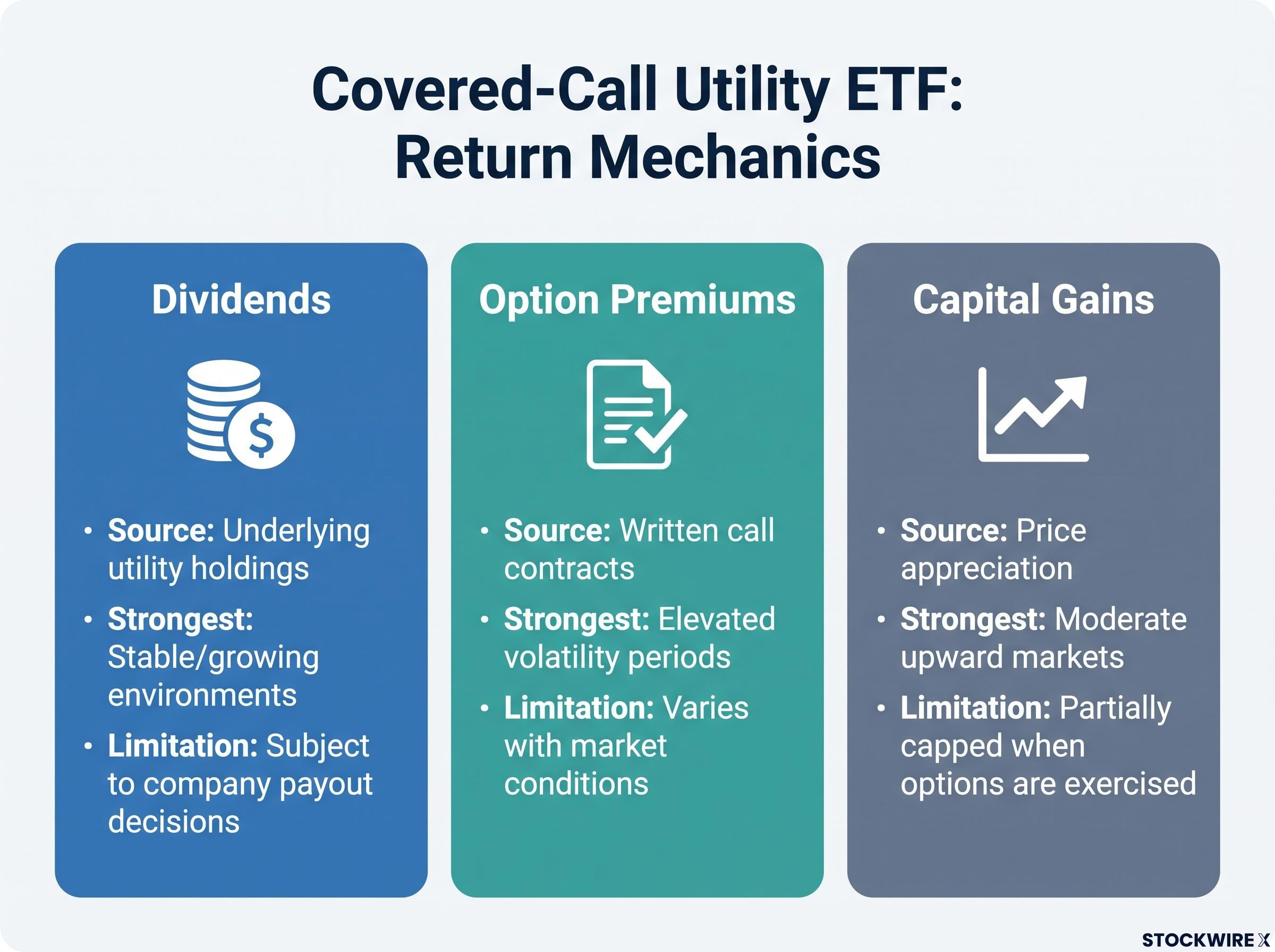
| Return Component | Source | Strongest Market Condition | Limitation |
|---|---|---|---|
| Dividends | Underlying utility holdings | Stable or growing earnings environments | Subject to company payout decisions |
| Option premiums | Written call contracts | Elevated volatility periods | Premium income varies with market conditions |
| Capital gains | Price appreciation of holdings | Moderate, steady upward markets | Partially capped when options are exercised |
The core tradeoff is explicit. In a strong bull market, the fund sacrifices upside above the strike price because the option buyer exercises their right to purchase the shares. In volatile or sideways markets, the fund collects premium income without that cost materialising.
Utilities are particularly well suited to this strategy because the sector has historically delivered the majority of its total return through dividends rather than explosive price appreciation. The opportunity cost of capped upside is lower here than in high-growth sectors, which makes the enhanced income stream a more natural fit.
Harvest Canadian Utilities ETF (HUTL) reported a distribution yield of approximately 7.97% at the time of research, paid monthly. This figure is updated daily and is illustrative only. Investors should verify the current yield directly from the provider’s product page before drawing conclusions.
The practical implication: a covered-call utility ETF can deliver yield that would be difficult to replicate from utility dividends alone. But you should understand exactly what you are giving up (uncapped equity upside) and whether that trade suits your specific objectives. Investors should also note that a portion of distributions from covered-call ETFs may constitute return of capital, with tax implications that vary by investor circumstance and jurisdiction.
Option premiums are highest when market volatility is elevated. That means covered-call utility ETFs can generate particularly attractive income in uncertain macroeconomic environments, precisely when income-seeking investors most value predictability.
What utility ETFs are actually providing exposure to in an AI portfolio
A utility ETF is not an AI investment in the way that buying Nvidia or a cloud computing fund is an AI investment. This distinction matters for portfolio construction.
Utility ETF exposure is picks-and-shovels infrastructure exposure to the AI energy build-out: the grid, generation assets, and physical electricity delivery. It is not exposure to AI software, AI chips, or AI platform businesses. The return drivers are fundamentally different. Utility returns are shaped by regulated earnings, load growth, and dividend policy. AI technology returns are shaped by adoption curves, competitive positioning, and margin expansion.
That difference is precisely what makes utility ETFs useful in a portfolio that already holds direct AI exposure. They provide a structurally correlated demand tailwind without duplicating the same risk factors.
Power availability has emerged as the most structurally durable of the AI infrastructure binding constraints, with multi-year grid interconnection delays reported by utilities confirming this is a structural bottleneck rather than a cyclical one, which in turn validates the multi-decade load commitment framing that underlies the utility growth thesis.
Think of a utility ETF as a bridge asset: sitting at the intersection of traditional income investing (bonds, dividend stocks) and long-term growth themes (AI infrastructure, electrification). Your portfolio construction decision is whether you want utility ETFs as an income allocation, an AI-adjacent thematic allocation, or a bond-proxy replacement. The analytical framework is different for each.
The broader ETF landscape confirms this is a mainstream trade
Multiple institutional-grade funds are explicitly positioned around AI-driven electricity demand, confirming this as a recognised investment category rather than a speculative niche.
| ETF Ticker | Strategy Type | AI Exposure Mechanism | Income Enhancement |
|---|---|---|---|
| XLU | Broad U.S. utilities | Large-cap utility holdings with AI-driven load growth | No covered call |
| VPU | Broad U.S. utilities | Broader basket; same AI electricity tailwind | No covered call |
| AIPO | Thematic AI infrastructure | Explicit data centre power and grid focus | No covered call |
| GRID | Smart grid infrastructure | Grid modernisation and electrification | No covered call |
| HUTL | Diversified utilities | Canadian, U.S., and international utility holdings | Covered call overlay |
The presence of multiple funds spanning vanilla utility exposure through to explicitly themed infrastructure vehicles tells you this is a thesis the institutional market has priced in as durable, not speculative.
Risks that belong in the analysis before you decide
- Interest-rate sensitivity: Utilities trade as yield alternatives to bonds. When rates rise, their relative attractiveness declines compared to risk-free alternatives, compressing valuations even when underlying fundamentals are improving. The recent utility rally has coincided with expectations of lower or stable borrowing costs. If rate expectations shift materially upward, near-term valuation pressure can arrive independently of whether the AI demand thesis plays out as projected. For most investors evaluating utility ETFs in mid-2026, rate trajectory is the single most important variable to monitor.
The same rate transmission channels that affect REITs apply with comparable mechanics to utility valuations: rising discount rates compress the present value of regulated earnings streams, yield competition from government bonds reduces relative attractiveness, and higher borrowing costs squeeze the capex financing spreads that underpin utility growth projections.
- Regulatory and political risk: Regulated returns are set by jurisdiction-specific regulators. Adverse decisions can cap earnings growth even in a strong demand environment. A globally diversified utility ETF reduces this risk but does not eliminate it. You should understand the regulatory frameworks of the major jurisdictions represented in any fund you hold.
- Yield variability and return of capital: Distribution yields on covered-call ETFs are variable and updated frequently. A portion of distributions may constitute return of capital rather than income, which carries differing tax treatment depending on your jurisdiction and circumstances. Review the distribution breakdown carefully, and consider fund fees alongside yield figures when comparing income vehicles.
This is not a generic disclaimer list. Each of these risks has the capacity to weaken the investment case even while the structural demand story remains intact. Understanding the conditions under which the thesis weakens is as important as understanding the conditions under which it strengthens.
Making a considered call in a sector that has changed its character
The core argument is straightforward. AI infrastructure demand has created a structural electricity load tailwind that changes the utility sector’s growth profile while leaving its income and regulatory-stability characteristics largely intact. That is a genuinely distinct combination for income-focused portfolios: accelerating demand underneath a business model built for earnings predictability.
The investor profile most analytically suited to this trade is income-first: retirees, cash-flow-centric portfolios, and those who prioritise distribution magnitude and regularity over maximising total return across full market cycles. If you are comfortable with partially capped equity upside and view rate stability as the key macro condition to monitor, the covered-call utility ETF structure fits that profile by design.
One practical framework: size a covered-call utility ETF as a dedicated income sleeve within the broader portfolio, keeping it separate from core equity holdings, and channel the monthly distributions systematically into other positions rather than letting them accumulate idle. That discipline extracts the yield benefit while preventing overconcentration in a single sector thesis.
Two forward variables matter most for monitoring the investment thesis over time:
- Interest rate trajectory: The single largest near-term risk to utility ETF valuations, regardless of how strongly the demand story develops
- Data centre demand materialisation pace: AI-related infrastructure investment cycles are projected to extend through the early 2030s and beyond, with data centre load growth expected to roughly double by 2030. Whether demand materialises at, above, or below projection will determine how durable the sector’s growth premium proves to be
This article is for informational purposes only and should not be considered financial advice. Investors should conduct their own research and consult with financial professionals before making investment decisions. Past performance does not guarantee future results. Financial projections are subject to market conditions and various risk factors.