Of the $446 million still owed to roughly 6,000 Australians when the First Guardian Master Fund was wound up, liquidators had recovered approximately $1.6 million by late 2025.
Most of that money was not speculative capital. It was retirement savings, compulsory super contributions and salary sacrifice built up over decades, transferred out of regulated super funds on the recommendation of financial advisers. For the thousands of people affected, the First Guardian collapse is not a corporate failure they read about. It is the disappearance of the money they were counting on to retire.
Here is what this piece covers: how a collapse like this actually happens, who was supposed to stop it and did not, what ASIC is now doing about it, and the specific questions any Australian with super or managed fund exposure should be asking right now. If you hold money in a managed fund or a choice super platform, the mechanics of this story are directly relevant to you.
What First Guardian actually was, and who put money into it
On the surface, First Guardian looked credible. It was a registered managed investment scheme (a pooled fund where investors’ money is combined and invested by a professional manager) launched in 2019 and operated by Falcon Capital Limited in Melbourne. The fund was marketed as a diversified strategy across equities, property, private equity and fixed income, and pitched as an outperformer relative to mainstream super funds.
A managed investment scheme pools contributions from multiple investors into a single fund operated by a responsible entity, with your money allocated across assets according to the scheme’s disclosed strategy; the mechanics of how managed investment scheme structures price units, distribute income, and apply fees are what determined how First Guardian’s problems compounded unseen across six thousand accounts.
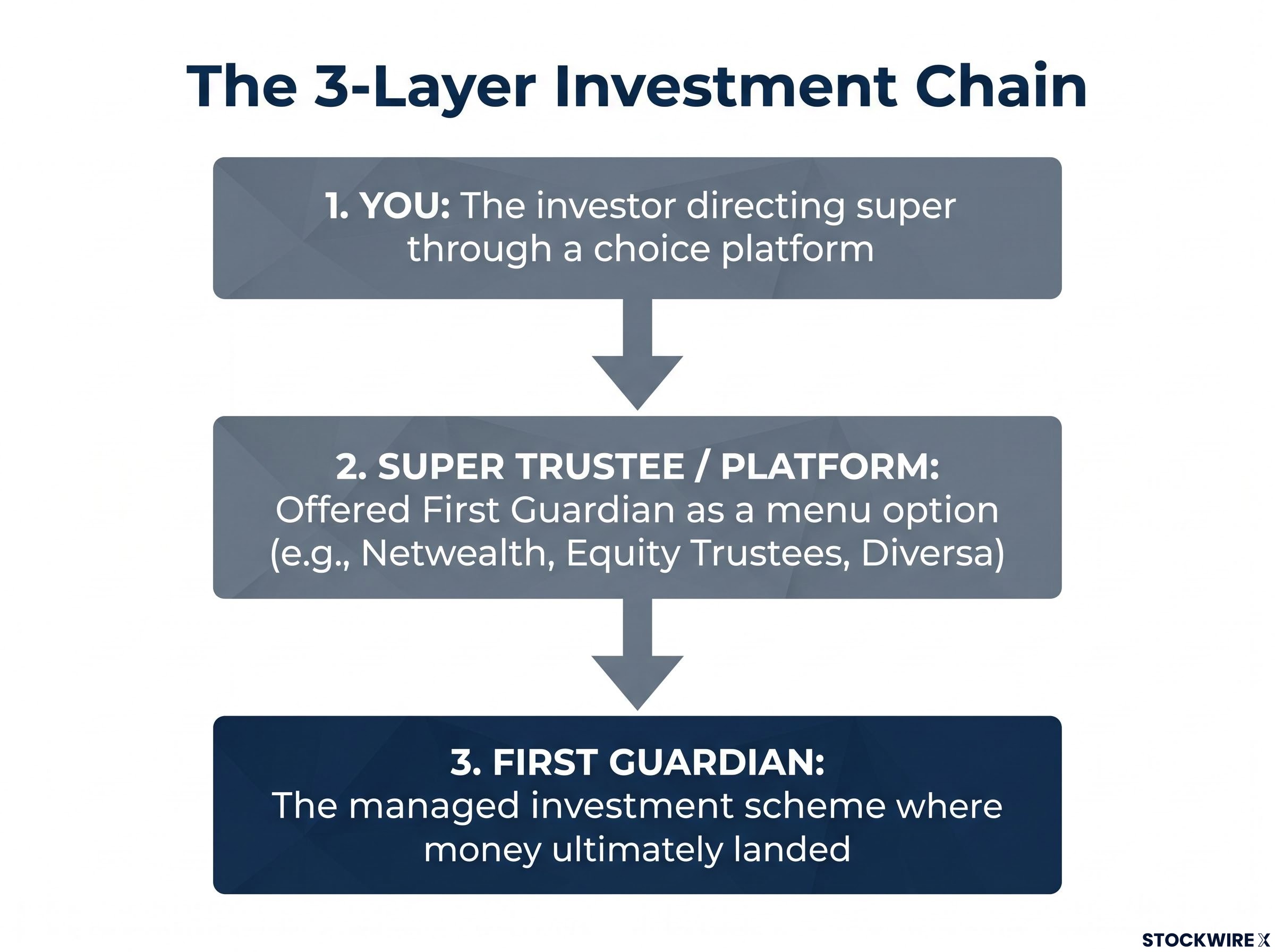
Most of the approximately 6,000 investors did not invest directly. They entered through superannuation choice platforms, including trustees such as Netwealth, Equity Trustees and Diversa, often on the recommendation of a financial adviser. The investment chain had three distinct layers:
- You, the investor, directing your super through a choice platform
- The super trustee or platform, which offered First Guardian as an investment menu option
- First Guardian itself, the managed investment scheme where your money ultimately landed
That layered structure matters. When you moved super from an APRA-regulated fund (the Australian Prudential Regulation Authority oversees banks, insurers and large super funds) into a choice platform and then into a managed investment scheme, you were stepping down from prudential oversight without most investors realising it. For the overwhelming majority of those 6,000 people, this was compulsory super and salary sacrifice, not discretionary wealth. The risk profile of their actual position was categorically different from what their advisers may have presented.
In May 2024, Falcon Capital froze redemptions, the first visible sign to investors that something was wrong.
When big ASX news breaks, our subscribers know first
How $446 million disappeared: what liquidators found inside the fund
When FTI Consulting was appointed as liquidator and began examining the fund’s books, the findings arrived in layers, each worse than the last.
The first concern was the fund’s mechanics. Liquidators told investors the fund bore the hallmarks of a Ponzi scheme: new investor money was allegedly used to meet obligations to existing investors rather than deployed into genuine, income-producing assets. The returns investors saw on their statements were not generated by a working portfolio. They were generated by an inflow of fresh capital.
Then came the related-party lending. Approximately $70 million had been lent or invested in entities linked to First Guardian’s own directors, with little or no evidence of repayment. More than $240 million went into overseas investments that liquidators are finding extremely difficult to recover, locked in jurisdictions where enforcement is slow or impractical.
And then the personal spending. A Lamborghini worth approximately $548,000 was purchased with investor money. This is not a detail included for shock value. It is a concrete illustration of how investor funds were allegedly diverted from the pool entirely.
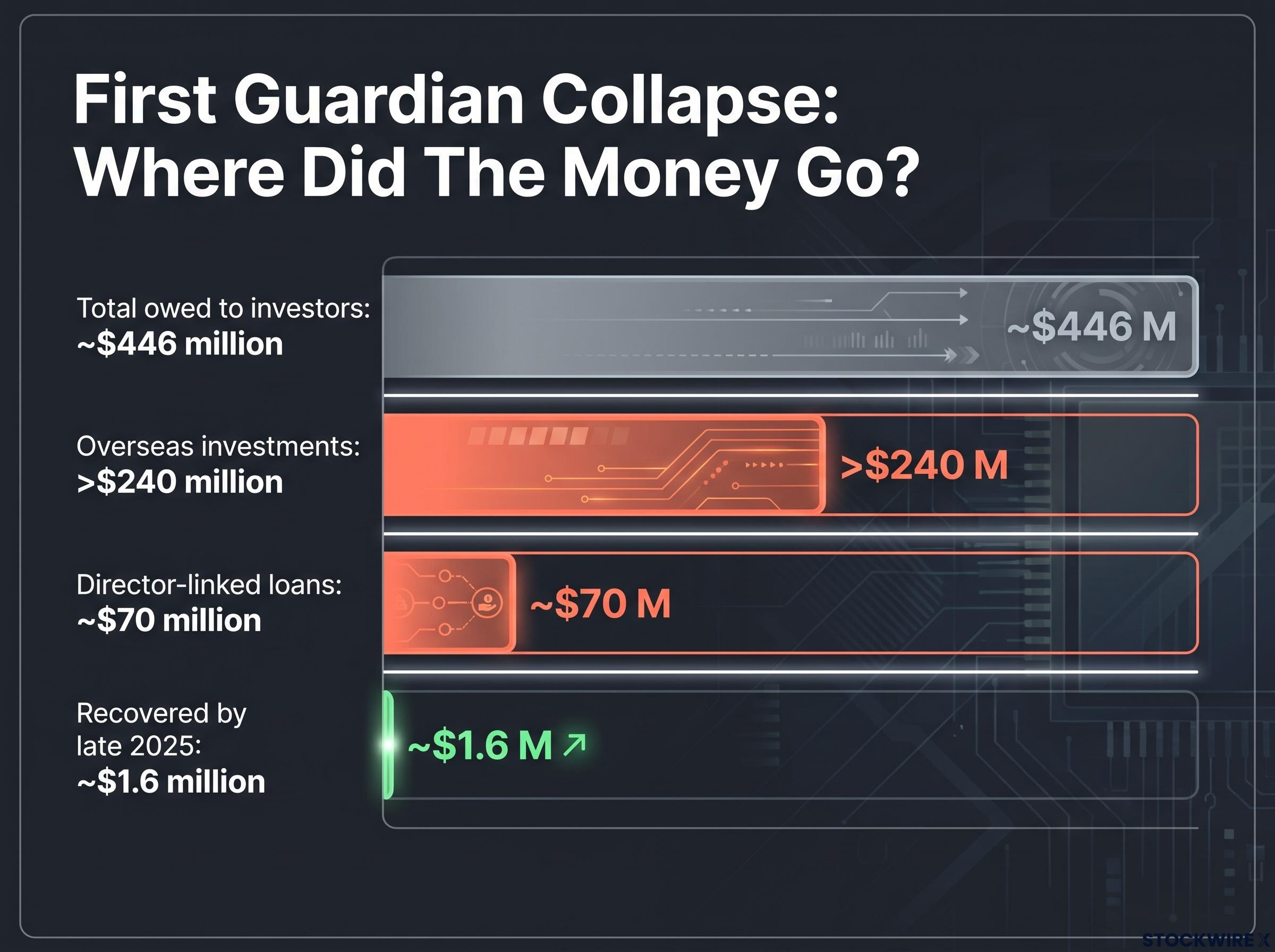
| Category | Figure |
|---|---|
| Total owed to investors | ~$446 million |
| Director-linked loans | ~$70 million |
| Overseas investments (difficult to recover) | >$240 million |
| Recovered by late 2025 | ~$1.6 million |
ASIC Chair Sarah Court described the consequences for investors as “devastating”, linking the harm directly to failures by gatekeepers, including the fund operator, financial advisers, superannuation trustees and auditors, to do their jobs properly.
The recovery figure of $1.6 million against $446 million owed is not a commentary on how fast liquidators are working. It tells you that the underlying assets were either never there, have been dissipated, or are locked in jurisdictions where recovery is unlikely. That is what a structural collapse looks like, as distinct from a fund that simply lost money in a downturn. A market loss can recover. This kind of loss, in most cases, cannot.
The gatekeepers who were meant to catch this, and why they did not
Australian managed investment schemes are supposed to have multiple layers of independent oversight built in by law. Under the Corporations Act, a registered scheme must have a responsible entity (the company that operates the fund and holds assets on trust for investors), a compliance plan setting out how the scheme will follow the law, and an annual independent audit of both the financial statements and the compliance plan.
That architecture exists for a specific reason. It means no single party controls both the money and the reporting on that money. The auditor checks the operator. The compliance plan constrains the operator. The trustee offering the fund on a super platform is supposed to independently assess whether the product is appropriate before putting it in front of members’ retirement savings.
In First Guardian, every one of those layers failed.
Where each layer of oversight broke down
- Fund operator (Falcon Capital): Allegedly misused investor funds, engaged in extensive related-party dealings, and failed to manage investments appropriately.
- Auditor (Auditeo): Issued unqualified audit reports relating to First Guardian. The clean audit sign-offs were followed by the appointment of liquidators within roughly half a year, indicating the reports did not reflect the serious problems already present inside the fund.
- Financial advisers and promoters: Steered investors into First Guardian with what investors report were overly optimistic or misleading assurances about safety and performance.
- Super trustees (including Netwealth): Netwealth has admitted it did not obtain or properly assess sufficient information about First Guardian’s risks before or while offering it to members, and did not make sufficient independent enquiries.
Structured managed fund due diligence, covering fee analysis, PDS review, ASIC register verification, and redemption terms, is precisely the process that platforms such as Netwealth admitted they failed to apply rigorously before listing First Guardian on their investment menus.
ASIC Chair Sarah Court has emphasised that auditors carry a critical responsibility to provide investors with an accurate picture of a scheme’s financial position, and that poor performance of that function can produce severe outcomes for investors. And Netwealth’s admission is not theoretical accountability. The company agreed to pay over $100 million in compensation to more than 1,000 members. That tells you something concrete: a trustee offering a product on its platform is not simply a neutral intermediary. It carries a legal duty of independent assessment, and the financial consequences of failing that duty are real.
This article is for informational purposes only and should not be considered financial advice. Investors should conduct their own research and consult with financial professionals before making investment decisions.
What ASIC is pursuing in 2026, and what it signals to the market
ASIC’s response to First Guardian is not a single action. It is a multi-pronged enforcement strategy where each arm targets a different failure point exposed by the collapse. As set out in ASIC media releases 25-090MR and 25-120MR, pursuing accountability for those involved in the First Guardian and Shield collapses has been designated a formal enforcement priority for 2026, with resources allocated and litigation treated as an active tool rather than a last resort.
ASIC’s First Guardian enforcement page documents the full sequence of Federal Court proceedings, asset preservation orders and the winding up of Falcon Capital, providing the primary regulatory record of how each accountability strand has progressed since the fund’s collapse.
The enforcement strands break down into four distinct layers, each escalating the scope of accountability:
- Asset freezes and litigation: ASIC obtained Federal Court orders that froze assets held by Falcon Capital and First Guardian, a step that ultimately resulted in Falcon being placed into liquidation. Investigations into suspected misuse of investor money, conflicts of interest and disclosure failures continue.
- Trustee accountability: ASIC commenced Federal Court proceedings against Netwealth, resulting in the admitted failures and the $100 million compensation settlement. This establishes that trustees cannot rely on a fund’s promotional materials or past returns when deciding what to place on their investment menus.
- Auditor misconduct as a standalone priority: ASIC is treating clean audit reports that do not reflect underlying reality as a specific enforcement target, not a secondary compliance observation. This is a materially different posture from treating audit failure as a background issue. It tells the market that ASIC views auditors as direct contributors to investor harm and that litigation against audit firms is a live possibility.
- Managed investment scheme law reform: The federal government has flagged tighter registration requirements, potential prudential-style obligations for large schemes, and restrictions on complex or illiquid schemes being offered to everyday super members.
ASIC’s audit surveillance priorities for FY2026-27 include a direct focus on whether audit firms are implementing remedial measures committed following prior findings, a posture that reflects the regulator’s determination to treat audit failure as a contributor to investor harm rather than a secondary compliance observation.
A consumer alert has been published by ASIC cautioning Australians against moving retirement savings into high-risk, complex schemes that are being aggressively promoted. The Compensation Scheme of Last Resort (CSLR) has published dedicated resources for Shield and First Guardian investors, explaining what kinds of misconduct-related losses may be eligible for compensation.
Six questions every Australian with super or managed fund exposure should ask now
Each of these questions maps directly to a specific point where the First Guardian system failed. Answering them well does not just reduce abstract risk; it closes the exact gaps that led to 6,000 Australians losing retirement savings.
- What regulatory regime is my money actually in? Many First Guardian investors did not realise they had moved from APRA-regulated super into a managed investment scheme with lighter oversight. Ask your adviser or platform to explain the investment pathway and what protections apply at each step.
- Can the fund’s strategy, risks and fees be explained clearly and simply? First Guardian’s offshore loans, related-party deals and complex structure were difficult for ordinary investors to evaluate. Treat opacity and complexity as risk signals, not sophistication markers.
- What does the fund’s audit report actually tell me? An unqualified audit opinion (a “clean” report) means the auditor did not identify material misstatements in the financial report as presented. It does not mean the fund is safe or well-run. Auditeo issued unqualified reports approximately six months before liquidators were appointed. View audit reports as one input among many, not a guarantee.
- Is the scheme registered and does the operator hold the appropriate licence? Check ASIC’s online registers to confirm the scheme is a registered managed investment scheme and that the responsible entity holds the appropriate Australian Financial Services Licence (AFSL).
- How is my adviser remunerated for recommending this fund, and what independent research has the platform relied on? First Guardian was heavily distributed through adviser networks and super platforms that now face scrutiny for poor due diligence. Netwealth’s admission that it did not make sufficient independent enquiries reinforces why this question matters.
- Have I sought independent advice before moving a large super balance? Moving retirement savings into a complex, higher-risk scheme is a decision that warrants independent, licensed advice from someone whose remuneration does not depend on you entering the scheme.
What the First Guardian case changes about managed fund accountability in Australia
The combined scale of the First Guardian and Shield collapses, approximately 11,000 investors and approximately $1.1 billion in superannuation savings, appears to have moved managed investment scheme oversight from an enforcement edge case to a systemic policy concern. ASIC and the federal government have framed the failures as “industrial-scale misconduct.”
ASIC and the federal government have described the combined First Guardian and Shield collapses as “industrial-scale misconduct” in the superannuation and managed investment space.
The regulatory framework for managed investment schemes is now in active transition. Audit standards, trustee due diligence obligations and MIS registration requirements are all under review. Netwealth’s $100 million compensation settlement is not just a one-off liability outcome. It sets a precedent that trustees offering managed fund options to super members bear a real duty of independent assessment, which means future product approvals will carry greater legal risk for platforms that do not conduct genuine due diligence.
The questions and safeguards raised by First Guardian are relevant to any Australian with super, not only those in high-risk schemes. The distribution pathways that carried First Guardian into people’s retirement accounts were mainstream super infrastructure: choice platforms, licensed advisers, familiar trustee names. That is what makes this story systemic rather than isolated.
For readers wanting to understand how First Guardian fits into the broader regulatory reset underway, our full explainer on ASIC’s capital markets reform agenda covers the structural changes to MIS oversight, enforcement sequencing, and the ASX governance reset that together define how Australian markets are being rebuilt.
Past performance does not guarantee future results. These statements regarding regulatory and enforcement developments are subject to change based on ongoing legal proceedings and policy decisions.