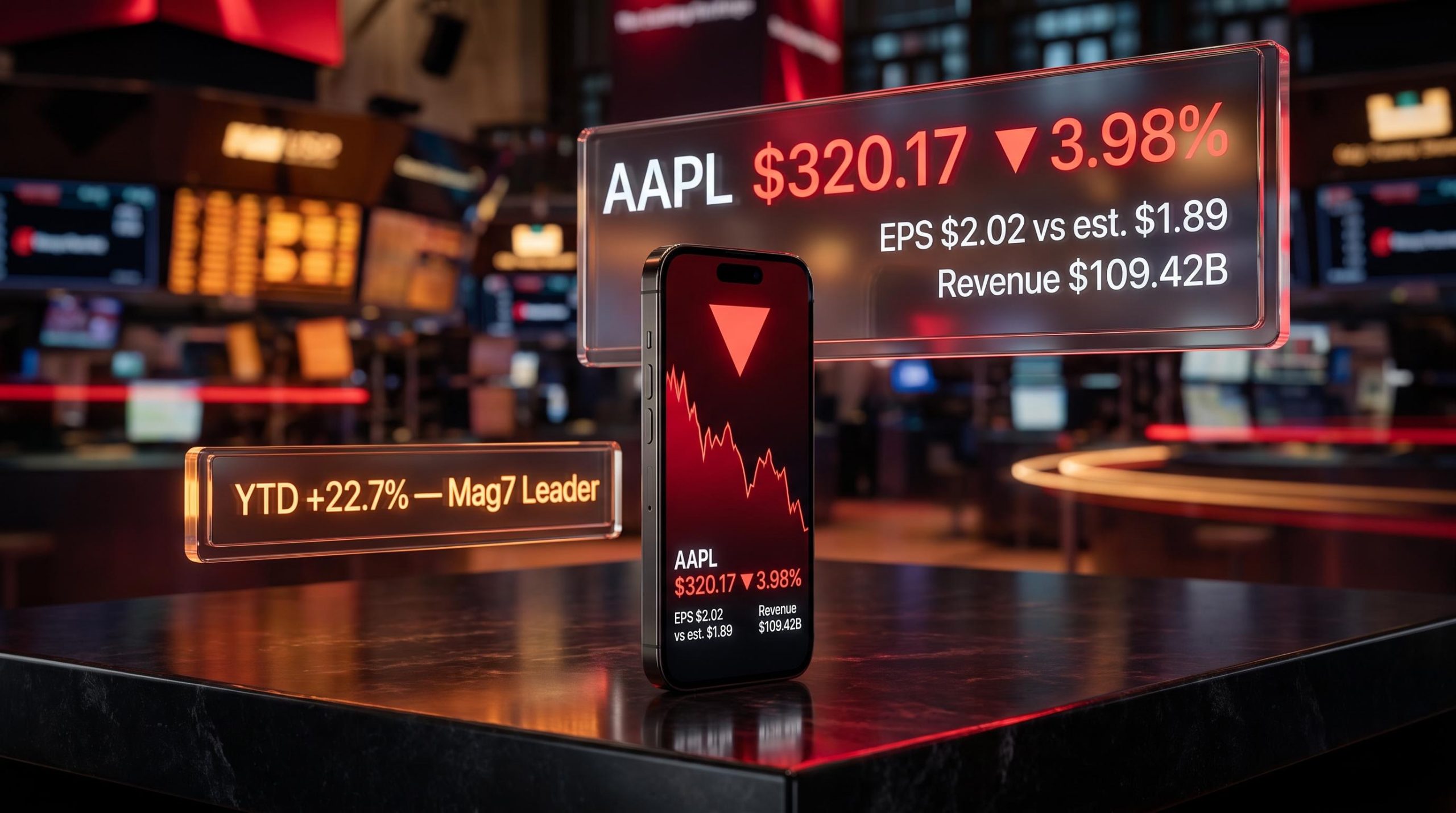
Apple just reported one of the strongest quarters in its history, beat Wall Street on both earnings and revenue, and its stock promptly fell nearly 4% after the bell.
The reaction is not a contradiction. It is the market making a precise statement about expectations, valuation, and what counts as genuinely new information when a stock that led all Magnificent Seven peers with a 22.7% year-to-date gain had already pushed its market cap briefly past $5 trillion earlier in the week. Understanding the gap between a clean earnings beat and a sell-off requires looking past the headline numbers to what investors were actually positioned for heading into tonight’s print.
Here is what the actual results show, what set up the drop before a single number was reported, and what the after-hours move means depending on whether you already own AAPL, are considering buying it, or are simply trying to read the market’s signal correctly.
Apple’s Q3 numbers were strong. Here is exactly what the company reported.
Apple posted fiscal Q3 2026 earnings of $2.02 per share, well above the analyst consensus of $1.89, on quarterly revenue of $109.42 billion versus the expected $108.86 billion. iPhone revenue beat analyst projections, making this a broad-based outperformance rather than a narrow technical beat on a single line.
iPhone market share dynamics provide context for why the hardware segment beat analyst projections tonight: Apple grew Q1 2026 global shipments approximately 5% in a market that contracted approximately 6%, capturing roughly 21% of global shipments, its highest share ever in a post-holiday quarter.
The headline number: Apple reported EPS of $2.02 versus consensus of $1.89, a 6.9% earnings beat on the bottom line.
The revenue beat, however, tells a more nuanced story. A 0.5% upside on a $109 billion base is the kind of result that confirms a thesis rather than upgrades it. That distinction matters enormously for a stock that was already priced for confirmation.
| Metric | Reported | Consensus Estimate |
|---|---|---|
| EPS (Q3 FY2026) | $2.02 | $1.89 |
| Revenue (Q3 FY2026) | $109.42B | $108.86B |
| After-hours price move | $320.17 (down ~3.98%) | $333.43 regular close |
Earnings were reported on 30 July 2026.
When big ASX news breaks, our subscribers know first
Why a 22.7% year-to-date run changes everything about how you read an earnings beat
Prior to tonight’s print, AAPL had posted the strongest year-to-date performance of any Magnificent Seven constituent in 2026, with shares up 22.7% and no mega-cap peer close to matching that advance.
That kind of run does not just reward past results. It embeds forward expectations into the price. By the time a stock has rallied 22.7%, the consensus EPS estimate is not the real bar for a positive reaction. The real bar is: did the company say something that pushes expectations further forward than where the stock already sits?
The earnings expectations gap that produced tonight’s sell-off is not unique to Apple; in Q1 2026, 84% of S&P 500 companies beat EPS estimates and stocks still frequently fell, because markets price the gap between reality and prior positioning rather than whether the absolute number is strong.
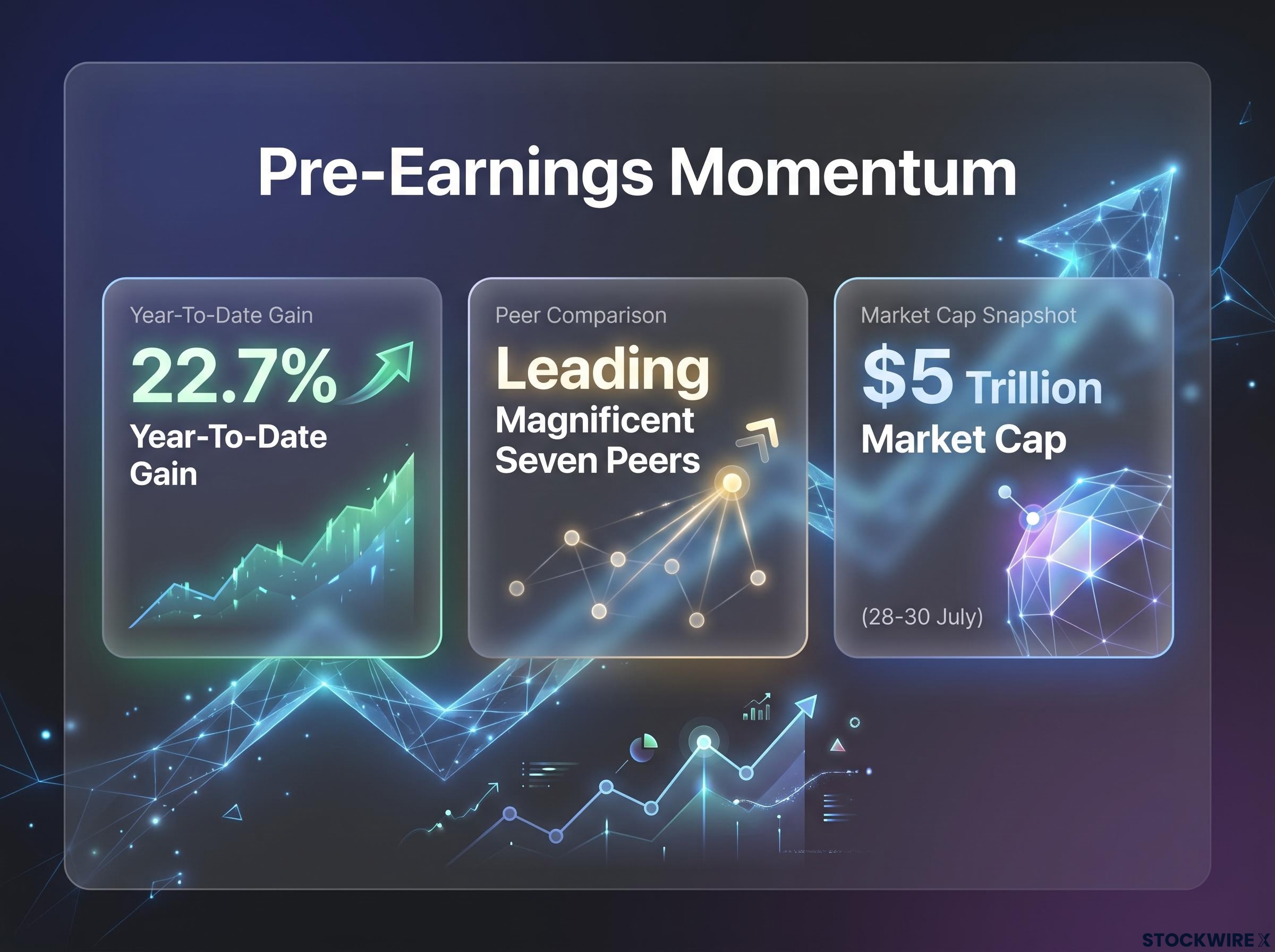
- AAPL year-to-date gain heading into earnings: 22.7%, leading all Magnificent Seven peers
When Apple’s market cap ticked above $5 trillion during the week of 28-30 July, that single number crystallised just how much optimism had already been priced in. When a company’s valuation briefly reaches $5 trillion, that price already assumes the quarter will be strong. Beating consensus by 0.5% on revenue confirms the assumption; it does not upgrade it.
That is not enough to push a premium-valued mega-cap higher. And the after-hours tape showed exactly what happens when confirmation meets positioning.
“Buy the rumour, sell the news” is not a cliche here. It is a precise description of what happened.
The pattern works like this: traders accumulate shares ahead of a widely expected strong result, building positions during the weeks of optimism that drive a stock higher into the event. When the actual numbers confirm the bullish thesis but do not greatly exceed it, many of those same holders use the confirmation as their exit point.
After-hours trading amplifies the dynamic. Lower volume, fewer institutional participants, and concentrated selling by short-term holders produce outsized price swings relative to what the same selling pressure would create in a regular session.
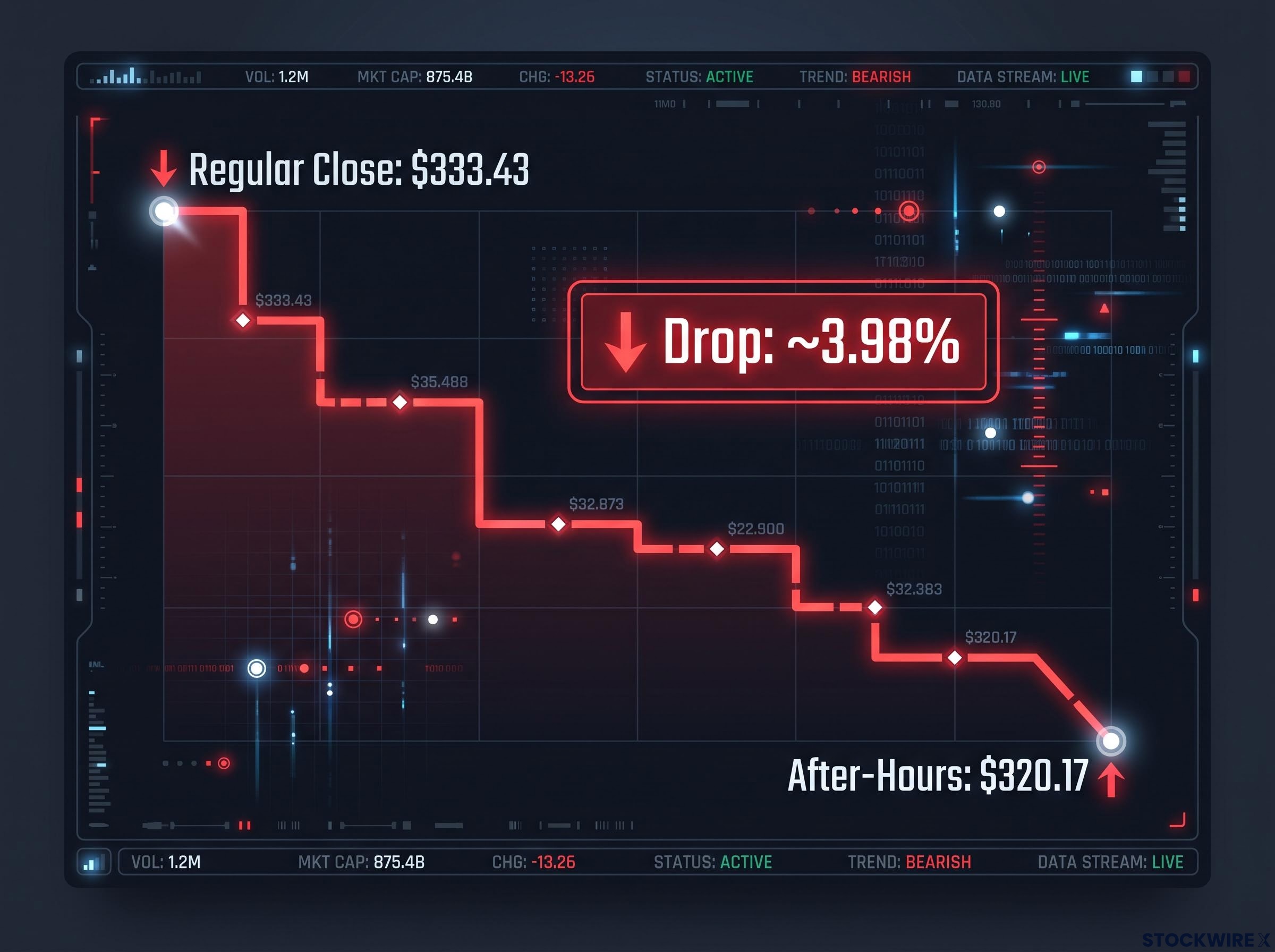
AAPL dropped to $320.17 in after-hours trading, down from a regular session close of $333.43, a decline of approximately 3.98%. Apple has previously dropped 4-5% in aftermarket trading following earnings beats when results did not add fresh upside to expectations, though this pattern reflects prior cycle behaviour.
Three specific conditions combined to produce tonight’s move:
- A 22.7% year-to-date run that front-loaded optimism into the share price
- A premium valuation, with market cap briefly exceeding $5 trillion, that left no margin for merely good results
- A confirmation-not-upgrade beat, where the numbers validated expectations without changing the forward story
The drop is not the market saying the quarter was bad. It is the market saying that everyone who wanted to own Apple into a strong quarter already owned it, and now some of them are leaving.
What investors were really watching: guidance, margins, and the AI cost question
For a company trading at Apple’s valuation, the reported quarter is the least interesting part of an earnings release. The market is pricing future cash flows, not the quarter just closed. That means guidance, management commentary, and forward margin signals carry more weight than the EPS number that landed tonight.
Heading into this report, the margin pressure narrative was already building. Analysts flagged that rising component costs tied to the global AI build-out, specifically memory and storage costs, could weigh on profitability in coming quarters.
Memory cost pressures on Apple’s margins were not a surprise to analysts heading into tonight’s print; Tim Cook had already warned in June 2026 that memory costs were ‘no longer sustainable,’ flagging an increasing impact on Apple’s business and initiating price increases on the Mac Mini as the company’s inventory buffer ran down.
Pre-earnings analyst warning: Rising component costs could compress gross margins by approximately 200 basis points, with further pressure expected in subsequent quarters. (Analyst-sourced projection, not a confirmed post-earnings figure.)
Three forward variables were under the closest scrutiny tonight:
- Gross margin trajectory: whether management signalled stabilisation or further compression ahead
- Component cost commentary: whether memory and storage cost inflation is accelerating or peaking
- AI monetisation clarity: whether Apple offered a more explicit revenue path for its AI capabilities, an area where it lags peers in narrative specificity
Apple’s services and iPhone segments were already broadly expected to be strong, which reduced the surprise potential of those beats. Without a meaningful guidance uplift or a clear new growth driver, the stock had no catalyst to recover after the initial sell-off. If management commentary confirmed cost headwinds rather than providing evidence margins would hold, that forward signal matters more to a long-duration asset than any backward-looking EPS number.
What the sell-off actually means depending on how you own Apple
The same 3.98% drop carries very different implications depending on when you bought, why you bought, and what your time horizon looks like.
Long-term holders
The fundamental story remains intact. Apple still operates a profitable hardware ecosystem, a growing services business, and generates strong free cash flow. A 4% post-earnings swing is within the normal volatility range for a mega-cap around a catalyst event. If your thesis was built on the business rather than the quarter, tonight does not change it.
Recent buyers and short-term traders
If you bought into the 22.7% year-to-date rally expecting the earnings beat to push the stock higher, the sell-off is the cost of buying optimism near its peak. The business did not deteriorate. But entering a heavily anticipated earnings event after a 20%+ run carries meaningful event risk, and tonight is a reminder of how that risk manifests even when the company delivers.
Prospective buyers
The pullback creates a question, not an answer. A 4% drop after a beat can represent either a more reasonable entry point or a signal that near-term upside is capped until margins or guidance improve. The distinction depends on what you believe about Apple’s forward margin trajectory and its ability to articulate a clearer AI revenue path. Those variables, not tonight’s EPS number, are what determine whether the current price is opportunity or warning.
What to watch now that the quarter is behind Apple
The quarter is closed and the beat is confirmed. What determines whether tonight’s drop is a short-term shakeout or the beginning of a more sustained re-rating sits in three forward variables:
- Gross margin guidance for Q4: whether management indicated stabilisation or flagged further compression from component cost inflation
- Component cost trajectory: whether memory and storage costs tied to the AI build-out are peaking or still rising, and how Apple plans to manage them
- AI monetisation narrative: whether Apple moves toward a more explicit articulation of how its AI investments translate to revenue, closing the gap with mega-cap peers
Even after the after-hours decline, Apple’s 2026 performance remains exceptional. Stripping out the 3.98% after-hours drop, the 22.7% year-to-date advance still places Apple among the top-performing large-cap technology names of the year. But a valuation that briefly touched $5 trillion leaves precious little tolerance for execution shortfalls in the quarters ahead.
The answer to whether tonight was noise or signal will not arrive until Apple’s fiscal Q4 report. Until then, margin commentary and AI developments are where the next re-rating catalyst, in either direction, is most likely to originate.
For investors wanting to place tonight’s Apple move in the context of broader mega-cap dynamics, our deep-dive into Magnificent Seven headwinds examines the four converging pressures Deutsche Bank identified, including rising memory costs and AI capex credibility tests, that have weighed on the group since their October 2025 peak.
This article is for informational purposes only and should not be considered financial advice. Investors should conduct their own research and consult with financial professionals before making investment decisions. Past performance does not guarantee future results.