
On 2 September 2026, the RBNZ raised its Official Cash Rate to 2.75% and watched the New Zealand Dollar fall. Then the governor spoke about oil prices, and the kiwi became the biggest mover in overnight FX markets.
The same central bank, the same tightening cycle, two completely opposite currency reactions separated by days. That gap is the story.
Governor Anna Breman’s hawkish commentary, flagging oil-driven inflation running above the RBNZ’s own September projections, has repriced New Zealand rate expectations sharply. Markets are now pricing roughly 18 basis points for the next meeting and just over 100 basis points of cumulative tightening by next summer.
Combined with Q2 2026 GDP that beat both analyst consensus and the RBNZ’s own forecast, the macro case for continued hikes has strengthened. For anyone tracking the NZD or RBNZ policy, the shift in tone is the operative signal, not the rate level itself.
This piece works through what the governor’s comments mean for the trajectory of policy, why the currency reacted the way it did, and what oil-driven inflation and stronger growth data signal about the months ahead. You will come away understanding the mechanism, not just the headline, and where the genuine risks to the bullish NZD thesis actually sit.
Why the governor’s oil comments moved the kiwi more than the rate hike did
The hike itself was not the surprise. On 2 September 2026, the RBNZ lifted the OCR by 25 basis points to 2.75%, its second consecutive increase after the first move in July 2026, and it landed exactly where markets had positioned for.
And the New Zealand Dollar fell sharply anyway.
The reason sits in the guidance, not the decision. According to Investing.com’s coverage of the meeting, the RBNZ paired the increase with signals of a less aggressive path ahead, and that softer forward tone, not the hike, sent the kiwi lower. The rate went up; the expected trajectory came down.
Then Governor Breman spoke, and the currency did the opposite.
The rate differential is only one of four competing NZD/USD drivers: Chinese PMI prints, GDT dairy auction results, and global risk sentiment each retain the capacity to override a hawkish RBNZ signal on any given session, which is why the currency can move against the rate trajectory without the macro case breaking down.
Sustained elevated oil prices are expected to produce inflation “somewhat higher near-term” than the RBNZ had projected in its September monetary policy statement.
That single reframing, treating oil-driven inflation as a live policy concern rather than background noise, made the NZD the most notable overnight mover in FX markets. Nothing about the rate had changed. The path had.
The expectations gap in practice
Currency markets do not trade the rate decision. They trade the distance between what a central bank does and what was already priced in.
Rate expectations are continuously baked into the exchange rate. A hike that everyone already anticipated is not new information, so it moves nothing on its own; what moves the currency is a shift in the expected future path relative to the standing consensus.
That is exactly what played out over those few days. The 2 September decision delivered the hike but trimmed the forward path, so the kiwi sold off despite higher rates. Breman’s comments raised the forward path, so the kiwi rallied despite no rate change at all.
For you, the practical read is durable: a hike delivered with dovish guidance is bearish for the NZD, and a hold delivered with hawkish language can be bullish. MUFG analyst Lee Hardman has been among the named voices tracking how this repricing is filtering into New Zealand rate markets. Watch the guidance, not the number, and the next RBNZ communication becomes far easier to interpret.
When big ASX news breaks, our subscribers know first
How central bank forward guidance and inflation surprises connect to currency movements
The mechanism behind that reaction is worth building from the ground up, because it applies to every hawkish pivot, not only this one.
Two channels do most of the work. The first is the interest-rate differential: a higher expected OCR path widens New Zealand’s yield advantage over major currencies, which pulls in carry trades and demand for NZD-denominated assets. The second is credibility: a central bank seen as firm on inflation lowers the perceived downside inflation risk to the exchange rate, supporting the currency’s longer-run appeal.
| Channel | Mechanism | NZD implication |
|---|---|---|
| Interest-rate differential | A higher expected OCR path widens New Zealand’s yield advantage, drawing carry-trade inflows and asset demand | Supportive, provided global risk appetite holds |
| Credibility | A firm anti-inflation stance reduces perceived downside inflation risk to the exchange rate | Supportive over the longer run by anchoring expectations |
Now layer oil onto this. The RBNZ is tightening while inflation sits above its 1-3% target band, and that context changes how it can respond to an energy shock. When headline inflation is already too high, a central bank cannot comfortably wave through an oil spike as temporary without risking that inflation expectations drift loose.
Oil feeds New Zealand inflation through four distinct routes:
The RBNZ inflation forecast context matters here: annual CPI reached 4.1% in the June 2026 quarter, with petrol rising 20.1% and diesel surging 47.7% in the quarter alone, accounting for roughly two-thirds of the total quarterly increase, which is precisely why stripping fuel from the headline puts core comfortably inside the 1-3% target band.
- Direct CPI impact: Higher petrol prices lift the transport component of the consumer basket immediately.
- Tradables inflation: Costlier fuel and freight raise the price of imported goods and shipping.
- Non-tradables pass-through: Business input-cost pressure filters into domestic services and goods, especially where demand stays resilient.
- Inflation expectations: If households and firms treat the oil shock as lasting, expectations drift higher, and the RBNZ’s credibility becomes harder to defend without a firm response.
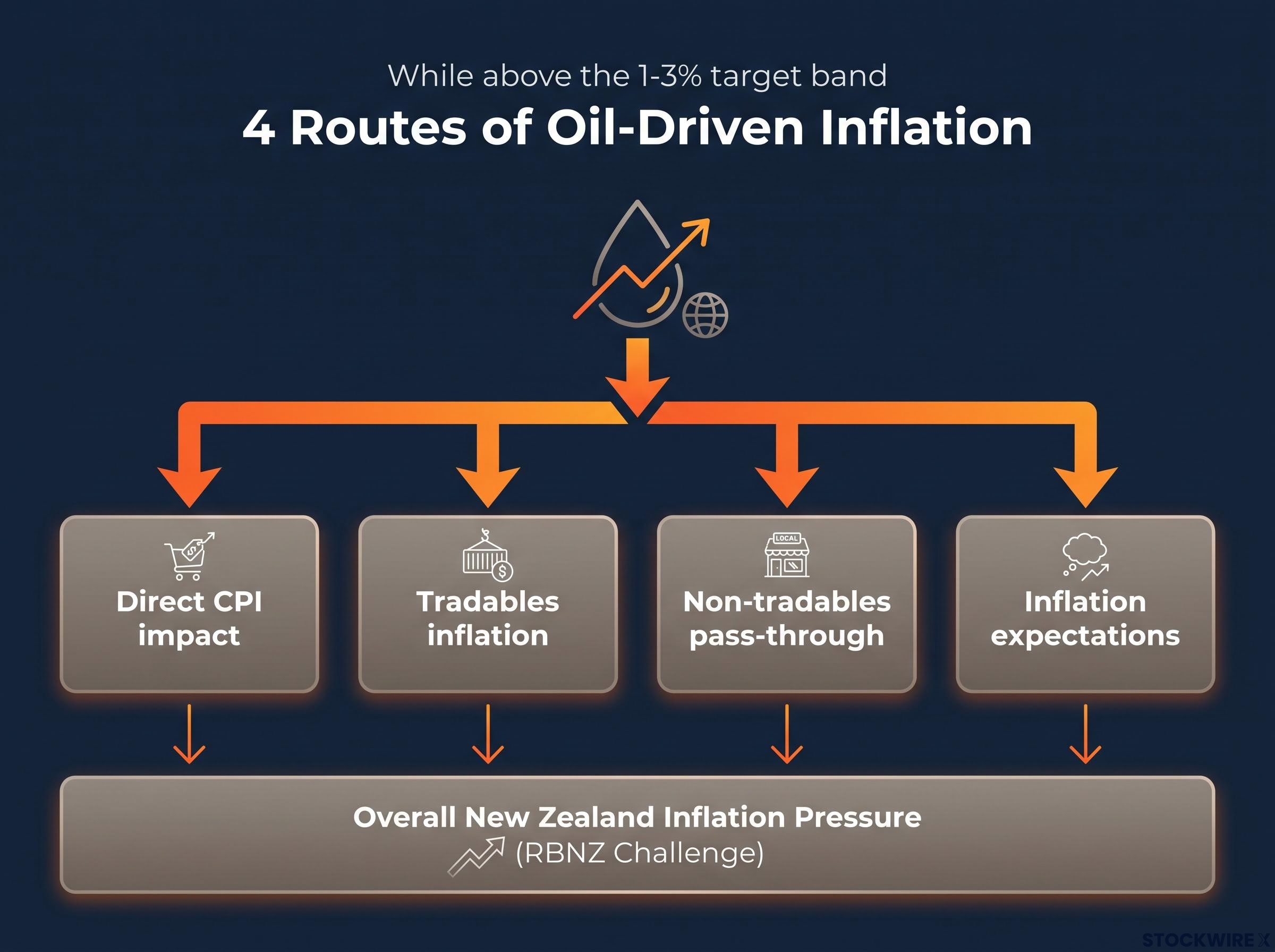
That is why Breman’s framing carried weight. Each of those channels feeds the credibility channel above, and the governor signalling awareness of all of them is precisely what strengthened market conviction on the next hike.
The pricing reflects it. Markets are carrying roughly 18 basis points for the next meeting and just over 100 basis points of cumulative tightening by next summer. Read that 100-plus figure correctly: it is not a forecast the RBNZ has issued, it is the market’s collective bet on how seriously the bank will treat oil-driven inflation. Treat it as a sentiment gauge, not a locked-in path, and it tells you how far conviction currently runs. ANZ’s 17 September 2026 review, titled “NZ Q2 GDP Review – Persevering,” reinforces the same read: the data keeps the door open to further increases.
What Q2 GDP growth adds to the tightening case
The GDP print did not arrive as good news for anyone hoping the RBNZ would find a reason to stop.
New Zealand’s economy grew 0.2% quarter-on-quarter in Q2 2026. That cleared the analyst consensus of 0.1%, and, more importantly, it cleared the RBNZ’s own forecast of zero growth. Annual growth came in at 2.6%, ahead of the roughly 2.2% the market had expected.
| Indicator | Actual | Forecast |
|---|---|---|
| Q2 2026 GDP q/q | 0.2% | 0.0% (RBNZ); 0.1% (consensus) |
| Q2 2026 GDP y/y | 2.6% | ~2.2% (market) |
| Q1 2026 GDP q/q (revised) | 0.9% | – |
The honest framing matters here. Growth decelerated hard from the upwardly revised 0.9% of Q1, so this is a beat, not a boom. That raises a fair question about whether the economy can absorb further hikes without stalling, and that question is the one the RBNZ will have to weigh.
But the detail that carries the analytical weight is the comparison against the central bank’s own number.
Reuters framed the result plainly: it “keeps the door open to further interest-rate increases.”
The RBNZ built its September monetary policy statement on a zero-growth assumption. Actual expansion, even a modest one, removes one of the cleaner justifications for pausing. ANZ’s review put the print above both its own and the RBNZ’s forecasts, and noted the Middle East conflict as a background drag on the growth outlook rather than a reason to expect a pause.
For you, watching RBNZ policy, that is the operative shift. The single condition most likely to justify a hold, growth landing clearly below forecast, has been removed. The burden of proof now sits firmly with the case for pausing, and combined with Breman’s oil commentary it forms a compound hawkish signal rather than two separate data points.
Where the NZD bull case breaks down: four risks to the hawkish thesis
The case for a stronger kiwi is coherent. It is not bulletproof. Here is where the hawkish RBNZ narrative fails to translate into sustained NZD strength, framed as live conditions rather than abstract downside.
- Global risk-off and a stronger USD. In periods of heightened risk aversion, safe-haven flows into the US Dollar can overwhelm New Zealand’s rate differential entirely. A renewed US yield advantage or a more aggressive Fed pushes NZD/USD lower regardless of what the RBNZ does, because carry yield stops mattering when capital wants safety.
- A stagflationary geopolitical shock. The same Middle East conflict flagged as a growth headwind can raise oil prices, which is inflationary, while simultaneously damaging growth, which is bearish for a risk-linked currency like the NZD. That combination puts the currency in the worst position: higher inflation without the growth to support a durable rate premium.
- Domestic demand softening. The deceleration from 0.9% to 0.2% q/q is the warning sign here. If further hikes suppress demand materially, markets may begin pricing a shorter tightening cycle and eventual RBNZ cuts, and that repricing would cap NZD strength well before the cycle formally turns.
- A perceived policy error. If investors conclude the RBNZ is over-responding to supply-side inflation that ultimately proves temporary, the credibility channel reverses. Higher rates stop reading as a yield signal and start reading as a recession signal, which is bearish for the NZD once conviction shifts.
Domestic demand indicators tell a more cautious story beneath the GDP headline: the August services PSI reached 51.2 but three of five sub-components, including Activity/Sales and Employment, remained in contraction, a divergence BNZ described as a narrowly based recovery that matters directly for whether the economy can absorb further hikes without stalling.
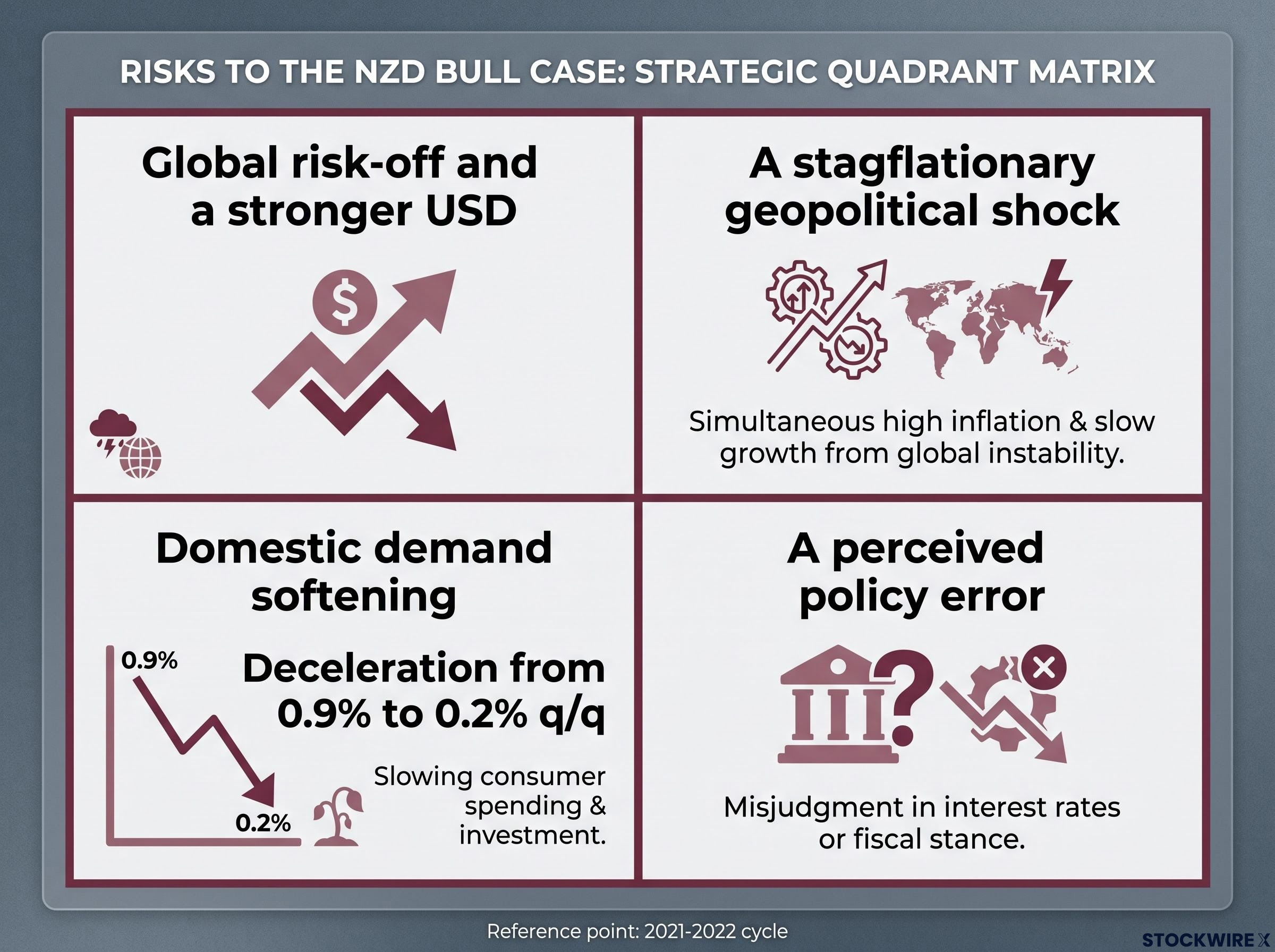
These risks are not symmetric in timing. USD strength and risk-off can hit in a session; a demand collapse or a policy-error repricing develops over months. Knowing which is which is the difference between reacting and positioning.
The 2021-2022 cycle is the reference point. The RBNZ tightened aggressively from near-zero to restrictive levels, and the initial NZD support was real, but global risk-off and USD strength repeatedly capped the gains. Rate differentials opened the door; global conditions decided how far the currency could walk through it.
What institutional analysts are currently saying
The prevailing institutional read leans hawkish. Both ANZ and MUFG’s Lee Hardman currently point toward continued hikes rather than arguing these risks are likely to materialise near-term.
That is not the same as saying the risks are absent. The view is that the current data configuration, above-target inflation, a GDP beat against the RBNZ’s own forecast, and the governor’s explicit oil commentary, makes the hawkish path the higher-probability scenario heading into the next meeting. For you, that means holding the bullish thesis with these four conditions as a monitoring checklist, not treating them as a reason to abandon it.
What the RBNZ’s next move will actually signal
The next decision is not a simple hike-or-hold. It is a test of whether Breman’s hawkish tone reflects a durable shift in the RBNZ’s reaction function or a tactical message designed to protect credibility without full follow-through.
A third consecutive 25 basis point hike would take the OCR to 3.00% and answer the question directly. It would confirm the bank’s reaction function now explicitly weights oil-driven near-term inflation, and it would give the market’s 100-plus basis points of cumulative pricing a credible policy anchor to build on.
But the delivery matters as much as the decision. Markets are pricing only around 18 basis points for the meeting, which means a full 25 basis point hike is not fully in the price. Delivered with maintained hawkish guidance, that leaves genuine room for a positive NZD surprise.
The reverse holds too, and 2 September is the template. A hike accompanied by softer forward guidance would likely see the kiwi weaken despite the increase, exactly as it did the first time.
The guidance language after the decision is where the NZD trade lives, not the rate level itself.
For investors wanting to layer a price-level framework onto the policy analysis, our deep-dive into the NZD/USD technical setup covers the supply zone formed by the 100-period and 200-period SMAs, the oversold RSI conditions following the September sell-off, and the resistance levels that define the cleaner re-entry points.
Sustained NZD support depends on the RBNZ validating that cumulative path progressively, not just at one meeting. The 2014 cycle showed what full validation can produce: as the RBNZ lifted the OCR from 2.5% to 3.5% and New Zealand offered one of the highest policy rates in the advanced-economy group, rate differentials drove meaningful NZD appreciation. The lesson for you is simple. Watch the guidance, not the headline, because the next leg in the currency will be decided by what the bank says after it moves.
Reading the RBNZ’s trajectory with the information available now
The hawkish case is not built on one number. It is built on three that reinforce each other.
Breman’s framing of oil-driven inflation as “somewhat higher” than the September projections, the 0.2% q/q GDP beat against the RBNZ’s own zero-growth forecast, and just over 100 basis points of cumulative tightening priced by next summer together form a more cohesive signal than any single data point could. The OCR sits at 2.75% after two consecutive hikes, and a third looks likely.
That said, the cycle is not resolved. Its length and depth will be decided by oil price persistence and by whether domestic demand holds up under the accumulating weight of tightening.
Three variables will confirm or challenge the thesis in the weeks ahead:
- RBNZ guidance language after the next meeting: the forward path, not the rate level, is where the currency trade sits.
- Global oil price sustainability: persistent prices validate the inflation concern; a fade weakens the entire hawkish case.
- New Zealand domestic demand indicators: watch consumption and business investment for signs the economy is buckling under higher rates.
Return to where this started. The same central bank sent the kiwi lower with a hike, then made it the overnight winner with words. That dynamic will repeat, and understanding the mechanism behind it is your practical edge.
This article is for informational purposes only and should not be considered financial advice. Investors should conduct their own research and consult with financial professionals before making investment decisions. Past performance does not guarantee future results. Financial projections are subject to market conditions and various risk factors, and forward-looking statements are speculative and subject to change based on market developments.