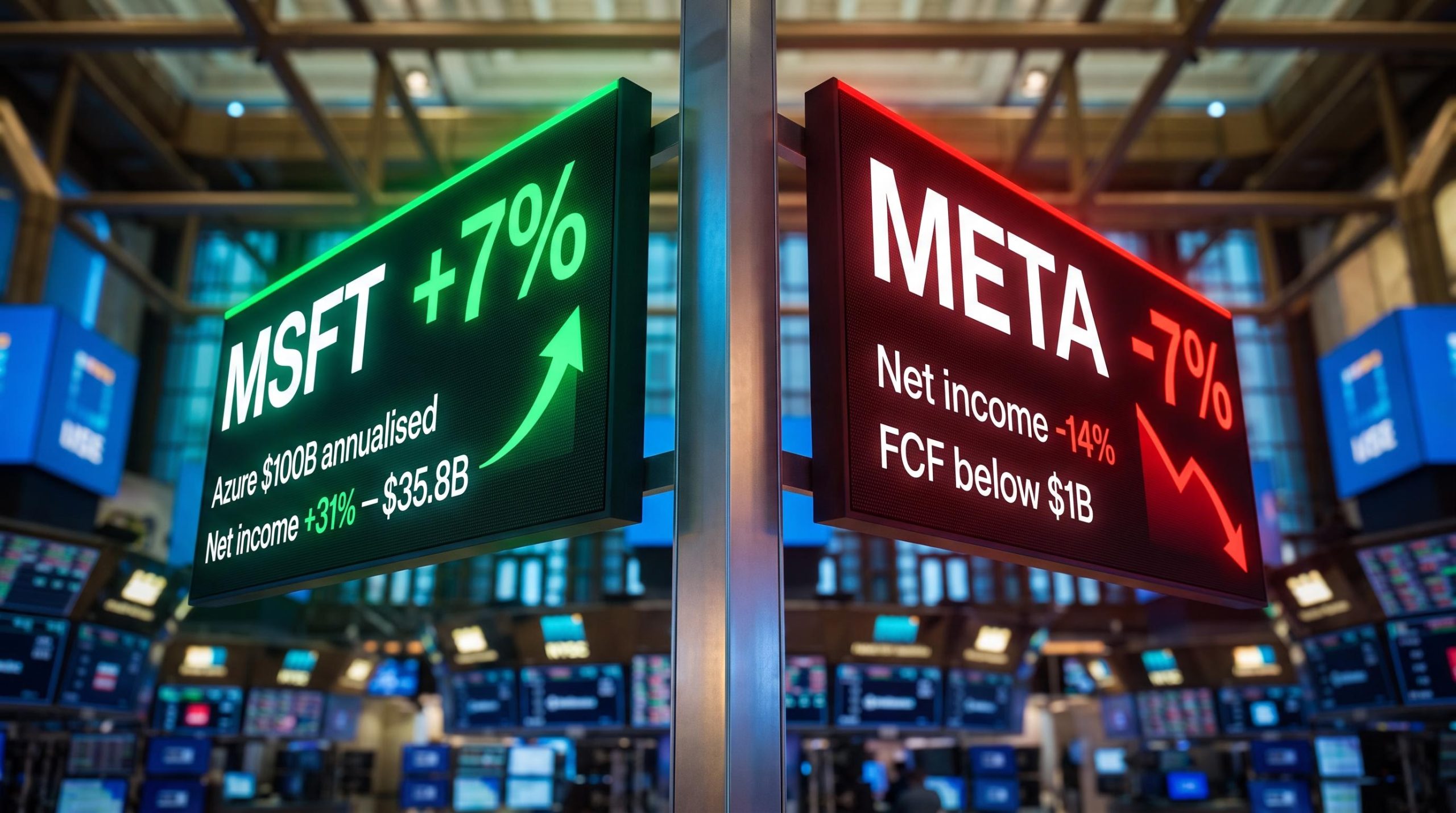
Meta and Microsoft are spending roughly a third of a trillion dollars on AI infrastructure in a single calendar year. Tonight, after the close on 29 July 2026, investors will decide whether that looks like disciplined investment or the most expensive bet in tech history.
Both companies report against a backdrop of deepening scepticism. The semiconductor sector has already delivered its verdict on what happens when strong absolute profits fall short of the lofty bar analysts have set: SK Hynix fell 20% after reporting record Q2 2026 operating profit. The same punishing logic now applies to the hyperscalers. Investors are no longer rewarding spending ambition; they are demanding proof of returns.
Here is the analytical framework for reading tonight’s numbers as they land: what each company must show, what the semiconductor sector’s recent slide reveals about investor psychology, and what a beat or a miss will mean for the AI trade well beyond these two stocks.
The question both companies must answer tonight
Investor sentiment has shifted. Eighteen months ago, the market rewarded aggressive AI spending as a sign of strategic ambition. Today, it treats the same spending as a liability unless it comes with visible, near-term returns. The scale of commitments already made has removed the benefit of the doubt.
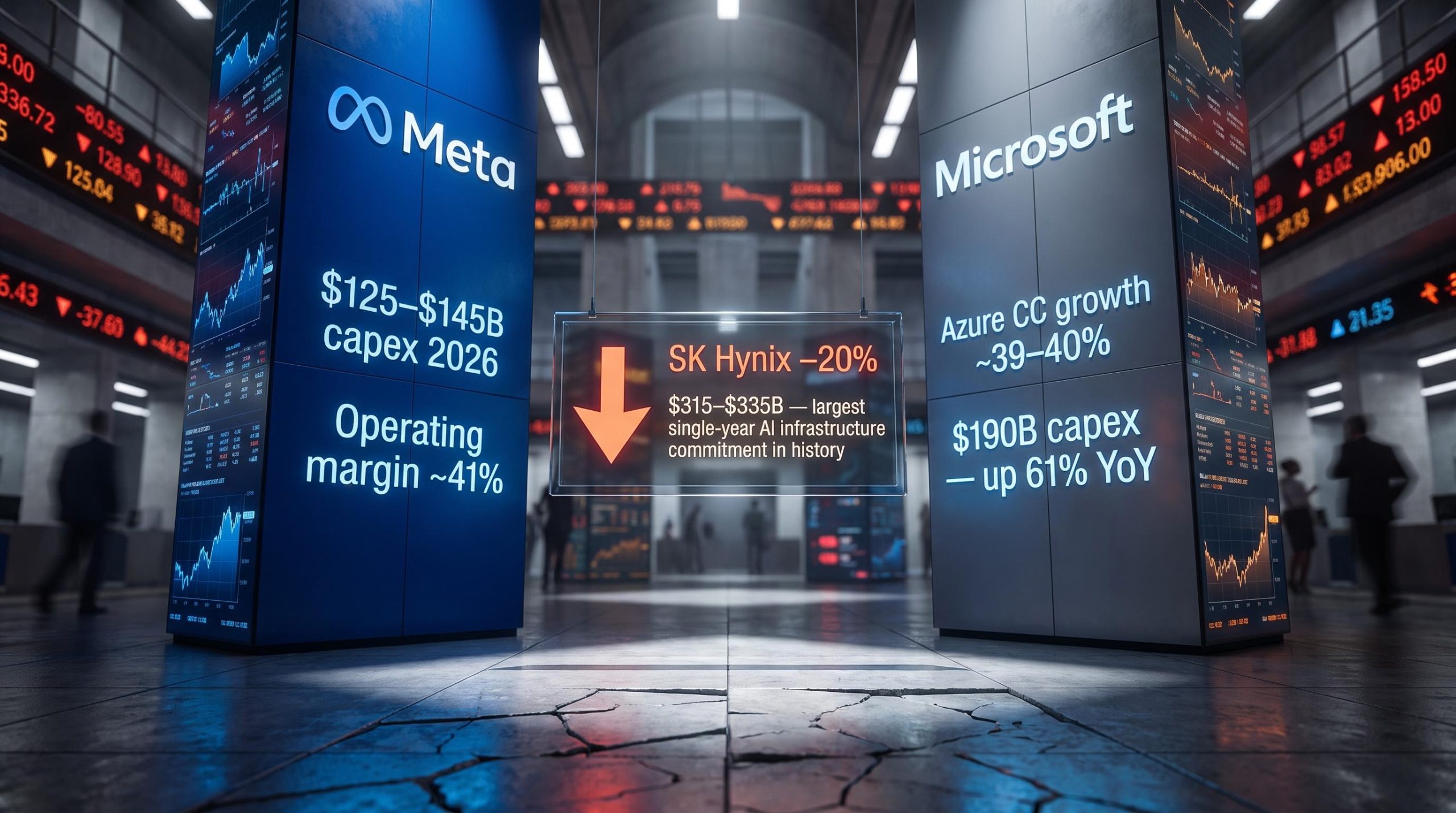
Meta and Microsoft have guided a combined $315-$335 billion in capital expenditure for 2026 alone, the largest single-year AI infrastructure commitment in corporate history.
The hyperscaler capex trajectory heading into tonight’s results includes $130 billion spent in Q1 2026 alone across the four largest cloud providers, with debt issuance running at roughly four times the five-year average to fund commitments that extend well beyond the current fiscal year.
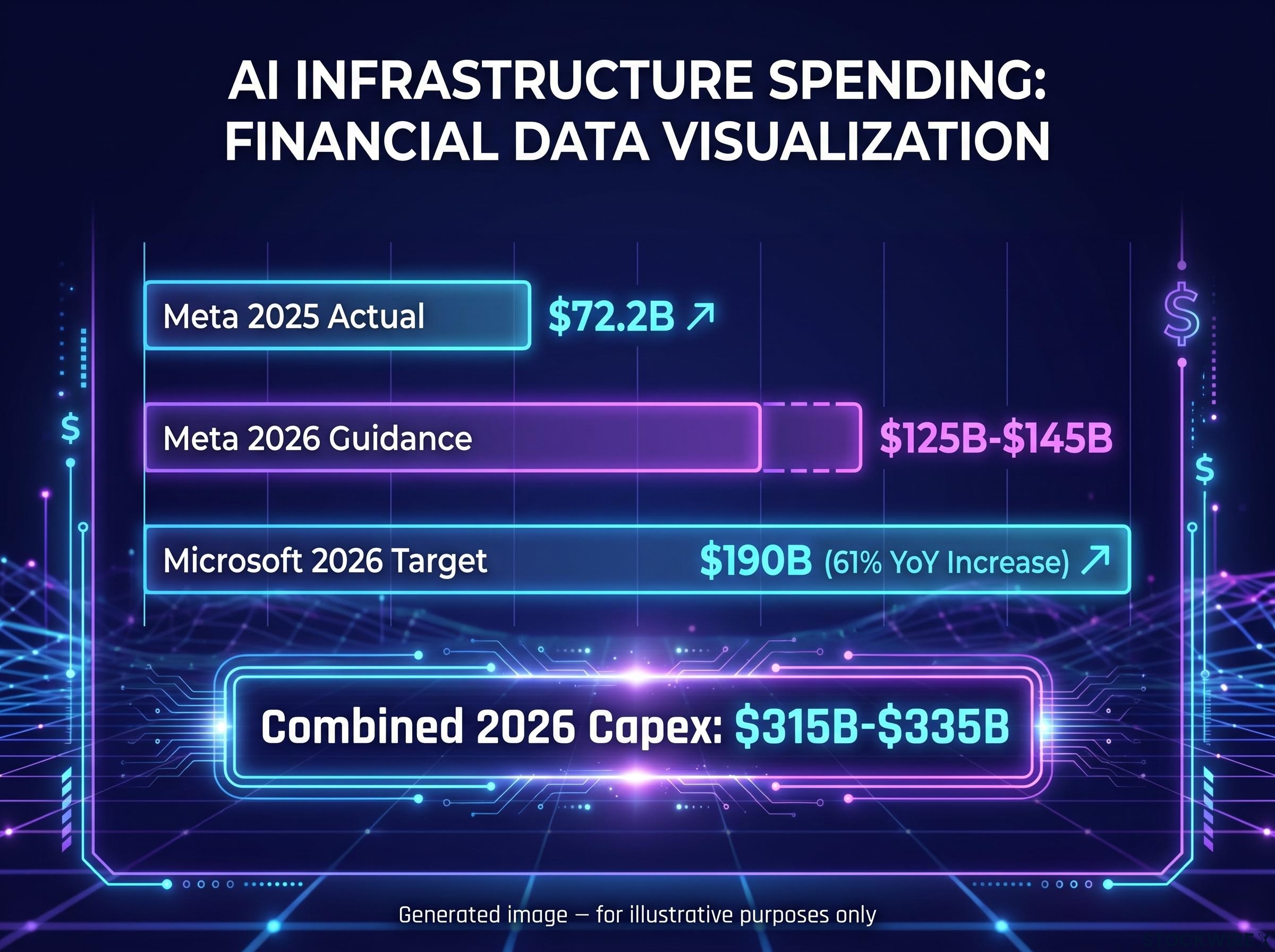
Meta raised its 2026 capex guidance to $125-$145 billion (up from $115-$135 billion as announced in May 2026). Microsoft has set a record target of $190 billion, a 61% increase over 2025. These are not theoretical projections. Much of the spend is already locked in.
That scale means both companies face the same four-part test tonight:
- Revenue acceleration attributed to AI: not just top-line growth, but explicit evidence that AI workloads and AI-improved products are driving incremental revenue.
- Proof that margins can coexist with massive capex: that depreciation and infrastructure costs are being absorbed without structural damage to the earnings model.
- Capex guidance that looks like a plan: a credible trajectory toward spending intensity plateauing, not an open-ended commitment that drifts higher each quarter.
- Evidence that flagship AI products have real traction: paid adoption, measurable engagement gains, or advertiser ROI that analysts can model, not just usage statistics.
Meeting guidance is no longer sufficient. The companies have effectively pre-spent the returns argument: investors are no longer debating whether AI infrastructure is worth building. They are asking whether the timeline for payback falls inside or outside a reasonable investment horizon.
When big ASX news breaks, our subscribers know first
What Meta’s numbers need to show
The consensus expectation for Meta’s Q2 2026 revenue sits at approximately $60.2-$60.3 billion, within company guidance of $58-$61 billion. The top-line figure matters, but it is not the interpretive key. What analysts want is attribution: how much of that revenue growth can be traced directly to AI-driven improvements in ad targeting, content ranking, and conversion rates.
| Metric | Consensus estimate | Prior quarter actual | What a miss signals |
|---|---|---|---|
| Revenue | ~$60.2-$60.3B | Within guidance band | AI ad gains are incremental, not structural |
| EPS | ~$7.18-$7.23 | Broadly flat YoY | Capex cost absorption is compressing earnings |
| Operating margin | ~41% | ~41.4% (Q1 2026) | AI infrastructure costs are outpacing monetisation |
| 2026 capex | $125-$145B | $72.2B (2025 actual) | Spending intensity still accelerating with no peak in sight |
The margin question is where the weight accumulates. Meta spent $72.2 billion on capex in 2025. The 2026 guide nearly doubles that. If the operating margin holds near 40% while ad growth lands above the midpoint of guidance, it tells you that AI targeting gains are real and that the capex curve is being absorbed without structural damage to the earnings model. If margin compresses while guidance is reaffirmed at current levels, the opposite conclusion follows.
The legal risk multiplier
Meta has itself flagged youth-related platform litigation and regulatory scrutiny, in both Europe and the United States, as potentially material to financials. This is not strictly an AI issue, but it compounds the AI capex problem: it narrows the window in which experimental, long-dated investments can be tolerated before investors demand a return to capital discipline. Rising legal costs and regulatory uncertainty reduce the market’s willingness to extend AI spending the benefit of the doubt.
What Microsoft’s numbers need to show
Azure constant-currency growth of approximately 39-40% is the single number the market is benchmarking against. Consensus revenue sits at approximately $87.5-$87.7 billion, with EPS expected at approximately $4.22-$4.24, up mid-teens year-over-year. But the clean Azure headline is necessary, not sufficient. Three distinct variables must all move in the right direction:
- Azure growth at or above the 39-40% bar, with explicit attribution of AI workloads as a meaningful share of that growth, not just general cloud expansion.
- Copilot paid adoption, where analysts are modelling 20-plus million paid seats and need evidence these seats are generating genuine per-seat revenue rather than functioning as bundling leverage in enterprise deals.
- OpenAI dependence signals, specifically any indication that Microsoft is diversifying its AI model stack to reduce single-partner exposure.
| Metric | Consensus estimate | Key threshold | What a miss signals |
|---|---|---|---|
| Azure CC growth | ~39-40% | Needs AI workload attribution | AI demand is not ramping fast enough vs. spend |
| Revenue | ~$87.5-$87.7B | Broad-based growth | Growth is cloud-concentrated, not diversified |
| EPS | ~$4.22-$4.24 | Mid-teens YoY growth | Depreciation and AI costs eroding earnings power |
| 2026 capex | ~$190B | Confirmation + 2027 view | Spending trajectory still steepening without milestones |
Microsoft’s stock is down approximately 22-23% over the prior 52 weeks as of late July 2026. That decline is the market’s pre-earnings verdict on the spending trajectory. Tonight’s numbers need to reopen the conversation, not merely hold the line, because at $190 billion in annual capex the cost of no-story is already priced in as a loss.
The OpenAI variable
Microsoft’s relationship with OpenAI cuts both ways. On the upside, it provides fast access to frontier models and differentiated product offerings across the Azure and Copilot portfolio. On the downside, it creates structural dependence on a separate entity for core technology, with potential tension over economics as OpenAI evolves its own commercial ambitions. With capex climbing toward $190 billion, a meaningful portion of that spend depends on a partner Microsoft does not fully control. Analysts will listen for any signal that in-house model development is accelerating to reduce single-partner risk. Some analysts have modelled FY2027 capex near $262 billion, though this figure has not been independently verified.
OpenAI compute diversification has already begun, with confirmed partnerships spanning AWS and Google Cloud, meaning the exclusivity assumption that underpinned Azure’s competitive advantage in prior quarters is no longer structurally intact.
What SK Hynix’s 20% crash tells us about market psychology
SK Hynix reported record Q2 2026 operating profit. The result was driven by AI memory demand, the single strongest secular tailwind in semiconductors. The numbers were, by any historical standard, exceptional.
Shares fell approximately 20% after the result missed elevated analyst estimates. South Korea’s KOSPI index dropped 12%, extending a prior slide. Record profit was not enough.
The mechanism is straightforward: the market has raised the expectation bar so high for AI-adjacent companies that meeting or slightly missing consensus is now a negative event, even when absolute results are historically strong. Alphabet’s announcement of an increased capex budget the prior week amplified the dynamic. Reports of rising Chinese competitive pressure on U.S. chipmakers added a third layer of sentiment risk.
Three concurrent pressures are now bearing down on AI-related equities:
- Elevated expectations that punish “good” results which merely meet rather than exceed consensus
- Alphabet’s capex signal, which reinforced fears that hyperscaler spending is accelerating without matching revenue proof
- Chinese competition concerns, which threaten the margin structure of U.S. semiconductor and AI infrastructure suppliers
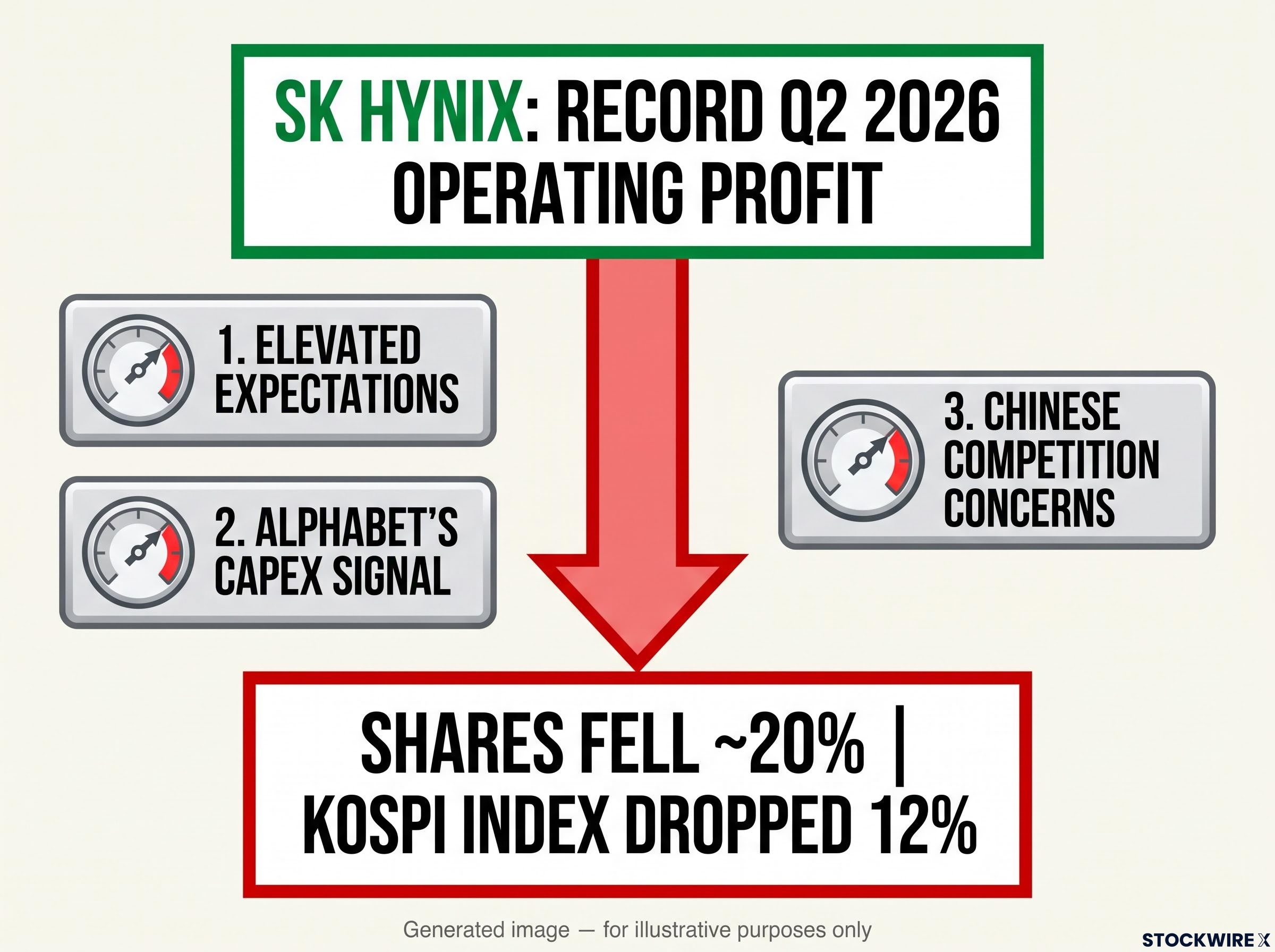
The lesson for tonight is specific. Meta and Microsoft are not just competing against their own guidance. They are competing against what the elevated AI optimism embedded in prior rallies already implied about their results. Record numbers that do not exceed elevated expectations are functionally indistinguishable from disappointments in this environment.
Why the economics of AI at this scale are genuinely hard to prove quickly
Much of the infrastructure investment both companies have committed is effectively irreversible in the short term. Long-term data centre and hardware commitments cannot be unwound. This removes the optionality that typically cushions investment risk and raises the stakes for near-term monetisation evidence.
The asymmetry investors face is structural. Capex costs hit the income statement and balance sheet immediately through depreciation. AI-driven revenue acceleration takes quarters or years to compound. Meta’s capex acceleration from $72.2 billion in 2025 to $125-$145 billion guided for 2026 illustrates the scale of the front-loading. Microsoft’s 61% year-over-year capex increase tells the same story.
PIMCO estimates hyperscaler capex now absorbs 93-94% of operating cash flow, up from 33-40% in 2022-2023, a compression ratio that reframes the AI capex vs returns question from a long-term strategic debate into an immediate balance sheet stress test.
The structural challenges sequence as follows:
- Irreversibility: data centre builds and GPU commitments are locked in regardless of near-term results.
- Depreciation lead-time: infrastructure costs flow through the income statement before the revenue those assets generate has had time to scale.
- Attribution opacity: it is difficult to isolate what AI is actually contributing to the top line.
The attribution problem
Not all AI revenue is created equal. Microsoft’s Copilot seat fees and Azure AI SKUs are discrete, measurable revenue lines. Meta’s AI value, by contrast, is embedded: better ad targeting, improved content ranking, and deeper engagement generate more ad impressions and higher conversion rates, but the contribution is entangled with the broader advertising engine.
That distinction matters most when capex guidance is rising. Investors can triangulate Copilot seats against infrastructure spend. They cannot easily do the same with Meta’s targeting improvements. The result is that both companies face the AI economics question, but the evidentiary burden falls differently.
For investors assessing tonight’s results, the most important interpretive question is not whether AI is generating revenue. It is whether the rate of revenue growth is fast enough to keep the return-on-capex curve from widening further over the next two to three years.
What a beat or a miss tonight means for the AI trade beyond these two stocks
Because Meta and Microsoft function as bellwethers, their combined AI capex represents roughly 43-46% of the estimated Big Tech total (approximately $725 billion in 2026, up roughly 77% year-over-year, though this aggregate figure has not been independently verified). The impact of tonight’s results will extend well beyond two stocks.
| Variable | Bull case signal | Bear case signal | Second-order effect |
|---|---|---|---|
| Azure growth | Above 40% with AI attribution | In-line or below 39% | Cloud and infrastructure names re-rate in either direction |
| Meta margin | Holds near 41% | Compresses toward 38-39% | Signals whether AI capex is absorbed or dilutive sector-wide |
| Copilot traction | Paid seats growing with genuine ARPU | Still primarily a bundling tool | Enterprise AI software valuations adjust accordingly |
| Capex trajectory | Reaffirmed with 2027 plateau signal | Drifting higher without milestones | Reprices every capex-heavy AI narrative in the market |
Meta and Microsoft’s combined $315-$335 billion in 2026 capex represents the largest single-year AI infrastructure commitment in corporate history. How they characterise the return timeline tonight will set the standard against which every other major AI capex announcement for the rest of 2026 is measured.
A clean beat stabilises the broader AI trade, from chipmakers to cloud infrastructure to enterprise software. A miss, or ambiguous commentary that pushes the payoff further out, accelerates the repricing already underway and pressures every company with a similar capex-heavy AI narrative.
Four distinct AI valuation frameworks, including Minsky’s financing stages, Kindleberger’s mania model, Sharma’s four O’s, and the Shiller CAPE, each classify the current hyperscaler cycle differently, which is why investors holding the same stocks can reach opposite conclusions about whether tonight’s results confirm or puncture the thesis.
Reading tonight’s results: the three numbers that settle the AI return argument
The full analytical framework condenses to three specific watchpoints. These will not resolve the long-term AI profitability question tonight, but they will tell you whether the trajectory is narrowing toward proof or widening toward open-ended commitment.
- Azure constant-currency growth versus the 39-40% consensus. A credible beat likely needs to clear 40% with explicit AI workload attribution. Anything below 39% reopens the demand question at the worst possible moment.
- Meta’s operating margin versus the Q1 2026 benchmark of approximately 41.4%. This is the definitive test of whether AI capex is being absorbed within the earnings model or is beginning to structurally compress it.
- Management tone on capex trajectory. Any commentary distinguishing between locked-in 2026 spend and a moderating 2027 curve is the forward-looking variable that will do the most work in shaping sector sentiment for the rest of the year.
The distinction tonight is between a trajectory narrowing toward proof and a trajectory widening toward open-ended commitment. That distinction determines whether the AI trade reprices higher or continues its correction.
Investors who enter tonight with these three thresholds in mind will be better positioned to interpret management commentary in real time, rather than reacting to headline beats or misses that may not capture the actual state of the AI return argument.
This article is for informational purposes only and should not be considered financial advice. Investors should conduct their own research and consult with financial professionals before making investment decisions. Past performance does not guarantee future results. Financial projections referenced are subject to market conditions and various risk factors.