In March 2020, gold fell roughly 12% peak-to-trough in the same month equities cratered. Six years later, in March 2026, it happened again: gold dropped approximately 11.80% while the S&P 500 fell just 5.09%. For an asset that millions of investors hold specifically as crisis protection, those are facts that demand an explanation, not a dismissal.
Gold has a credible, research-backed case for safe haven status. It also has documented episodes of failing precisely when investors needed it most. Both things are true, and they are not contradictory. The question is not whether gold is a safe haven. The question is under which conditions its protection holds and under which conditions it breaks.
After reading this, you will be able to diagnose any given crisis by type, match your gold expectations to that diagnosis, and stop relying on a blanket assumption that will periodically surprise you.
The precise definition of a safe haven, and where the concept is commonly misread
Most investors use the phrase “safe haven” as a synonym for “low risk.” That is the wrong definition, and it leads to the wrong expectations.
In financial research, a safe haven asset is one that retains or gains value during periods of market stress, showing zero or negative correlation to risky assets specifically during those stress periods. Not across all market conditions. Not as a permanent property. Only when it matters.
Three characteristics define a true safe haven:
- Zero or negative correlation during stress: the asset holds its value or appreciates while risk assets decline, specifically during periods of turmoil.
- Time-conditional: the same asset can behave as a safe haven in one crisis and move like any other risk asset in another; the property is not permanent.
- Crisis-type dependent: protection varies based on the nature of the shock, not just its severity.
There is also a distinction between a “strong” safe haven, one that moves inversely to risk assets during turmoil, and a “weak” safe haven, one that is merely uncorrelated. In practice, these behave very differently. Uncorrelated is not the same as protective.
What this means for you is straightforward: “gold is a safe haven” is not a binary verdict. It is a conditional claim. Knowing that distinction immediately changes how you should use gold in a portfolio.
When big ASX news breaks, our subscribers know first
The structural properties that give gold its protective role
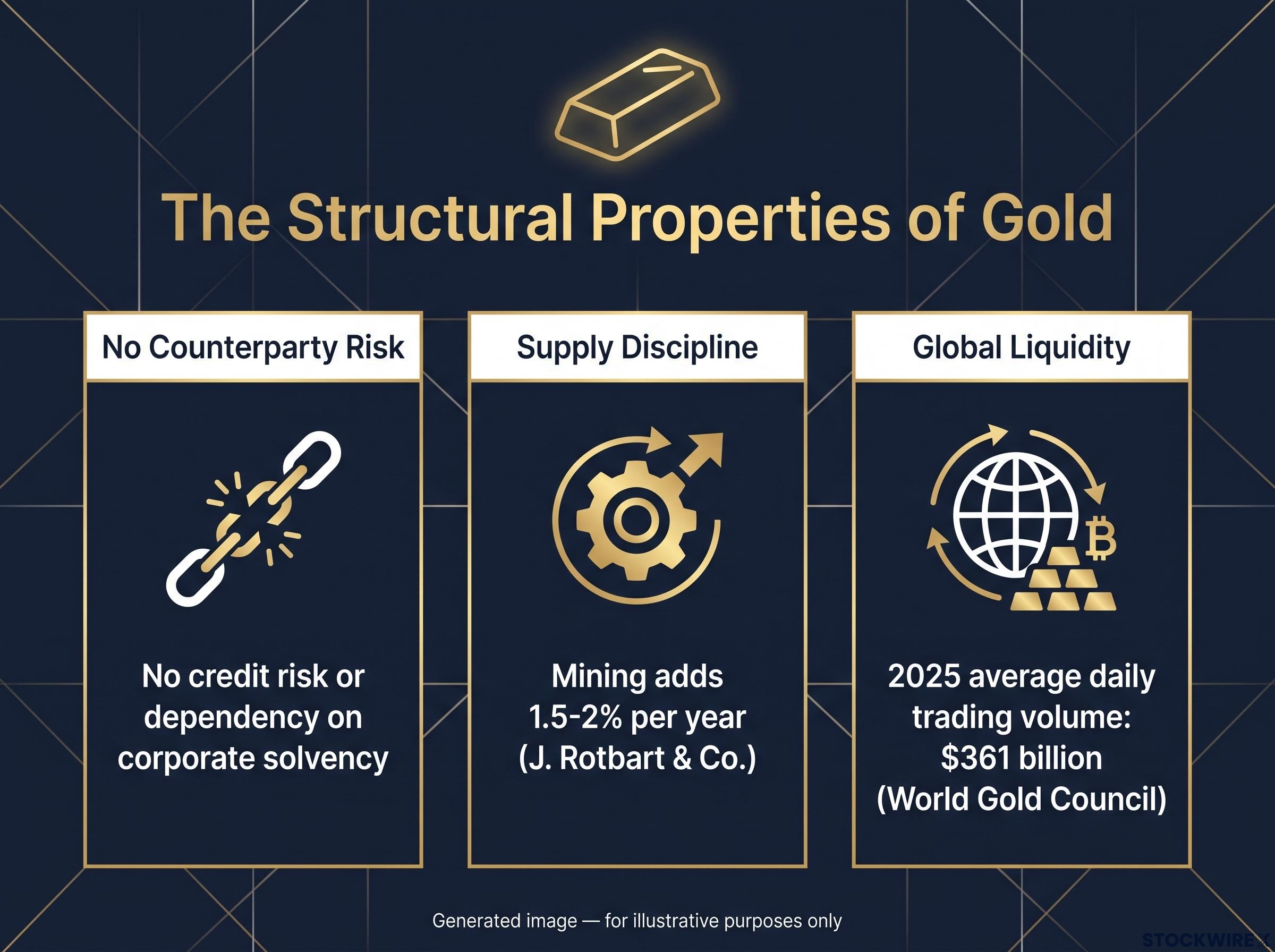
Gold’s safe haven reputation did not arise from market sentiment or historical convention alone. Three specific structural features underpin it, and no other widely held asset combines all three in quite the same way.
- No counterparty or credit risk: unlike equities, which depend on corporate solvency, or bonds, which depend on an issuer honouring its obligations, or fiat currencies, which depend on confidence in governments and central banks, physical gold is not tied to any institution or obligation. It carries none of those dependencies. (Counterparty and leverage risks still apply to gold derivatives, but the physical commodity itself is free of them.)
- Supply discipline: mining adds to the total stock of gold at a pace of roughly 1.5-2% per year (J. Rotbart & Co.), and that figure cannot be altered by a central bank decision or a policy announcement. No monetary authority can expand the gold supply at will.
- Global liquidity: gold trades in deep, global markets, making it usable as both a crisis hedge and collateral.
In 2025, the World Gold Council reported that gold’s average daily trading volume was approximately $361 billion, a figure that puts it in the same bracket as major currency pairs and significant portions of the US Treasury market in terms of depth and accessibility.
These properties explain why gold is used as systemic insurance rather than a return-seeking asset. The case for gold is not superstition. It is a set of specific mechanical properties that you can evaluate on their own terms.
What the historical record actually shows, crisis by crisis
The strongest way to understand gold’s conditional safe haven role is to walk through the data, crisis by crisis, and watch the pattern emerge.
| Crisis / Period | Gold Return | S&P 500 Return | Gold Behaviour |
|---|---|---|---|
| 2001-2002 (dot-com) | +1.41% / +23.96% | -11.89% / -22.10% | Protected |
| 2008 (GFC, full year) | +3.97% | -37.00% | Mixed (fell in acute phase, recovered) |
| March 2020 (acute phase) | ≈ -12% peak-to-trough | -12.51% | Failed (acute phase) |
| 2020 (full year) | +25.75% | +18.40% | Protected |
| March 2023 (banking stress) | +2.08% | -18.11% | Protected |
| March 2026 | -11.80% | -5.09% | Failed (acute phase) |
Data sourced from Monetary Metals.
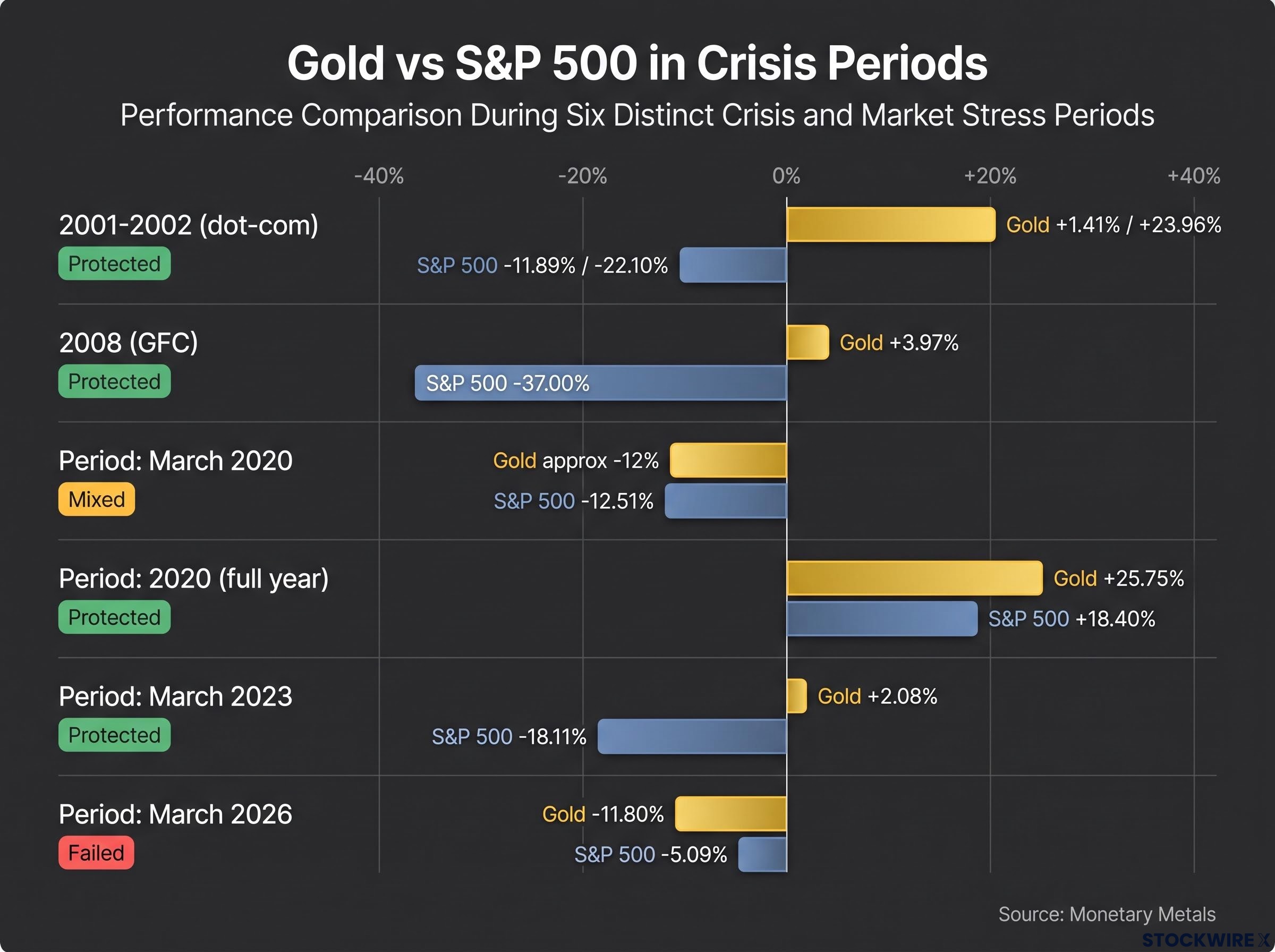
The pattern is visible once you see it side by side. During the dot-com downturn and the 2023 banking stress, gold did exactly what investors expected: it held or gained while equities fell. During 2008 and over the full year of 2020, gold delivered strong returns, but only after an initial acute-phase drawdown where it fell alongside stocks. And in March 2020 and March 2026, gold failed during the sharpest phase of stress, the exact window when investors most wanted it to work.
The full-year 2020 data is particularly telling. Gold returned +25.75% versus the S&P 500’s +18.40%, but in March of that year, gold fell roughly 12% peak-to-trough. Both the safe haven case and its short-term failure coexisted in the same event.
What the research says about when protection holds
Academic research sharpens the picture further. A large empirical study found that gold is a strong safe haven when stock market contractions are triggered by macroeconomic news, terrorism, or trade policy. But protection is much weaker or absent when declines are driven by commodity price moves or election results.
There is a time dimension too. Research on crash-day behaviour found that gold’s safe haven effect often lasts only approximately 15 trading days before flows partially reverse as confidence recovers. The protection is real, but it is tactical and short-lived around peak stress, not permanent.
The three conditions that override gold’s safe haven function
Once you accept that gold’s protection is conditional, a practical follow-up question arises: what exactly are the conditions? Three specific mechanisms can override gold’s defensive properties, and recognising them allows you to anticipate gold’s behaviour rather than be caught off guard by it.
- Forced liquidation and liquidity squeezes. In severe margin-call events, investors sell what they can sell, not what they want to sell. Gold’s high liquidity, normally an advantage, makes it one of the first assets liquidated to raise cash. The very feature that makes gold usable as a hedge also makes it vulnerable in the most acute phase of a crisis.
- Signal to monitor: spiking funding rates, broad de-risking across asset classes, collateral stress in repo markets.
- Rising real (inflation-adjusted) interest rates. As a non-income-producing asset, gold faces a rising opportunity cost whenever inflation-adjusted yields on safer alternatives move higher. Research consistently shows a strong inverse relationship between gold prices and 10-year US Treasury real yields, which means climbing real rates act as a well-documented drag on the metal.
- Signal to monitor: are 10-year real yields rising or falling?
Rising real yields exert downward pressure on gold through two reinforcing channels: the opportunity cost of holding a zero-income asset rises directly as Treasury yields climb, and higher US yields typically strengthen the dollar, raising the effective local-currency cost of gold for major importing markets and softening global demand simultaneously.
- US dollar strength. Since gold is denominated in USD, an appreciating dollar effectively makes gold more expensive in local-currency terms for buyers outside the United States, weighing on demand at the same time that some market participants are seeking safety. In global risk-off episodes where the USD itself acts as the primary safe haven, dollar strength can mechanically push gold lower or mute its gains.
- Signal to monitor: is the dollar strengthening against major currencies, and is the USD acting as the dominant risk-off trade?
All three conditions were simultaneously active in both March 2020 and March 2026, which explains why those acute phases saw gold fall alongside equities rather than providing the expected offset.
The 2026 bear market showed how powerfully real yields and dollar strength can override every geopolitical and inflationary signal that conventional safe-haven logic treats as bullish, with gold falling nearly 25% from its all-time high even as military conflict and elevated inflation data pointed in the opposite direction.
When you can identify which of these headwinds is active in any given environment, you move from asking “why is gold falling?” to understanding the precise mechanism. That is a different and more useful position to be in.
How to use this framework in practice, matching gold to the right crisis type
The most common mistake investors make with gold is conflating two separate decisions: the strategic allocation question and the tactical trading question. These have different logics, different time horizons, and different answers.
Strategic allocation treats gold as long-term portfolio insurance. Research from the World Gold Council and academic portfolio studies has historically looked at gold positions in the 2-10% range as a means of improving long-term diversification and providing tail-risk protection, though the right level for any individual will vary according to their risk tolerance, investment goals, and time horizon. A strategic gold position is not a bet on next month’s price; it is a structural decision about portfolio resilience across multiple potential futures.
The case for long-term portfolio diversification with gold has strengthened as sovereign debt levels erode the traditional diversification value of government bonds, with World Gold Council and BlackRock data showing a 5-10% gold allocation improved risk-adjusted returns and reduced maximum drawdowns in a 60/40 portfolio over the 2013-2023 period.
Tactical positioning is a separate question entirely. Research shows gold is a “perfect tactical safe haven” only when the timing of shocks is relatively certain, a condition that rarely holds under genuine uncertainty. Do not let short-term price action dictate the existence of a long-term allocation, or vice versa.
Gold’s protection tends to hold when:
- Stress involves institutional trust and financial system fragility
- Currency debasement or inflation fears are the dominant driver
- Geopolitical and policy uncertainty is elevated
- The crisis is systemic and macro in nature
Gold’s protection tends to weaken when:
- Acute liquidity squeezes and margin-call selling dominate
- Aggressive rate-hiking lifts real yields
- Global risk-off episodes primarily strengthen the USD
- Declines are driven by commodity-specific or idiosyncratic shocks
Your expectation for gold should match the dominant driver of whatever downturn you are facing. That is the diagnostic step most investors skip.
The three signals to monitor before and during a crisis
Before and during any market stress event, track these three signals explicitly:
- Real yield direction: are 10-year real yields rising (headwind for gold) or falling (tailwind)?
- USD direction: is the dollar strengthening as the primary safe haven trade, or is it weakening?
- Liquidity and forced-selling indicators: are funding rates spiking? Is broad de-risking visible across asset classes? Is there collateral stress?
When all three are adverse simultaneously, near-term gold weakness is probable even within a long-term uptrend. That combination was present in both the March 2020 and March 2026 drawdowns. Knowing this in advance does not eliminate the drawdown, but it prevents the surprise.
Conditional, not broken: what an accurate view of gold actually looks like
Gold’s safe haven properties are real, empirically supported, and structurally grounded. They are also conditional on the type of shock, not guaranteed across all crisis types. That is the core finding, and it is more useful than either “gold always protects” or “gold is a myth.”
In the current mid-2020s environment, the long-term case for gold remains intact. Official sector demand from central banks has increased, reinforcing gold’s role as monetary and geopolitical insurance. Academic work on gold in a fragmented geopolitical world finds it retains low or negative correlation to risk assets during systemic stress. The structural properties, no counterparty risk, supply discipline, global liquidity, have not changed.
At the same time, gold’s short-term behaviour remains sensitive to real yields, dollar moves, and liquidity conditions. Its safe haven effect is tactical and often short-lived around peak stress, with partial reversals as confidence recovers. That makes long-term strategic framing more appropriate than trade-by-trade expectations.
Gold is best understood as crisis-type-dependent insurance rather than an all-weather shield. That conditional framing is not a weaker version of the safe haven concept. It is a more precise and actionable one, because it tells you exactly when to rely on gold and when to hold your expectations in check.
The investors who fare best with gold are not the ones who hold it with blanket confidence or dismiss it with blanket scepticism. They are the ones who understand the conditions, monitor the signals, and calibrate their expectations accordingly.
Investors wanting a complementary macro lens for calibrating gold’s relative value over long horizons will find our dedicated guide to the Dow-to-gold ratio useful, which examines how this long-horizon metric has signalled major secular turning points between equity and gold cycles.
Past performance of gold during previous crises does not guarantee similar behaviour in future downturns. Any gold allocation should reflect your individual risk tolerance, investment objectives, and time horizon. This article is for informational purposes only and should not be considered financial advice. Investors should conduct their own research and consult with financial professionals before making investment decisions.