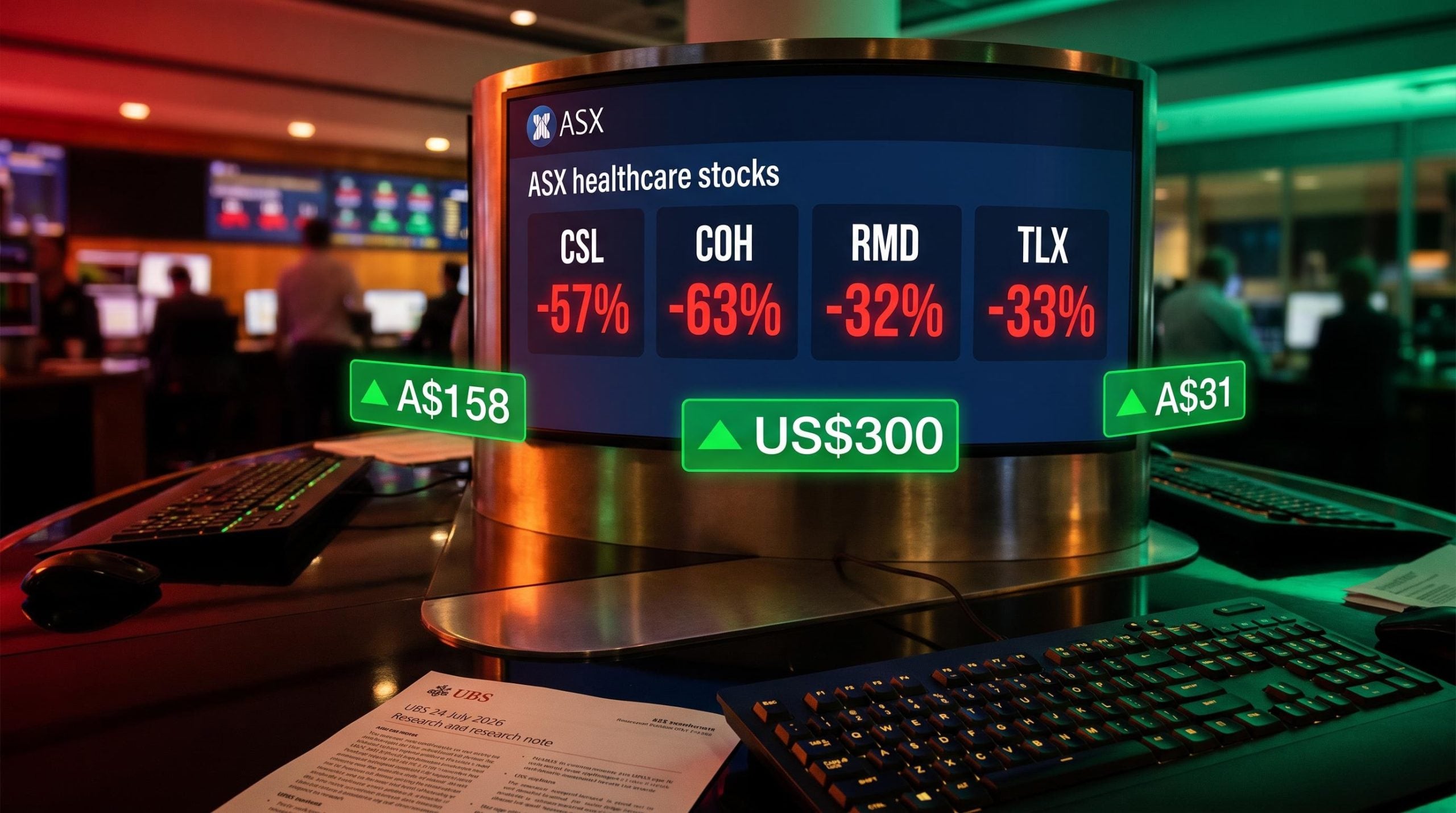
UBS has just assigned Buy ratings to three of the four largest ASX healthcare names, with price targets implying upside of 36% to more than 100% from current levels. The catch: the broker’s own earnings forecasts are more pessimistic than the street consensus on virtually every one of them.
After share price falls of 32% to 63% over the past 12 months, ASX healthcare stocks are sitting at multi-year lows. But the sector’s collapse has not been driven by an earnings collapse. For most of these companies, consensus analysts still expect growing profits through FY28. What broke was not the earnings outlook; it was what the market was willing to pay for those earnings. UBS’s 24 July 2026 sector note lays out exactly where it thinks the market has overcorrected, and where it has not.
Here is the specific UBS thesis for each stock, what the underlying earnings data actually shows, and what the gap between those two things tells you about whether these names are genuinely cheap or simply fallen.
ASX healthcare’s 30-60% collapse was a valuation story, not an earnings story
Start with the share price damage: Cochlear down 63%, CSL down 57%, Telix Pharmaceuticals down 33%, and ResMed down 32% over the past 12 months. Those numbers look like companies in serious operational trouble.
They are not.
The pattern visible in this UBS note, where share prices detach from earnings trajectories, reflects a broader valuation compression cycle that has run across ASX healthcare for five years, driven primarily by rising interest rates rather than any deterioration in the underlying businesses.
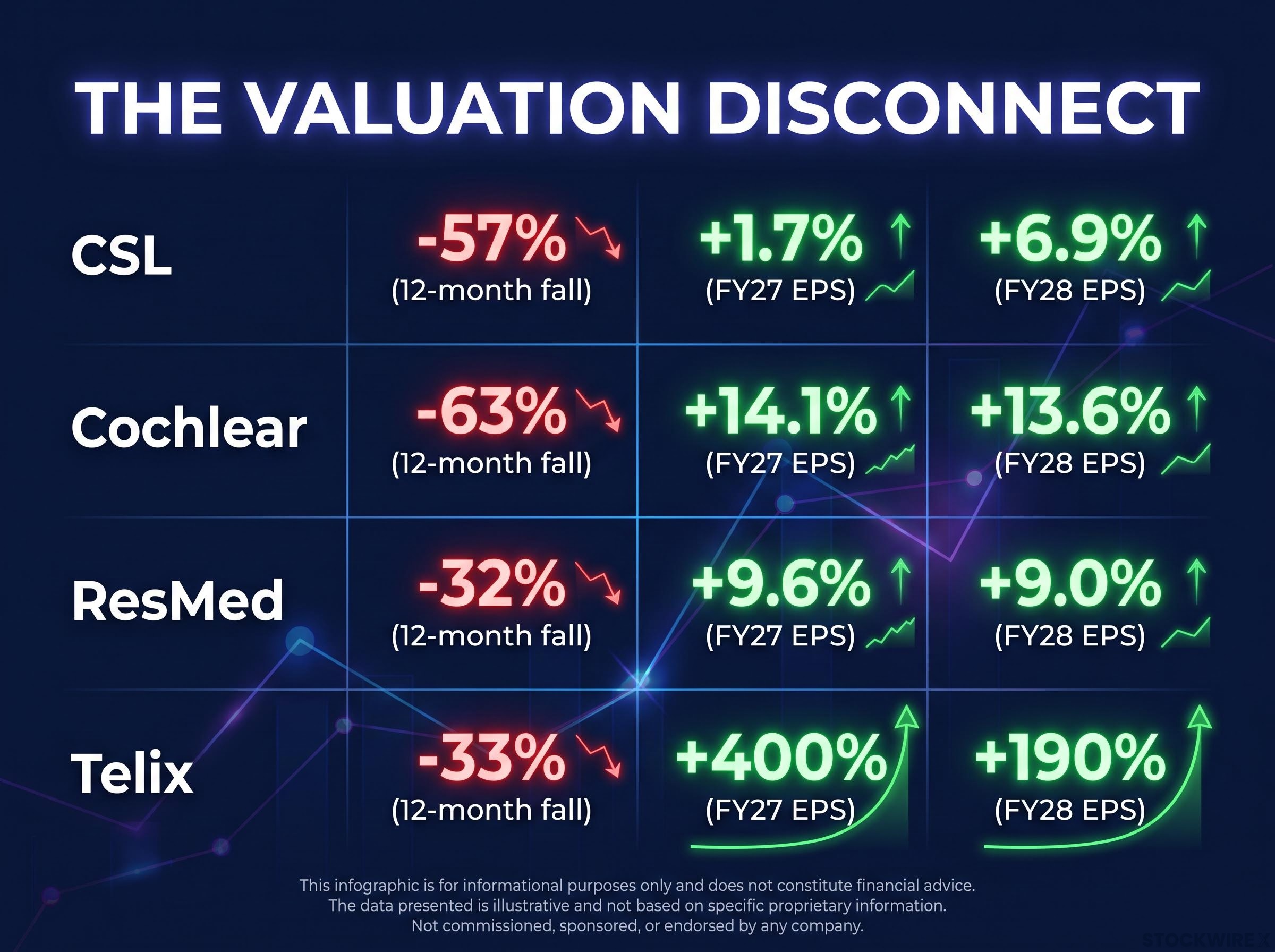
Refinitiv consensus EPS estimates tell a different story. Three of the four are forecast to grow earnings through FY28, some at double-digit rates. The table below lays out the disconnect.
| Company | 12-month price change | FY27 consensus EPS growth | FY28 consensus EPS growth | Price-earnings disconnect |
|---|---|---|---|---|
| CSL | -57% | +1.7% | +6.9% | Severe |
| Cochlear | -63% | +14.1% | +13.6% | Severe |
| ResMed | -32% | +9.6% | +9.0% | Significant |
| Telix | -33% | +400% | +190% | Significant |
A share price decline of 30-60% alongside broadly positive consensus EPS forecasts signals that the market has not actually priced in falling earnings. Instead, it has re-priced what each dollar of those earnings is worth, compressing the P/E multiple investors are prepared to assign to them. That distinction changes how you read every UBS call in this note.
CSL’s market capitalisation of approximately A$57.2 billion is substantially larger than Cochlear at A$7.8 billion, ResMed at A$17.2 billion, and Telix at A$4.9 billion. Because CSL’s weighting dominates the sector, its 57% fall has pulled sector-level indices down by a greater magnitude than the underlying earnings trends across the group would imply.
When big ASX news breaks, our subscribers know first
What UBS is actually saying with these Buy calls
The UBS note dated 24 July 2026 contains an unusual tension. The broker is more conservative than consensus on near-term earnings for virtually every stock, yet it is simultaneously issuing Buy ratings with substantial implied upside on three of the four.
| Company | UBS rating | UBS price target | Implied upside/downside | UBS FY26 EPS vs consensus |
|---|---|---|---|---|
| CSL | Buy | A$158 | ~36% upside | -13% vs consensus -4.8% |
| Cochlear | Neutral | A$106 | ~7% below price | -21% vs consensus +15.7% |
| ResMed | Buy | US$300 | ~53% upside | +8% vs consensus +16.1% |
| Telix | Buy | A$31 | >100% upside | -79% vs consensus -$0.02 to +$0.02 |
That gap is the signal. When a broker issues a Buy with 53% upside while simultaneously forecasting weaker-than-consensus near-term earnings, it is telling you the upside comes from multiple expansion and sentiment normalisation, not from an imminent earnings beat. The broader analyst consensus 12-month target for CSL sits at approximately A$139, which means UBS at A$158 is more bullish than the median analyst on valuation, but not on the near-term earnings path.
Multiple compression operating independently of earnings growth is a consistent pattern across ASX healthcare in the current rate cycle, and ResMed illustrates it clearly: Q3 FY2026 revenue grew 11% year-on-year while the share price fell more than 20% from its 2025 highs.
For you as an investor, this means the UBS thesis is a re-rating trade. The risk profile is meaningfully different from buying ahead of a quarterly surprise.
CSL and ResMed: the case for two very different recovery trades
CSL: volume recovery as the re-rating trigger
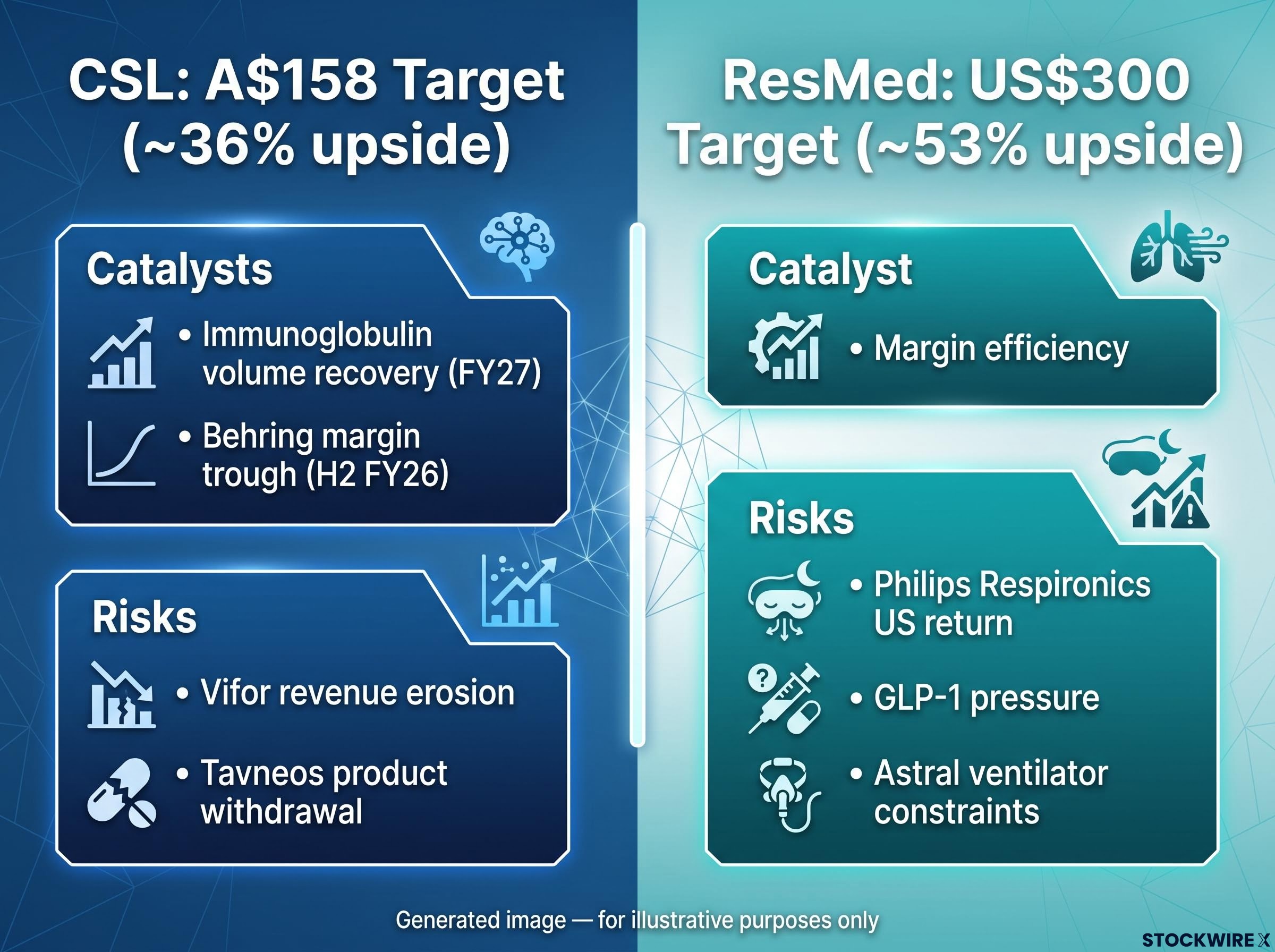
UBS’s A$158 Buy target is built around a single central catalyst: a recovery in immunoglobulin volumes through FY27, by which point the broker expects margin pressure at the Behring division to have troughed in the second half of FY26. On UBS’s numbers, the profit growth that follows that trough is modest, in the low-single-digit range.
The Behring margin story and the Vifor impairment cycle sit at the centre of the CSL bear case, and the specific divisional drags behind those two pressure points, including plasma cost inflation, amortisation charges, and channel normalisation headwinds, explain why UBS’s near-term earnings forecasts land 13% below consensus.
Key risks investors should monitor:
- Behring division margin compression, with pressure concentrated in the current financial year before an expected trough in H2 FY26
- Erosion of Vifor revenues as generic alternatives take market share
- The Tavneos product withdrawal
- Ongoing competitive dynamics in the immunoglobulin market
UBS’s A$158 target sits well above the median analyst consensus of approximately A$139, which reinforces the point: the bull case here requires the market to rebuild confidence in CSL’s earnings durability, not just execute on existing forecasts.
ResMed: margin efficiency against a structural headwind
For ResMed, UBS’s US$300 price target implies roughly 53% upside, with the broker pointing to gains from manufacturing efficiencies as the central driver of margin improvement. But the stock fell 32% despite positive consensus EPS growth for a reason: GLP-1 weight-loss drugs and a potential Philips Respironics re-entry into the US market represent genuine structural threats to sleep apnoea device demand.
Key risks for ResMed:
- A possible return by Philips Respironics to the US market
- Growing pressure on device volumes from GLP-1 adoption
- Supply constraints affecting Astral ventilator production
If you are weighing these two names, the distinction matters. The CSL thesis requires confidence in one specific volume recovery. The ResMed thesis requires confidence that GLP-1 drugs have not permanently disrupted the structural market for sleep apnoea devices. Those are very different bets.
Cochlear’s Neutral rating and why one of these calls is not like the others
UBS has assigned Cochlear a Neutral rating, setting a price target of A$106 that falls roughly 7% short of where the stock is currently trading, making it the sharpest divergence from consensus in the entire note.
UBS forecasts Cochlear FY26 EPS at -21%. Consensus expects +15.7%. That is a 37-percentage-point gap, and one side will be materially wrong.
Two specific concerns underpin the broker’s caution. First, the commercial rollout of the Nexa hearing implant has not met early expectations. Second, the US patient base skews older and is more sensitive to out-of-pocket costs, leaving volumes more vulnerable to insurance coverage shifts and broader economic conditions than many market participants appear to be factoring in.
Cochlear has suffered the largest fall in the cohort at -63%, yet UBS is the most cautious of the four. That combination reinforces the core thesis of this note: even a 63% share price decline does not automatically make a stock cheap if the broker’s near-term earnings view sits dramatically below consensus. The gap itself is a risk that the broader market has not yet resolved.
The Neutral rating also gives the three Buy calls more credibility. This is a selective note, not a blanket sector upgrade.
Telix and the binary risk that makes 100%-plus upside rational
Of the four stocks covered in the UBS note, Telix Pharmaceuticals carries the highest implied upside, at more than 100% to the broker’s A$31 Buy target. The logic supporting that figure is structurally different from what underpins the CSL or ResMed calls. The company’s existing revenue is anchored in diagnostics, with Illuccix and Gozellix expanding their combined market share, but the valuation case rests primarily on pipeline outcomes that are yet to be determined.
Key catalysts:
- The BiPASS clinical trial, where a positive result could expand the addressable market by more than double UBS’s current 2030 estimate
- The TLX591 candidate targeting prostate cancer as a therapeutic application
The TLX591 safety data published earlier in 2026 showed no treatment-related deaths and no new safety signals across 36 patients in ProstACT Global Part 1, a result that supports the mechanistic differentiation thesis but leaves the efficacy question for the 490-patient Part 2 expansion trial still to be answered.
Key risks:
- Binary clinical and regulatory outcomes as the primary value drivers
- UBS FY26 EPS estimate of -79% reflects a still-developing earnings base
The earnings trajectory logic runs in a specific sequence:
- Current diagnostic revenue provides cash flow stability
- Near-term EPS remains in development-stage territory (UBS FY26: -79%; consensus: -$0.02 to +$0.02)
- If clinical programmes progress, UBS forecasts FY27 EPS growth of +666%, with consensus at +400% and FY28 at +190%
If you are comparing Telix’s 100%+ upside target to CSL’s 36%, the numbers are not equivalent expressions of analyst conviction. Telix’s target reflects a probability-weighted binary outcome. CSL’s reflects a valuation re-rating on a more established earnings base. In portfolio construction terms, they represent fundamentally different types of positions.
What the UBS note does not resolve, and what investors should watch
Three variables will determine whether the re-rating thesis plays out:
- Whether immunoglobulin volumes recover on UBS’s timeline for CSL
- Whether GLP-1 displacement of sleep apnoea device demand accelerates or stabilises for ResMed
- Whether Telix’s BiPASS trial delivers data supporting the total addressable market expansion thesis
The Cochlear situation carries its own resolution. The 37-percentage-point gap between UBS’s FY26 EPS estimate and consensus means one side will be materially wrong. How that resolves will determine whether COH has further to fall or whether the street reasserts.
All analyst targets and consensus figures referenced in this article are point-in-time estimates drawn from the UBS note dated 24 July 2026 and Refinitiv data as of July 2026. They are subject to revision. Always verify with current broker reports and data providers before making investment decisions.
Multiple compression reverses when sentiment rebuilds on the back of positive surprises, not on the back of in-line results. For all three Buy-rated stocks, the re-rating thesis ultimately depends on earnings not just staying positive but beating already-revised-down expectations. That is the bar.
The UBS note provides a structured framework, but Australian investors need to map it to their own risk tolerance. A large-cap recovery trade (CSL), a mid-cap device play with a structural headwind overhang (ResMed), a clinical-stage binary bet (Telix), and a dissenting call that even a 63% fall is not enough of a discount (Cochlear) are four very different positions.
- CSL: large-cap recovery trade, ~36% implied upside
- ResMed: mid-cap device play with structural headwind, ~53% implied upside
- Telix: clinical-stage binary bet, >100% implied upside
- Cochlear: dissenting Neutral, target ~7% below price
The most important question is not whether UBS is right. It is which of these recovery structures, if any, matches your investment horizon and your appetite for the specific risk each one carries. The three Buy calls are not interchangeable.
This article is for informational purposes only and should not be considered financial advice. Investors should conduct their own research and consult with financial professionals before making investment decisions. Past performance does not guarantee future results. Financial projections are subject to market conditions and various risk factors.
—