
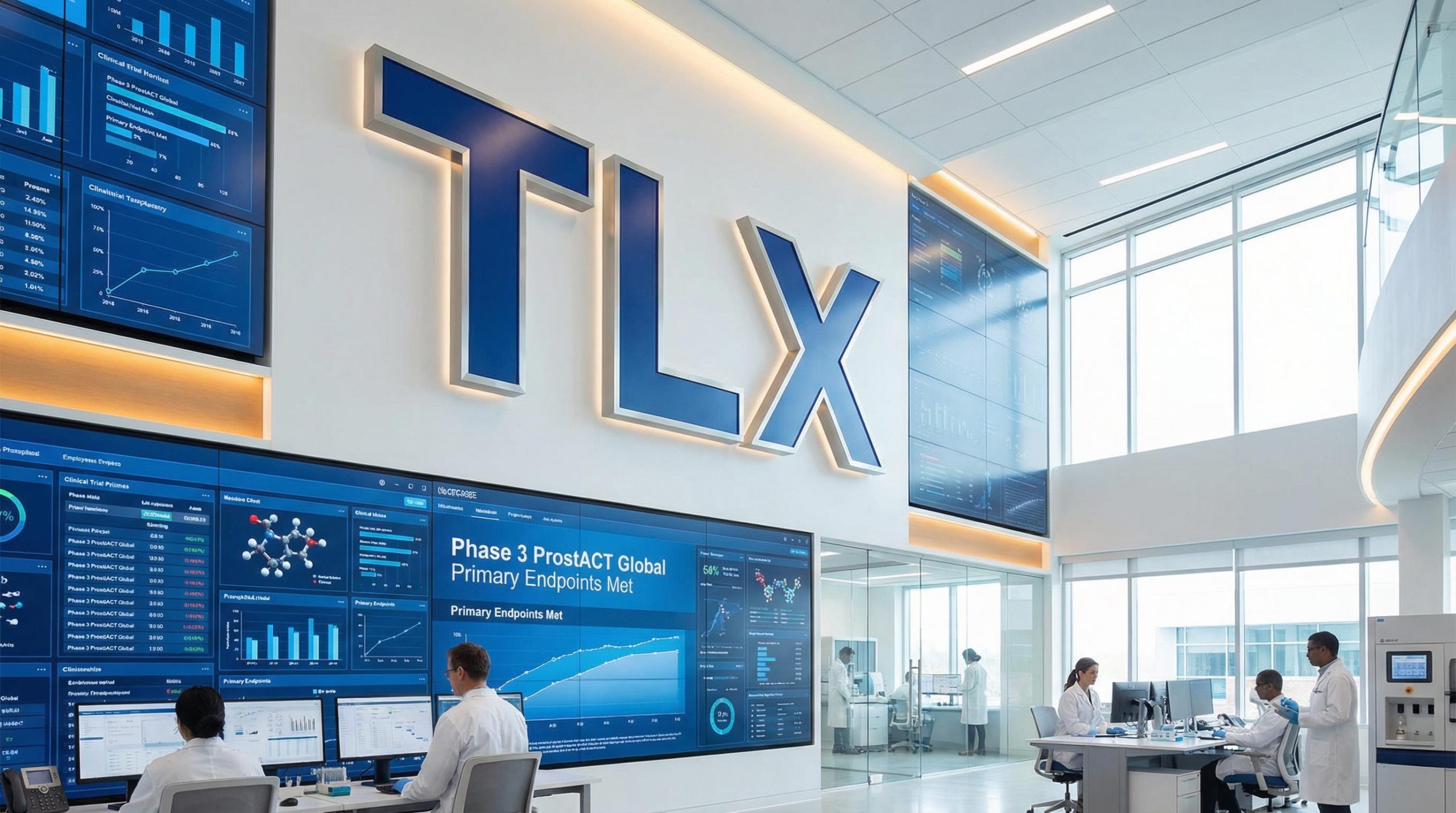
Telix Pharmaceuticals has reported positive Part 1 results from its ProstACT Global Phase 3 trial, clearing a critical regulatory hurdle for TLX591-Tx, the company’s next-generation prostate cancer therapy. The safety and dosimetry data package, which met all primary and secondary endpoints, is now being submitted to the U.S. FDA to secure clearance for the randomised Part 2 expansion trial in the United States.
Telix clears critical safety hurdle for next-generation prostate cancer therapy
Part 1 of the ProstACT Global Phase 3 trial enrolled 36 patients across three treatment cohorts, all of whom received both doses of TLX591-Tx (76 mCi each, 14 days apart). The trial confirmed the therapy’s safety profile and dosimetry characteristics, with 32 patients remaining alive and 26 continuing on the study. Importantly, there were no treatment-related deaths.
TLX591-Tx is a radio-antibody drug conjugate (rADC) targeting PSMA in metastatic castration-resistant prostate cancer (mCRPC). The two-dose regimen contrasts sharply with first-generation therapies, which require six doses administered over several months. Part 2 of the trial is already enrolling patients in Australia, New Zealand, and Canada, with regulatory approvals secured in China, Singapore, South Korea, Japan, Türkiye, and the UK.
Study Objectives Met
Confirmed safety, pharmacokinetics, dosimetry across cohorts. No new safety signals.
For investors, the successful completion of Part 1 removes a key de-risking milestone. FDA submission for Part 2 clearance is the next catalyst, positioning TLX591-Tx to compete in the lucrative PSMA-targeted therapy market, where first-generation treatments have already demonstrated multi-billion dollar commercial potential.
When big ASX news breaks, our subscribers know first
What is a radio-antibody drug conjugate and why does it matter?
Radio-antibody drug conjugates (rADCs) use large antibody molecules (molecular weight ~150,000) to target specific proteins on cancer cells. TLX591-Tx targets PSMA, a protein highly expressed on prostate cancer cells, delivering radioactive lutetium-177 directly to tumours.
First-generation small molecule radio-ligand therapies clear through the kidneys, exposing salivary glands and kidneys to higher radiation doses. TLX591-Tx, by contrast, clears through the liver (hepatobiliary route), potentially reducing off-target toxicity. The therapy also exhibits a prolonged terminal half-life of 5.6 days versus 1.7 days for small molecules, meaning sustained tumour radiation exposure.
The differentiated mechanism addresses known tolerability issues with existing therapies. If TLX591-Tx demonstrates comparable efficacy with improved safety, it could capture meaningful market share from established competitors.
| Feature | TLX591-Tx (rADC) | First-Gen Small Molecule RLT |
|---|---|---|
| Doses required | 2 doses (14 days apart) | 6 doses (over ~9 months) |
| Terminal half-life | 5.6 days | 1.7 days |
| Clearance route | Liver (hepatobiliary) | Kidneys (renal) |
| Off-target exposure | Liver, spleen | Salivary glands, kidneys, GI tract |

Safety data shows manageable side effects across all treatment combinations
Part 1 tested TLX591-Tx in combination with abiraterone (11 patients), enzalutamide (11 patients), and sequenced with docetaxel (14 patients). No new safety signals or adverse drug-drug interactions were observed.
Non-hematologic adverse events were predominantly low-grade: fatigue (53%), nausea (28%), and dry mouth (25%) were the most common, with almost all events graded as 1 or 2.
Hematologic events, while more significant, were described as transient and manageable:
- Grade 3 thrombocytopenia: 14%
- Grade 4 thrombocytopenia: 31%
- Grade 3 neutropenia: 22%
- Grade 4 neutropenia: 25%
Platelet nadir occurred at an average of 43 days post first dose, with recovery to Grade 1 or better approximately 15 days post-nadir, consistent across all cohorts. This profile aligns with expectations for lutetium-177 radiopharmaceuticals.
The transient nature of hematologic events and the low-grade non-hematologic profile support the thesis that TLX591-Tx can be safely combined with standard-of-care treatments, which is essential for commercial positioning in real-world clinical practice.
Dosimetry confirms tumour targeting with low off-target radiation
Dosimetry measures how much radiation reaches tumours versus healthy organs. Organ radiation exposure was well below established safety limits for radiation toxicity, with notably low radiation to salivary glands and kidneys, a key differentiator from first-generation therapies.
Lesion activity remained detectable through 15 days post-dose, demonstrating prolonged tumour retention. Tumour absorbed dose data across 132 lesions analysed in 33 patients showed:
- Bone lesions: mean absorbed dose 5.00 Gy
- Lymphatic lesions: mean absorbed dose 2.01 Gy
- Soft tissue lesions: mean absorbed dose 5.73 Gy
Favourable dosimetry supports both the safety case and the efficacy hypothesis: TLX591-Tx delivers meaningful radiation to tumours while sparing organs at risk. This is foundational data for regulatory discussions.
Global expansion positions Telix for accelerated enrollment
Part 2, targeting 490 patients in a randomised expansion trial, is already enrolling in Australia, New Zealand, and Canada following Independent Data Monitoring Committee review. Regulatory approvals have been obtained in China, Singapore, South Korea, Japan, Türkiye, and the UK. Japan requires a separate Part 1 study in nine patients before Part 2 commencement.
U.S. Part 2 clearance is pending FDA IND amendment following this Part 1 data submission. The trial design allows investigators to combine TLX591-Tx with either an androgen receptor pathway inhibitor (ARPI) switch (abiraterone or enzalutamide) or docetaxel, reflecting real-world practice patterns.
Multi-jurisdictional enrollment de-risks timeline execution. If U.S. FDA clears Part 2, Telix will have its pivotal efficacy trial underway across major markets simultaneously.
What investors should watch next
Key upcoming catalysts include:
- FDA response to IND amendment for U.S. Part 2 clearance
- Part 2 enrollment milestones across global sites
- Interim data readouts from randomised expansion
- Broader portfolio updates (Zircaix, Pixclara regulatory timelines)
The primary endpoint of Part 2 is radiographic progression-free survival (rPFS) by blinded independent central review. Patients will be randomised 2:1 (TLX591-Tx plus standard of care versus standard of care alone).
For investors, the key question shifts from “Is it safe?” to “Does it work?” Part 1 answers the safety question affirmatively. Part 2 will address efficacy. The next 12-18 months represent a high-value data generation period for Telix.
Want the Next Biotech Breakthrough in Your Inbox?
Join 20,000+ investors receiving FREE breaking ASX healthcare news within minutes of release, complete with in-depth analysis. Click the “Free Alerts” button at Big News Blast to get market-moving announcements the moment they drop, with expert coverage already done for you.