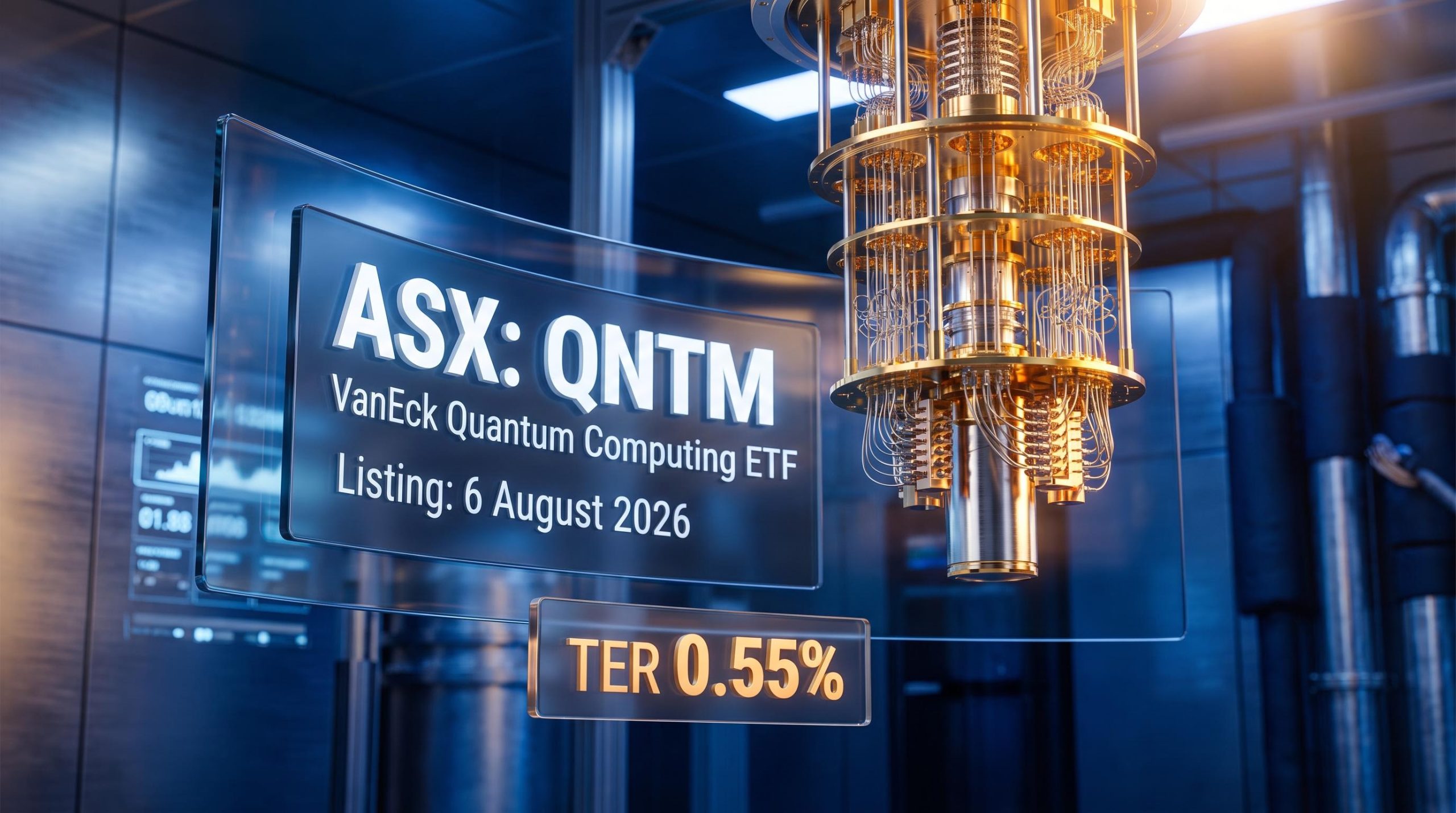
Quantum computing has been in the headlines for years, but for most investors the term has never quite translated into something concrete. It sits in the same mental category as fusion energy or space tourism: interesting in theory, unclear in practice. That changes on 6 August 2026, when VanEck’s Quantum Computing ETF (ASX: QNTM) begins trading on the ASX, making a position in quantum computing as straightforward as buying shares through a standard brokerage account.
For Australian investors, the timing matters. Most quantum-focused companies are listed in the United States or Europe. Gaining exposure to them has typically meant opening a foreign brokerage account, converting currency, and conducting technical research in a genuinely specialist field. An ASX-listed ETF removes both barriers at once.
This piece covers both layers you need before 6 August arrives: what quantum computing actually is, explained in plain terms, and what the ETF structure means for someone weighing whether this kind of exposure belongs in their portfolio. By the time you finish, you will have a working understanding of the technology and a clear picture of who this product is, and is not, suited to.
What a classical computer cannot do (and why that gap matters)
Every device you use, your phone, your laptop, every server behind every website, processes information in bits. Each bit is either a 0 or a 1. No in-between. All computation, from spreadsheet calculations to streaming video, is built from sequential operations on those binary states.
That architecture works brilliantly for most tasks. Where it breaks down is in problems where the number of possible combinations grows exponentially as you add variables. Double the variables, and you do not double the computation required; you may square it, or worse. For certain problem categories, even the fastest supercomputer on Earth would need longer than the age of the universe to check every possibility.
This is not a failure of engineering that faster chips will eventually fix. It is a structural ceiling baked into how classical machines process information. That distinction matters: it is why the solution requires a fundamentally different physical approach rather than just more speed. Problem types that hit this wall include:
- Drug discovery: simulating how complex molecules interact at quantum precision
- Logistics routing: optimising delivery networks with thousands of interdependent variables
- Cryptographic challenges: factoring very large numbers that underpin modern encryption
- Financial optimisation: modelling portfolios with hundreds of correlated assets and constraints
Understanding this ceiling is what makes quantum computing feel like a genuine leap rather than incremental progress. The problems above are not waiting for a better processor. They are waiting for a different kind of machine.
When big ASX news breaks, our subscribers know first
How quantum computers actually work: superposition, entanglement, and interference explained
Quantum computers replace classical bits with qubits (quantum bits). The difference is not just a naming convention. It reflects a fundamentally different relationship with information, one built on three properties that work together to make certain computations possible.
Superposition and qubits
A classical bit is always in one definite state: 0 or 1. A qubit, by contrast, can exist in a state called superposition, meaning it represents 0, 1, or a combination of both simultaneously, until it is measured. At the point of measurement, the superposition collapses into a definite result.
The computational power this unlocks scales dramatically. Where n classical bits encode exactly one of their possible configurations at any given moment, n qubits in superposition encode a combination of all possible configurations at once.
The scaling comparison: n classical bits encode exactly one of 2ⁿ configurations at a time. n qubits in superposition encode a combination of all 2ⁿ configurations simultaneously. With just 50 qubits, that is over one quadrillion configurations held in parallel.
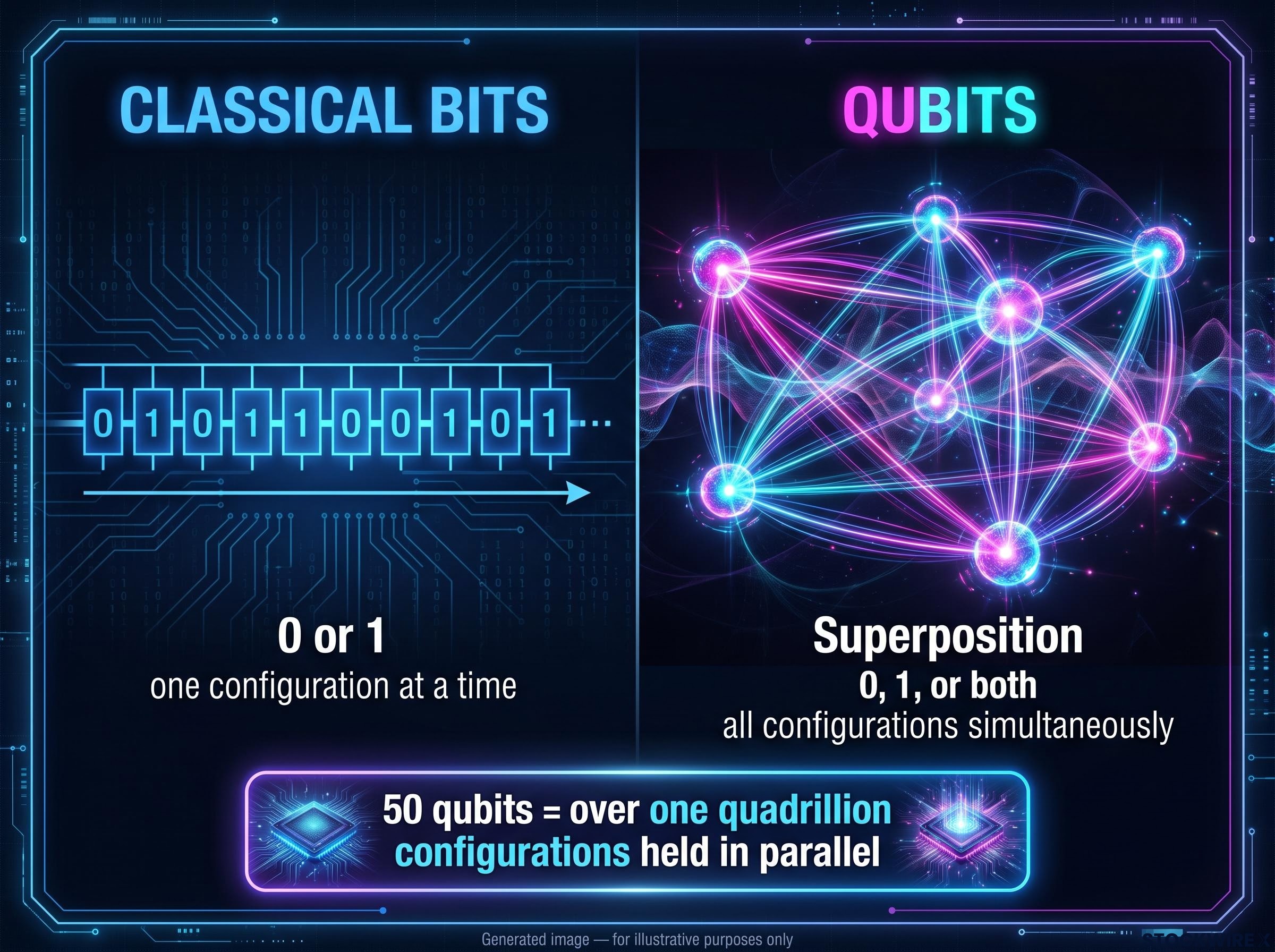
This is what allows quantum algorithms to explore an enormous solution space simultaneously rather than checking possibilities one by one.
Entanglement and interference
Entanglement is a correlation between qubits that has no equivalent in classical computing. When two qubits are entangled, the state of one instantly constrains the state of the other, regardless of physical distance. In practical terms, this means operations on one qubit affect the joint state of many entangled qubits at once, allowing algorithms to process linked information across the system in a single step.
Interference is the mechanism that turns all of this into a usable result. Quantum algorithms are designed so that computational paths leading toward correct answers reinforce one another (constructive interference) while paths leading toward incorrect answers cancel out (destructive interference). Shor’s algorithm, which can factor large numbers at speeds classical machines cannot match, is one well-known example of interference in action.
These three properties working together are what allow quantum computers to approach certain problems from a structurally different angle. It is not just speed; it is a fundamentally different way of exploring a solution space.
IBM’s quantum computing fundamentals documentation explains how superposition, entanglement, and interference work together in practice, drawing on IBM’s own hardware development experience to illustrate why these properties enable a structurally different approach to computation rather than simply a faster one.
Where quantum computing is being put to work right now
The gap between theoretical capability and real-world deployment is where your investment framing should start. Quantum computing is actively being explored across several high-value domains, each representing industries you may already have exposure to in your portfolio:
- Chemistry and drug discovery: simulating molecular interactions at quantum precision to accelerate the identification of new drug candidates
- Materials science: designing new materials with specific properties, from battery components to industrial coatings
- Logistics and route optimisation: solving complex scheduling and routing problems with hundreds of interdependent constraints
- Cryptography: both the threat side (Shor’s algorithm could eventually break certain encryption schemes) and the defence side (quantum-safe cryptography development is already underway)
- Climate and financial risk modelling: handling large, complex systems with many interacting variables more effectively than classical simulation allows
Post-quantum cryptography timelines add a layer of near-term demand the hardware narrative alone does not capture: NIST finalised its post-quantum standards in 2024 and the Cloud Security Alliance set a hard enterprise adoption deadline of 14 April 2030, creating compliance-driven procurement that is already drawing institutional capital into the sector.
That said, the honest picture matters here. Broad commercial quantum advantage has not yet been achieved at scale. Timelines vary from a few years to a decade or more depending on the application. Current quantum devices are small, noisy, require cooling to temperatures colder than outer space, and remain highly error-prone. They are targeted at specific, high-value problems rather than general computing tasks.
Quantum computers are not faster replacements for everyday computing. They are specialised tools for a narrow class of high-complexity problems where classical machines hit a structural ceiling.
That gap between current hardware limitations and the scale of applications being explored is precisely what defines quantum computing as a long-horizon investment rather than a near-term revenue story. If you are considering QNTM, that framing should be front of mind.
Why quantum computing has become an investable megatrend
A physics research project does not become an investable theme by accident. Three converging forces are building the ecosystem that turns quantum computing from a laboratory curiosity into something asset managers can structure a product around.
First, strategic government funding. The United States, European Union, China, and several other nations are treating quantum technologies as priorities on par with semiconductor independence and artificial intelligence. Public funding programmes are seeding research, talent pipelines, and early-stage commercial infrastructure.
Government funding in quantum computing has moved beyond research grants: the US Department of Commerce took minority equity stakes in nine companies through a $2.013 billion CHIPS Act programme in May 2026, a structural shift that validates IBM and others as policy-anchored names within the quantum value chain.
Second, clear corporate roadmaps. Companies including IBM and Microsoft have published multi-year quantum development plans targeting progressively larger and more reliable systems with improved error correction. These are long-term commitments backed by substantial capital, not one-off experiments.
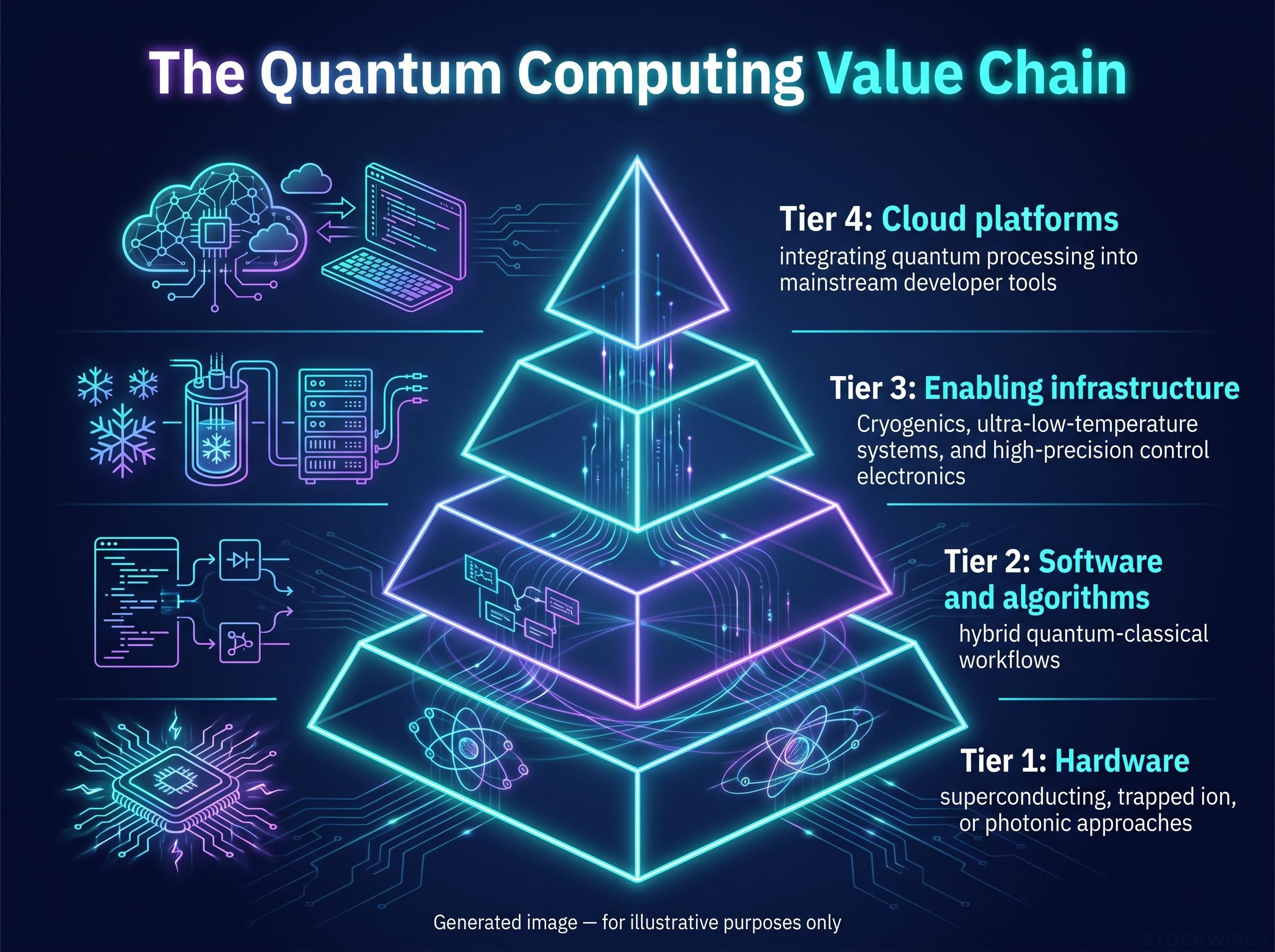
Third, a broadening value chain. The quantum sector now spans multiple layers, each with its own set of listed or listable companies.
| Layer | What it includes |
|---|---|
| Hardware | Quantum processor manufacturers using superconducting, trapped ion, or photonic approaches |
| Software and algorithms | Companies developing quantum applications and hybrid quantum-classical workflows |
| Enabling infrastructure | Cryogenics, ultra-low-temperature systems, and high-precision control electronics suppliers |
| Cloud platforms | Major tech providers integrating quantum processing into mainstream developer tools |
The diversity of this value chain is both the opportunity and the core argument for an ETF. No single company owns the entire stack. The eventual winners at each layer are not yet determined. That means concentration risk in individual positions is high, which is part of what makes a diversified index structure appealing.
European precedent: The VanEck Quantum Computing UCITS ETF (also ticker QNTM) began trading on 21 May 2025 at a total expense ratio (TER) of 0.55%, giving the ASX version a comparable European fund against which its terms can be assessed.
What ASX: QNTM actually gives Australian investors (and what it does not)
QNTM is scheduled to begin trading on the ASX on 6 August 2026. VanEck has positioned it as Australia’s first dedicated quantum ETF, part of a simultaneous launch of three new thematic funds. The European counterpart, launched in May 2025, provides a template for what the ASX version is likely to look like, though specific terms (fees, index methodology, and full portfolio characteristics) will be confirmed in the Product Disclosure Statement (PDS) at launch.
For you as an Australian investor, the ETF structure delivers four practical advantages:
- Diversification across the value chain. Your exposure spreads across hardware, software, infrastructure, and cloud platform companies rather than concentrating in a single name or technology approach.
- Global market access through a single ASX trade. Most quantum-focused companies are listed overseas. QNTM packages that international exposure without requiring foreign brokerage accounts or currency conversion.
- Simplified research. Rather than evaluating individual company roadmaps in a highly technical field, you can assess the fund through its PDS, which will detail index methodology, fees, and risk profile.
- Familiar administration. You buy and sell on the ASX through your existing brokerage, with standard Australian settlement and reporting.
The trade-off is equally clear. This is a thematic ETF concentrated in a single early-stage sector. It is not a substitute for broad-market exposure, and you should expect significant volatility over your holding period.
The investor profile this product suits has specific characteristics:
- A long time horizon and genuine tolerance for the uncertainty of early-stage deep technology
- An existing diversified core portfolio where QNTM fills a satellite allocation, not a foundation
- Clear conviction about the long-term relevance of quantum computing, paired with acceptance that commercial timelines and individual winners remain uncertain
For an investor who already holds a diversified portfolio, QNTM offers a single-trade path to global quantum exposure that would otherwise require navigating foreign exchanges, currency conversion, and deep technical due diligence on individual stocks. That is the product’s genuine value proposition.
What to do before the 6 August launch date arrives
The launch is just over a week away. Rather than summarising what quantum computing is, here is a concrete short list of steps to work through before the fund goes live:
- Review the PDS when it becomes available. The Product Disclosure Statement will confirm the index methodology, fee structure, and portfolio holdings for the ASX version. The European QNTM fund carries a 0.55% TER, which offers a rough point of comparison, but the ASX version’s own fee structure and terms must be verified in the PDS before drawing conclusions.
- Assess where thematic exposure fits in your portfolio. QNTM belongs in a satellite allocation alongside a diversified core, not as a replacement for broad-market holdings. If your portfolio is already concentrated in technology themes, adding another technology-adjacent position increases that concentration.
- Be honest about your time horizon. Broad commercial quantum advantage has not yet been achieved at scale. This is a long-horizon theme. If your investment timeline is measured in months rather than years, the volatility profile may not suit your circumstances.
- Seek professional financial advice if you are unsure. This is high-risk, early-stage thematic exposure, and a financial adviser can help you assess whether it is appropriate for your situation and risk tolerance.
Thematic ETF portfolio construction typically caps any single theme at 5% of total holdings, sitting within a satellite allocation that itself should not exceed 10% of the overall portfolio, which means the size of a QNTM position should be calibrated against your existing technology exposure before any capital is committed.
Evaluating ETF fees and exposure goes beyond the headline management expense ratio: tracking difference, bid-ask spreads, and the actual underlying holdings each affect the return you receive, and for a thematic fund like QNTM, verifying that the index genuinely targets quantum-specific companies rather than broad technology names is a critical first step.
This article is for informational purposes only and should not be considered financial advice. Investors should conduct their own research and consult with financial professionals before making investment decisions. Past performance does not guarantee future results, and forward-looking statements about quantum computing timelines are speculative and subject to change based on technological developments and market conditions.
The arrival of an ASX-listed quantum ETF does not mean the technology has reached commercial maturity. It means a diversified entry point now exists for investors with a long-horizon conviction and the right portfolio context to absorb the risk. The 6 August listing gives you the access. What you do with it depends on your own due diligence.