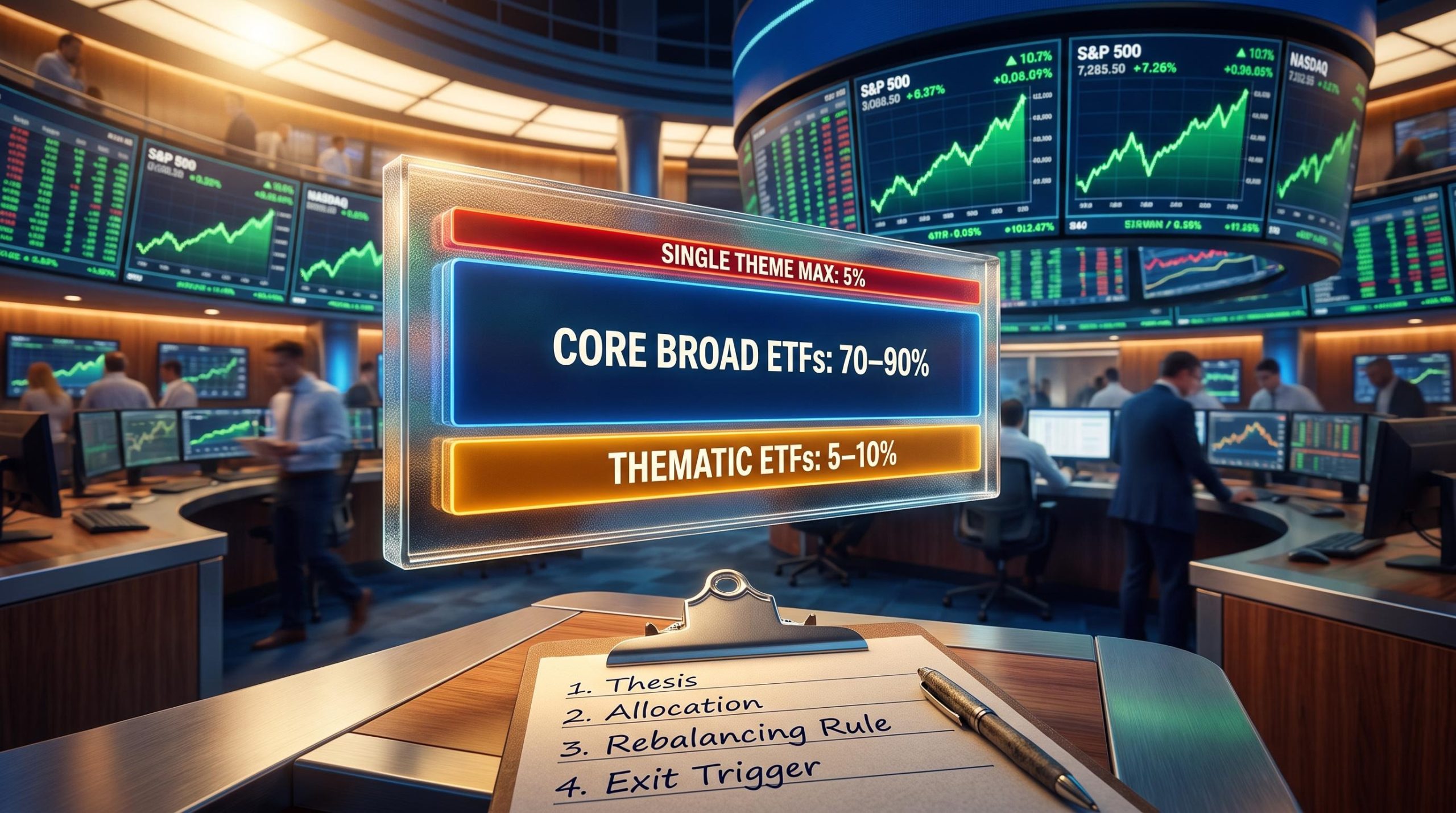
Most investors who search for thematic ETFs begin at the wrong end of the problem. They start with a story (“AI is changing everything”) and then build backwards toward a portfolio, which is exactly the sequence that produces costly mistakes.
Building an ETF portfolio around a dominant market theme is a legitimate and potentially rewarding strategy, but only when the theme is chosen after a disciplined process rather than before it. The sequence matters. The framework matters. And the willingness to exit when conditions shift matters just as much as the initial decision to enter.
Here is a clear, repeatable process for identifying which themes are attracting real capital, evaluating whether conditions support thematic positioning, and protecting the rest of your portfolio while you pursue the opportunity.
Build the foundation before touching a theme
The most common mistake in thematic investing is not picking the wrong theme. It is skipping the step that comes before the theme entirely.
If you build a portfolio out of three or four thematic ETFs and nothing else, you are not managing themes. You are making concentrated bets without a safety net. When one of those themes reverses, and eventually one will, there is no diversified core to absorb the impact.
Thematic ETFs are satellite positions. They sit on top of a diversified core, not instead of one. In practical terms, your core typically consists of three components:
The core-satellite portfolio framework formalises this split by treating broadly diversified index ETFs as the permanent foundation and reserving a bounded allocation for deliberate, thesis-driven satellite positions, a structure that also handles the rebalancing question most investors overlook when their thematic positions drift above target weight.
- A broad equity ETF (for example, a low-cost global or domestic index fund)
- An international equity ETF (for geographic diversification beyond your home market)
- A bond ETF (for stability and downside cushioning)
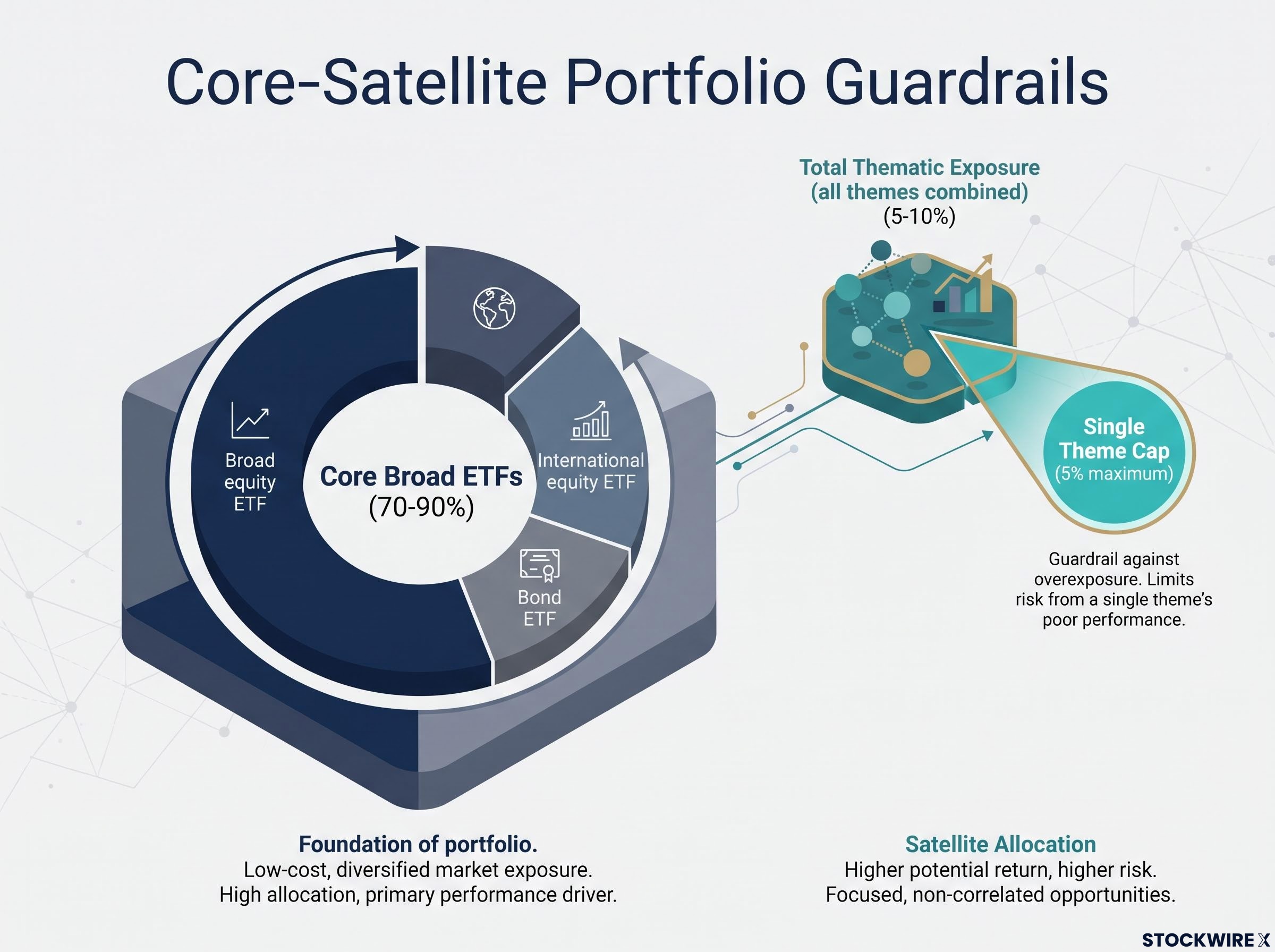
Themes sit on top of this core, not instead of it. Core broad ETFs typically make up 70-90% of a well-constructed portfolio. Thematic positions occupy the remaining allocation as satellites.
Before any thematic discussion begins, clarify your objectives (retirement savings, long-term growth, income generation), your risk tolerance, and your time horizon. If your thematic ETF is not sitting on top of a diversified foundation, you are not managing a theme; you are making a concentrated bet, and the framework described here assumes you understand the difference.
When big ASX news breaks, our subscribers know first
Reading the broad market before you commit capital
You have your core in place. Now you are ready to pick a theme, right?
Not yet. The next question is whether the market environment actually supports thematic positioning. This is where discipline separates profitable thematic investors from those who are right about a trend but still lose money.
A thematic ETF is, by definition, a higher-beta position. It moves more than the broad market in good times and in bad. When the overall market is trending higher, that amplification works in your favour. When conditions deteriorate, that same amplification accelerates your losses. Chasing a theme in a deteriorating market is the specific condition under which even correct theses produce losing trades.
Here is what to check:
- Assess index direction. Key benchmarks such as the S&P 500, Nasdaq, and ASX 200 provide useful directional readings regardless of where you invest. What you are looking for is a sustained uptrend characterised by higher highs and higher lows, not a brief post-selloff bounce.
- Assess duration. The trend needs to be measured in months, not weeks. A two-week bounce after a selloff is not a supportive environment for thematic capital.
- Define your deterioration trigger. Before you deploy capital, decide what conditions would cause you to reduce thematic exposure. Write it down.
When conditions turn: the decision rule
If broad market indices lose their upward trajectory and appetite for risk begins to contract, thematic satellite positions are the first part of your portfolio to trim, not your core holdings.
Classifying a market selloff correctly, before making any adjustment to thematic positions, is the step most investors skip; a price decline driven by irrational fear and intact fundamentals calls for a very different response than one reflecting a genuine structural shift in the theme’s competitive economics.
This is a pre-defined rule, not a reactive panic decision. Your core stays intact because it is built for durability. Your thematic positions are the ones with amplified risk, which means they are the first to go when the tide turns against you. The market environment check tells you whether that tide is with you or against you, and for thematic positioning specifically, fighting the tide is where most thematic losses occur.
How to identify where capital is actually flowing
With a supportive market confirmed, you can begin the work that most investors start with (and should not): identifying the dominant theme.
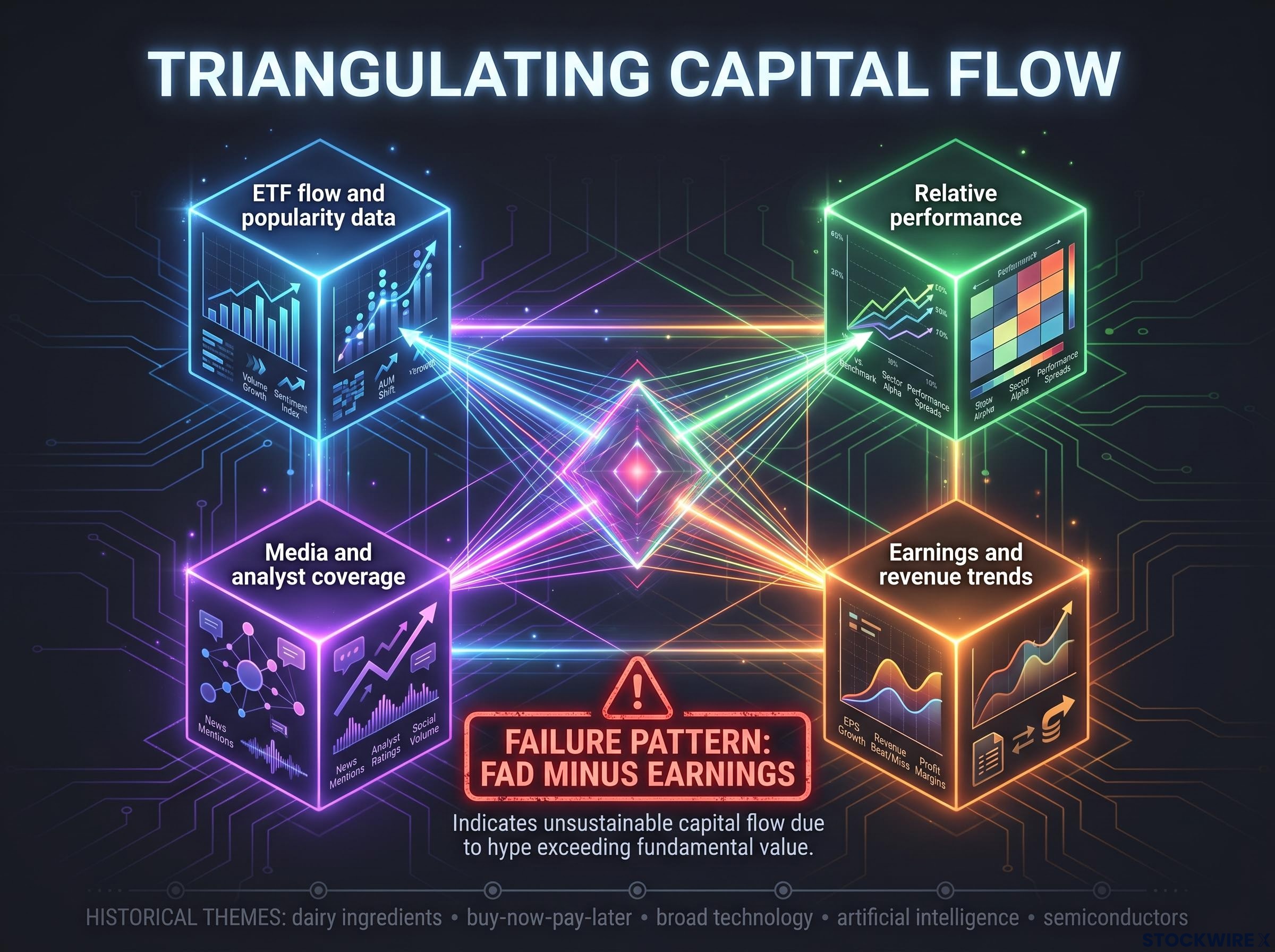
The goal here is not to pick the theme that sounds most exciting. It is to find the theme where capital is actually concentrating, backed by structural fundamentals rather than headlines alone. You do that by triangulating four signals, each one adding a layer of conviction to the picture.
| Signal | What to look for | What it tells you |
|---|---|---|
| ETF flow and popularity data | Persistent inflows into thematic ETFs; appearances on “most traded” or “most bought” broker lists | Broad investor attention and momentum are building, not just media noise |
| Relative performance | Thematic and sector ETFs consistently outperforming broad indices over weeks and months | Capital and momentum are concentrating in this space, not just holding steady |
| Media and analyst coverage | Increased financial media attention, new ETF launches, issuer marketing activity | The theme is in an active capital-attraction phase with identifiable catalysts |
| Earnings and revenue trends | Companies within the theme delivering actual revenue and profit growth | The theme has structural backing, not just narrative strength |
The market’s dominant theme shifts over time: dairy ingredients, buy-now-pay-later, and broad technology have all had their moment, as have artificial intelligence and semiconductors more recently. Some of these proved structural; others faded once the narrative ran out of earnings to support it.
“Fad minus earnings” is the failure pattern. A theme with rising media attention but no earnings growth underneath is a story, not a strategy. Structural themes backed by real revenue growth are your target.
Thematic investing evaluation that stops at narrative strength, without examining addressable market size, competitive moat, and realistic valuation, is the specific analytical gap that turns compelling stories into losing positions; the difference between internet infrastructure in 1995 and 3D printing in 2013 was not the quality of the story but the earnings trajectory underneath it.
When all four signals align, persistent ETF inflows, relative outperformance, rising analyst attention, and genuine earnings growth, you are likely looking at a mid-cycle theme with durable momentum, not a headline story that will reverse within weeks.
Before you select a single ETF, pick one clear theme and write down a thesis: why should this theme grow, and what could go wrong? The bull case and the failure conditions, on paper, before any capital moves.
What makes a thematic ETF worth owning
You have identified the theme. Now comes the unglamorous but critical step that separates owning the theme cleanly from owning a diluted approximation of it: selecting the right ETF.
Two investors with the same thesis can produce very different outcomes depending on which implementation vehicle they choose. ETF selection is where thesis quality gets preserved or destroyed.
Your four selection criteria, in order of priority:
- Index methodology and holdings purity (most important, covered below)
- Liquidity and assets under management (AUM): meaningful trading volume and AUM reduce bid-ask spreads and improve execution quality
- Expense ratios: thematic and active ETFs often charge higher fees; compare across similar funds and assess whether the premium is genuinely justified
- Currency and domicile: for international themes, decide whether currency-hedged or unhedged exposure suits your situation, and check for any tax or regulatory factors relevant to your jurisdiction
Illiquid, small ETFs are particularly costly to exit when decisive rotation is needed. Given that thematic strategies may require you to exit quickly when a thesis breaks, liquidity is not optional. It is a risk-management requirement.
Holdings purity: the first test
Read the fund objective, the index methodology document, and the actual holdings file. You are looking for whether the top holdings are genuinely central to the theme, or whether they are broad market names that have been included because of their size and liquidity rather than their thematic relevance.
A “clean” holding is a company whose revenue is materially driven by the theme you are targeting. A broad market name included for size (a mega-cap tech company appearing in nearly every thematic fund, for example) dilutes your exposure. If half the fund’s weight sits in companies you could own through a broad index ETF, the thematic premium you are paying is not buying you thematic exposure.
A poorly constructed thematic ETF gives you the story with the wrong underlying economics, which means you can be right about the theme and still lose money because the fund does not actually deliver the exposure you expected.
How much thematic exposure is too much
5-10% of your overall portfolio. That is the total allocation to all thematic ETF positions combined. No single theme above 5%.
If those numbers feel small, they are meant to. Most self-directed investors dramatically oversize thematic positions, and a concrete anchor is more useful here than a conceptual argument.
| Portfolio component | Typical allocation range |
|---|---|
| Core broad ETFs | 70-90% |
| Total thematic exposure (all themes combined) | 5-10% |
| Single theme cap | 5% maximum |
Professional portfolio frameworks consistently point to a structure in which core broad ETFs fill 70-90% of the portfolio and each satellite theme is capped at 5-10% of the total. The logic is straightforward: your core delivers long-term compounding, and your thematic satellites provide the opportunity for outperformance without threatening the foundation.
The three-step approach to scaling in:
- Start small. Deploy an initial allocation of, for example, 5% of your portfolio to one theme.
- Wait for confirmation. The thesis should be validated by ongoing price action, earnings results, and stable market conditions before you add.
- Scale only when confirmed. Increase the position only when the evidence supports it, not when the excitement does.
These numbers are not conservative suggestions. They reflect the level of concentration risk that professional frameworks treat as the outer boundary of prudent thematic exposure. Exceeding them shifts your portfolio from thematic enhancement to thematic dominance, and that is a fundamentally different risk profile.
Setting your exit rules before you need them
Most investors only think about exits after they are already losing. That is precisely the moment when clear rules are hardest to apply, because emotion, loss aversion, and hope all conspire against rational decision-making.
Peer-reviewed research on investor loss aversion and exit decisions documents how the disposition effect causes investors to hold losing positions far longer than rational analysis would support, with emotional responses and cognitive bias reliably overpowering pre-set decision rules when no written exit criteria exist.
Pre-defined exit rules, written before the position is opened, are what distinguish disciplined thematic investing from emotional speculation. Here are the five conditions under which you should reduce or close a thematic position:
Sector rotation risk materialised sharply for Australian thematic ETF holders in 2026, when technology-focused funds fell by up to 25% while resources and energy themes delivered triple-digit gains; the episode illustrates precisely why the exit framework described above must be defined in advance rather than constructed in the middle of a drawdown.
- Thesis break: your written thesis is no longer valid, whether due to regulatory change, structural shift, or deteriorating earnings, not simply because the price fell temporarily
- Technical breakdown: momentum has clearly reversed based on levels or moving averages you defined in advance
- Thematic rotation: falling ETF inflows and weaker relative performance signal that capital is rotating away from your theme
- Broad market deterioration: major indices break their uptrends and risk appetite fades, triggering your pre-defined rule to reduce satellites first
- Better opportunities elsewhere: a different theme offers clearer structural drivers, better valuations, or stronger momentum, and reallocating is consistent with the core-satellite approach
Investors who maintain loyalty to a particular theme regardless of changing conditions are identified as a characteristic of underperforming investors. The objective is capital growth, not ideological commitment to any particular sector or asset.
The pre-investment checklist
Before you deploy capital to any thematic position, complete these four items in writing:
- Thesis statement: What is the bull case, and what are the specific failure conditions?
- Target allocation: What percentage of your portfolio will this position occupy?
- Rebalancing schedule or band: Will you rebalance on a calendar basis (semi-annually or annually) or when the position drifts more than 10-25% above or below its target weight?
- Sell rule: Under what specific conditions will you exit? (For example: “only if thesis breaks or broad market regime changes.”)
Having your exit rules written down before you enter is what allows you to be decisive when the thesis breaks. The time when you most need clarity is precisely the time when emotion makes clarity hardest.
The mistakes this framework is designed to prevent
Each of these errors is common precisely because it feels rational in the moment. Recognising them in advance is what makes the framework internalisable rather than mechanical.
- Chasing hot themes without a plan. Jumping into whatever is trending, without a thesis, risk framework, or exit rule. The framework prevents this at Step 3 (write a thesis before selecting an ETF).
- Ignoring the core. Building a portfolio entirely out of themes instead of starting with broad diversification. Step 1 addresses this directly.
- Over-concentration. Letting one thematic ETF become a disproportionate share of total assets or risk. The quantitative guardrails in Step 4 cap this.
- Confusing research with certainty. Reading extensively about a theme and mistaking narrative strength for guaranteed future returns. Even compelling stories need earnings, valuation discipline, and risk controls.
- Set-and-forget with themes. Treating thematic ETFs like permanent core holdings. Themes are typically non-core, time-bounded satellite positions that require ongoing monitoring.
- Maintaining theme loyalty through changing conditions. Refusing to exit because you “believe in the story.” Step 5 (pre-defined exit rules) exists specifically to counter this pattern.
The objective is capital growth, not ideological commitment to any particular sector or asset. Every element of this framework is designed to keep that distinction clear.
Putting the framework to work in your next investment decision
The five-step sequence gives you a repeatable decision process: confirm the market environment, identify where capital is actually flowing, select a clean and liquid ETF, size the position prudently within core-satellite guardrails, and monitor against pre-defined exit rules.
What this framework changes is the direction of your decision-making. Instead of reacting to market narratives and building backwards from a story, you are evaluating whether and how much to participate, with specific criteria at each stage and a written plan for when to walk away.
The adaptability principle is the framework’s defining characteristic. Willingness to revise positions when conditions shift is not indecision. It is the mechanism that protects your portfolio.
Before your next thematic position, start with the pre-investment checklist. Write down the thesis, the allocation, the rebalancing rule, and the exit trigger. If you cannot complete it, you are not ready to deploy the capital.
This article is for informational purposes only and should not be considered financial advice. Investors should conduct their own research and consult with financial professionals before making investment decisions.
—