
Macquarie has flagged an underweight stance on Australia’s Big Four banks ahead of earnings season, even after upgrading price targets across the sector. The broker’s argument is direct: current valuations do not adequately reflect the margin and revenue headwinds building through FY27 and FY28, and the rally in bank share prices has run ahead of the earnings outlook.
The timing matters. With ANZ, CBA, NAB, and Westpac all set to report shortly, Macquarie’s cash earnings forecasts sit 1-2% below market consensus for FY26 and 4-6% below for FY27. That gap is not a rounding error. It signals a structurally more cautious view than most analysts currently hold, and it raises a specific question: are bank share prices reflecting an earnings trajectory the market is too optimistic about?
Here is a clear breakdown of Macquarie’s individual calls on each bank, the price targets attached to them, and the specific signals worth watching when results land. If you hold bank exposure or are considering adding to it, this is the framework for reading the numbers that matter most.
Why Macquarie is staying cautious on the banks sector despite upgraded targets
Macquarie has raised price targets across all four major banks. It has also kept its underweight sector rating firmly in place. That is not a contradiction; it is a statement about the difference between near-term earnings support and medium-term structural risk.
The near-term picture is genuinely supportive. Faster credit growth and benign credit quality give banks upside risk to second-half results. But Macquarie’s view is that three structural forces will compress revenue conditions through FY26-28:
- Margin compression from falling rates, more expensive deposit funding, and ongoing mortgage competition
- Decelerating credit growth in both housing and business lending over the medium term
- Rising operating costs driven by inflation, technology investment, and regulatory and compliance spend
Macquarie’s cash earnings forecasts sit 1-2% below consensus in FY26 and 4-6% below in FY27, the structural underpinning of its cautious stance.
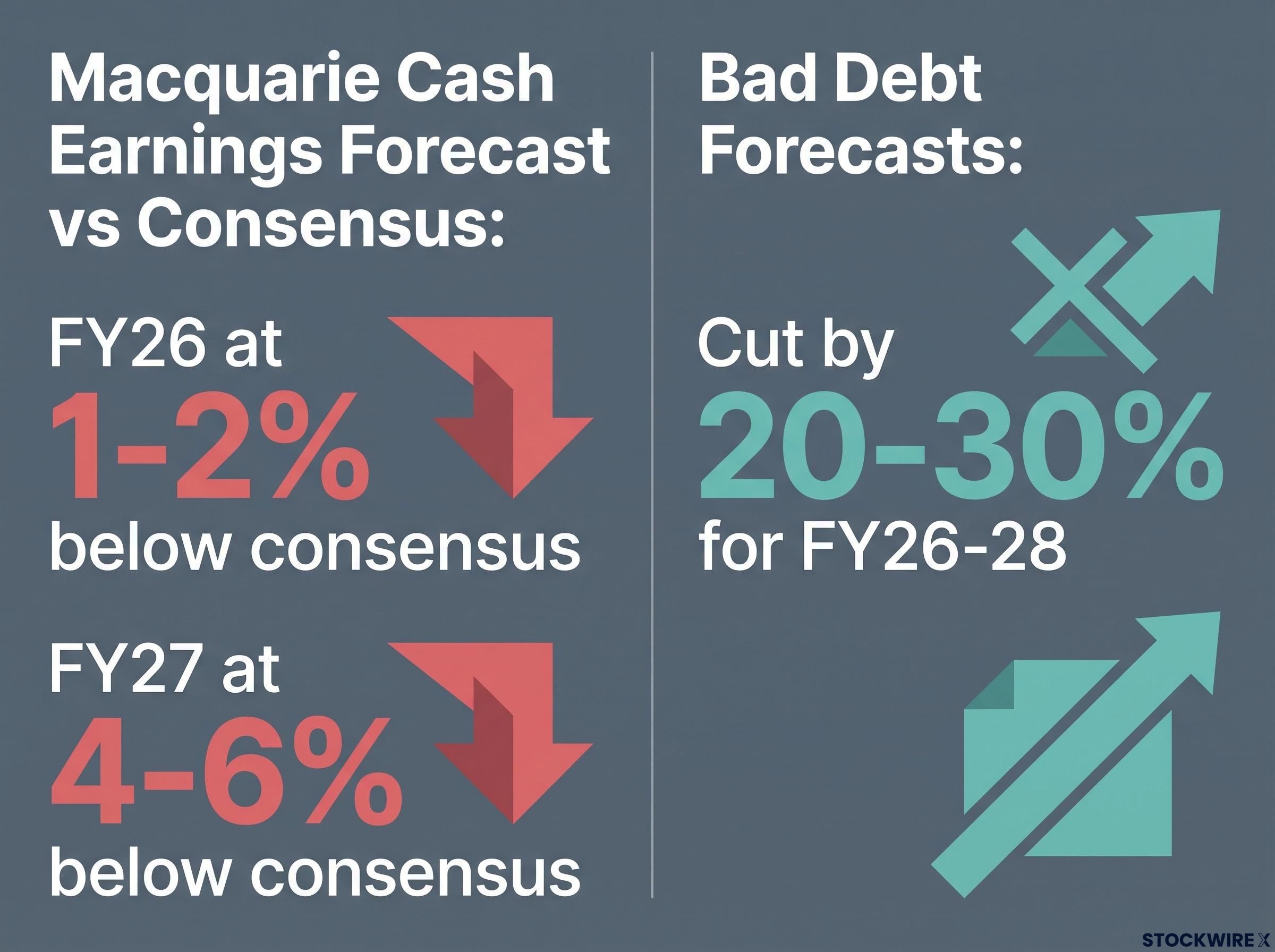
If Macquarie is right about those numbers, current bank share prices are reflecting an earnings outlook the broker considers too optimistic. The gap between its forecasts and market consensus is the single most important number in this call, because it quantifies exactly how much room the market has left for disappointment.
The risks Macquarie is flagging are not hypothetical: margin misses across the sector in May 2026 triggered share price declines of between 7% and 14% across the Big Four, with Morgan Stanley reversing a 4% earnings upgrade made just months earlier.
When big ASX news breaks, our subscribers know first
ANZ and NAB: the broker’s preferred names within an underweight sector
Within a sector it views cautiously, Macquarie still draws a clear line between relative value and overvaluation. ANZ and NAB sit on the preferred side of that line, both rated Neutral, but for different reasons.
| Bank | Rating | Price Target | Key Strength | Primary Risk |
|---|---|---|---|---|
| ANZ | Neutral | $32.50 | Balance sheet strength and relative valuation | FY28 pre-provision earnings downside of approximately 7% |
| NAB | Neutral | $39 | Deposit franchise progress and proprietary distribution | SME credit quality sensitivity and cyclical exposure |
ANZ Group Holdings (ASX: ANZ)
ANZ is Macquarie’s top pick among the Big Four, and the case rests on three pillars: comparatively stronger balance sheet positioning, solid credit quality, and a valuation that still looks reasonable versus peers despite recent share price strength.
The medium-term risks are real, though. Macquarie puts the potential shortfall against pre-provision consensus earnings at roughly 2% through FY27 and as much as 7% by FY28. Second-half profit faces downside pressure from a potential step-up in impairment charges, and the Suncorp integration adds a specific variable: bringing savings rates into line with the combined entity post-merger could weigh on deposit margins. Even the preferred pick carries meaningful medium-term risk, and the near-term relative value argument needs to be weighed against that 7% FY28 figure.
National Australia Bank (ASX: NAB)
NAB earns its Neutral rating on the back of demonstrated improvements in growing its deposit base and building out direct distribution capabilities. Macquarie sees a bank that has been building the right capabilities.
The complication is cyclical sensitivity. Given that NAB carries a comparatively large book of small and medium enterprise (SME) lending, a segment where borrowers often show stress ahead of the broader economy, its loan quality metrics could deteriorate before those of its peers. Provisioning releases, where banks reverse money previously set aside for expected loan losses, could provide an EPS swing factor in either direction, and the timing matters as much as the size.
CBA and Westpac: why Macquarie rates both as underperform
Valuation is the unifying thread behind both Underperform ratings. But CBA and Westpac arrive at that rating through different structural paths.
| Bank | Rating | Price Target | Core Concern | Key Watchpoint |
|---|---|---|---|---|
| CBA | Underperform | $111 | Priced for perfection at current valuation | Housing market sensitivity and deposit margin compression |
| Westpac | Underperform | $30 | NAB-like valuation with lower returns | Margin compression and cost control execution |
Commonwealth Bank of Australia (ASX: CBA)
Macquarie acknowledges what everyone already knows: among the major banks, CBA’s profit generation holds up better than any of its peers across the cycle. It is the franchise quality benchmark among the majors. The problem is not the business. The problem is the price.
At current levels, Macquarie argues CBA is priced for perfection, which means any disappointment in housing conditions or margins has nowhere to hide. Macquarie expects the dividend to edge up by just $0.05 per share to $2.65, a modest increment that reflects the limited room for earnings expansion in the current macro environment. Investor watchpoints include:
- Housing market sensitivity and any downside scenario commentary from management
- Early evidence of deposit margin compression as competitive and rate dynamics shift
- Dividend guidance and whether management signals further growth constraints
Owning the highest-quality bank franchise is not the same as owning the best-valued stock. That is the distinction Macquarie is asking investors to weigh.
Housing market risk adds a structural dimension to the CBA valuation concern that goes beyond current margin dynamics: Morgan Stanley’s projection of a potential 10% residential property price decline by end-2027 would compress mortgage collateral values and slow credit growth simultaneously, hitting CBA’s dominant mortgage book from multiple directions.
Westpac Banking Corp (ASX: WBC)
The Underperform case for Westpac is more straightforward. Its valuation sits at a level comparable to NAB’s, yet the returns it generates fall short of that peer’s. That mismatch is the core of the argument.
Weaker margins and cost pressures are the principal factors behind Macquarie’s expectation of earnings downside in FY27 and FY28. Macquarie will be watching execution on Westpac’s productivity and technology programmes as the key variable, because closing the returns gap with NAB requires either improved margins or tighter cost control, and ideally both.
What the sector’s big four banks actually have in common this earnings season
Before reading any individual result, it helps to understand the four levers that drive major bank earnings, and why each one is under pressure simultaneously:
- Net interest margins (NIMs): the difference between what banks earn on loans and pay on deposits. As the RBA rate cycle turns, deposit spreads (the gap between the policy rate and what banks pay depositors) compress, squeezing this primary profit driver
- Credit growth: new lending volumes in housing and business. Faster growth has supported near-term results but is expected to moderate beyond FY26
- Fee income: transaction, wealth management, and advisory revenue. Competitive pressure limits pricing power
- Cost control: the ability to manage operating expenses against inflation, technology investment, and regulatory compliance spend
The RBA rate cycle is the primary external variable shaping NIM trajectories across the sector, with the cash rate reaching 4.35% following three consecutive hikes from a base of 3.85% in January 2026, a pace that compressed margins before revenue benefits could flow through to reported profits.
Macquarie has cut bad debt forecasts by 20-30% for FY26-28, citing favourable macro conditions and structural improvements in risk management.
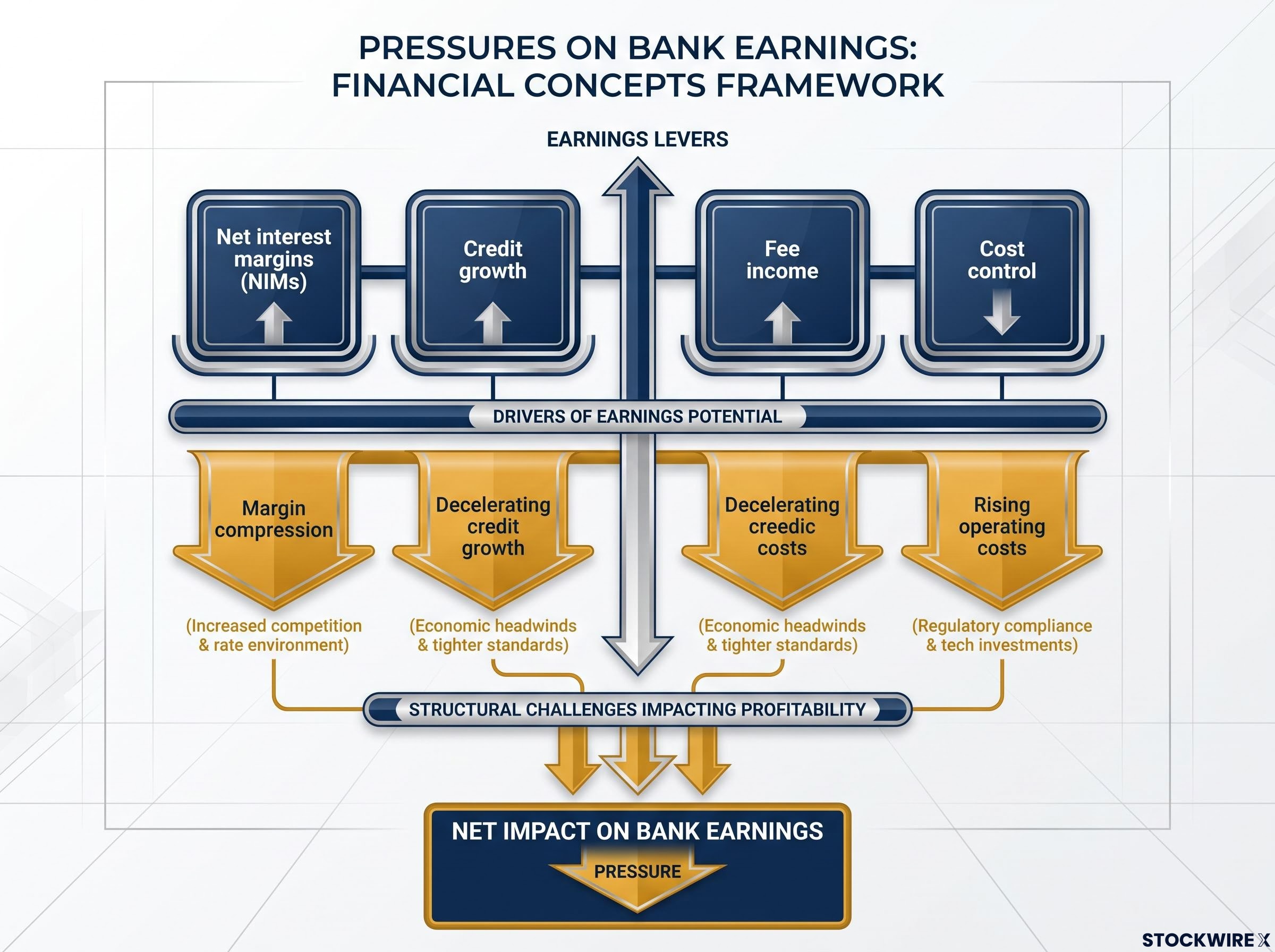
That sounds positive, and it is the reason near-term headline profits should look solid. But it is not a signal that the medium-term revenue story has improved. Lower bad debts support today’s profit number. Margin compression, slowing credit growth, and rising costs determine whether those profit levels are sustainable. When results land, the forward-looking commentary on those three forces will matter more than the headline figure.
The five signals Macquarie says investors should watch when results land
Macquarie treats forward guidance commentary as more meaningful than the reported headline profit number. With that framing in mind, here are the five specific signals the broker is monitoring:
- New loan pipeline activity: rising applications suggest credit demand is holding; declining pipelines signal deceleration ahead. A sustained drop would support Macquarie’s slowing-growth thesis.
- Pricing pressure across deposits and mortgages: if banks are competing more aggressively on pricing to retain customers, margins compress. Watch for commentary on mortgage cashback offers, deposit rate matching, and switching volumes.
- Loan book stress signals: particularly in SME and household segments. Any early signs of stress in arrears or watch-list loans would challenge the benign credit quality assumption that underpins current valuations.
- Expense trajectory versus prior commitments: compare actual cost outcomes and new expense targets against prior management efficiency commitments. Costs rising faster than guided is a margin problem that compounds quickly.
- Margin guidance under lower-rate scenarios: specifically, how management frames the NIM outlook if the RBA continues cutting. ANZ’s Suncorp integration adds a bank-specific variable here, as savings rate adjustments post-merger could affect deposit margin commentary.
APRA quarterly ADI statistics covering the March 2026 period include non-performing loan data and asset quality metrics across the major banks, giving investors an independent benchmark against which to measure management commentary on SME credit conditions when results land.
If management guidance across the four banks is more upbeat than Macquarie’s conservative assumptions, it would challenge the underweight thesis directly. That is a genuine possibility, and investors should weigh it alongside the broker’s more cautious positioning.
What Macquarie’s underweight call means for investors positioning ahead of results
Macquarie’s position is cautious, not catastrophic. Banks remain profitable. Dividends are expected to hold broadly stable across the sector, not collapse. But in the broker’s view, total return potential at current valuations is limited.
Broker consensus on Big Four valuations has shifted materially in 2026, with Morgans issuing sell ratings on all four major banks in late April and CBA trading at roughly 27 times earnings against a historical average of approximately 18 times, a premium that leaves limited margin for any earnings disappointment.
| Bank | Rating | Price Target | Macquarie View |
|---|---|---|---|
| ANZ | Neutral | $32.50 | Preferred exposure; balance sheet strength and relative value |
| CBA | Underperform | $111 | Resilient earnings priced in; limited upside at current valuation |
| NAB | Neutral | $39 | Solid franchise progress; SME exposure adds cyclical sensitivity |
| Westpac | Underperform | $30 | Returns lag NAB despite similar valuation; cost and margin headwinds |
The price targets tell you where Macquarie thinks fair value sits today. But the more important signal is the direction of earnings revision risk embedded in those targets. If Macquarie is right about FY27 earnings sitting 4-6% below consensus, bank valuations face a rerate. If consensus is right, the underweight thesis gets challenged.
This article is for informational purposes only and should not be considered financial advice. Macquarie’s view represents one institutional perspective. Investors should weigh it against other broker research, their own risk tolerance, income needs, and time horizon before making investment decisions.
—