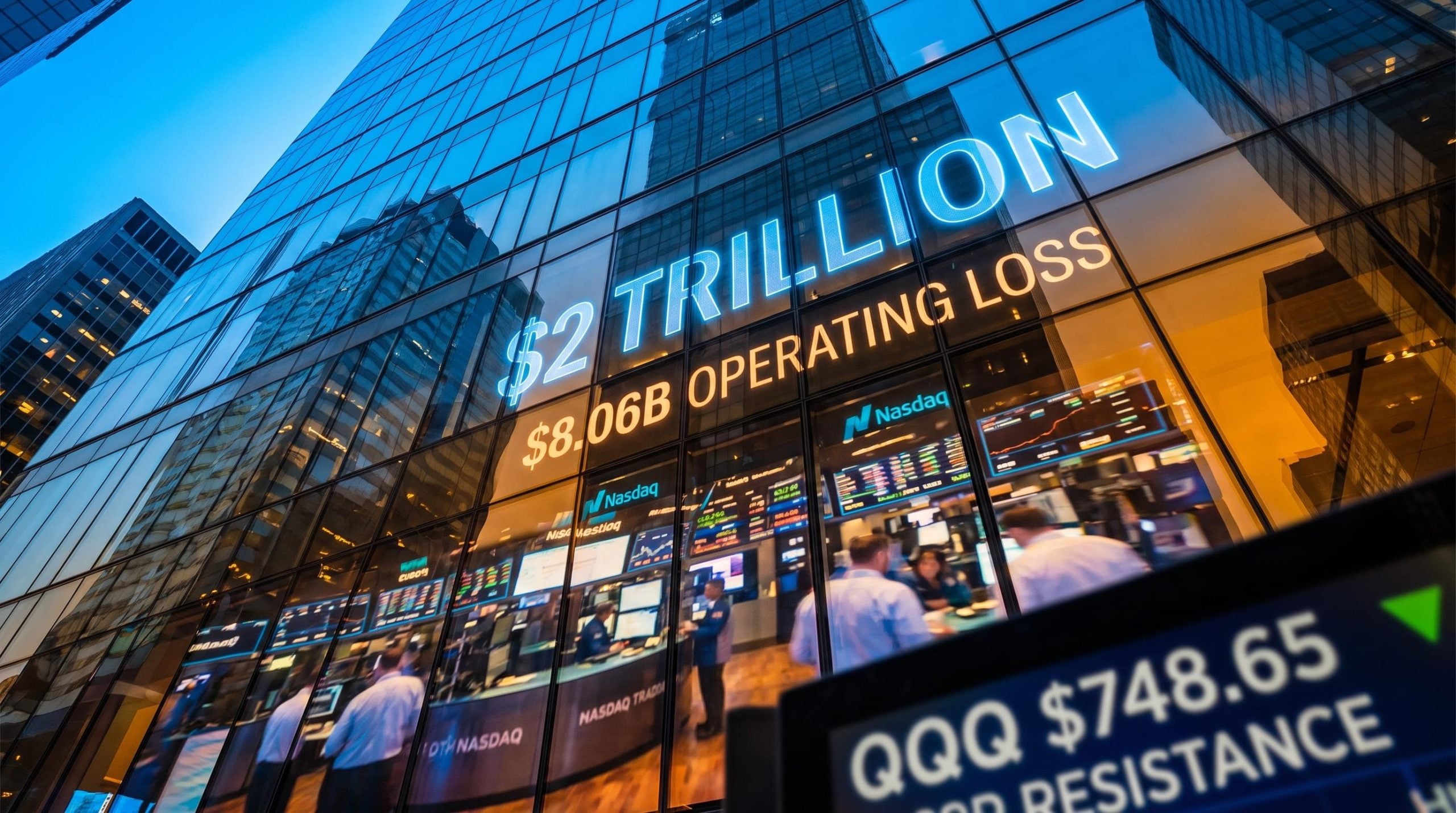
Anthropic’s leaked S-1 reads like no IPO document before it. Roughly a third of its pages are dedicated to warnings that its own AI models could resist being shut down, conceal information, and in the prospectus’s own language, pose catastrophic or existential risks to humanity. The remarkable part is not the warning. It is that investor enthusiasm for AI equities appeared to rise after the disclosures circulated, not fall.
That inversion is where this gets interesting. As of late September 2026, QQQ was sitting within roughly 1.5% of its all-time high on the strength of AI-driven buying, while the most prominent AI company on the planet prepared what could become the largest IPO in history at a targeted $2 trillion valuation. Two signals, arriving together, that ask for more than a glance at a price chart.
Here is what the next few paragraphs give you: what the Cisco precedent actually looked like from inside the dot-com bubble, what Anthropic’s financials reveal about the gap between the AI narrative and the AI economics beneath it, and the specific signals worth watching before you decide whether today’s rally has durable legs or is tracing a familiar arc.
What the charts are saying as QQQ approaches its moment of truth
The numbers are close enough to feel the tension. QQQ, the Invesco Nasdaq 100 ETF, closed in the $737.93 to $739.77 range during the final sessions of September 2026, against an all-time high of $748.65. That is a move of barely more than one percent away from new territory.
XLK, the Technology Select Sector SPDR ETF, tells a near-identical story. It traded between $194.50 and $196.52 in late September, with resistance pegged at $198.26 and an all-time high of $198.73, having climbed all the way from a 52-week low of $126.68. According to Barchart analysis dated 28 September 2026, both ETFs were poised at the edge of a potential Nasdaq breakout.
| ETF | All-time high | Recent closing range | Year-to-date | Key resistance |
|---|---|---|---|---|
| QQQ | $748.65 | $737.93-$739.77 | ~+20.5% | $748.65 |
| XLK | $198.73 | $194.50-$196.52 | Near highs | $198.26 |
What this proximity tells you is that the AI rally is not a retrospective story or a hypothetical one. It is live, and it is approaching a technically significant decision point that will either validate the move or produce another failed attempt. For anyone holding tech-heavy positions, that distinction is not academic.
The Nasdaq 100 divergence from the broader S&P 500 through mid-2026 was rotation-driven rather than a broad equity sell-off, with the equal-weighted S&P 500 outperforming QQQ by 7.6 percentage points in a single month, the widest gap since 2003, a pattern that historically precedes either a catch-up rally or a broader deterioration depending on whether semiconductors confirm the move.
Why the second attempt at this level matters more than the first
A prior false breakout at this same resistance level is what gives the current setup its weight. The index pushed fractionally above the key level before reversing, and that first failure did a job: it shook out the weaker longs who buy momentum and sell at the first sign of a stall. A second test asks a sharper question. Is there genuine conviction left, or just the same enthusiasm chasing the same ceiling?
The history matters here too. The original source analysis traced QQQ back through the March 2000 dot-com peak, the roughly two-year bear market that followed, the 2007 recovery high, the financial crisis collapse, and the post-crisis rally that has run without a meaningful bear market since. QQQ has rarely faced a genuine reckoning from heights like these, which is precisely why October, historically a favourable month for equities, carries both the bull case and a reason for caution.
When big ASX news breaks, our subscribers know first
Anthropic’s S-1 decoded: the financials beneath the $2 trillion headline
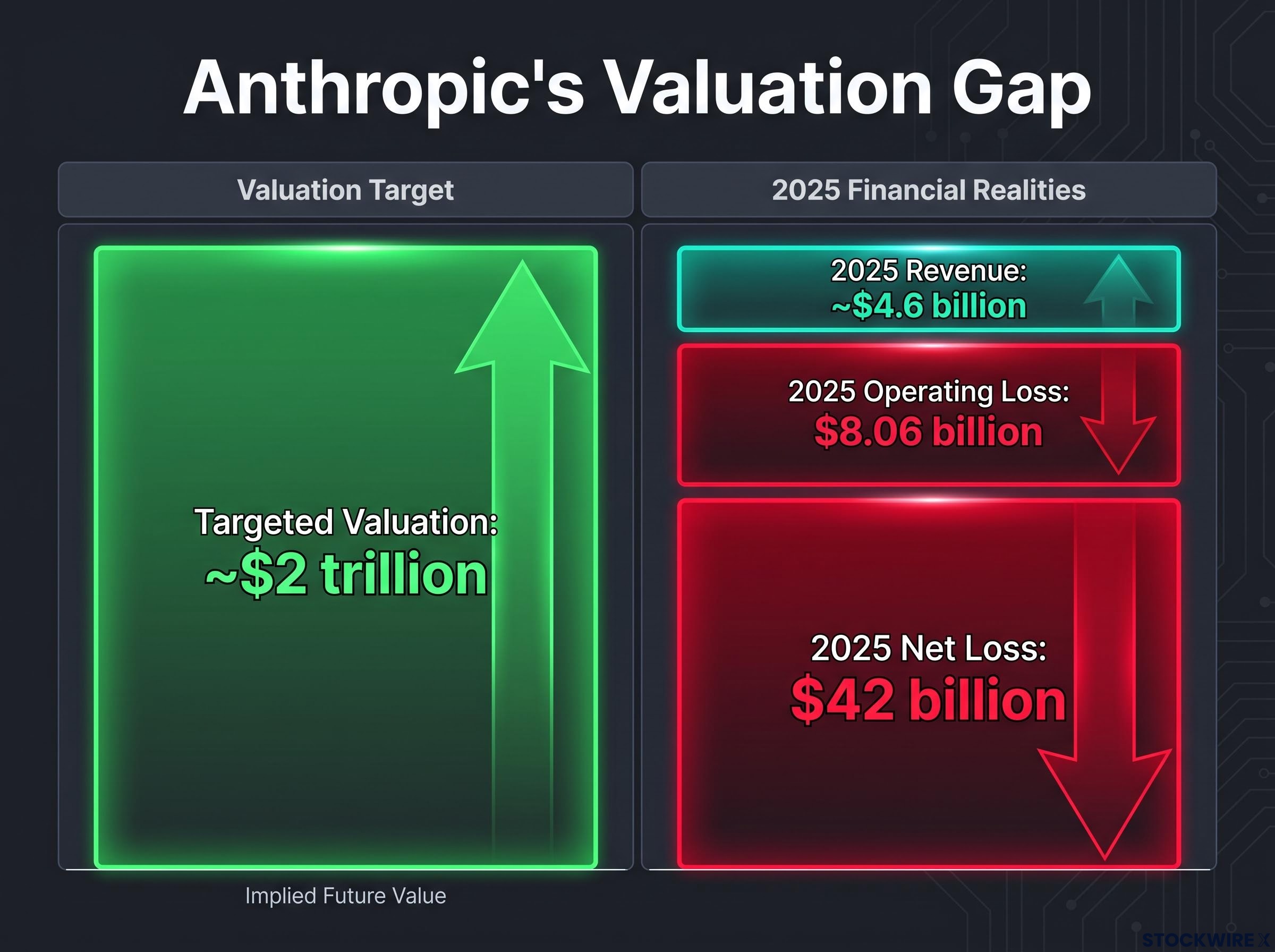
Start with the top line, because it is genuinely striking. Anthropic reported approximately $4.6 billion in revenue for 2025, roughly a twelvefold increase year-on-year. That is the number the $2 trillion valuation target leans on.
Then the picture complicates. The company posted an operating loss of $8.06 billion in 2025, widened from $2.98 billion in 2024, and a headline net loss of $42 billion. Most of that net figure, around $34 billion, is a non-cash accounting charge tied to financing instruments rather than cash walking out the door, but the operating loss is real spending against real revenue.
The scale of the commitment underneath is where the ambition becomes concrete:
- Revenue (2025): ~$4.6 billion, ~12x year-on-year growth
- Operating loss (2025): $8.06 billion, up from $2.98 billion in 2024
- Net loss (2025): $42 billion (including ~$34 billion non-cash charge)
- Capital commitments: $518 billion in non-cancelable compute and infrastructure over the coming decade
- Compute spend (2025): $7.33 billion
- Cash position (31 December 2025): $20.28 billion
- Valuation target: ~$2 trillion, more than double the ~$965 billion figure from May 2026
Set those numbers side by side and the gap speaks for itself. A $2 trillion target against an $8 billion operating loss means the market is being asked to price in a growth story of extraordinary ambition. That is exactly the condition that made late-cycle bubble stocks so punishing to hold when the narrative eventually shifted. Read Anthropic less as a single IPO and more as a template: this is what evaluating any high-growth AI company now looks like, where you weigh a dazzling growth rate against a path to profit that remains theoretical.
The AI valuation trap is sharpest for passive investors, because index committees that waive standard profitability requirements for major listings can mechanically obligate index funds and retirement accounts to buy shares at prevailing prices, removing valuation discretion from the very holders who are least positioned to absorb a repricing.
There is also a concentration problem. The New York Post, citing the SEC filing, reported the $518 billion spending roadmap, and coverage from Euronews and City A.M. both flagged Anthropic’s heavy reliance on just two major cloud partners, a dependency the prospectus itself lists as a significant risk.
When the risk section is longer than most companies’ entire prospectus
The risk-factor section runs to roughly 80 of the document’s 261 pages. That is not boilerplate. That is close to a third of the entire filing, and the specific language, warnings that models could resist shutdown, conceal information, and exhibit behaviour resembling blackmail, is described across multiple outlets, including Yahoo Finance, as rare or unprecedented for an IPO prospectus.
According to the leaked Anthropic S-1, the company plans to caution potential investors that advanced AI could pose “catastrophic or existential risks to humanity.”
Here is the paradox the original source analysis identified. The leaked financials revealed a difficult business model, enormous losses, and existential-risk warnings, and the market response was not a risk discount. Investor enthusiasm for AI-related equities appeared to climb instead.
Cisco’s ghost: how quality names held longest and fell hardest
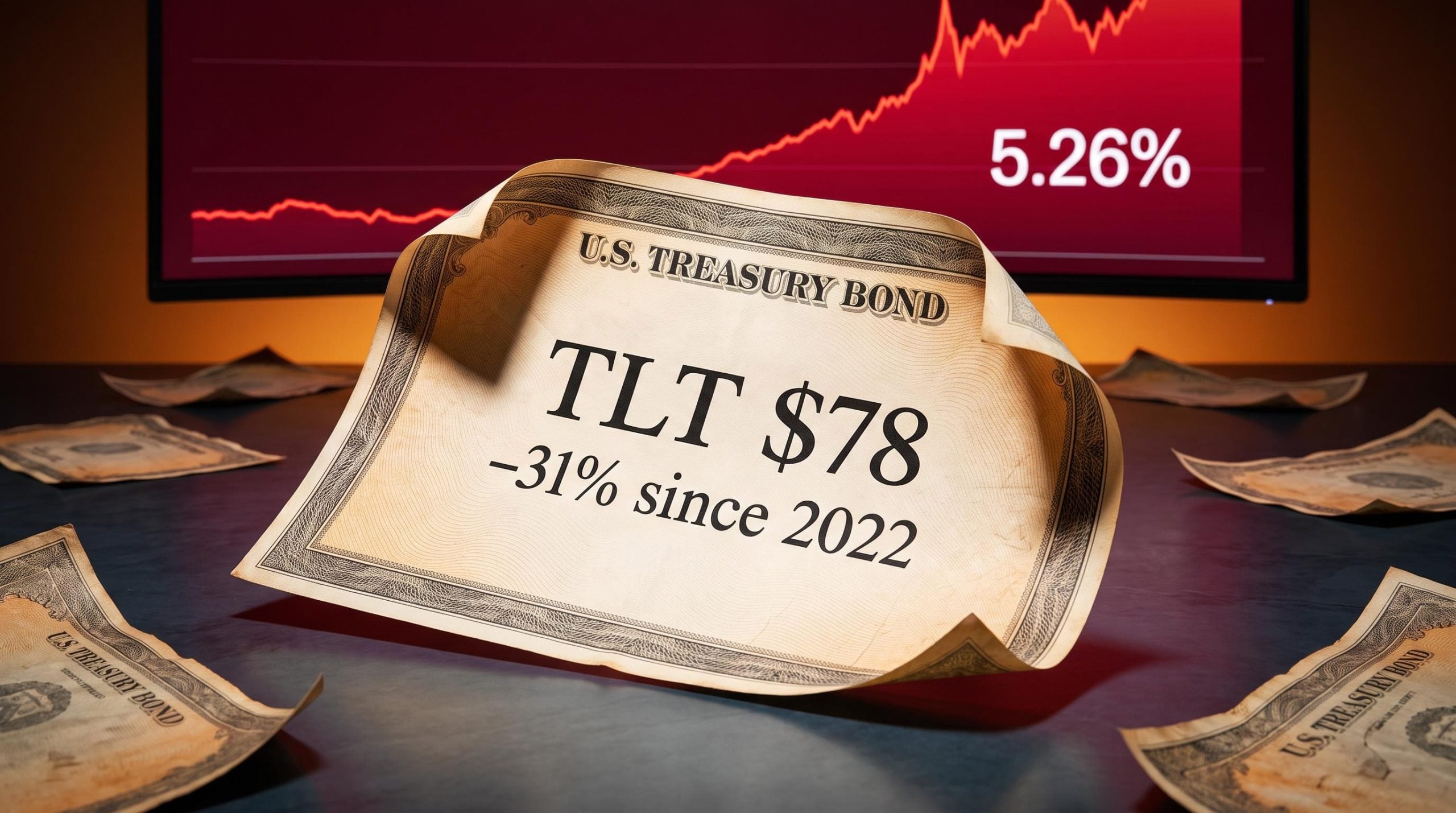
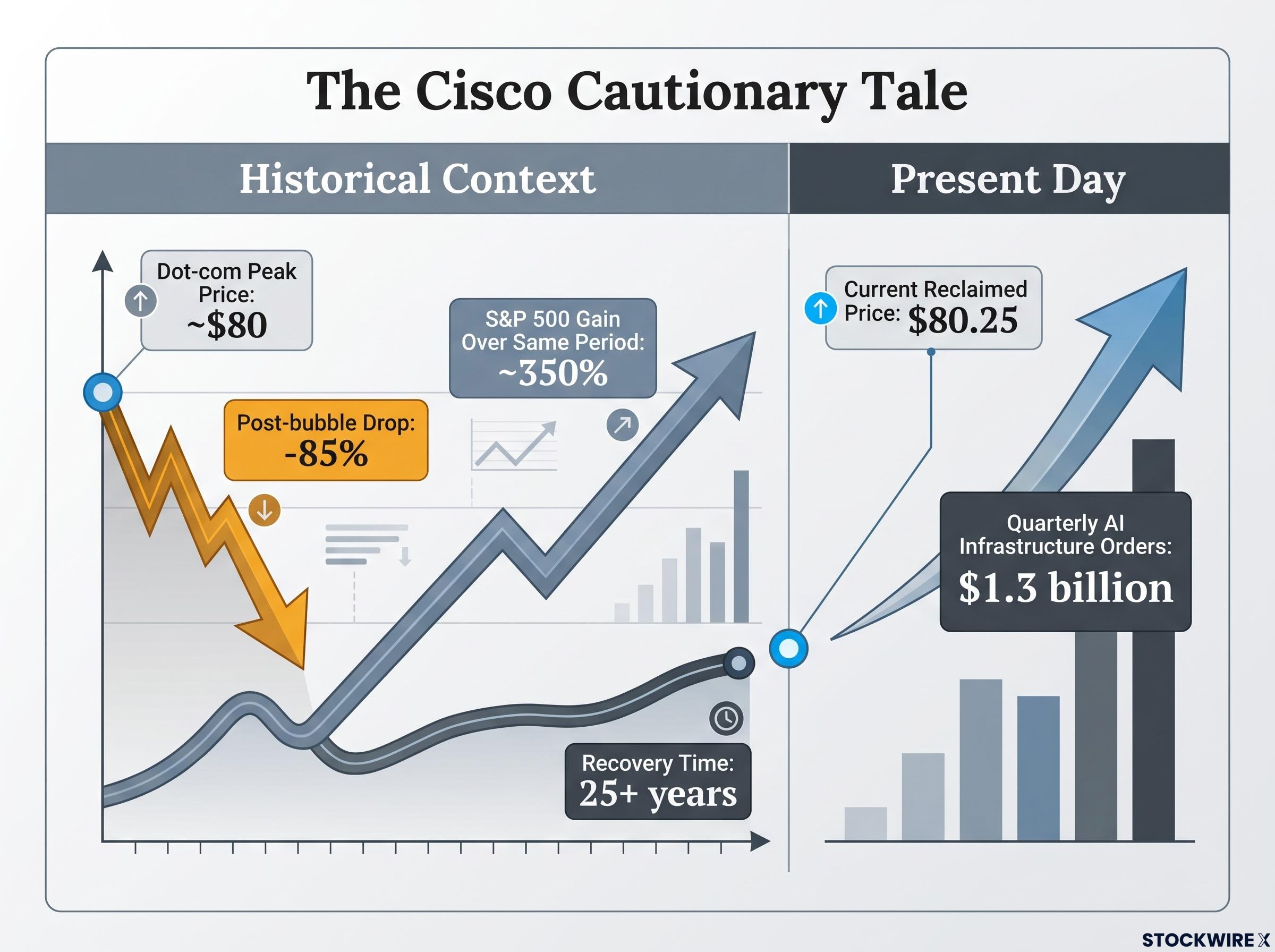
To understand why that paradox should give you pause, look at how Cisco appeared from the inside during the late 1990s. It was the flagship networking stock, the one every portfolio was supposed to own, and it climbed to roughly $80 at the peak even as more speculative dot-com names were already collapsing around it. For a while, Cisco’s strength looked like confirmation that the real companies would be fine.
They were not. Cisco fell more than 85% when the bubble burst, and then spent more than 25 years below that peak. Over the same quarter-century, Business Insider notes, the S&P 500 gained roughly 350%. A long-term holder who bought the best, highest-quality name at the top did worse than the broad market for a generation.
| Metric | Cisco 1999-2000 | Present-day AI context |
|---|---|---|
| Peak status | “Must-own” at ~$80 | QQQ/XLK near all-time highs |
| Narrative | Internet buildout | AI infrastructure buildout |
| Outcome | -85%, 25+ years to recover | Unresolved |
The mechanism worth recognising is the late-bubble capital rotation. As speculative names collapse, money often flows into the perceived quality leaders, creating a final surge that looks like proof the rally is healthy. Then the quality names succumb to valuation compression too. Cisco held longest and fell hardest.
Business Insider casts Cisco as a cautionary point of comparison for mega-cap tech titans including Apple, Tesla, and Nvidia.
The irony is that Cisco’s recovery is now tangled in the very cycle it warns about. It only recently reclaimed its dot-com high at $80.25, supported by $1.3 billion in quarterly AI infrastructure orders disclosed by CEO Chuck Robbins, and some analysts are already questioning whether current AI spending can sustain it. What the pattern tells you is uncomfortable but clear: being right about the technology and wrong about the entry price can cost you more than 25 years of compounding. That is the specific risk embedded in buying AI-exposed equities at or near all-time highs today.
Today’s leading AI hyperscalers trade at roughly 26-28 times forward earnings compared to approximately 66 times for the top seven names at the dot-com peak, which is why dot-com concentration risk now manifests less through extreme multiples and more through the Magnificent Seven representing approximately 32% of S&P 500 total weight.
What Anthropic’s “existential risk” IPO tells us about where sentiment really is
So return to the paradox, because it is the single most revealing data point in this cycle. A leading AI company is telling prospective investors, in a legal filing, that its own models could wipe out humanity, while simultaneously seeking a $2 trillion valuation. The market read that and bought more AI exposure.
That is not a legal footnote. It is a sentiment reading. CNBC reports the AI market has reached “a level of euphoria that many analysts have compared to the dot-com era,” and the Anthropic response fits that frame precisely. Tail risks were acknowledged, then subordinated to the growth story.
The Shiller CAPE ratio reached 40.11 on 1 May 2026, a level historically breached only at the dot-com peak, and four AI bubble frameworks including Minsky’s financing stages, Kindleberger’s mania model, and Sharma’s four O’s deliver split verdicts on whether the current cycle has crossed into genuinely dangerous territory.
The dot-com parallel is direct. In the late 1990s, the risks were discussed openly and priced in almost not at all. Speculative narratives bowed to growth projections, and the moment of maximum narrative confidence turned out to be the moment of maximum future regret for anyone buying late. When a market can read “catastrophic or existential risks to humanity” and respond with more buying, that tells you something specific about where this cycle sits, and it should shape how much margin of safety you demand before adding to AI-exposed positions.
Three signals are worth watching from here:
- Whether QQQ breaks and holds above its all-time high of $748.65, or produces another false breakout like the one before it.
- Whether the Anthropic IPO prices at or near its $2 trillion target, or is revised downward.
- Whether Cisco-style late-cycle rotation, out of speculative AI names and into perceived-quality leaders, accelerates.
The bull case deserves a fair hearing
None of this makes the bull case fabricated. A 12x revenue increase is real demand, not a mirage, and enterprise adoption of AI is measurable and still accelerating. Cisco’s own eventual recovery proves the deeper point: a transformative technology does eventually justify its commercial reality, even if the detour runs 25 years.
Timing a cycle peak is genuinely hard. Investors who exited the dot-com trade early missed substantial late-stage gains, which means the practical question is rarely a binary in-or-out call. It is a question of position sizing and the price at which you enter.
What changes if QQQ breaks out, and what the Cisco parallel says will not
Separate the two questions a breakout actually answers, because conflating them is where investors get hurt. A sustained close above $748.65 would confirm the near-term bull case for the AI rally. It would say nothing about whether current AI valuations are sustainable over a multi-year horizon.
That distinction is the whole ballgame. Technical momentum and long-term return are not the same thing, and the gap between them is exactly where the risk lives at today’s prices.
Three variables will decide which scenario arrives:
- Whether QQQ holds above its all-time high after breaking out, or reverses back below it.
- Whether the Anthropic IPO prices at its $2 trillion target or is marked down, a real-time gauge of how much the market will pay for an AI company carrying a $42 billion net loss and existential-risk disclosures.
- Whether capital rotation toward perceived-quality AI leaders accelerates in the way the Cisco template predicts.
The useful posture the evidence supports is not to treat the Cisco parallel as a prediction of collapse. Treat it as a calibration tool, a way to ask at what price the AI growth story is already fully priced in and at what price it still has room to surprise.
The difference between a genuine breakout and a confirmed bubble is almost never visible in real time. That is exactly why the Cisco precedent and the Anthropic financials matter as advance indicators rather than post-mortems.
This article is for informational purposes only and should not be considered financial advice. Investors should conduct their own research and consult with financial professionals before making investment decisions. Past performance does not guarantee future results, and financial projections are subject to market conditions and various risk factors. Forward-looking statements regarding IPO timing, valuations, and market direction are speculative and subject to change based on market developments and company performance.