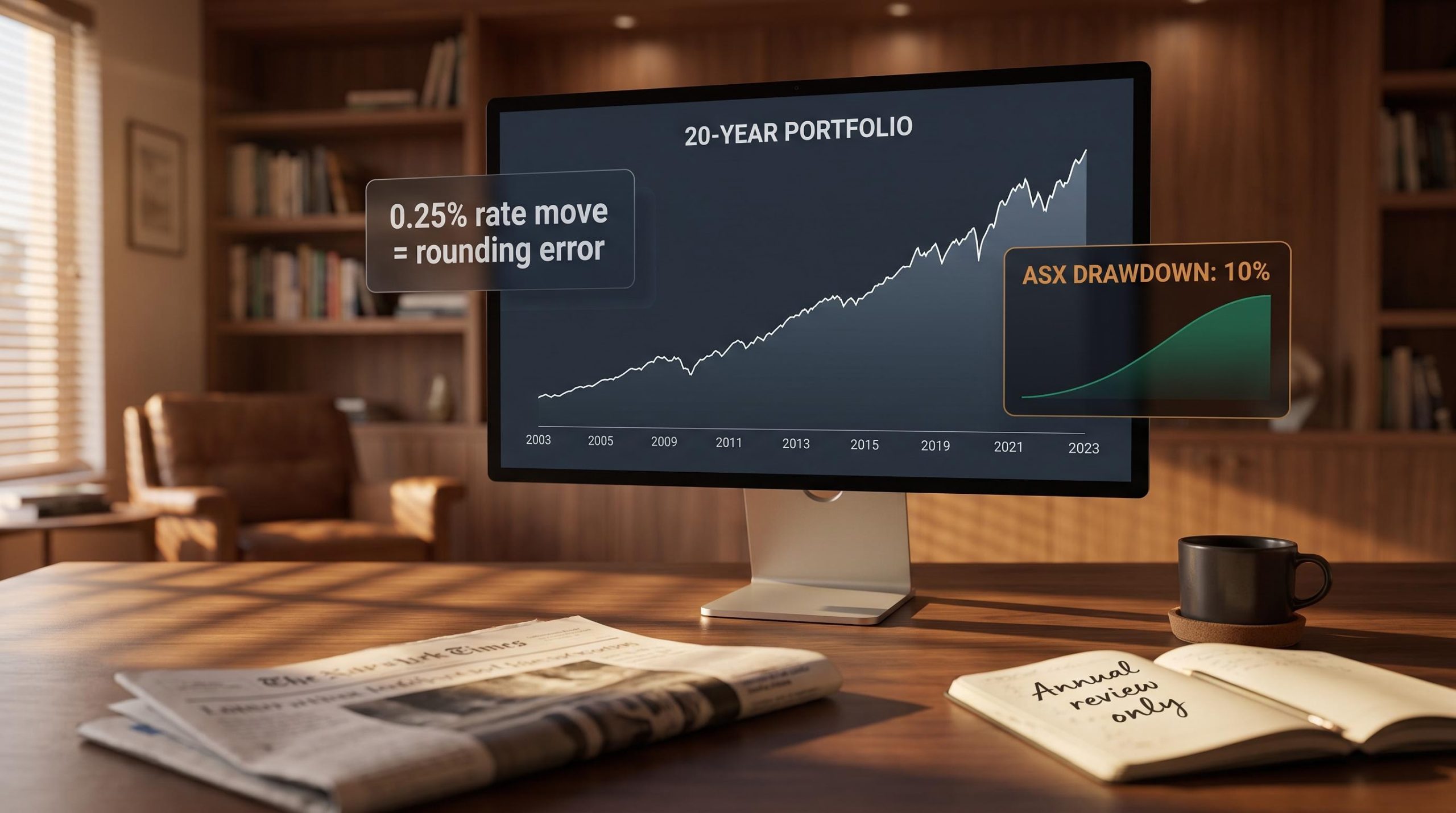
Australian investors have never had more financial information at their fingertips. Market commentary arrives in real time. Rate decisions generate days of analysis. Unemployment prints spark immediate portfolio anxiety. And yet the evidence consistently points in one direction: more information leads to worse outcomes, not better ones. A 0.25 percentage point interest rate shift, the kind of number that dominates headlines for 48 hours, has no meaningful effect on a well-structured portfolio held for 20 years.
The problem is not that the information is bad. It is that the information is built for a different audience entirely. The daily news cycle is calibrated for professional participants, fund managers and traders operating on three-to-six month mandates, who need short-term data to do their jobs. Long-term investors are consuming intelligence designed for someone else’s role.
Here is a framework for identifying which financial news actually concerns you and which of it you can safely stop reading. The distinction is sharper than most investors expect, and it changes how you approach every headline from here.
The news you are reading was written for someone else
Financial news and economic commentary exist primarily for traders, fund managers, and institutional participants whose performance is assessed over months or quarters, not decades. Their mandates typically require them to beat a benchmark, operate within defined risk limits, and satisfy client expectations, all measured across relatively short timeframes. That makes short-term data operationally relevant to them in a way it simply is not for you.
A retail investor saving for retirement over 20-30 years has no benchmark to beat, no mandate to follow, and no quarterly assessment to survive. The distinction is structural, not a matter of sophistication. Shani Jayamanne at Morningstar Australia has observed directly that daily short-term data is not generally relevant to long-term investors. Tracking economic indicators such as interest rates, unemployment figures, and wage growth falls within professional responsibilities, which is why those data points generate concern among fund managers and institutional participants but need not generate concern among individuals investing for the long term.
That means the average Australian investor reading financial news is not poorly informed. They are misinformed about what is relevant to their situation. That distinction changes everything about how to approach the news feed.
Negativity bias in financial media is not accidental: negative headlines outnumber positive ones by approximately 17 to 1, a structural feature of media business models optimised for engagement that systematically over-weights fear-framed signals relative to the actual information content they carry for long-term investors.
| Dimension | Professional participant needs | Long-term retail investor needs |
|---|---|---|
| Time horizon | 3-6 month outlook cycles | 10-30+ year accumulation phase |
| Performance measure | Benchmark-relative returns | Progress toward personal financial goals |
| Data frequency | Daily, weekly, monthly prints | Quarterly or annual portfolio reviews |
| Portfolio mandate | Sector restrictions, risk parameters, client constraints | No mandate, no restrictions, full flexibility |
When big ASX news breaks, our subscribers know first
What a 0.25 percentage point rate move actually does to a 20-year portfolio
Every few weeks, the Reserve Bank of Australia announces its latest cash rate decision. The lead-up generates commentary. The announcement generates more. The aftermath fills another news cycle. For an investor holding a diversified portfolio over two decades, here is what the arithmetic actually looks like.
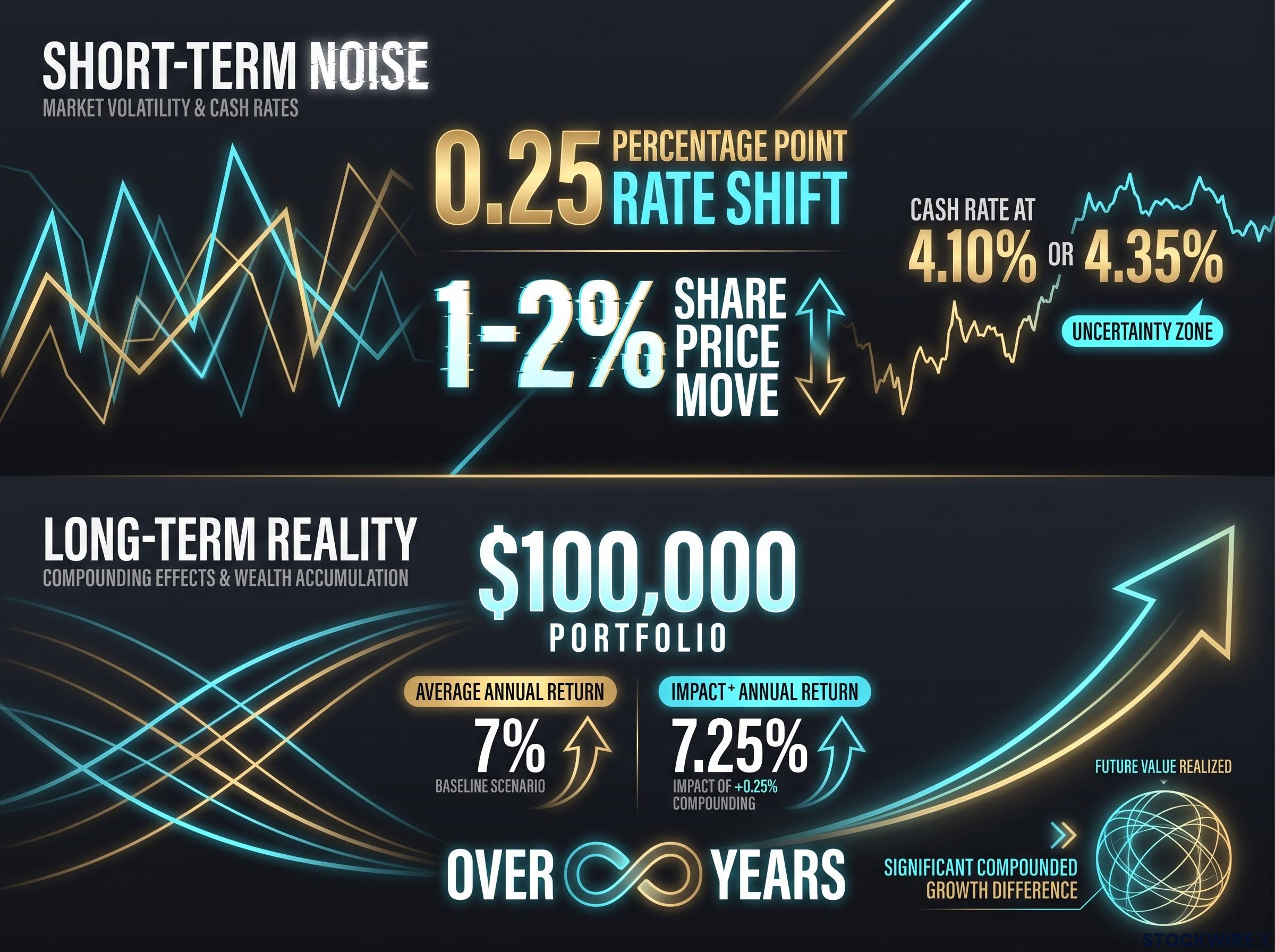
- In the near term, a 0.25 percentage point rate shift adjusts borrowing costs, savings rates, and bond yields at the margin. Share prices may move 1-2% on the day, sometimes less.
- Over the following years, compounding absorbs the perturbation. On a $100,000 portfolio growing at an average annual return of, say, 7% versus 7.25%, the difference after a full 20 years amounts to a rounding error in your final balance relative to the dozens of other variables (contributions, fees, asset mix) that drive the outcome.
- At year 20, the portfolio’s value is determined overwhelmingly by your asset allocation, contribution consistency, and fee structure, not by whether the cash rate was 4.10% or 4.35% on any given Tuesday.
A gathering of leading Australian economists, which included a former Reserve Bank of Australia Governor, spent considerable time presenting near-term forecasts and assessing current economic conditions. The takeaway for long-term individual investors was clear: movements in short-term economic data have little bearing on the outcomes of portfolios built around decade-long time horizons.
If a rate move that consumes 48 hours of financial media coverage produces no measurable difference to a 20-year outcome, the anxiety the coverage generates is a real cost. The event itself is not.
How watching the market too closely makes you poorer
Here is the counterintuitive finding that the behavioural research lands on repeatedly: investors who interact with their portfolios least frequently achieve better long-term outcomes. Not marginally better. Materially better.
The mechanism is straightforward. Regular exposure to market news heightens anxiety, which drives a specific set of decisions: selling during drawdowns, chasing performance after rallies, and attempting to time re-entry. Each of these decisions feels rational in the moment. Over decades, they compound into significantly lower returns.
The gap between what a strategy requires and what an investor actually does is not a knowledge problem; it is a behavioural architecture problem, where the structural conditions around contribution automation and account-checking frequency determine whether a multi-decade strategy remains intact under emotional pressure.
The behaviour gap: Actual investor returns consistently lag the stated returns of the funds they invest in. The gap is not caused by bad fund selection. It is caused by poor timing, buying high after good news and selling low after bad news, driven by overreaction to short-term events.
That gap is effectively a behavioural tax that long-term investors pay voluntarily. And it is one you can stop paying.
The cost of a single poorly-timed decision
Consider an Australian investor who panics during a 10% drawdown on the ASX and sells their superannuation holdings, moving to cash. The market recovers over the following months, as it historically does, but the investor waits until confidence returns before re-entering. By then, they have missed the sharpest part of the recovery.
That single decision, one sell and one delayed buy, compounded over 20 years, can produce a gap of tens of thousands of dollars versus a do-nothing approach. For an Australian superannuation holder, checking your balance every time the ASX falls is not cautious behaviour. It is a risk factor for your long-term outcome.
Sell decision biases are the primary site of portfolio value destruction: a University of Chicago study found that randomly selected exit points outperformed professional managers by up to 150 basis points annually, which reframes the discipline of doing nothing not as passivity but as a statistically superior exit strategy.
Why simple personal portfolios outperform professional complexity
Here is something that should reframe how you think about investment sophistication. A pattern that Shani Jayamanne at Morningstar Australia has noted consistently, writing in July 2026 and drawing on years of professional interactions with fund managers, is that many of these professionals invest their own money in straightforward, diversified portfolios that bear little resemblance to the strategies they execute at work.
The divergence exists because professional portfolios are shaped by obligations that simply do not apply to personal accounts: the need to remain within approved asset classes, manage against peer performance, respond to investor inflows and outflows, and demonstrate results over short reporting windows. When a fund manager spends their professional day executing complex sector rotations and then invests their own retirement savings in a balanced index fund, that is not a contradiction. It is a clear signal about what actually works for long-term personal wealth.
The structural advantage individual investors hold is substantial:
- No benchmark obligation: You do not need to outperform the ASX 200 or any other index.
- No mandate constraints: You can hold any asset class in any proportion.
- No peer comparison pressure: Your performance is measured against your personal goals, not a competitor’s quarterly return.
- No performance review frequency: You are not explaining a drawdown to a client every three months.
Advisory literature consistently recommends simple, diversified, low-cost funds for individuals rather than mirroring complex institutional strategies. Simplicity, in this context, is not naive. It is the rational response to the structural freedoms you hold.
The news that actually deserves your attention
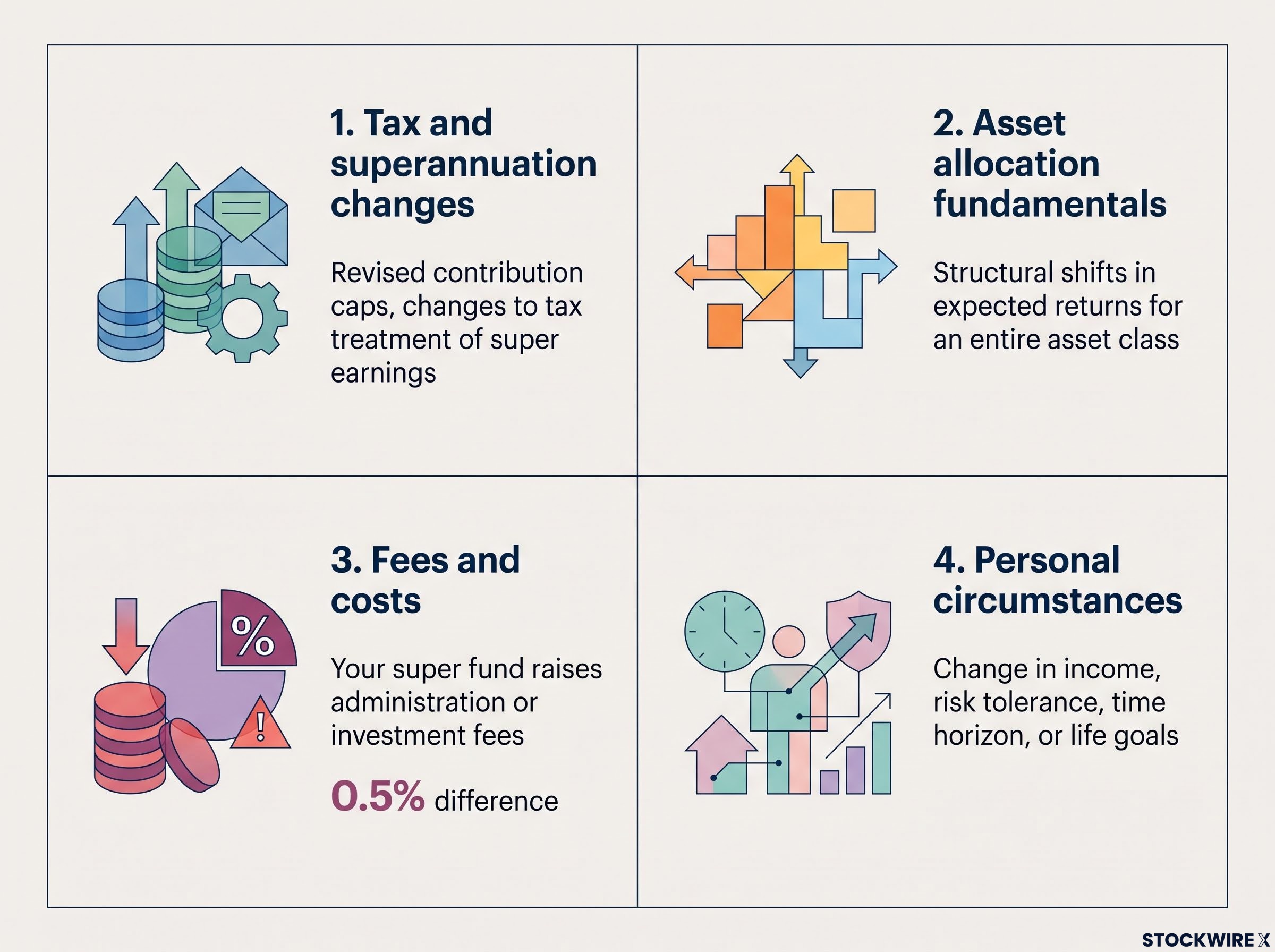
Filtering out noise does not mean filtering out everything. A narrow category of financial developments genuinely warrants your attention, and distinguishing these from daily market commentary is the practical skill this framework delivers.
| Category | Example (Australian context) | Why it matters long-term |
|---|---|---|
| Tax and superannuation changes | Revised contribution caps, changes to tax treatment of super earnings | Directly alters the after-tax return on your largest wealth vehicle |
| Asset allocation fundamentals | Structural shifts in expected returns for an entire asset class | May require rebalancing to maintain your target risk profile |
| Fees and costs | Your super fund raises administration or investment fees | Fees compound over decades; a 0.5% difference can mean tens of thousands at retirement |
| Personal circumstances | Change in income, risk tolerance, time horizon, or life goals | Your strategy should reflect your situation, not the market’s mood |
“Does this change my evaluation of long-term fundamentals?”
That single question is the gating test for any financial headline. Legislative changes to superannuation contribution limits clear it. A monthly jobs print does not. A structural shift in how an entire asset class is expected to perform over the next decade clears it. A quarterly earnings miss from a single company in a diversified portfolio does not.
Most of what fills a financial news feed each morning does not pass this test. The categories that do are few, and they tend to arrive slowly rather than breaking overnight.
Tuning out without switching off: what a sustainable information diet looks like
The practical question is not whether to disengage from short-term noise but how to do it sustainably. Wholesale avoidance is neither realistic nor necessary. What works is a rhythm.
- Set a portfolio review cadence. Quarterly or annual checkpoints aligned with your long-term goals, not with data release schedules or market events.
- Define your signal categories in advance. Before the next headline arrives, decide which categories (tax changes, fee changes, personal circumstances, structural asset-class shifts) qualify as genuine signals worth evaluating.
- Apply the fundamentals test before acting. For any piece of financial news that generates an urge to act, ask whether it changes your evaluation of long-term fundamentals. If it does not, the correct response is no response.
- Treat discomfort during volatility as a process indicator. The urge to check your superannuation balance during a drawdown is itself evidence that the noise is working on you. Recognising that discomfort, rather than acting on it, is the discipline that compounds.
The Australian superannuation system is structurally designed for precisely this kind of low-intervention, long-term approach. Most long-term wealth accumulation in Australia happens within a compulsory, tax-advantaged structure that rewards patience by design. Interfering with it based on short-term market news is a self-imposed cost.
Research consistently shows that the investors who interact with their portfolios least frequently achieve better long-term outcomes. An Australian investor who checks their super balance annually and adjusts only when personal circumstances genuinely change is not being passive. They are executing the strategy the evidence supports.
The structural edge most Australian investors are not using
Long-term investors hold a set of structural advantages that professional participants do not: no benchmark obligation, no mandate constraint, no peer comparison pressure, and no short-term performance accountability. These are not consolation prizes for lacking professional resources. They are genuine competitive edges, because the professional obligation to react to short-term data is precisely what drives underperformance in personal accounts.
The decision to disengage from short-term noise is not giving up. It is deploying those structural advantages deliberately. Financial media volume will continue to grow. The investors who build and maintain a noise filter early will compound that discipline alongside their returns.
The Australian superannuation system is designed to reward this approach. Volatility-driven interference with it is a self-imposed cost, one that compounds just as surely as the returns themselves.
Superannuation balance benchmarks reveal that the average Australian aged 50-54 holds approximately $198,400, more than $430,000 below the ASFA comfortable retirement threshold, a gap that interference with compounding through volatility-driven switching widens materially over the remaining accumulation years.
The long-term investor’s apparent disadvantage, less information, less access, fewer tools, is in many respects the advantage. It removes the professional obligation to react. And the compulsion to react is what drives underperformance.
This article is for informational purposes only and should not be considered financial advice. Investors should conduct their own research and consult with financial professionals before making investment decisions. Past performance does not guarantee future results.