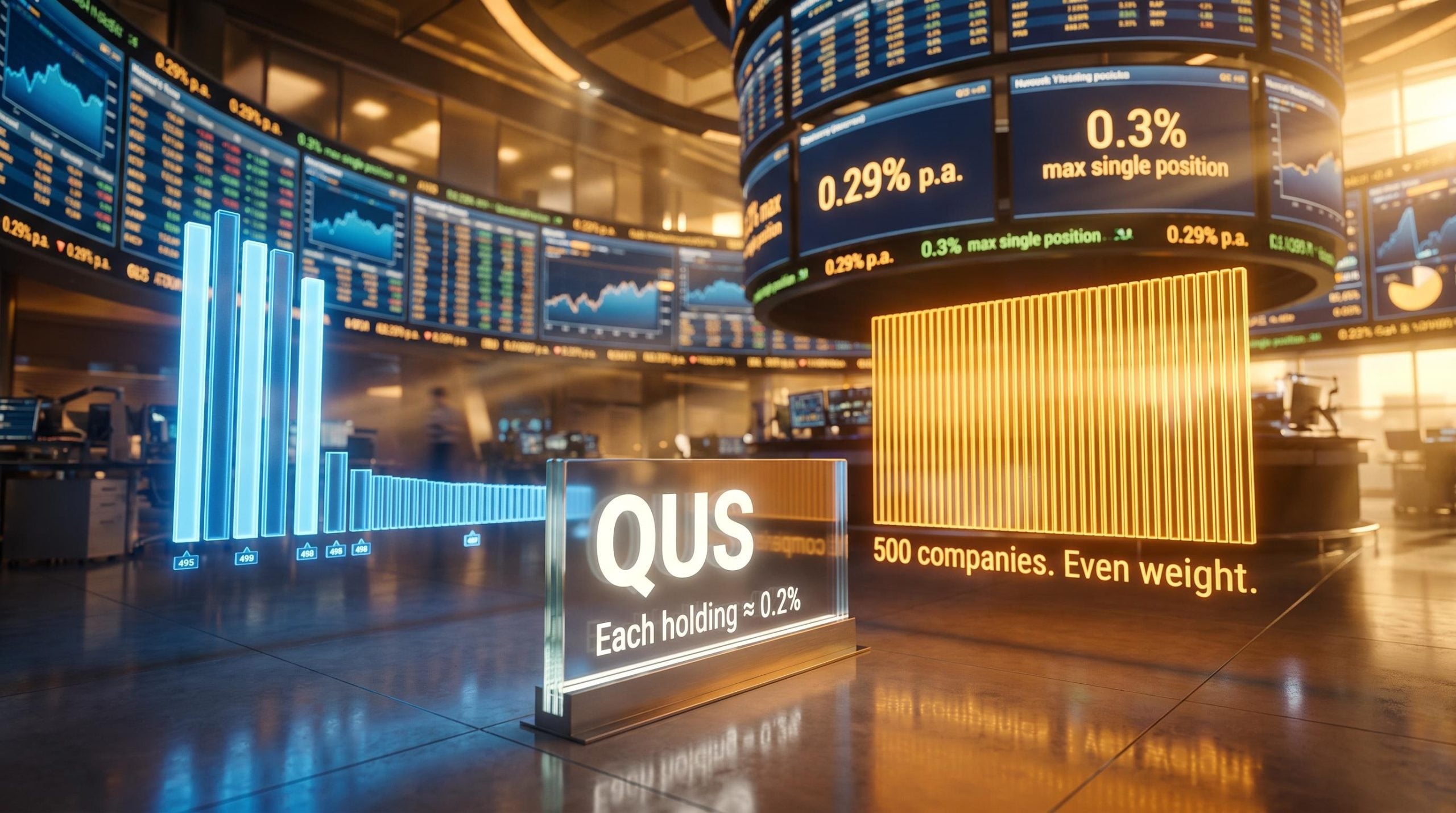
You buy an S&P 500 ETF expecting exposure to 500 companies. Then you check the holdings and find that your returns are being driven by a small cluster of mega-cap names carrying a weight far above their numbers. The broad diversification you assumed you were getting turns out to be considerably narrower in practice.
That reality is built into the structure of how cap-weighted indices allocate capital, and after an extended period of US mega-cap dominance, the mismatch between expected and actual diversification has grown to a point many investors find uncomfortable. BetaShares QUS, the S&P 500 Equal Weight ETF trading on the ASX, was designed specifically to address this structural imbalance. It holds the same 500 companies but spreads capital across them in a fundamentally different way.
Here is what this explainer gives you: a clear understanding of how QUS constructs its portfolio, the specific market conditions where it will trail a standard S&P 500 ETF, and a practical framework for deciding whether it belongs in your strategy. Not a sales pitch, not a product summary. A genuine basis for making the call yourself.
What makes an equal-weight ETF structurally different
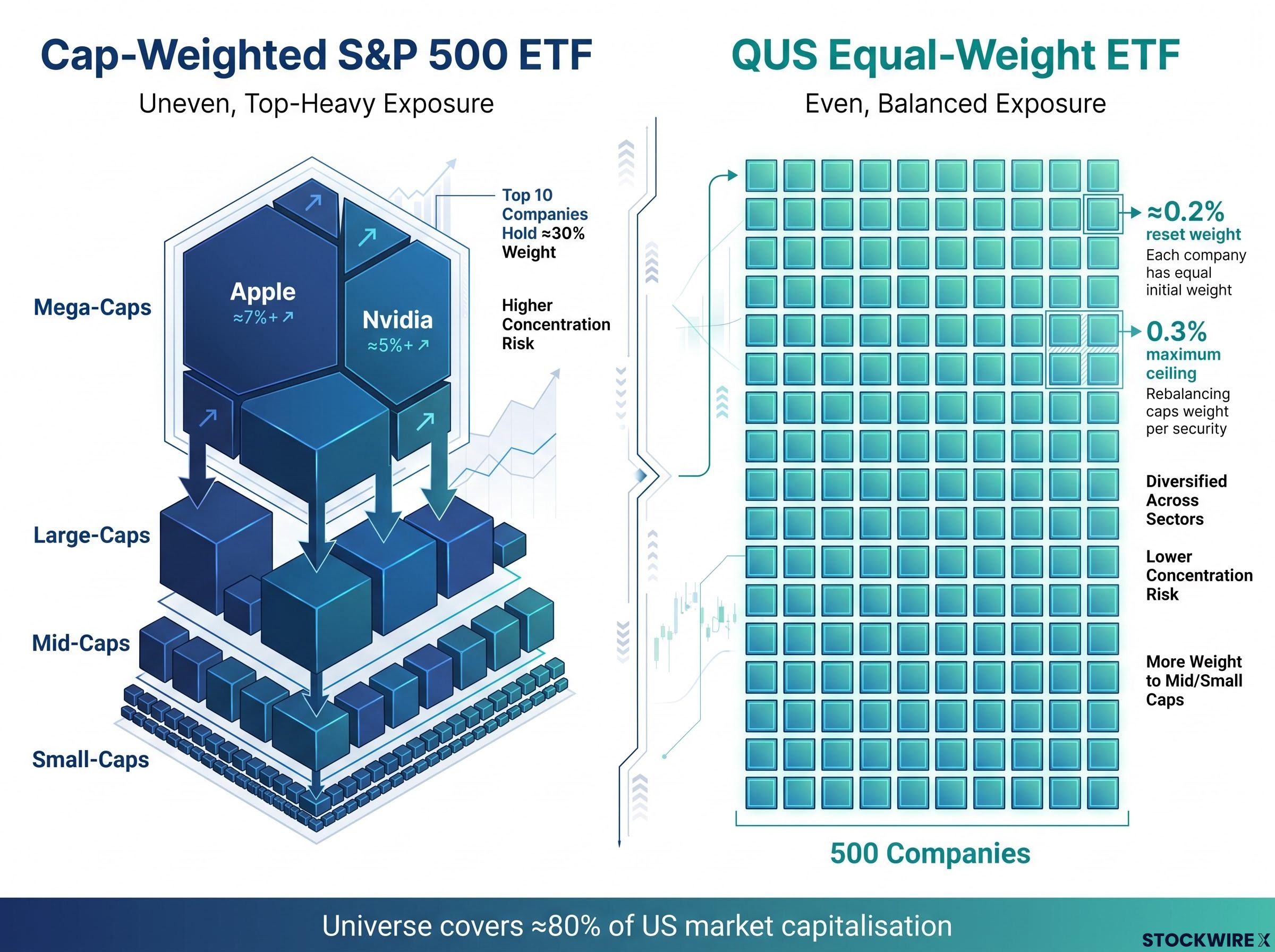
A standard cap-weighted S&P 500 ETF assigns each company a weight proportional to its market capitalisation. The bigger the company, the more of your money it absorbs. That is automatic; no fund manager decides it. The consequence is that a small cluster of mega-cap stocks can drive the majority of your return.
The cap-weighting feedback loop channels every new dollar of passive inflow disproportionately toward stocks that have already appreciated, systematically concentrating more capital in the largest names regardless of whether their valuations justify it.
QUS breaks that link entirely. At each quarterly rebalance, every one of the 500 constituents is reset to approximately 0.2% of the portfolio, regardless of company size. Three features define this construction:
- It holds the same 500 large-cap US companies as a standard S&P 500 ETF.
- Each holding is reset to approximately 0.2% at rebalance, and the index rules prevent any single position from breaching 0.3% of the total portfolio.
- The reset happens quarterly, mechanically reversing any drift caused by price movements.
This is not a small-cap fund. The S&P 500 universe still covers approximately 80% of US market capitalisation across sectors. QUS simply redistributes your capital evenly across that universe.
| Attribute | Cap-weighted S&P 500 ETF | QUS equal-weight S&P 500 ETF |
|---|---|---|
| Weighting method | By market capitalisation | Each stock ≈ 0.2% at rebalance |
| Mega-cap impact | Very high; a few stocks can dominate returns | Strongly reduced; no single stock dominates |
| Mid/smaller stock role | Secondary | Much larger relative role |
| Style tilt | Growth/large-cap momentum | More contrarian, more mid-cap exposure |
The 0.2% ceiling is the structural guarantee you are actually buying. Whatever happens to Apple, Nvidia, or any single mega-cap, it can move QUS by at most a fraction of a percentage point. That is the protection embedded in the design.
When big ASX news breaks, our subscribers know first
How the quarterly rebalancing mechanism actually works
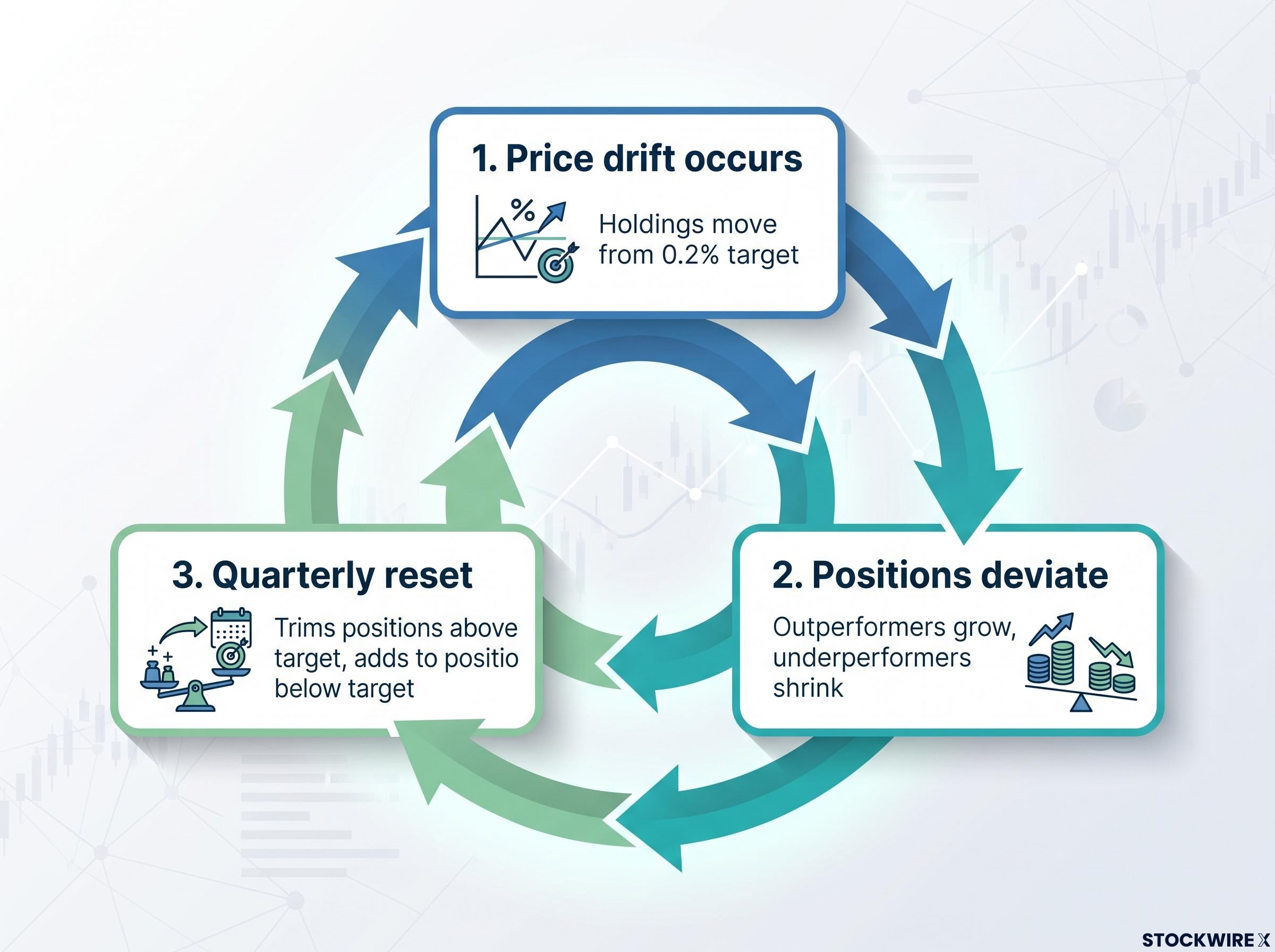
Between rebalances, prices move. Some holdings appreciate and drift above 0.2%; others fall and drift below it. This is normal. The portfolio is no longer equally weighted by the time the next quarter arrives.
The rebalancing process corrects that drift in three steps:
- Price drift occurs: Daily market movements push individual holdings away from their 0.2% target weight.
- Positions deviate: Outperformers grow to a larger share of the portfolio; underperformers shrink to a smaller share.
- Quarterly reset: The fund trims positions that have grown above target (selling at higher prices) and adds to positions that have fallen below target (buying at lower prices).
“Selling higher priced shares while buying those which are lower priced, through regular rebalancing.” — BetaShares
This is a systematic contrarian discipline baked into the index rules, not a judgement call by a portfolio manager. Nobody at BetaShares decides which stocks to trim or add; the rebalancing formula handles it mechanically.
For you, this mechanism means QUS will automatically trim any stock that runs hard, including one you might feel excited about holding more of. That is the discipline’s value and its friction simultaneously. You get protection against concentration; you give up uncapped participation in individual winners.
One practical consequence: the regular rebalancing increases portfolio turnover relative to a cap-weighted index. That means additional transaction costs at the fund level, though individual investors typically realise capital gains only when they sell their units, not when the ETF rebalances internally.
When equal-weight strategies have historically lagged cap-weighted indices
When the rebalancing mechanism systematically reduces the weight of stocks that rise fastest and increases the weight of those that lag, the strategy’s weakest moments become predictable: periods where gains are generated almost entirely by a concentrated group of the index’s largest constituents. That is not a flaw in the design. It is the mechanism operating precisely as intended, in a market environment that rewards the opposite approach. Two primary conditions have historically produced underperformance for equal-weight strategies:
- Mega-cap, technology-led bull markets. When the largest companies in the index are also the fastest-growing, a cap-weighted fund allocates more capital to those winners automatically. QUS holds those same names at only 0.2% each and trims them quarterly. The result is less upside capture during sustained mega-cap rallies.
- Risk-off environments where smaller names fall harder. Equal weighting increases the relative importance of mid-sized and smaller S&P 500 constituents. During broad sell-offs or periods of significant economic stress, these companies have historically tended to fall more than the most liquid mega-caps, meaning QUS can experience larger drawdowns than a cap-weighted alternative.
An Australian investor holding QUS through a period like the 2023-2025 US mega-cap technology surge would have experienced measurably lower returns than a holder of a standard cap-weighted S&P 500 ETF. The mechanism described in the previous section explains exactly why: QUS was trimming the very stocks that were driving the bulk of index returns.
US mega-cap dominance has reached a scale with no modern historical precedent, with five companies controlling roughly 30% of total US equity market capitalisation and the top ten S&P 500 constituents accounting for around 40% of index weight, figures that Goldman Sachs and Morgan Stanley describe as extreme by any reasonable measure.
Understanding these conditions matters because it is the difference between interpreting a period of relative underperformance as evidence the fund is broken versus recognising it as the expected behaviour of a strategy you chose deliberately. Informed expectations protect you from selling at the wrong moment in a style cycle.
The practical differences for Australian investors holding QUS on the ASX
The equal-weight philosophy is one thing. The reality of holding this specific fund from Australia introduces three additional variables that shape your actual returns:
- Currency exposure is unhedged. QUS holds USD-denominated assets but trades in AUD on the ASX. A stronger Australian dollar reduces the AUD value of your USD holdings, regardless of how the underlying US equities perform.
- Management fee sits at 0.29% p.a. This is higher than ultra-low-cost cap-weighted S&P 500 ETFs, reflecting the additional complexity and turnover of equal-weight indexing.
- Income is distributed semi-annually. The fund passes through dividends from underlying US holdings, net of fees and expenses. Tax treatment depends on your account type, whether that is a standard taxable account or a superannuation fund.
The hedged versus unhedged ETF decision produced a 13-percentage-point return gap over the year to May 2026 between otherwise identical strategies, a divergence driven entirely by AUD/USD movements rather than any difference in underlying holdings or fund management.
Fee context: The 0.29% p.a. management fee may appear modest in isolation, but fee differences compound materially over investment horizons of ten or more years. Weigh the equal-weight diversification benefit against the incremental cost relative to cheaper cap-weighted alternatives.
For you as an Australian investor, the currency dimension deserves particular attention. In a high-AUD environment, currency drag can offset a meaningful portion of strong underlying US equity performance. Your return in Australian dollars can diverge significantly from the index return in US dollars, and that divergence has nothing to do with the equal-weight strategy itself. It is a separate variable operating on top of it.
Where QUS fits, and where it does not, in an Australian investor’s portfolio
Two investor profiles help you determine which side of this decision you sit on.
The first is an investor who already holds cap-weighted global or US ETFs and is uncomfortable with how much of their portfolio’s fate depends on a small cluster of mega-cap companies. For this investor, QUS works as a diversifying satellite allocation, tilting part of their US exposure away from concentration and toward more even participation across the S&P 500. They are not replacing their core holding; they are reducing its dominance.
The second is an investor who wants maximum exposure to US mega-cap growth, prioritises the lowest possible fee, or specifically wants hedged currency exposure. For this investor, QUS introduces trade-offs that work against their priorities. A cap-weighted S&P 500 ETF or a dedicated US technology ETF better reflects their view.
| Consideration | QUS may suit | QUS may be less suitable |
|---|---|---|
| Mega-cap concentration | Concerned about over-reliance on a handful of names | Wants full exposure to mega-cap growth |
| Fee sensitivity | Accepts 0.29% p.a. for diversification benefit | Prioritises lowest possible management fee |
| Currency hedging | Comfortable with unhedged USD exposure | Prefers hedged international holdings |
| Systematic winner-trimming | Values contrarian discipline embedded in rules | Uncomfortable with a fund that trims stocks still running |
The clearest signal that QUS suits you is not your view on the S&P 500 broadly. It is your specific discomfort with the concentration risk embedded in a standard cap-weighted index, and whether you are willing to accept periodic underperformance in exchange for structural diversification.
Deciding whether the equal-weight trade-off earns its place in your strategy
The decision is not whether equal weight is better than cap weight as a universal rule. It is whether the specific trade-offs described across this explainer match your actual portfolio, your risk tolerance, and your expectations.
Equal weight buys you structural diversification and a systematic contrarian discipline. It costs you 0.29% p.a., introduces unhedged AUD/USD currency exposure as a persistent return variable, and will lag during the precise market conditions when mega-cap momentum makes cap-weighted indices look most impressive.
Before adding or ruling out QUS, assess what you already hold. If your existing ETFs already carry significant mega-cap concentration, QUS addresses a real problem. If they do not, the case weakens.
Three conditions under which QUS earns its place:
- You already hold cap-weighted US or global ETFs and want to reduce mega-cap concentration as a satellite allocation.
- You are comfortable with unhedged USD exposure and accept that currency movements will be a meaningful return driver.
- You accept the quarterly rebalancing discipline, including the trimming of your best-performing holdings, as a feature rather than a frustration.
If those three conditions match your situation, QUS is not a bet that equal weight always wins. It is a bet that concentration risk in a standard cap-weighted index is a risk worth paying to reduce. That is a narrower, more specific question, and you now have everything you need to answer it.
For investors who want a structured due diligence process before committing capital to any ETF, our dedicated guide to evaluating ETF fees and true exposure walks through an eight-step framework covering fee compounding, holdings analysis, tax obligations, and the full cost components beyond the headline management expense ratio.
This article is for informational purposes only and should not be considered financial advice. Investors should conduct their own research and consult with financial professionals before making investment decisions. Past performance does not guarantee future results.