Most investors treat AI as a single trade. They pick an AI-labelled ETF or buy a handful of names they recognise, and assume they have covered the theme. What they have actually done is chosen a specific layer of a complex industrial value chain, one where the risk profile at the semiconductor level looks nothing like the risk profile at the software level, and where the gap between those layers determines whether your portfolio is positioned for the right kind of return at the right time horizon.
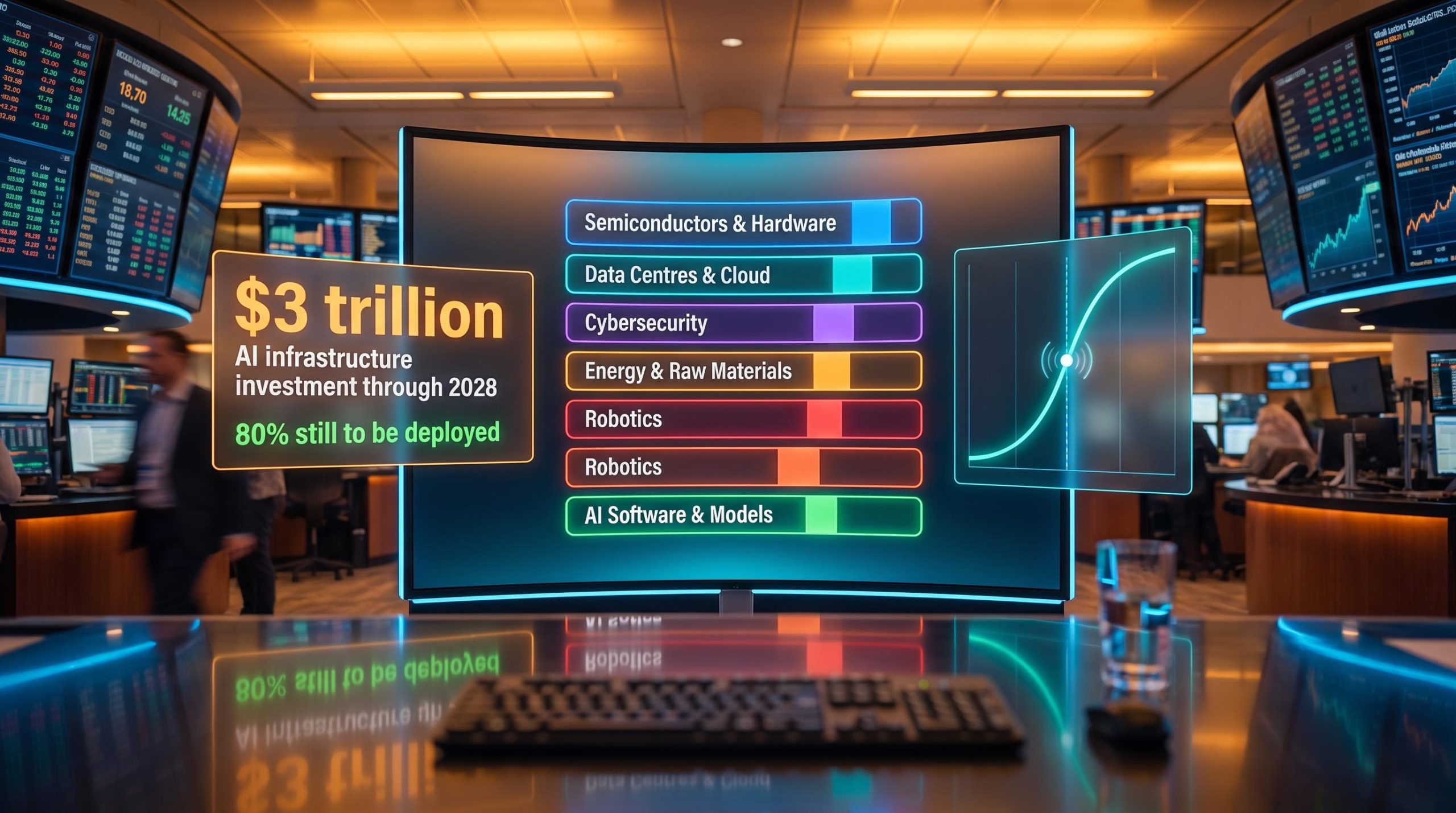
That distinction matters more than usual right now. Morgan Stanley Research estimates nearly $3 trillion of AI-related infrastructure investment through 2028, with over 80% still to be deployed. The allocation choices you make in mid-2026 sit at the steepest part of the spending curve, which means the difference between informed capital and uninformed capital is as wide as it has been in years.
Here is the practical skill you are about to pick up: a mental model for examining any AI-labelled investment by asking which layer of the value chain it actually serves, where that layer sits on the growth curve, and whether the answer matches your risk tolerance and time horizon. That framework turns a single question (“should I invest in AI?”) into six specific ones, each with a different answer for a different kind of portfolio.
The S-curve: the mental model every AI investor needs first
You already know, intuitively, that technologies do not grow in a straight line. Smartphones spent years as niche devices, then adoption exploded, then growth flattened as most people who wanted one already had one. That pattern, slow early uptake, rapid mid-stage acceleration, and mature slower growth, is the S-curve. It applies to AI segments just as clearly.
The investing implications map directly onto the three stages:
- Early stage: High uncertainty, binary outcomes. The technology may work at scale or it may not. If it does, returns can be very large. If it does not, losses are steep. Quantum computing and humanoid robotics sit here today.
- Mid stage: The technology is proven, adoption is accelerating, and the market is far from saturated. Historically, this is where many of the largest returns in technology investing have occurred. Hyperscalers, data centres, and cybersecurity sit here.
- Late stage: Cash flows are more stable, growth is slower, and returns depend more on valuation discipline than explosive expansion. Some consumer-facing AI software is approaching this territory.
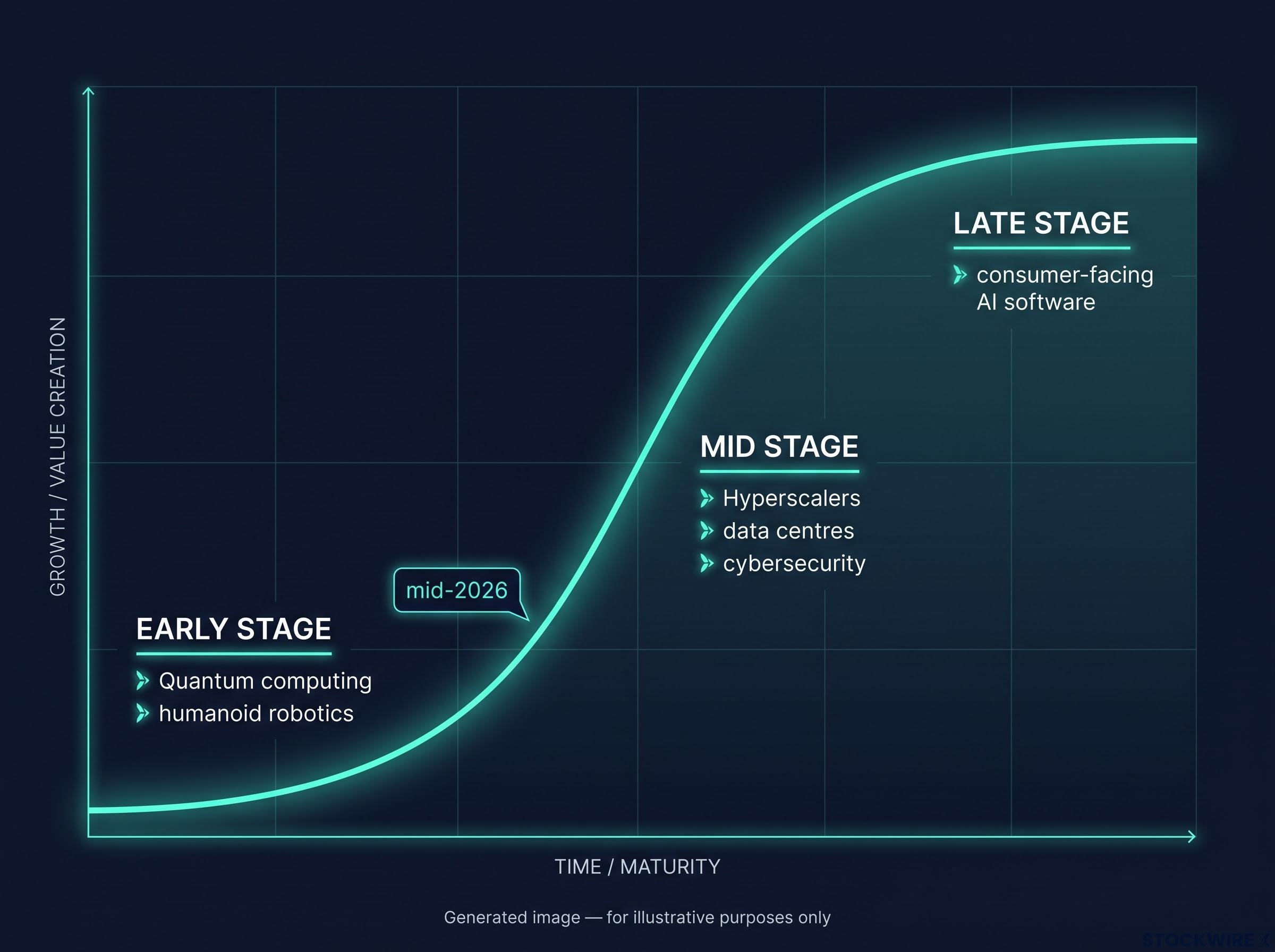
As of mid-2026, most major AI segments sit somewhere between early and mid-stage, but not in the same place. That difference is where your portfolio decisions begin. The S-curve gives you a way to interrogate any AI investment claim on its own terms, rather than treating all AI exposure as the same bet.
A broader thematic investing framework, covering problem size, realistic total addressable market, long-term durability, valuation, and competitive moat, gives you the tools to apply the same scrutiny to any AI-labelled product before you commit capital, not just to the segments covered here.
When big ASX news breaks, our subscribers know first
Layer one: semiconductors and compute hardware
The “picks and shovels” logic is the most common entry point for retail investors thinking about AI. Every model training run and every inference call depends on physical hardware: GPUs, AI accelerators, high-bandwidth memory, and manufacturing equipment. If AI is growing, the companies supplying compute should benefit. That logic is sound as far as it goes. Where it breaks down is in the assumption that all hardware businesses benefit equally.
| Attribute | Moat-driven hardware | Commodity hardware |
|---|---|---|
| Competitive advantage | Proprietary architectures, design complexity | Replicable product improvements |
| Margin profile | High and defensible over longer periods | Subject to compression as competitors replicate |
| Cycle risk | Moderate; demand tied to structural AI spending | High; boom-bust pricing and inventory cycles |
Apple is a useful case study here: consumers consistently pay a significant premium over the cost of the underlying components, because the value is embedded in the software ecosystem rather than the physical device. A strong hardware product without a comparable software layer rarely sustains that kind of pricing power. Micron, SK Hynix, and Samsung are recent examples on the other side, memory chip names that attracted significant investor enthusiasm and then saw declining stock performance after sentiment cooled.
Where the semiconductor opportunity ends and the risk begins
As of mid-2026, leading AI hardware names trade at very high multiples that already price in aggressive growth. The reward-to-risk calculation is meaningfully different from what it was two years ago. If you are buying into this layer now, you are not getting early-mover pricing.
Cycle risk in memory and commodity components is the most immediate concern. These segments face boom-bust dynamics that can erase gains rapidly. Longer term, technology leap risk is real: new architectures, more efficient accelerators, or (on a longer timeline) quantum computing breakthroughs could redistribute winners entirely.
The practical takeaway is straightforward. Enthusiasm for an AI-adjacent hardware category does not equal durable returns. Before committing capital, your question should be whether the specific business has a defensible moat, not whether the category sounds right.
Layer two: data centres, cloud, and the infrastructure build-out
The scale of capital flowing into AI infrastructure is genuinely substantial. This is not speculative projection.
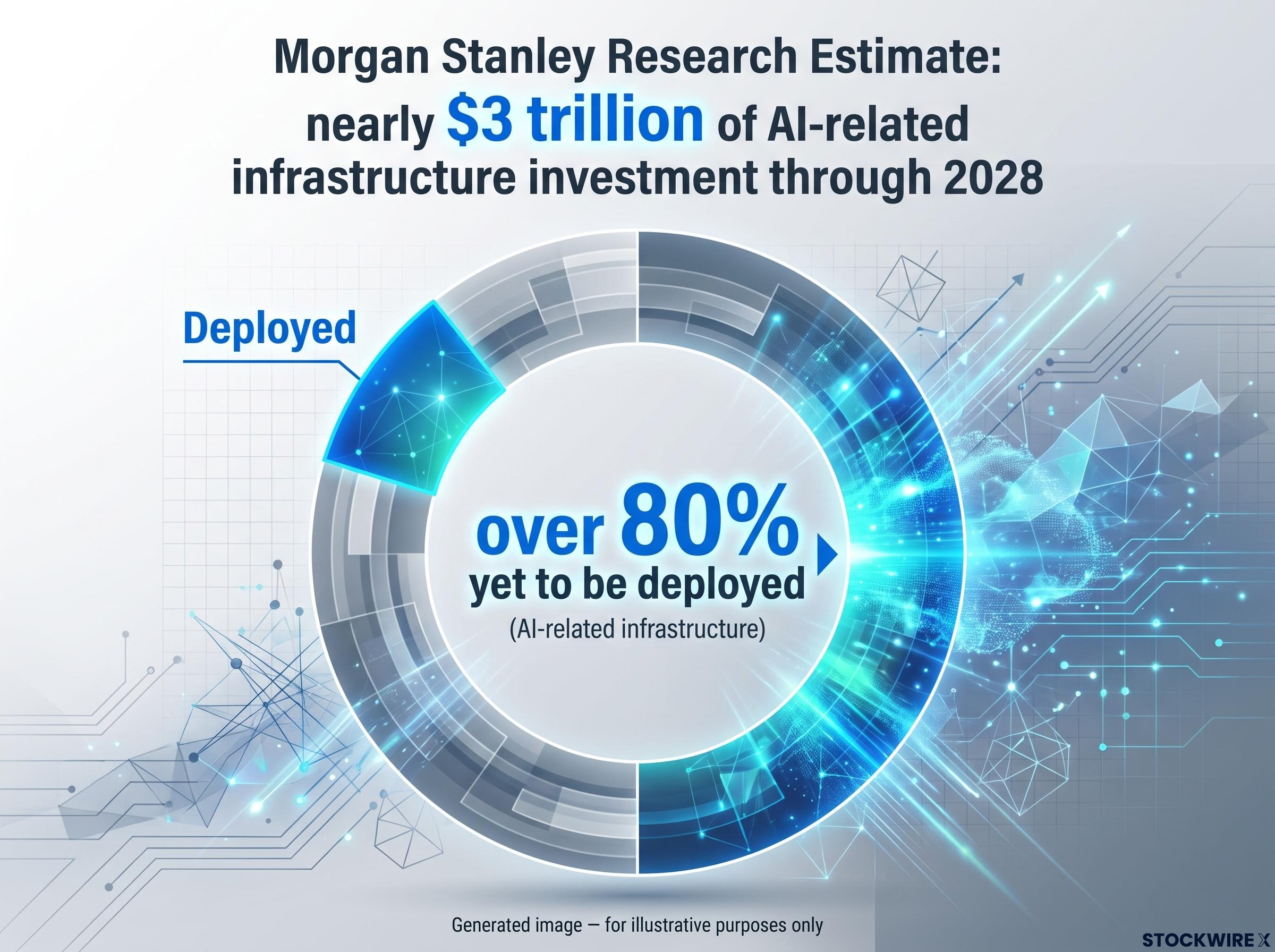
Morgan Stanley Research estimates nearly $3 trillion of AI-related infrastructure investment through 2028, with over 80% yet to be deployed. Other estimates for total global AI build-out run to $4-8 trillion over roughly five years (research-cited, not independently verified).
That spending flows into three distinct sub-segments, each with a different return driver:
- Hyperscale cloud providers benefit from economies of scale and deep enterprise lock-in. Once AI workflows run on a given cloud platform, switching is costly and operationally risky, which creates pricing power.
- Data centre operators and REITs earn lease and service income on long-term contracts, giving them a more infrastructure-like cash-flow profile with greater visibility.
- Networking and interconnect vendors capture spending on fibre, routers, and specialised data centre networking gear that AI workloads demand at scale.
The S-curve position here is firmly mid-stage: capital spending is well underway but still largely ahead.
The risk that balances the opportunity is overbuild. The infrastructure build-out is racing ahead of fully proven end-user demand, and if utilisation lags expectations, returns across this entire layer would suffer. That $3 trillion figure is not a guarantee of investor returns; it represents capital being committed ahead of proven demand. Your question, before sizing this position, should be about utilisation rates and unit economics, not just headline spending.
Cybersecurity and energy: two segments investors often overlook
These two segments rarely appear in the same sentence, but they share one characteristic that makes them worth considering together: their investment case rests on necessity, not excitement. That is precisely why they deserve space in a balanced AI portfolio.
Cybersecurity grows in direct proportion to the broader technology footprint. As more AI applications, data pipelines, and cloud deployments come online, the surface area that requires protection expands alongside them. Security budgets follow that expansion because organisations have little choice: this is not discretionary spending for three specific reasons:
- Regulated industries (financial services, healthcare, critical infrastructure) face legal requirements to secure data and systems.
- AI adoption itself expands the volume of critical systems that must be protected. More digital surface area means more to defend.
- AI functions as both a threat and a tool: advanced attacks increasingly use AI, while defenders deploy AI for faster detection and response, creating a self-reinforcing spending cycle.
The offence-defence asymmetry in enterprise security is accelerating this dynamic: Palo Alto Networks’ internal AI scan compressed five to seven years of conventional vulnerability discovery into six weeks, setting a new baseline for how quickly attack surfaces can be mapped and how urgently defenders must respond.
Companies like Palo Alto Networks illustrate the platform lock-in dynamic in this space. Large security platforms become deeply embedded in enterprise workflows, compliance processes, and incident-response systems, creating high switching costs and recurring revenue.
Energy and raw materials represent the physical constraint on AI growth. Data centres are extraordinarily power-hungry, and materials including copper, lithium, and silver are required for grids, cooling systems, and batteries.
BHP has publicly stated for several years that copper supply will fall short of demand before 2030, driven by grid infrastructure, data centre build-out, and electric vehicle adoption.
The investment characteristics of these two segments differ in a useful way. Cybersecurity offers business models closer to recurring enterprise software. Energy and materials are cyclical commodity plays, which means they function as diversifiers with lower correlation to tech equity drawdowns. For your portfolio, owning a cybersecurity or materials position as part of an AI allocation is not a contradiction. These segments let you participate in AI-driven demand without the same valuation and commoditisation risks that come with direct semiconductor or software exposure.
Robotics and AI software: the highest upside and the sharpest trade-offs
These two segments generate the most narrative excitement. They are also where the gap between story and investment reality is widest, and where understanding the distinction between them matters most for your portfolio.
Industrial vs. humanoid robotics: same category, different clocks
Robotics brings AI decision-making to bear on physical tasks in the real world, but the two sub-segments within it sit at completely different points on the growth curve:
- Industrial robotics is mid-to-late stage in established sectors like auto manufacturing, with ongoing expansion into new use cases such as logistics and warehousing. Commercial viability is proven. The primary risk is competition and margin pressure, not technology failure.
- Humanoid and general-purpose robots are genuinely early-stage, with limited commercial scale as of mid-2026 despite high-profile development activity. Tesla has reportedly converted at least one manufacturing facility entirely to humanoid robot production, with its Optimus robot cited as a strategic priority. The outcomes here remain binary: large upside if the technology scales commercially, steep losses if timelines stretch or the economics do not work.
Treating these two as interchangeable is a portfolio construction error. They carry different time horizons, different capital intensity profiles, and different probabilities of success.
AI software and models: priced for what, exactly?
AI software platforms, foundation models, SaaS products, consumer apps, and vertical AI solutions sit on top of the infrastructure layers below them. Software businesses have historically maintained pricing power and profitability due to switching costs and ecosystem lock-in, which makes this layer attractive on paper.
The monetisation question, however, is still being answered. Broad AI adoption is real, but durable unit economics at full scale are still being proven across much of the segment. OpenAI has confidentially filed for an IPO with expectations for a potential listing later in 2026 (research-cited, not independently verified), which would test public market appetite for frontier AI business models directly.
Here is the factor many retail investors miss: if you hold a Nasdaq-100 tracker, you already own meaningful AI software exposure through the large-cap names that dominate that index. The practical question worth asking is not whether to hold AI software exposure at all, but whether layering an AI-specific ETF over your existing holdings adds genuine diversification or simply amplifies a position you already carry.
AI concentration risk compounds this problem: a Morningstar basket of 34 AI-related names gained approximately 50.8% in 2025 but produced extreme return dispersion, with some names posting triple-digit gains and others falling double digits, which means owning multiple AI-labelled funds does not automatically produce diversification across the value chain.
Building an AI portfolio that actually reflects the full value chain
The analysis above gives you the map. This section gives you the process for using it. Five specific principles translate the value-chain framework into practical allocation decisions:
- Check your existing exposure first. Many global equity and tech funds already hold substantial AI-related positions. Before buying any AI-specific ETF, examine your current holdings to identify which layers of the value chain you already own.
- Examine ETF holdings, not ETF labels. AI-theme ETFs often hold a mix of everything. Look at the top ten holdings to see which segment actually dominates. The label tells you almost nothing useful; the holdings tell you which part of the value chain you are paying for.
- Diversify across the chain. Returns from AI will likely accrue across multiple layers (chips, infrastructure, software, security, materials), not just consumer apps. Spreading exposure across segments reduces dependence on any single technological outcome.
- Be explicit about hardware versus software risk. Hardware and commodities tend to be more cyclical and capital-intensive, with margins that competitors can erode over time. Software and platforms generally offer more recurring, predictable economics, though they carry their own valuation and commoditisation risks. The historical pattern is that businesses with genuine software-based competitive advantages have sustained profitability more reliably than hardware peers.
- Plan to rebalance. The AI theme is volatile. Specific segments can run far ahead of fundamentals and correct sharply, making active rebalancing more important here than in broad index investing.
Illustrative ETF examples across the value chain (not recommendations) include NDQ and FANG for broad US tech, HAK for cybersecurity, RBTZ for robotics and automation, QRE for Australian resources, and AC/DC for battery and supply chain technology.
Investors wanting to translate the value-chain framework into a specific allocation will find our comprehensive walkthrough of AI ETF portfolio construction covers practical sizing logic, overlap management between holdings, and a four-tier framework with example weights across large-cap platforms, international tech, and mid-cap innovators.
| Segment | S-curve position | Risk level | Typical access vehicle |
|---|---|---|---|
| Semiconductors and hardware | Mid | High (cyclical, valuation) | Semiconductor ETFs, Nasdaq-100 trackers |
| Data centres and cloud | Mid | Medium | Cloud/infrastructure ETFs, data centre REITs |
| Cybersecurity | Mid | Medium (recurring, non-discretionary) | Cybersecurity ETFs (e.g., HAK) |
| Energy and raw materials | Structural inflection | Medium (cyclical, macro-sensitive) | Resources ETFs, battery/supply chain ETFs |
| Robotics | Early to mid-to-late (varies) | High to very high | Robotics and automation ETFs (e.g., RBTZ) |
| AI software and models | Mid-to-late adoption | Medium-high (valuation, commoditisation) | Broad tech indices, AI-theme ETFs |
Matching your risk tolerance to the right segment, not just the right theme
The AI investment theme is not a single choice. It is a series of segment-level decisions, and your job is to choose the layers that fit your horizon and risk capacity, not to own everything labelled AI. The S-curve position of a segment is a more reliable guide to risk and time horizon than the enthusiasm of the market at any given moment.
Where you sit on the risk spectrum determines which segments belong in your portfolio:
- Higher risk tolerance, longer horizon: Semiconductors, humanoid robotics, frontier compute (quantum). These carry binary outcomes and require patience measured in years, not quarters.
- Medium risk tolerance: Cloud and data centre infrastructure, cybersecurity, established AI software platforms. Proven demand, still-growing adoption, more stable business models.
- Lower risk tolerance or diversification focus: Energy and raw materials, industrial robotics. These are linked to AI demand but carry lower correlation with tech equity drawdowns and offer exposure to structural supply-demand dynamics.
One practical note on frontier segments: quantum computing has not yet reached commercial deployment, and most assessments place any meaningful real-world adoption at least a decade away, with some timelines extending considerably further. For most retail investors, broad thematic exposure across proven segments is a sounder approach than concentrating capital in technologies that have not yet demonstrated commercial viability.
Before you act on any of this, the most useful step is not purchasing a new fund. Instead, map your current holdings against the value-chain framework above, identify which layers you already have meaningful exposure to, and assess where genuine gaps exist relative to your risk appetite. That process is what converts a general interest in AI into a deliberate, considered allocation.
This article is for informational purposes only and should not be considered financial advice. Investors should conduct their own research and consult with financial professionals before making investment decisions. Past performance does not guarantee future results. Financial projections are subject to market conditions and various risk factors.
—