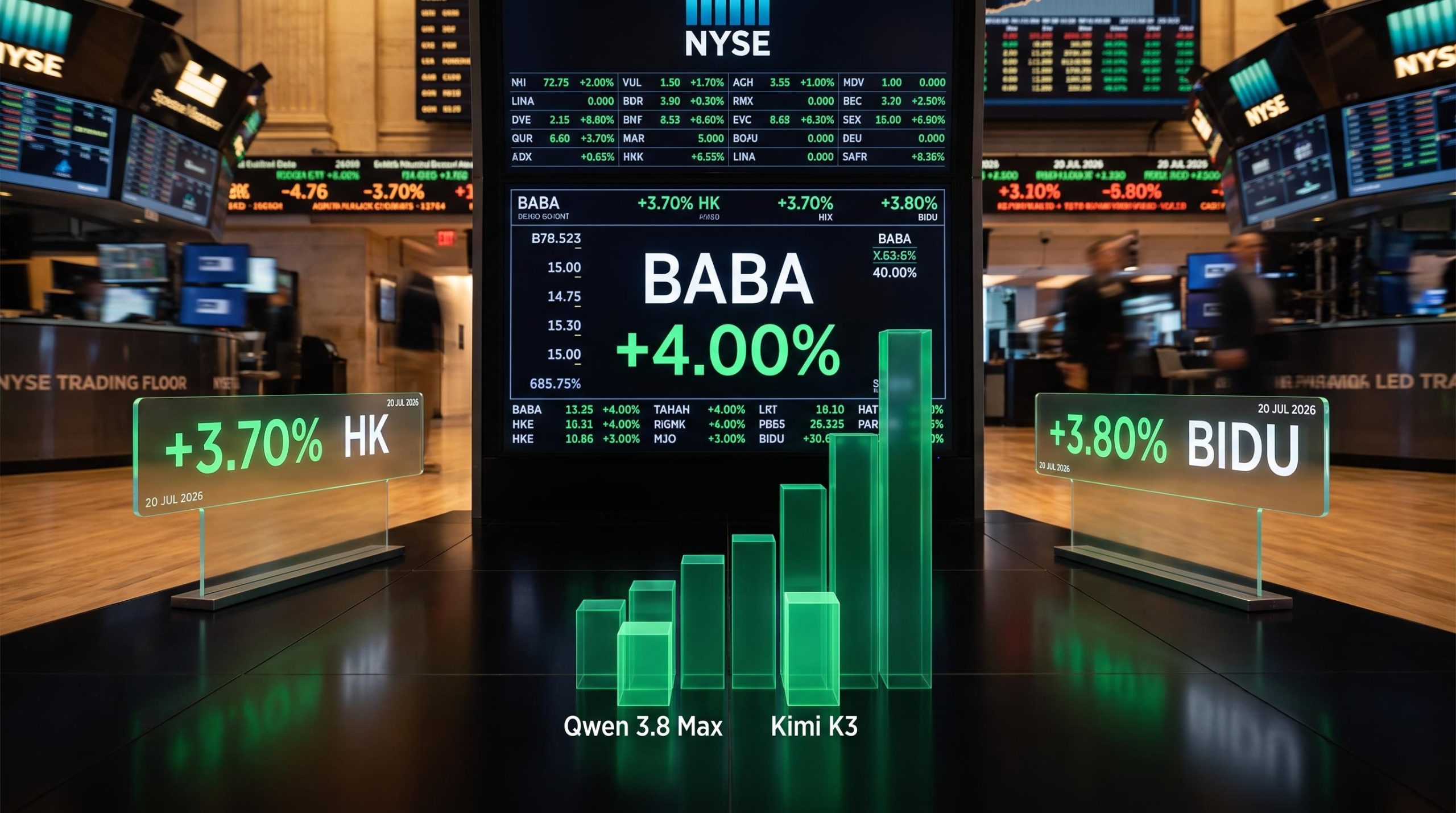
Alibaba shares climbed roughly 4% in premarket trading on 20 July 2026, and the catalyst was not a single product announcement. Two Chinese AI model launches landed on the same morning: Alibaba’s Qwen 3.8 Max and Moonshot AI’s Kimi K3. Those releases arrived alongside market reports indicating Chinese regulators had granted Apple Intelligence operational clearance in China, with Qwen reported as the powering model, and analyst calls from Citi and Bank of America identifying Alibaba as the standout beneficiary of a structural shift in how enterprises buy AI.
This is not an isolated pop. Since DeepSeek’s January 2025 market event, strong Chinese model releases have repeatedly rotated investor capital from Asian semiconductor hardware into Chinese AI platform equities. Today’s dual launches are being read the same way: as ecosystem-level validation, not a single company’s marketing moment.
Here is what actually drove the move, what the analyst thesis says about whether the tailwinds last, and the competitive risk the bull case does not always surface.
What moved Alibaba today: two model launches, one clear market read
Two separate Chinese AI model releases ahead of the NYSE open on 20 July 2026 set the tone for the session. Alibaba’s Qwen 3.8 Max and Moonshot AI’s Kimi K3 landed within hours of each other, and analysts read them together as a sector-level signal rather than two isolated product launches.
The price reaction told the same story:
- Alibaba NYSE-listed shares: approximately 4% higher in premarket
- Alibaba Hong Kong-listed shares: as much as 3.7% higher during Monday’s session
- Baidu shares: approximately 3.8% higher in premarket
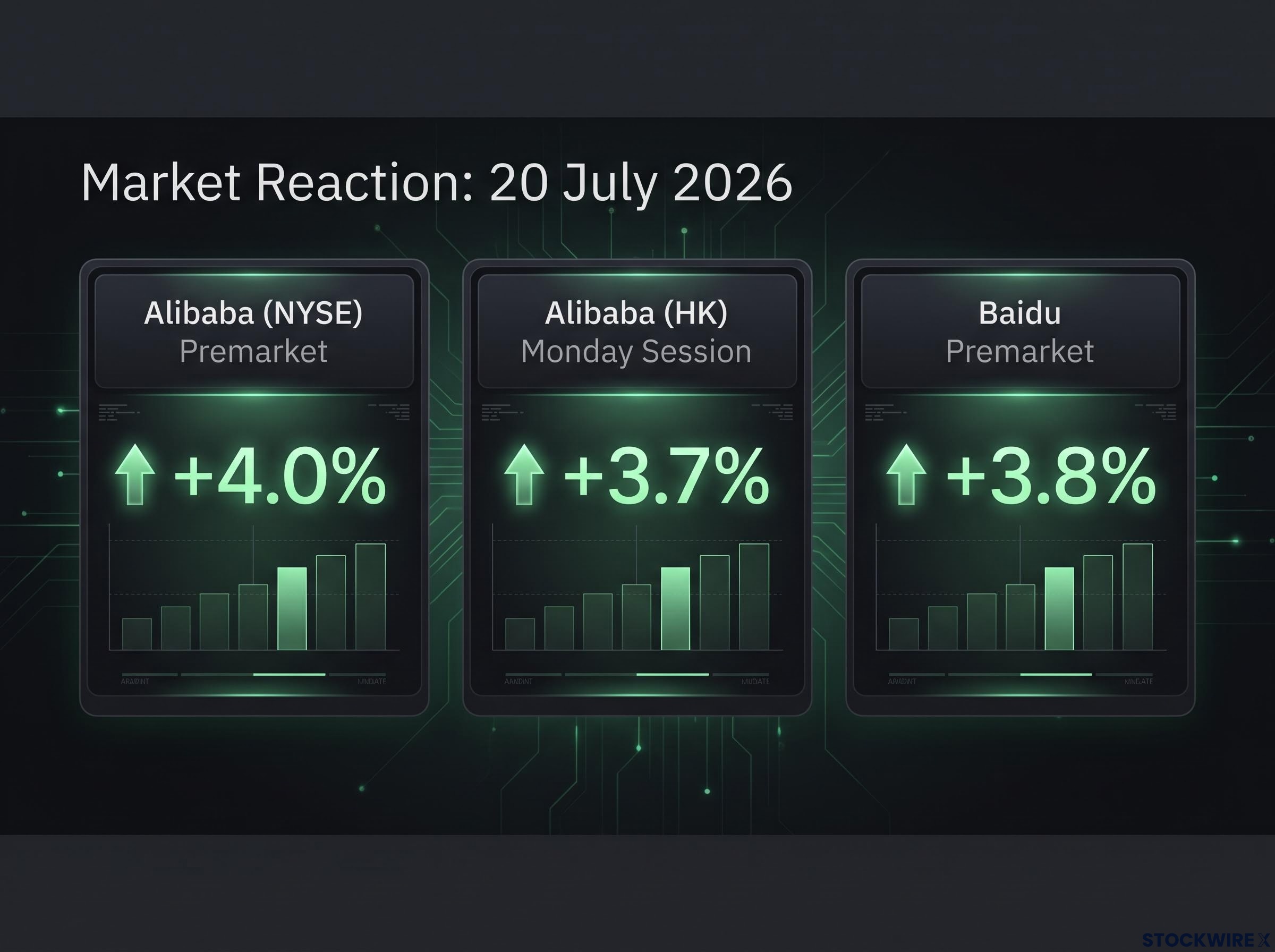
The simultaneous advance across Alibaba and Baidu tells you this is sector rotation playing out in real time, not a single-company event. The dynamic fits a recurring sequence that has been visible since DeepSeek’s January 2025 release: each time a credible Chinese model lands, capital shifts away from Asian hardware names and into Chinese AI platform stocks. That recurring dynamic is what makes the underlying thesis worth examining rather than dismissing as noise.
When big ASX news breaks, our subscribers know first
What Qwen 3.8 Max and Kimi K3 actually delivered
Qwen 3.8 Max: what independent testing confirmed
Independent enterprise-focused testing confirmed that Qwen 3.8 Max delivers significantly better multi-agent coordination, higher citation accuracy on long regulatory documents, and faster time-to-first-token compared to Alibaba’s prior Qwen 3.7 Max. Evaluations explicitly measured cloud-relevant performance traits, including latency under load and GPU memory efficiency, which matters because it shows Alibaba is engineering Qwen to run efficiently on its own infrastructure.
What is not independently validated: Alibaba’s self-reported figure of 2.4 trillion parameters and its own assertion that the model ranks second worldwide, trailing only Anthropic’s Claude Fable 5. Those are vendor claims. The verified performance improvements are the durable signal for investors; the self-reported rankings require external corroboration before they should drive conviction.
Kimi K3: near the frontier, built for enterprise workloads
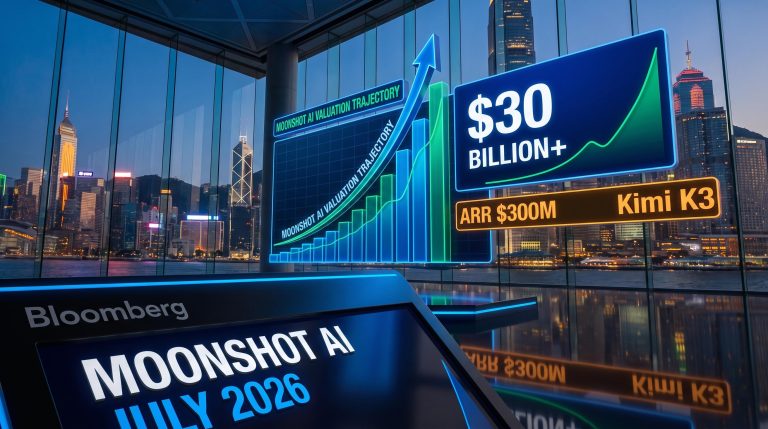
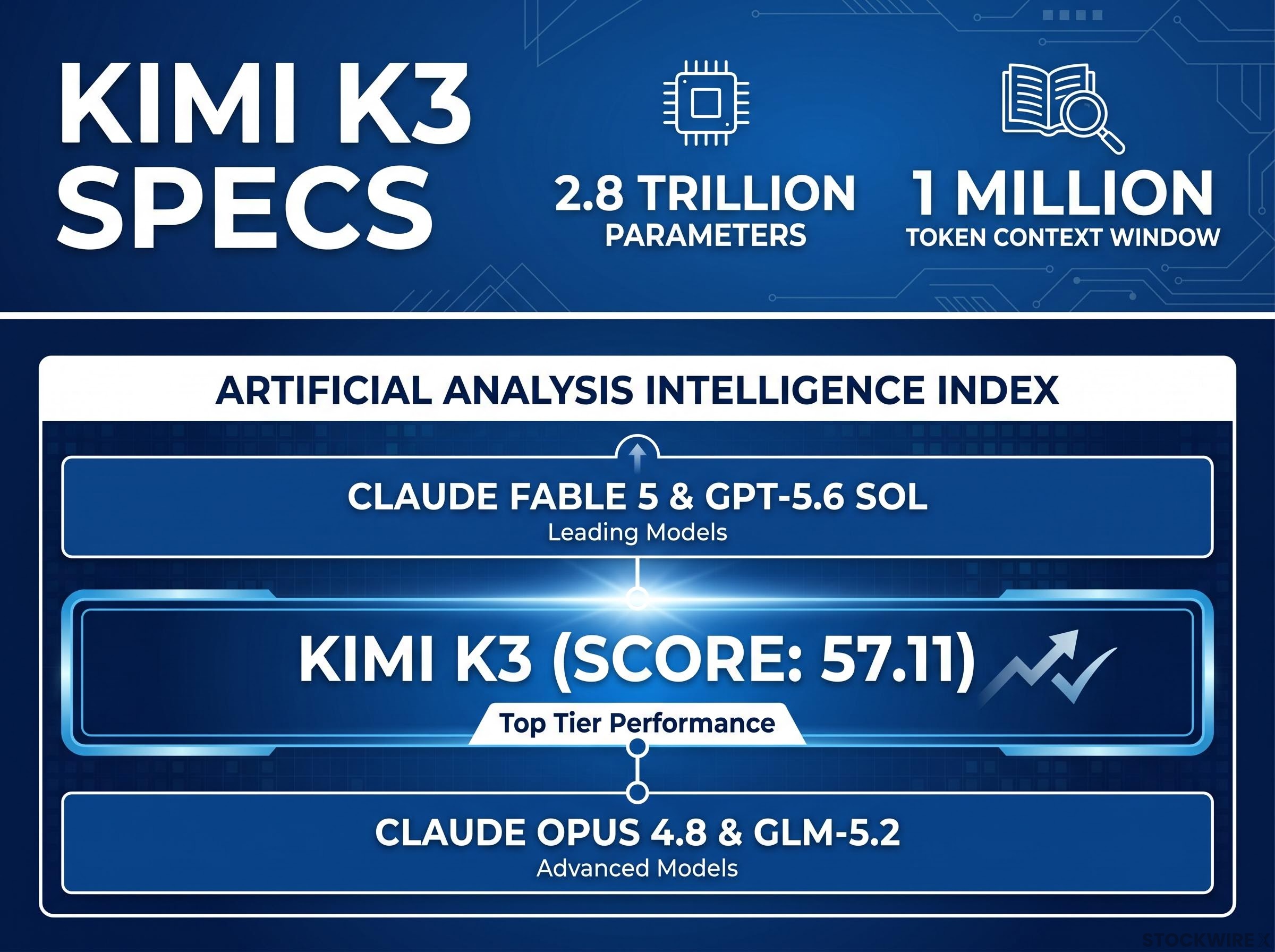
Moonshot AI’s Kimi K3 carries 2.8 trillion parameters, ships as an open-weight release, and supports a context window of 1 million tokens. Its Artificial Analysis Intelligence Index score of approximately 57.11 places it narrowly below Claude Fable 5 and GPT-5.6 Sol, while outranking Claude Opus 4.8 and GLM-5.2. In blind Arena testing it took top honours on front-end web development tasks and posted strong results across software engineering and agentic workloads.
Morgan Stanley analyst Gary Yu characterised Kimi K3 as the product of patient, incremental work rather than a sudden leap, framing it as evidence of how far China’s broader AI model ecosystem has advanced through sustained effort.
That framing matters. K3 is evidence of an ecosystem maturing, not a single company getting lucky with one model.
Kimi K3’s entry into the Chinese AI frontier follows a pattern Bernstein analysts characterised as confirmatory rather than isolated, the third successive Chinese model milestone after DeepSeek V3 and GLM-5.2 within roughly eight months, a sequence that has systematically compressed the performance gap between domestic and Western frontier models.
Why Alibaba’s cloud infrastructure is the real structural bet
The structural argument for Alibaba does not depend on Qwen winning any particular benchmark. Alibaba Cloud captures AI-related spending whether Qwen is the model enterprises choose or not, because any organisation deploying AI at scale needs cloud infrastructure to run it.
Citi argued that rapid model iteration is pushing enterprises toward multi-model procurement, selecting tools by capability and price per task rather than committing to a single vendor, and that businesses with integrated stacks covering chips, cloud, models, and applications are best placed to capture that shift, with Alibaba cited as a prime example. The logic is straightforward: as enterprises adopt multiple AI models simultaneously, selecting based on capability and cost per task, integrated platform providers capture value at the infrastructure layer regardless of which model wins on a given benchmark.
Enterprise AI deployment preference in China has been consolidating rapidly around Alibaba, with a Morgan Stanley survey of 60 Chinese CIOs showing its share rising 9 percentage points in a single cycle while DeepSeek collapsed from 33% to 18%, a shift that predates today’s model launches and provides the structural enterprise context behind Citi’s multi-model procurement thesis.
Alibaba Cloud’s AI revenue growth reached 38% in the January-March 2026 quarter, driven by enterprise AI adoption, with the company targeting more than $100 billion in annual AI and cloud revenue within five years, a trajectory that makes the cloud infrastructure argument structurally significant rather than speculative.
Independent evaluations of Qwen 3.8 Max reinforce this thesis. By measuring latency under load and GPU memory efficiency, those tests show Alibaba is deliberately designing Qwen to run efficiently on its own cloud. That tightens the model-to-cloud flywheel: a better-performing model on Alibaba Cloud attracts enterprise workloads, which generates cloud revenue independent of model licensing.
For investors evaluating whether today’s move reflects durable value rather than a one-day reaction, the cloud infrastructure argument is the part of the thesis that does not depend on Qwen maintaining any particular ranking. Three metrics make it trackable:
- AI-related cloud revenue growth in quarterly earnings
- GPU capital expenditure trajectory
- Qwen usage metrics disclosed inside Alibaba Cloud
The Apple distribution channel and what the regulatory clearance means
The Apple angle has a confirmed foundation and a more recent development that warrants careful framing.
In 2025, Alibaba and Apple publicly agreed to collaborate on on-device AI in China, with Qwen-based models adapted to run on Apple’s neural engines. The announcement was significant enough to move Alibaba’s share price at the time.
According to market reports, Chinese authorities approved Apple Intelligence for operation in China in the middle of July 2026, with Alibaba’s Qwen named as the model underpinning the domestic experience. This specific regulatory milestone and final model confirmation have not been independently corroborated beyond original reporting, so investors should treat it as a continuation of the well-evidenced 2025 partnership rather than a confirmed new catalyst.
The Apple Intelligence regulatory clearance, granted by the CAC on 15 July 2026, positions Alibaba’s Qwen at the operating system level across iOS, iPadOS, macOS, and visionOS, though no rollout timeline has been announced and the gap between approval and active deployment remains unresolved.
If the reports prove accurate, Apple hands Alibaba a consumer distribution channel of a scale that its enterprise business alone cannot match, reaching tens of millions of device users who sit entirely outside its existing customer base. The revenue impact, however, is uncertain and likely back-loaded.
The Apple angle is the part of today’s move most likely to be based on partially confirmed information. It is a meaningful optionality signal rather than a crystallised revenue catalyst, and position sizing should reflect that distinction.
The open-source risk: how Kimi K3 pressures Qwen’s pricing power
The same model launches that validate the Chinese AI ecosystem also create a competitive problem for Alibaba’s Qwen.
Bank of America observed that although Alibaba’s cloud division positions the company as a broad beneficiary of AI expansion, the open-source nature of Qwen leaves it exposed to sharpening rivalry from domestic peers. The specific mechanism is worth understanding: Kimi K3’s open-weight, per-task cost-efficient positioning compresses the moat around proprietary Chinese models, potentially pressuring Qwen’s pricing power even as Alibaba Cloud benefits from the broader ecosystem’s growth.
| Kimi K3 as ecosystem validator (positive for Alibaba) | Kimi K3 as pricing moat compressor (risk for Qwen) |
|---|---|
| Demonstrates Chinese open-weight models can approach Western frontier quality on complex tasks | Open-weight availability (approximately one to two weeks post-launch, later July 2026) lets enterprises run K3 on any cloud |
| Raises enterprise confidence in the domestic AI ecosystem, driving more cloud workloads to providers like Alibaba | Per-task cost efficiency relative to Western frontier models pressures Qwen’s pricing on comparable workloads |
| Supports Citi’s multi-model procurement thesis, which structurally favours integrated platforms over pure model vendors | Reduces partner exclusivity if enterprises can substitute K3 for Qwen on specific tasks without switching cloud providers |
The open-source risk is not a reason to dismiss the Alibaba bull case. It is the variable that determines whether Qwen generates durable model-level margins or becomes primarily a distribution tool for driving cloud adoption.
Open-weight model commoditisation has repeatedly compressed frontier pricing within 6-12 months of a closed-source release, a structural pattern that pressures the revenue assumptions behind large AI infrastructure commitments and makes the model-to-cloud flywheel, rather than model licensing itself, the more defensible source of platform-level margin.
What investors should watch to know if today’s thesis is holding
The analyst consensus as it stands today: Citi and Bank of America both frame Alibaba as a beneficiary of the multi-model enterprise era, with cloud infrastructure as the durable moat and the Apple partnership as meaningful optionality. Neither view discounts the open-source competitive pressure on Qwen itself.
Four signals will confirm or complicate this thesis over the coming quarters:
- AI-related cloud revenue growth in Alibaba’s next earnings report, specifically whether enterprise AI workloads are translating into measurable cloud revenue acceleration
- Qwen usage metrics disclosed by Alibaba Cloud, which would indicate whether the model-to-cloud flywheel is tightening or whether enterprises are running rival models on Alibaba infrastructure instead
- Independent corroboration of the Apple Intelligence regulatory clearance and final model confirmation, which would convert optionality into a concrete distribution catalyst
- Kimi K3’s open-weight market impact following its full public release later in July 2026, specifically whether it pressures Qwen’s per-task pricing or expands the total addressable market for Chinese AI cloud workloads
Today’s move reflects real structural developments. The gap between a valid thesis and a validated investment position depends on these observable metrics, not on model benchmark rankings alone. Investors who anchor to the data points above are better positioned to distinguish a durable re-rating from a rotational trade that reverses when the next leaderboard shifts.
This article is for informational purposes only and should not be considered financial advice. Investors should conduct their own research and consult with financial professionals before making investment decisions.