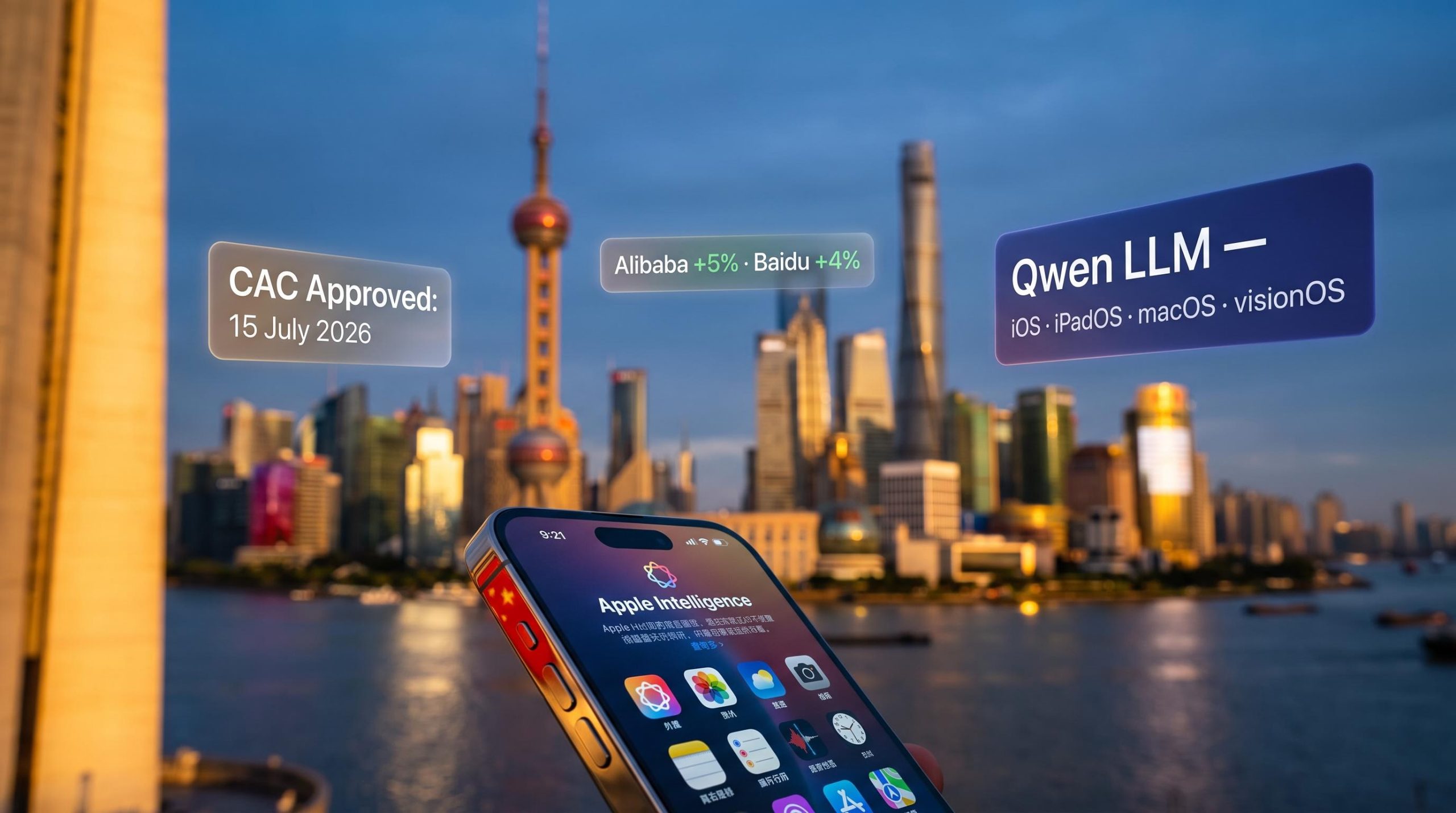
After more than two years of exclusion from China’s AI-enabled smartphone market, Apple has received regulatory clearance from Beijing to deploy Apple Intelligence on Chinese iPhones. Alibaba and Baidu are the named domestic partners.
The Cyberspace Administration of China (CAC), the body that governs generative AI service approvals in the country, listed Apple Intelligence among approved services on 15 July 2026. The clearance removes the single most visible competitive disadvantage Apple faced against Huawei and other domestic rivals in a market where AI features have become the primary battleground for premium smartphone share.
Here is what the approval does, and does not, change for the three companies most directly affected: how the partnership is structured, why Alibaba and Baidu shares moved immediately, and what still has to happen before a single Chinese iPhone user sees anything different on their screen.
What Beijing’s approval actually covers
The CAC formally listed Apple Intelligence among approved generative AI services on 15 July 2026, following Apple China’s completion of its regulatory filing on or around 8 July 2026. The approval covers iOS, iPadOS, macOS, and visionOS. It was publicly reported approximately 16 July 2026.
That is the good news. The qualifier is that regulatory approval is an entry ticket, not a launch date.
Apple must still complete security assessments, localise features for Chinese content regulations, and deliver OS updates before anything goes live. No official rollout timeline has been set by either Apple or the CAC. The competitive gap with Huawei and domestic rivals has narrowed on paper, but the distance between “approved” and “active on your phone” remains open, and for investors pricing in an immediate sales impact, that distinction matters.
| Date | Event |
|---|---|
| ~8 July 2026 | Apple China completes regulatory filing with the CAC |
| 15 July 2026 | CAC officially lists Apple Intelligence among approved generative AI services |
| ~16 July 2026 | Approval publicly reported; Alibaba and Baidu shares rise |
| TBD | Security assessments, feature localisation, and OS updates |
| No date specified | Full rollout to Chinese users |
When big ASX news breaks, our subscribers know first
The two-partner structure Apple agreed to build
The partnership is not a simple licensing deal. It is an architecture, and the division of roles tells you which company carries the greater commercial upside.
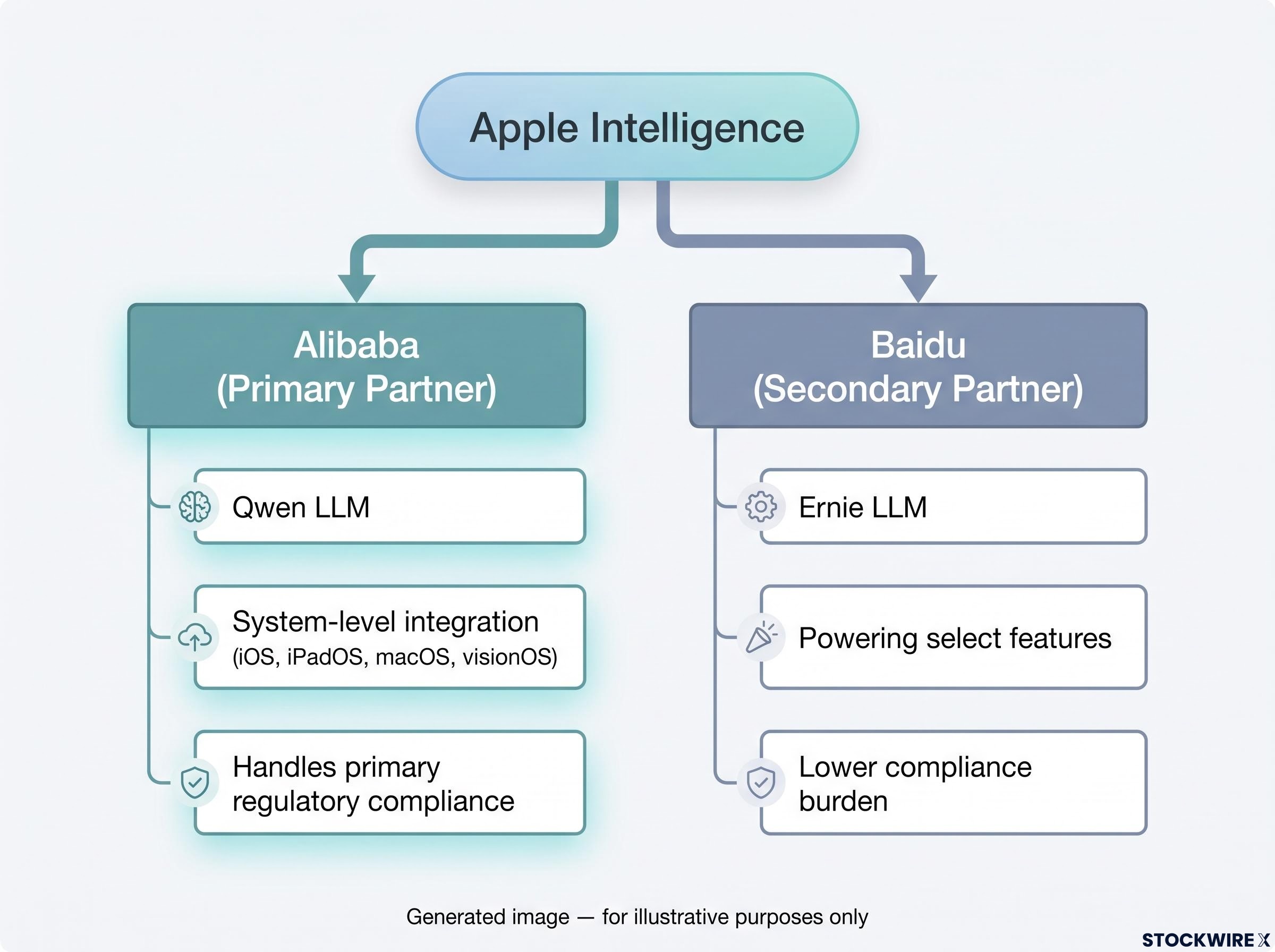
Alibaba’s Qwen large language model (LLM), a type of AI system trained to understand and generate text, is the primary engine powering Apple Intelligence across all four platforms: iOS, iPadOS, macOS, and visionOS. That is system-level integration, meaning Qwen is embedded in the operating system itself. Users access its capabilities directly within Apple’s interface without switching to a separate app. Alibaba also handles primary compliance requirements under the arrangement, which is a significant reason the regulatory pathway worked.
Baidu occupies a secondary role. Its Ernie LLM will power specific Apple Intelligence features, though the exact scope of those features remains unconfirmed.
- Alibaba (primary partner): Qwen LLM integrated at the operating system level across iOS, iPadOS, macOS, and visionOS. Handles primary regulatory compliance.
- Baidu (secondary partner): Ernie LLM powering select features. Specific scope unconfirmed. Lower compliance burden.
The system-level positioning of Qwen is the detail that separates this from a typical app partnership. Alibaba is not competing in an app store; it is built into the device. For investors weighing these two stocks, that distinction shapes the scale of the commercial opportunity each company is actually capturing.
Alibaba’s enterprise AI position was already consolidating well before the Apple partnership: a Morgan Stanley survey of Chinese CIOs placed Alibaba at 41% deployment preference, up 9 percentage points in a single survey cycle, underscoring the structural momentum behind Qwen’s expansion into Apple’s device ecosystem.
Why China’s AI approval process is this difficult to navigate
The CAC governs which generative AI services can operate in China. Foreign companies face a structurally harder path than domestic firms because they must partner with approved domestic AI providers, submit to content compliance frameworks, and accept ongoing security assessments as conditions of continued operation.
China’s Generative AI Measures, which came into effect in August 2023, mandate security assessments, algorithm registration, and content review for all providers of generative AI services in the country, with foreign firms typically required to maintain separate China-specific models, datasets, and governance processes as conditions of operation.
How selective is the process? Consider the numbers.
Only two foreign AI services have received CAC approval: Apple Intelligence and Samsung’s Galaxy AI.
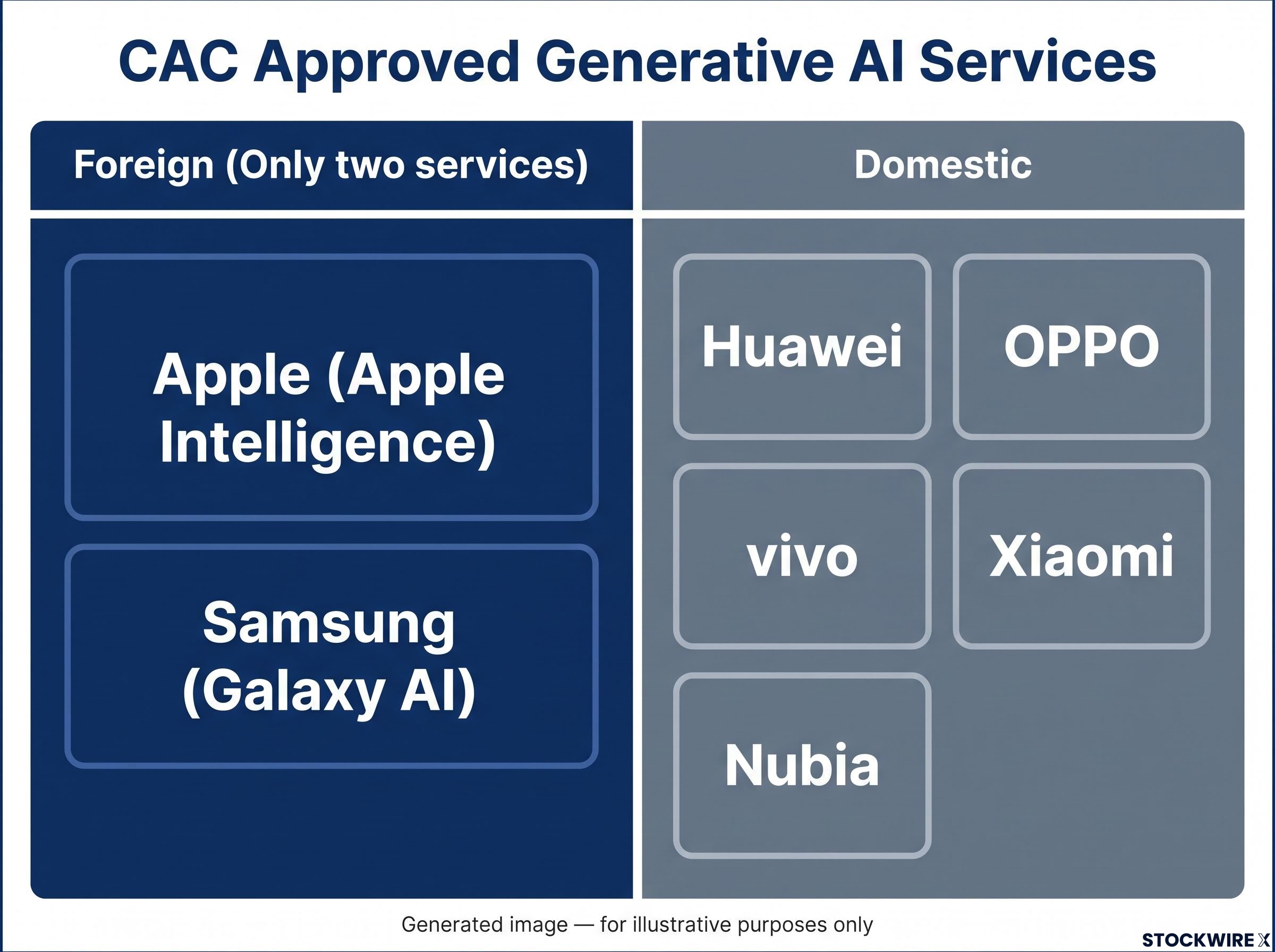
The full approval list alongside Apple includes a mix of domestic and foreign names:
- Foreign: Apple (Apple Intelligence), Samsung (Galaxy AI)
- Domestic: Huawei, OPPO, vivo, Xiaomi, Nubia
For readers watching other Western technology companies eyeing China’s AI market, the rarity of the clearance is precisely what makes Apple’s position in it commercially valuable. This is not a liberalised market. It is a carefully managed one, and the requirement to partner with domestic AI providers is a structural condition, not a temporary hurdle. Any foreign company that wants to activate AI features in China faces the same framework.
How Alibaba and Baidu shares responded, and why
The market response was immediate.
Alibaba posted a gain of close to 5%; Baidu advanced by around 4%.
The gains are not headline noise. They reflect a specific investor logic: system-level integration into Apple’s device ecosystem gives both companies a distribution channel they could not replicate independently. Hundreds of millions of Chinese iPhone users represent a potential audience for Qwen and Ernie that neither model could reach through app downloads alone.
The gap between Alibaba’s larger gain and Baidu’s slightly smaller move maps directly onto their roles. Alibaba is the primary model provider with operating-system-level embedding. Baidu has meaningful but narrower exposure in a secondary capacity.
For investors in either stock, the share movements are the market pricing a durable distribution advantage, not a single-day headline. The question that follows is whether the partnership translates into measurable model adoption data and revenue once features go live. Until activation happens, the gains reflect expectation, not confirmation.
The template this deal sets for foreign technology companies in China
Lift the lens from Apple specifically and a broader pattern comes into focus. The partnership structure follows a three-part model that other foreign technology firms will study closely:
- Foreign company provides the device interface and user-facing experience.
- Domestic partner supplies the AI model that powers the features.
- Domestic partner handles regulatory compliance with the CAC framework.
Apple CEO Tim Cook had previously identified the China AI gap as a competitive issue. The solution his company arrived at required meaningful commercial and data concessions: the AI engine powering Apple Intelligence in China is not Apple’s own, and the compliance responsibility sits with the domestic partner. That is the price of market access.
iPhone shipments reportedly increased 24.4% year-over-year in Q2 2026, though this figure has not been independently verified in primary sources. If accurate, it suggests the competitive recovery was already underway before AI features arrived, which makes the approval a potential accelerant rather than a rescue.
Apple’s Q2 2026 earnings confirmed record iPhone revenue of $56.99 billion alongside a 24.4% year-over-year shipment gain in China, establishing the competitive baseline against which any AI-driven acceleration will be measured once features go live.
For readers watching the broader U.S.-China technology relationship, this deal is evidence that commercial pragmatism continues to create pathways even when the geopolitical environment is adversarial. The terms of those pathways, however, increasingly favour Chinese regulatory requirements.
What has to happen before Chinese iPhone users see anything change
The approval is real. What remains is implementation, and the list of outstanding steps is not short:
- Security assessments by Chinese authorities
- Feature localisation for Chinese language and cultural context
- Content regulation compliance adaptation
- OS updates to deliver the features to devices
Apple has not specified a launch date. The CAC has not set one either. Apple Intelligence was absent from Chinese iPhones for over two years before this clearance, and every additional month of delay carries competitive cost: Huawei and domestic rivals have already embedded AI features into their devices and are iterating.
The absence of a launch date is the variable investors should watch most closely. Until Apple announces a rollout timeline, the approval’s commercial impact on iPhone sales in China remains theoretical rather than measurable.
China AI market timing is a recurring analytical problem: 47% of Chinese CIOs in a Morgan Stanley survey are targeting 2027 for initial AI project rollouts, a finding that adds structural context to why Apple’s absence of a launch date may cost less in the immediate term than the competitive narrative suggests.
This article is for informational purposes only and should not be considered financial advice. Investors should conduct their own research and consult with financial professionals before making investment decisions.
What the approval changes, and what still has to be proven
The clearance ends a two-year exclusion. Apple gets a competitive lifeline in its second-largest market. Alibaba gets system-level AI distribution it could not buy through any other channel. Baidu gets incremental exposure at lower risk.
The genuine uncertainty sits between approval and activation. Whether this clearance translates into the recovery Apple needs depends on execution decisions that have not yet been made public. Three variables will determine the outcome:
- Rollout timeline: When Apple announces a launch date, the commercial clock starts.
- Feature scope: Whether Chinese Apple Intelligence reaches parity with the global version, or ships with a narrower set of capabilities.
- Competitive response: How Huawei and domestic rivals adjust their AI feature roadmaps in response.
The regulatory barrier is cleared. The commercial case now depends entirely on how fast, and how completely, these three companies turn a filing into a product.
Apple’s services revenue trajectory, rather than near-term iPhone unit volumes, is where analysts expect the measurable financial signal from China AI activation to eventually appear, with the 2027-2028 reporting periods representing the earliest window for confirmation.
Forward-looking statements in this article are speculative and subject to change based on market developments and company performance.