Most investors searching for guidance on how to prepare for a financial crisis are looking for the same thing: a signal to act on before the next crash arrives. The instinct is understandable. Financial crisis histories are widely documented, and the lesson they appear to teach is simple: get out before the fall. Yet that instinct, applied as a timing strategy, is precisely what destroys long-run returns. With AI-driven markets attracting concentrated capital flows, systemic debt levels elevated globally, and narrative momentum building across multiple sectors in 2026, the tension between pattern recognition and disciplined preparation has rarely been more relevant. This guide offers a different approach: a four-question diagnostic framework and a periodic self-assessment checklist designed to convert crisis awareness into a concrete preparation discipline, not a prediction-and-exit strategy.
Why crisis pattern recognition almost never translates into better timing
Subprime mortgage risk was publicly discussed as early as 2005. Analysts flagged deteriorating lending standards, rising default probabilities, and structural fragility in securitised debt markets. The S&P 500 kept climbing through 2006 and 2007, reaching its pre-crisis peak in October 2007. The gap between “visible risk” and “priced-in risk” spanned more than two years.
This is not an anomaly. It is the norm. Structural warning signs and rising markets coexist for extended periods across nearly every major crisis episode on record.
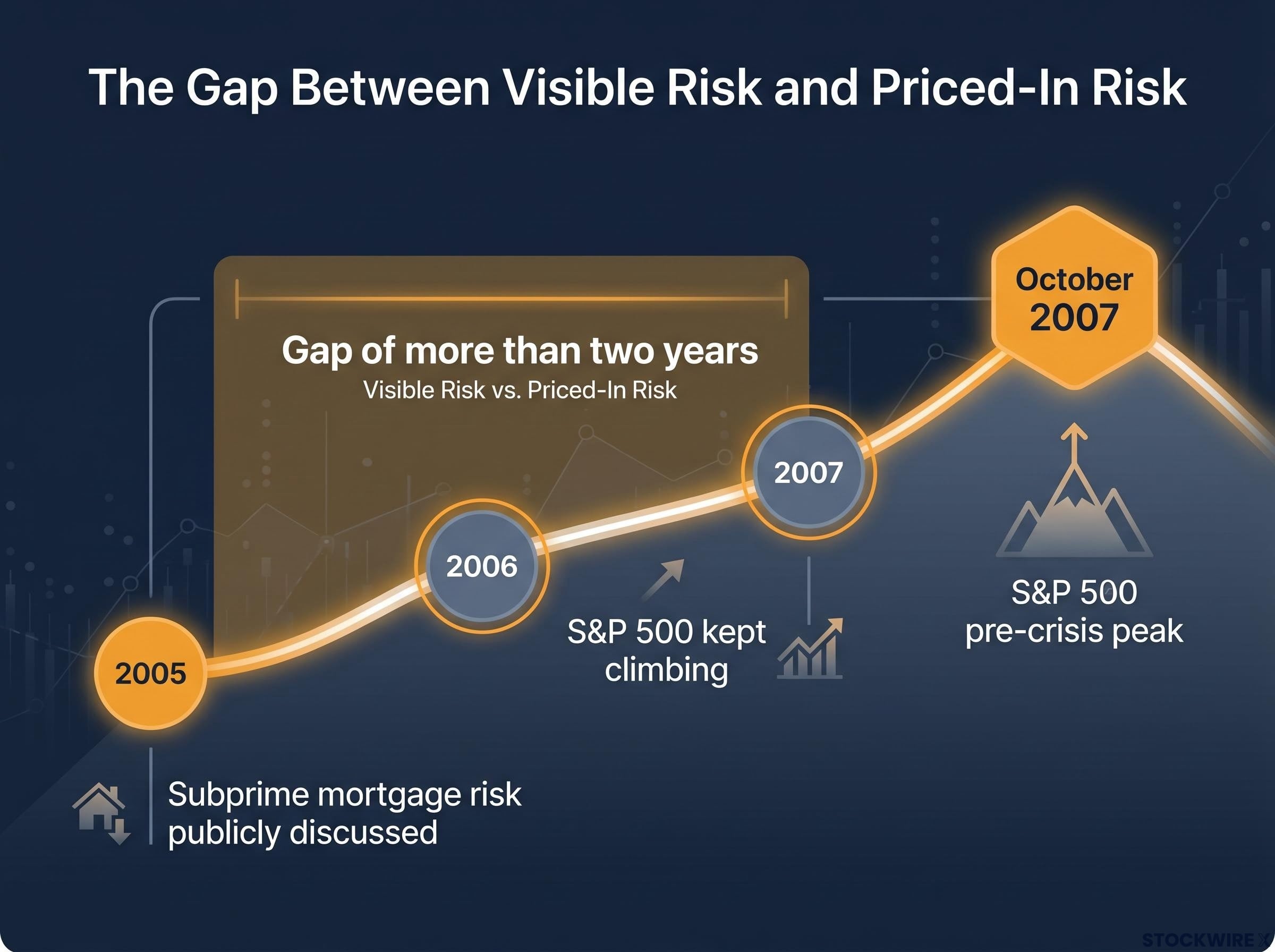
Visible structural risks and rising markets frequently coexist for years. Recognising the risk tells investors little about when it will be fully priced in.
Even if an investor correctly identifies a building risk, successful market timing requires executing every step in a fragile sequence:
- Exit positions early enough to avoid the worst of the decline
- Hold cash through a period of rising markets that punishes caution
- Re-enter near the bottom, with no clear signal that the bottom has arrived
- Repeat this consistently across multiple cycles
Missing any single step in that chain typically leaves investors worse off than a simple, fully invested strategy over a full market cycle. Research from major financial education institutions, including Schwab and others, consistently documents that staying invested outperforms ad-hoc timing attempts over complete cycles.
The cost of crash protection strategies is measurable and persistent: the traditional 60/40 portfolio lagged the S&P 500 by approximately 14 percentage points in 2024, illustrating that defensive positioning carries a real annual drag that compounds across the same multi-year periods investors are trying to protect against.
Vanguard research on staying invested over a 37-year period from 1988 to 2024 documents the compounding cost of missing even a small number of the market’s best days, with investors who attempted to time exits consistently underperforming those who held through full cycles.
None of this is a counsel of ignorance. Pattern recognition is genuinely useful. It simply serves a different purpose than most investors assume: it informs preparation, not timing.
When big ASX news breaks, our subscribers know first
What crisis history actually teaches: preparation over prediction
If crisis literacy does not reliably improve timing, what does it improve? The answer is the quality of the plan investors bring to volatility before it arrives.
Crisis history is most valuable when it informs a written Investment Policy Statement (IPS), a document that captures the investor’s target allocation, risk boundaries, rebalancing rules, and liquidity plan before markets become stressful. The diagnostic questions introduced later in this guide are designed as prompts to review that IPS, not as overrides for it.
A written IPS typically covers:
- Target allocation across asset classes, aligned with genuine risk tolerance and time horizon
- Risk limits that define how far the portfolio can drift before rebalancing is triggered
- Rebalancing rules that specify when and how to return to target weights
- A liquidity plan that ensures near-term cash needs are funded regardless of market conditions
The historical pattern reinforces why this matters. Every major innovation cycle, railways, electrification, the internet, financial engineering, crypto, and now AI, has attracted capital, narrative momentum, and periodic dangerous overconfidence. The investors who fared best across those episodes were not the ones who predicted the turning point. They were the ones who entered the downturn with a plan that prevented them from becoming forced sellers at the worst possible moment.
The goal is to be a prepared investor who can hold through volatility and benefit from recovery, not one who crystallises losses at the bottom.
Assessing your portfolio’s crisis readiness
The four questions below are not a one-time audit. Each functions as a lens that sharpens with repeated use across different market environments. A “yes” to any question should trigger a review of the IPS and preparation posture, not a trade.
Question 1: Are there early signs of funding market or credit stress?
For non-specialists, these signals fall into two categories. Plumbing stress refers to strain in funding and repo markets, where institutions borrow short-term to finance longer-term positions. Risk premium spikes refer to widening credit spreads, particularly in the sector driving the prevailing narrative.
- The question: Are funding markets showing signs of strain, or are credit spreads widening in the leading sector?
- Historical signal: Repo market disruptions and commercial paper strain preceded the acute phase of the 2008 crisis by months.
- Portfolio implication: Verify that near-term cash needs are funded and that riskier positions are ones that can be held through a full cycle.
Question 2: Are leveraged institutions heavily exposed to the same trade?
Crises become systemic when banks, insurers, and shadow banks load up on the same asset class, often funded with short-term borrowing. The image is concrete: dozens of institutions holding the same kind of mortgage bond, all funded overnight.
- The question: Are systemically important financial institutions visibly leaning into the same trade, often with leverage?
- Historical signal: Institutional herding into subprime-linked securities amplified what could have been a contained housing correction into a global financial crisis.
- Portfolio implication: Assume that the prevailing institutional trade can contaminate assets that appear unrelated during a stress event.
Institutional herding signals are currently unusually concentrated: the May 2026 BofA Fund Manager Survey recorded the largest single-month equity allocation surge ever measured, a 37-percentage-point jump to a net 50% overweight, with long global semiconductors identified as the most crowded trade at 73% conviction, exactly the configuration that diagnostic question two is designed to detect.
Question 3: Are systemic debt levels high or rising?
Rising systemic debt shrinks the financial system’s margin of safety. When that margin narrows, the appropriate response is to widen personal margins: less leverage, more liquidity.
- The question: Are public and private debt levels elevated or increasing relative to historical norms?
- Historical signal: Pre-crisis periods consistently feature rising leverage that compresses the system’s ability to absorb shocks.
- Portfolio implication: Reduce personal leverage and increase liquidity so that a market downturn does not force selling at depressed prices.
The BIS analysis of debt and the financial cycle provides empirical grounding for the relationship between rising leverage and crisis severity, showing that the build-up of financial vulnerabilities across public and private sectors reliably compresses the system’s capacity to absorb subsequent shocks.
Question 4: Is a major untested innovation dominating return expectations?
Not every major innovation constitutes a speculative bubble. The more relevant question is whether the risks associated with an innovation are being systematically underestimated.
- The question: Is a large portion of expected returns across the market concentrated in a single untested theme?
- Historical signal: This pattern recurred with railways, the internet, financial engineering, and crypto, each attracting capital well beyond what near-term fundamentals supported.
- Portfolio implication: If more than a narrow allocation depends on one new theme working out quickly, that is concentration risk, not insight.
| Question | What it detects | Historical example | Portfolio implication |
|---|---|---|---|
| Funding or credit stress | Early institutional confidence erosion | Repo and commercial paper strain preceding the 2008 acute phase | Confirm near-term cash needs are funded |
| Institutional overexposure | Systemic spillover from leveraged herding | Banks holding subprime mortgage bonds funded with overnight borrowing | Assume contamination of “safe” assets during stress |
| Rising systemic debt | Shrinking system-wide margin of safety | Pre-2008 leverage expansion across public and private sectors | Reduce personal leverage, increase liquidity |
| Untested innovation dominance | Concentration risk from underestimated innovation risk | Internet stocks (late 1990s), financial engineering (mid-2000s) | Audit single-theme concentration |
The concrete preparation actions the framework actually points to
If one or more of the diagnostic questions flags elevated risk, the following four actions represent the practical levers available. Each can be completed this week. Each materially improves resilience regardless of whether a downturn arrives.
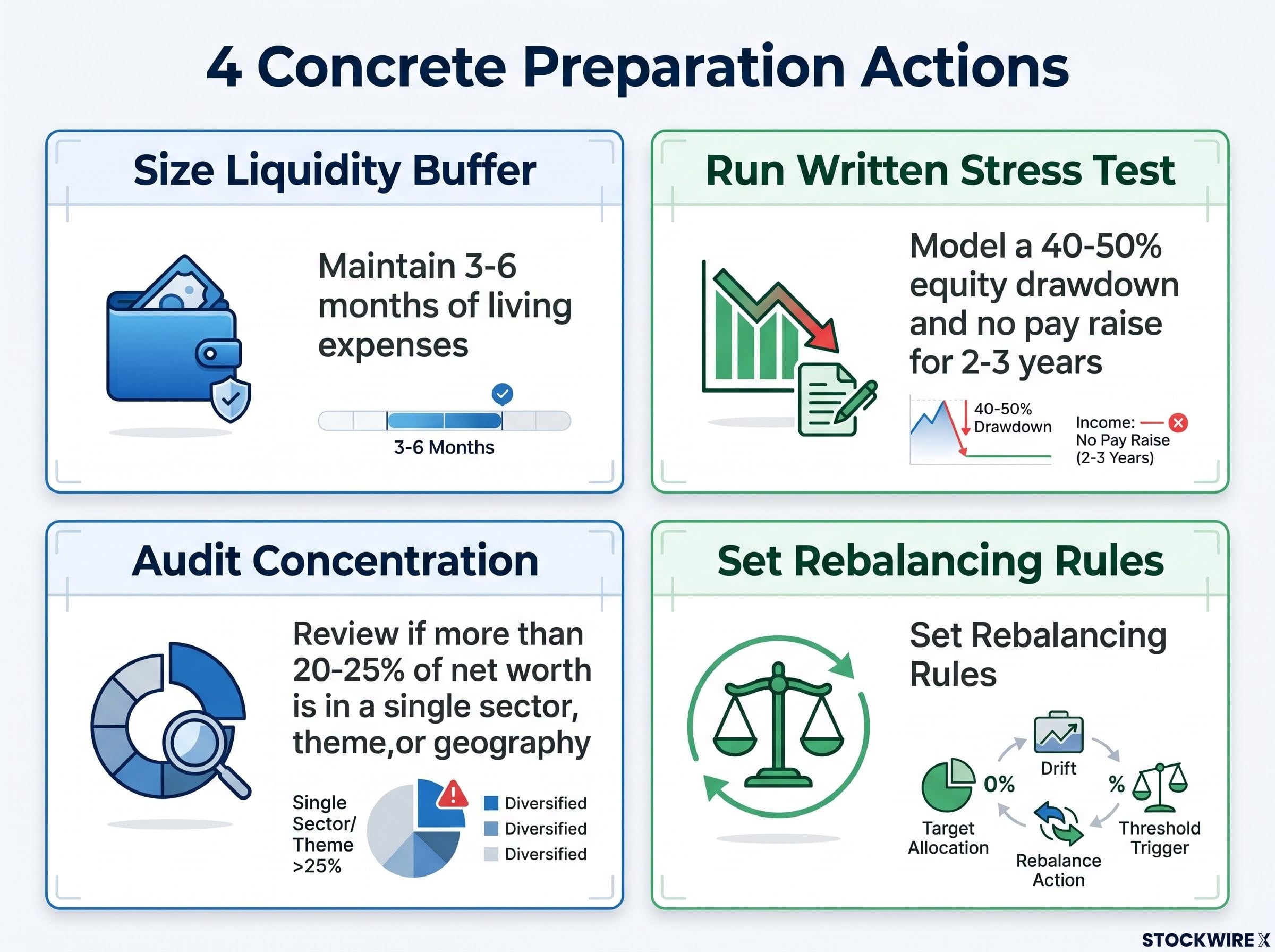
- Size the liquidity buffer. Maintain 3-6 months of living expenses in cash-like instruments. Increase this if income is variable or equity exposure is high. The buffer ensures that no market condition forces a sale at the wrong time.
- Run a written stress test. Model a simple scenario and write down the results.
Model this scenario: a 40-50% equity drawdown, no pay raise for 2-3 years, and a temporary job loss if relevant. Write down how the portfolio and household cash flow respond. The written results are the preparation; the act of writing them reduces panic-driven decisions during actual downturns.
- Audit concentration. If more than 20-25% of net worth is tied to a single sector, theme, or geography, determine whether that exposure is intentional and aligned with the IPS, or simply the result of recent performance chasing. Intentional concentration with acknowledged risk is different from accidental concentration disguised as conviction.
- Set rebalancing rules. Rules-based rebalancing back to target weights after large market moves is a low-drama method of systematically selling what has risen and buying what has fallen, without requiring anyone to call a turning point. Dollar-cost averaging offers a similarly documented, repeatable approach.
Rules-based rebalancing after large market moves functions as a systematic sell-high-buy-low mechanism that requires no forecast: Vanguard recommends a quarterly review combined with a 5% drift threshold as the rebalancing trigger, and a portfolio that has drifted from a 60% to a 70% equity weighting during a multi-year rally clearly meets that threshold before a correction arrives.
Writing these down matters. A plan that exists only as a vague intention provides little resilience when volatility arrives. A written protocol, reviewed annually, functions as a commitment device against the very instincts that destroy returns during downturns.
What 2008 shows about the difference between prepared and reactive investors
The 2008 financial crisis produced a severe market drawdown that tested every investor’s process. It also produced one of the strongest subsequent recovery periods in stock market history. The gap between those two outcomes, the drawdown and the recovery, is where preparation made the difference.
Investors who navigated 2008 well did not, as a group, predict the crash. They were simply prepared before it arrived. Three elements characterised their positioning:
- A liquidity buffer sufficient to cover near-term obligations without forced selling
- A diversified allocation aligned with their actual risk tolerance, not the risk tolerance they believed they had during the preceding bull market
- A written commitment to hold through volatility, whether formalised in an IPS or maintained as a personal investment policy
These three elements map directly to the diagnostic framework and preparation checklist presented above. The framework is not theoretical. It describes, in portable form, the exact preparation posture that distinguished investors who held through the downturn and captured the recovery from those who sold near the bottom and re-entered too late.
The recovery argument
Staying invested through the 2008 downturn positioned investors for one of the strongest recovery periods on record. The preparation framework does not promise to avoid losses. It aims to ensure that temporary losses remain temporary, rather than being crystallised into permanent ones by forced or panic-driven selling.
Crisis literacy works best as a habit, not a one-time audit
The four diagnostic questions and four preparation actions combine into an eight-question checklist designed for annual or semi-annual review. The checklist applies to any market environment, not only periods that visually resemble past crises.
What to assess in the market environment
- Is there a major, untested innovation driving a large share of current return expectations?
- Are systemically important financial institutions visibly leaning into the same theme, often with leverage?
- Are systemic debt levels high or rising relative to historical norms?
- Are there emerging signs of stress or distrust in funding or credit markets?
What to assess in the portfolio
- Is the liquidity buffer at 3-6 months or more of expenses in safe, liquid instruments?
- Could a 40-50% equity drawdown be absorbed without forced selling?
- Is the portfolio uncomfortably concentrated in the prevailing themes?
- Is the current allocation still aligned with the written IPS, or does the IPS need updating?
| Checklist question | What a “yes” means for preparation |
|---|---|
| Untested innovation dominating returns? | Review concentration; ensure exposure is intentional, not performance-chasing |
| Institutions heavily exposed with leverage? | Assume safe assets may correlate with risk assets during stress; diversify accordingly |
| Systemic debt rising? | Widen personal margin of safety: reduce leverage, increase liquidity |
| Funding or credit stress emerging? | Confirm near-term cash needs are funded; verify willingness to hold riskier positions through a full cycle |
| Liquidity buffer adequate? | If not, top it up before markets give a reason to |
| Can a 40-50% drawdown be absorbed? | If not, allocation exceeds true risk tolerance; adjust target weights |
| Concentrated in prevailing themes? | Audit whether concentration reflects conviction or drift |
| Aligned with written IPS? | If no IPS exists, write one. If it exists, confirm it still reflects current circumstances |
Running this checklist once or twice a year takes less than an hour. The discipline it builds compounds across market cycles, ensuring that preparation stays current without requiring ongoing monitoring or specialist expertise.
Prepared investors outlast the noise, and the data consistently shows it
Crisis literacy, applied as a preparation discipline rather than a prediction tool, positions investors to hold through volatility and benefit from recovery. The data across multiple market cycles supports a consistent finding: investors who entered downturns with a liquidity buffer, a diversified allocation, and a written commitment to their process emerged in stronger positions than those who attempted to time the exit and re-entry.
The most concrete starting point is the Investment Policy Statement. Investors who do not have one can begin by writing their target allocation, risk limits, rebalancing triggers, and liquidity plan on a single page. Those who already have one can run the stress-test scenario: model the 40-50% drawdown, write down the results, and confirm that the plan holds.
From there, the annual checklist sustains the habit. The goal is not to predict what comes next. It is to ensure that whatever comes next does not force a bad decision.
For readers wanting to examine whether their diversification assumptions still hold in the current rate and inflation environment, our full explainer on building portfolio resilience beyond the 60/40 framework covers how the stock-bond correlation turned persistently positive during the inflation shocks of 2022, 2025, and May 2026, and what a three-tier adaptive portfolio structure looks like in practice.
This article is for informational purposes only and should not be considered financial advice. Investors should conduct their own research and consult with financial professionals before making investment decisions. Past performance does not guarantee future results. Financial projections are subject to market conditions and various risk factors.
—