Wesfarmers has not published a single dollar figure for what its AI programme will deliver. Yet at its June 2026 investor day, the company revealed a deployment already live in Bunnings stores, a cross-divisional forecasting model led by Kmart, and a multi-year partnership with Microsoft spanning five major business units. The disclosure lands as ASX-listed retailers face rising cost pressure and intensifying competition, and as institutional and retail investors increasingly scrutinise how conglomerates translate technology spend into verifiable earnings outcomes.
What follows maps the actual architecture of Wesfarmers’ AI strategy across its retail and industrial portfolio, explains the earnings mechanisms at work in each division, and provides investors with an analytical framework to assess whether the programme is positioned to compound returns or dilute capital.
The “solve once, accelerate everywhere” model at the heart of Wesfarmers’ tech strategy
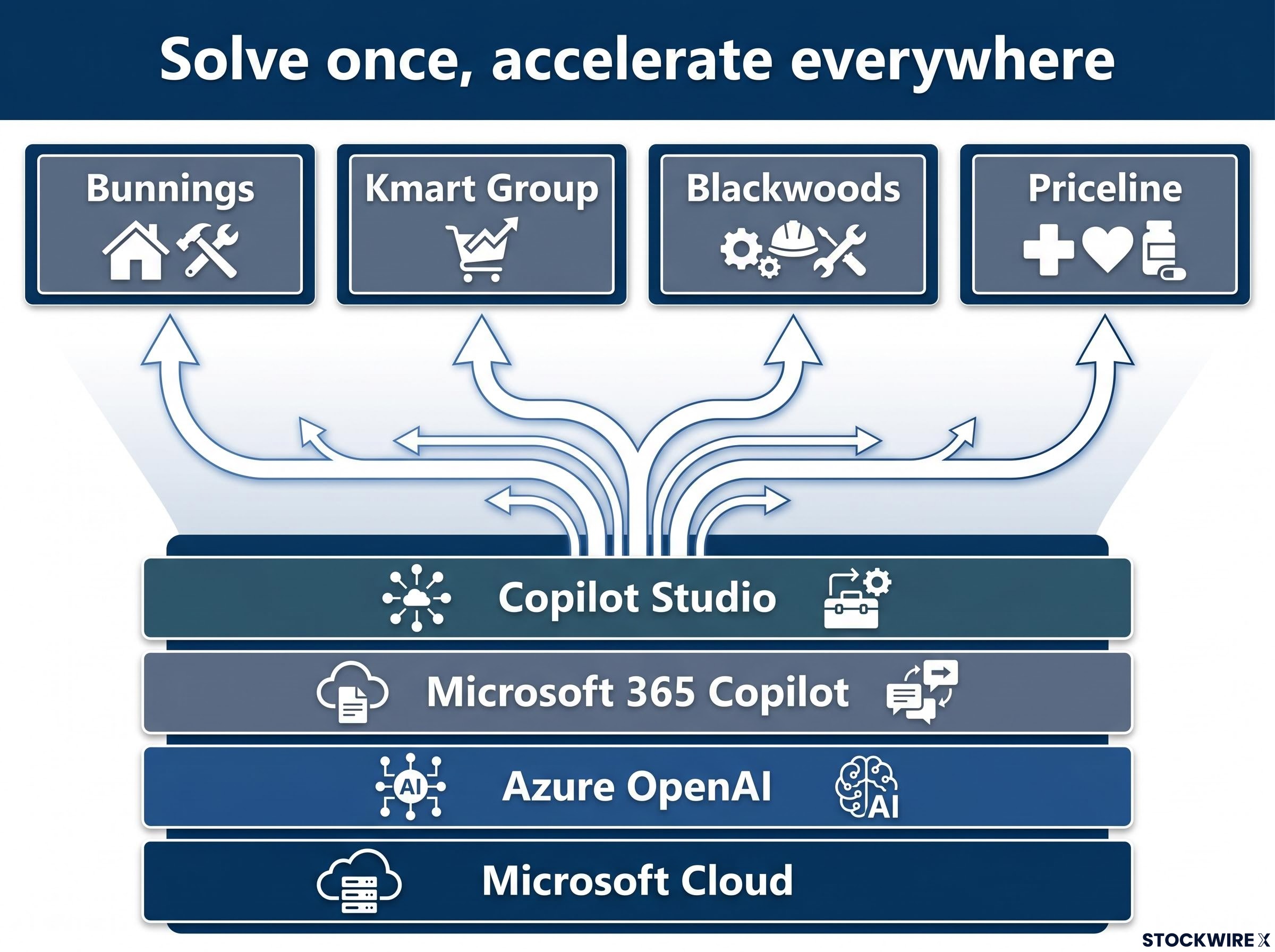
The defining feature of Wesfarmers’ AI programme is not any single tool. It is the operating model behind it: build a capability once in one division, then deploy it across the group at a fraction of the original cost. This principle, which management has described as “solve once, accelerate everywhere,” turns the conglomerate structure into a technology advantage that smaller, pure-play retailers cannot easily replicate.
The structural platform underneath this model is a multi-year strategic partnership with Microsoft, covering Bunnings, Kmart Group, Blackwoods, Priceline, and the broader Group. The partnership spans four technology layers:
- Azure OpenAI: Large language model access for custom AI applications across divisions.
- Microsoft 365 Copilot: Productivity augmentation for knowledge work, reporting, and analysis.
- Copilot Studio: Custom AI agent development for brand-specific use cases.
- Microsoft Cloud: Shared enterprise infrastructure supporting data integration and scalability.
This is not a vendor contract. It is a shared enterprise platform designed to lower the marginal cost of every subsequent AI deployment across the group.
The Microsoft partnership explicitly names Blackwoods as one of the five business units covered, which gives the Blackwoods transition into Bunnings Group, confirmed effective 1 July 2026, an added dimension for investors: the industrial and commercial supply business will migrate into a structure that shares Bunnings’ enterprise AI infrastructure, potentially accelerating capability deployment to SME customer segments without duplicating platform costs.
Why a shared platform beats brand-by-brand spending
When retailers invest in technology at the brand level, the result is typically duplicated costs and incompatible data infrastructure. Each banner builds its own forecasting model, its own data pipeline, its own integration with suppliers.
Wesfarmers’ cross-divisional model avoids this by centralising capability build while allowing brand-specific deployment. From early 2026, supply chain, technology, and data teams have been working together across divisions to identify AI use cases that can be built once and scaled. The economics are straightforward: each incremental solution carries a lower cost to deploy across the portfolio, improving the return on the underlying technology investment.
When big ASX news breaks, our subscribers know first
How supply chain AI is being built to move the earnings needle
The most earnings-visible use case in the programme is demand forecasting. Kmart has been identified as the lead division for an AI-driven forecasting tool, designed to detect demand shifts and support more informed planning decisions. Initial estimates indicate the tool can improve forecast accuracy and reduce markdown exposure, with benefits flowing through to productivity and working capital as implementation matures.
Initial Estimates The AI demand forecasting tool developed with Kmart as the lead division is estimated to improve forecast accuracy and reduce markdown exposure, with benefits extending to working capital efficiency as implementation scales.
The rollout model extends the tool’s benefits to Bunnings and Officeworks under the “solve once, accelerate everywhere” principle. Supply chain automation and digitisation projects are also underway to strengthen fulfilment capabilities across the group.
The earnings linkages are direct. Better forecast accuracy reduces the volume of inventory that must be marked down at end-of-season, protecting gross margins. Lower excess stock improves inventory turns and frees working capital. Both mechanisms flow through to higher EBIT margins without requiring top-line growth.
| Use Case | Lead Division | Earnings Mechanism | Maturity Stage |
|---|---|---|---|
| Demand forecasting | Kmart | Reduced markdowns, improved working capital | In development, initial estimates available |
| Excess inventory management | Cross-divisional | Lower write-downs, faster sell-through | Use case identified |
| Supply chain visibility | Cross-divisional | Improved availability, lower logistics cost | Use case identified |
| Fulfilment automation | Cross-divisional | Lower fulfilment cost per order | Projects underway |
What AI is and is not doing yet for investors to understand
Not all AI applications affect earnings in the same way, and investors evaluating Wesfarmers’ disclosures benefit from distinguishing between two categories:
- Cost-side AI (supply chain, workforce productivity, back-office automation): These applications reduce operating expenses, lower markdown exposure, and improve capital efficiency. The earnings mechanism is margin defence and expansion. Wesfarmers has confirmed live deployments in this category, including the Bunnings team-member assistant and Copilot licences rolled out across the group.
- Revenue-side AI (personalisation, agentic commerce, conversion uplift): These applications aim to increase revenue per customer through better recommendations, targeted offers, and AI-assisted digital storefronts. The earnings mechanism is top-line resilience and growth. Wesfarmers has described these as forward-looking initiatives, with management stating the group aims to “lead the shift to agentic commerce.”
The distinction matters because cost-side applications are typically faster to quantify and closer to earnings impact, while revenue-side tools require longer adoption cycles and are harder to isolate in reported results.
No quantified financial targets have been disclosed in connection with the AI programme. No dollar savings figures. No basis-point margin uplift targets. This is consistent with the early stage of capability build, not an evasion, but it does mean investors cannot yet model the programme’s contribution to earnings per share with precision.
ASX Listing Rule 3.1 continuous disclosure obligations require listed entities to immediately disclose information that a reasonable person would expect to materially affect security prices, but provide an exception where information is insufficiently definite or relates to matters of supposition, which explains why Wesfarmers’ absence of quantified AI targets is consistent with its disclosure duties rather than a governance omission.
What is live, and what is still a roadmap
Confirmed live deployments include the Bunnings AI-powered team-member assistant, Copilot licences across the group, RFID and electronic shelf-edge labelling in Bunnings across selected product categories, and the Kmart demand forecasting tool in active development.
Roadmap-stage initiatives include agentic commerce storefronts, the full cross-divisional demand planning rollout, and end-to-end supply chain visibility. Investors should treat the first category as near-term margin contributors and the second as capability investments with a longer payback horizon.
Division-by-division: where the productivity gains are materialising
Bunnings has moved furthest in live deployment. The AI team-member assistant is already in use by store teams, aimed at improving productivity and service quality. RFID and electronic shelf-edge labelling support competitive pricing decisions and reduce the manual burden of price management across selected product categories.
Kmart Group is the lead division for demand planning and has deployed AI-powered chat tools to boost customer traffic and improve conversion rates. Contact centre operations are also being enhanced through AI, with improvements to customer satisfaction. Kmart’s dual role, as both the forecasting lead and a digital commerce innovator, positions it as the group’s most AI-intensive retail brand.
Officeworks and Priceline are beneficiaries of the demand planning rollout and broader customer data personalisation initiatives. Both divisions stand to gain from tools developed and validated in Kmart and Bunnings, consistent with the cross-divisional model.
| Division | Key AI Tools Deployed | Primary Earnings Mechanism |
|---|---|---|
| Bunnings | AI team-member assistant, RFID, electronic shelf-edge labelling | Workforce productivity, competitive pricing |
| Kmart Group | AI demand forecasting (lead), AI-powered chat, contact centre AI | Markdown reduction, conversion uplift, customer satisfaction |
| Officeworks | Demand planning rollout (beneficiary) | Inventory efficiency, availability improvement |
| Priceline | Customer data personalisation, demand planning rollout (beneficiary) | Targeted offers, inventory efficiency |
| WesCEF | Data analytics, robotics for plant operations | Earnings stabilisation, reduced downside risk |
WesCEF: AI as an earnings stabiliser, not a growth driver
WesCEF operates in chemicals, energy, and fertilisers, where the value proposition of AI is structurally different from retail. Data analytics and robotics are being deployed to support safe and reliable plant operations, with applications in predictive maintenance, process optimisation, and safety analytics.
The earnings logic here is stabilisation rather than growth. Fewer unplanned outages mean more consistent production volumes and lower tail risk. For investors, this translates into more predictable earnings from the industrial segment, a distinct but complementary benefit alongside the margin expansion potential in retail.
The competitive logic: why Wesfarmers’ scale changes the risk calculus
Every major Australian retailer is investing in AI and automation. Standing still would almost certainly erode Wesfarmers’ relative position. The question for investors is not whether the spend is justified, but whether Wesfarmers is better positioned than peers to absorb the cost and timeline uncertainty of a multi-year programme.
The answer turns on two structural advantages. First, the diversified earnings base and strong cash generation, particularly from Bunnings, provide a funding runway that pure-play retailers would struggle to match. Second, the cross-divisional platform model spreads the cost of each capability build across multiple brands, improving the return profile of every incremental deployment.
The distinction between surface-level AI deployments and genuine enterprise AI adoption is well-documented: an estimated 70-80% of enterprise AI pilots fail or stall, typically because of poor data integration rather than any shortage of tooling, and infrastructure-level adopters are projected to achieve 3x the ROI of their surface-level counterparts by 2027. Wesfarmers’ cross-divisional shared platform, built on unified Azure infrastructure rather than brand-level point solutions, is structured to sit in the infrastructure-level category rather than the pilot graveyard.
Execution risks remain, and investors should monitor them clearly:
- Legacy system integration: Connecting AI tools to existing inventory, pricing, and supply chain systems is non-trivial and can delay benefit realisation.
- Cross-divisional scaling: A tool that works in Kmart may require material adaptation for Bunnings or Officeworks, adding cost and timeline.
- Frontline staff adoption: Store-level productivity gains depend on team members actually using the tools effectively, which requires sustained training investment.
- Absence of near-term financial guidance: Without quantified targets, investors lack a benchmark against which to measure progress in the short term.
Governance and Oversight Wesfarmers has described its approach to AI adoption as “effective and responsible,” with board-level guardrails and training programmes designed to ensure tools improve decision-making “with appropriate human oversight and a clear link to commercial outcomes.”
What the AI programme signals about Wesfarmers’ long-term return profile
The AI programme is best understood as a structural capability upgrade aimed at defending and gradually expanding margins, not a discrete cost-out initiative with a defined payback date. Three earnings pathways capture the commercial logic, each operating on a different timeline:
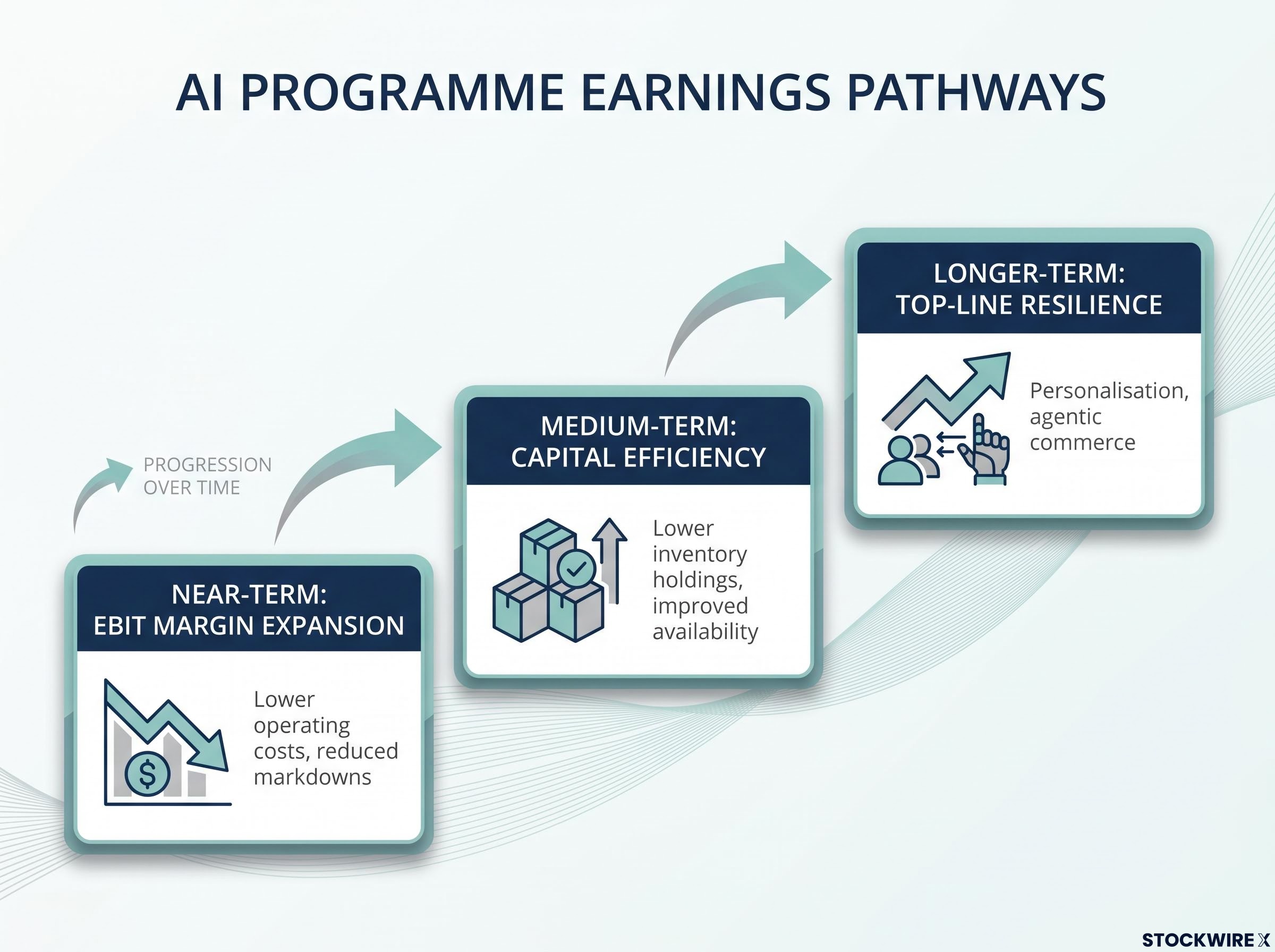
- Near-term: EBIT margin expansion. Lower operating costs and reduced markdowns from supply chain AI are the most immediately visible pathway. Demand forecasting and inventory management tools are closest to earnings impact.
- Medium-term: capital efficiency. Lower inventory holdings and improved product availability should improve inventory turns and free working capital, strengthening return on invested capital over the next two to three years.
- Longer-term: top-line resilience. Personalisation, agentic commerce, and enhanced customer experience are designed to support revenue growth and customer retention, but these tools require longer adoption cycles and are harder to isolate in financial results.
Management’s framing of AI and digital as long-term enablers of “efficiency, customer experience, and long-term value creation” is consistent with how Wesfarmers has historically communicated major capability investments. The absence of quantified financial targets reflects the early stage of the programme, not a departure from disciplined capital allocation.
The AI programme is one plank of a wider capital deployment agenda disclosed at the same event: Wesfarmers’ broader strategy briefing also covered the Covalent Lithium project, which achieved first lithium hydroxide production in FY26, Bunnings’ digital marketplace now exceeding 300,000 SKUs, and a balance sheet running at a Debt/EBITDA ratio of 1.9 times, all of which shape the funding runway available for multi-year technology investment.
Leading indicators investors should watch
Investors do not need new disclosures to track the programme’s commercial translation. Four observable metrics, already reported in Wesfarmers’ interim and full-year results, will serve as leading indicators:
- Gross margin trends by division, particularly in Kmart and Bunnings, where supply chain tools are most advanced.
- Inventory days, as a signal of whether demand planning improvements are translating into leaner stock positions.
- Markdown rates, the most direct indicator of forecast accuracy gains.
- Digital channel contribution to sales, as a measure of customer-facing AI adoption and conversion effectiveness.
A structural bet on margin defence, not a magic quarter
Wesfarmers’ AI programme is credible in design and early in execution. The supply chain use cases, led by Kmart’s demand forecasting tool, offer the most near-term earnings visibility. The cross-divisional operating model creates a scale advantage in technology spend that few Australian retailers can match. The Microsoft partnership provides an enterprise platform rather than a patchwork of brand-level experiments.
The absence of quantified targets means investors must rely on indirect metrics and directional disclosures to track progress. Gross margin trends, inventory turns, and digital channel commentary in the next half-year results will offer the first meaningful data points for assessing commercial translation.
This is not a programme designed to deliver a magic quarter. It is a structural bet on building durable capabilities that defend margins and compound returns across the portfolio over multiple years, consistent with how Wesfarmers has approached major investments throughout its history.
For investors wanting to translate this AI programme analysis into a portfolio decision, our full explainer on WES shares valuation examines the current broker consensus range of A$64 to A$70, the Bunnings earnings anchor, and whether the 2025 share price pullback has created a genuine entry point or simply moved WES from expensive to fair.
This article is for informational purposes only and should not be considered financial advice. Investors should conduct their own research and consult with financial professionals before making investment decisions. Forward-looking statements regarding AI programme outcomes are subject to execution risk and market conditions.