It starts with something small. A colleague mentions a stock over coffee. A podcast host spends ten minutes on a company with conviction that sounds like certainty. That evening, the brokerage app is open, and the pull is there: not a pull rooted in analysis, but in the uncomfortable feeling that someone else knows something worth acting on. This is not a character flaw. It is a predictable feature of how human psychology collides with markets, and it becomes more acute the more passively someone invests, because doing the right thing can feel indistinguishable from doing nothing. What follows is a framework for understanding why FOMO and the urge to act are structural, not personal, and how a core-satellite approach can channel those impulses into disciplined satellite positions rather than impulsive portfolio disruptions.
Why passive investing creates the itch to act
Passive investing works by design over years and decades. That is its strength and its psychological cost. A diversified index fund provides almost no short-term feedback loop to reward the investor emotionally. There is no moment of vindication, no trade that confirms a thesis. The strategy asks its participants to do less, and human psychology resists that request.
The paradox is real: the better the long-term strategy, the less it satisfies the short-term need to feel engaged, useful, and in control.
The specific forces at play are distinct and worth naming:
- FOMO: The fear that a specific opportunity is passing and inaction will result in regret.
- Social proof: The tendency to assign credibility to an idea because someone else holds it with confidence.
- Discomfort of inactivity: The feeling that a portfolio left alone is a portfolio being neglected.
- Informal tips: Recommendations from podcasts, group chats, or conversations that arrive without context or analysis attached.
Each of these operates independently, but they compound. A tip from a trusted source triggers social proof, which activates FOMO, which generates urgency, which produces a trade that bypasses any evaluation process.
Gemma Mitchell, a financial adviser and podcast host at Rask, has framed satellite investing as a mechanism that provides active participation without destabilising the core portfolio. The concept is a “sanctioned outlet,” a controlled space where the urge to act can operate without threatening the long-term strategy. Suppressing the impulse entirely is less effective than giving it boundaries. Practitioners have also observed that investors who monitor portfolios too frequently become reactive, with some advisers recommending clients remove brokerage apps from their phones when checking becomes compulsive.
When big ASX news breaks, our subscribers know first
What core-satellite investing actually means and how the split works
The phrase “core-satellite” appears frequently in ETF marketing materials and portfolio construction guides, but it is worth understanding as something more than a label. It is a psychological architecture as much as an allocation model.
The core is the foundational allocation. It typically consists of low-cost, diversified index funds or ETFs that do the heavy lifting of long-run wealth building. This is the portion of the portfolio the investor commits to leaving alone, through market drawdowns and rallies alike, because its value compounds over time precisely when it is not disrupted.
Building a core ASX ETF portfolio with overlapping funds is one of the most common structural mistakes Australian investors make; holding multiple broad-market products that share 80-90% of underlying holdings adds aggregate fees without genuine diversification, undermining the stability the core allocation is designed to provide.
The satellite is a smaller, intentionally bounded allocation used for higher-conviction or more active positions. These may include individual stocks, sector-specific ETFs, or thematic investments. The boundary matters: a satellite allocation with a defined ceiling prevents a single idea from consuming the portfolio.
The split draws a clear line between what the investor will not tinker with and what they are permitted to engage with actively. That line is the framework’s real function.
| Attribute | Core | Satellite |
|---|---|---|
| Purpose | Long-run wealth accumulation | Active participation and engagement |
| Typical holdings | Diversified index funds or broad ETFs | Individual stocks, sector ETFs, thematic positions |
| Review frequency | Quarterly or less | Monthly or as thesis evolves |
| Tolerance for underperformance | High (decades-long horizon) | Lower (thesis-dependent, time-bounded) |
| Emotional function | Stability and compounding | Sanctioned outlet for curiosity and conviction |
Community investor Alex, speaking on the Rask platform, described a real-world application of this split: a core passive allocation supplemented by a single-stock satellite position in Ryanair, selected on business fundamentals rather than sentiment. Alex framed the satellite explicitly as an exercise in process discipline, not a performance strategy.
How FOMO and social proof turn tips into trades
Understanding that FOMO exists is not the same as understanding how it operates. The mechanism has a sequence, and recognising the sequence is what allows an investor to interrupt it before a tip becomes a trade.
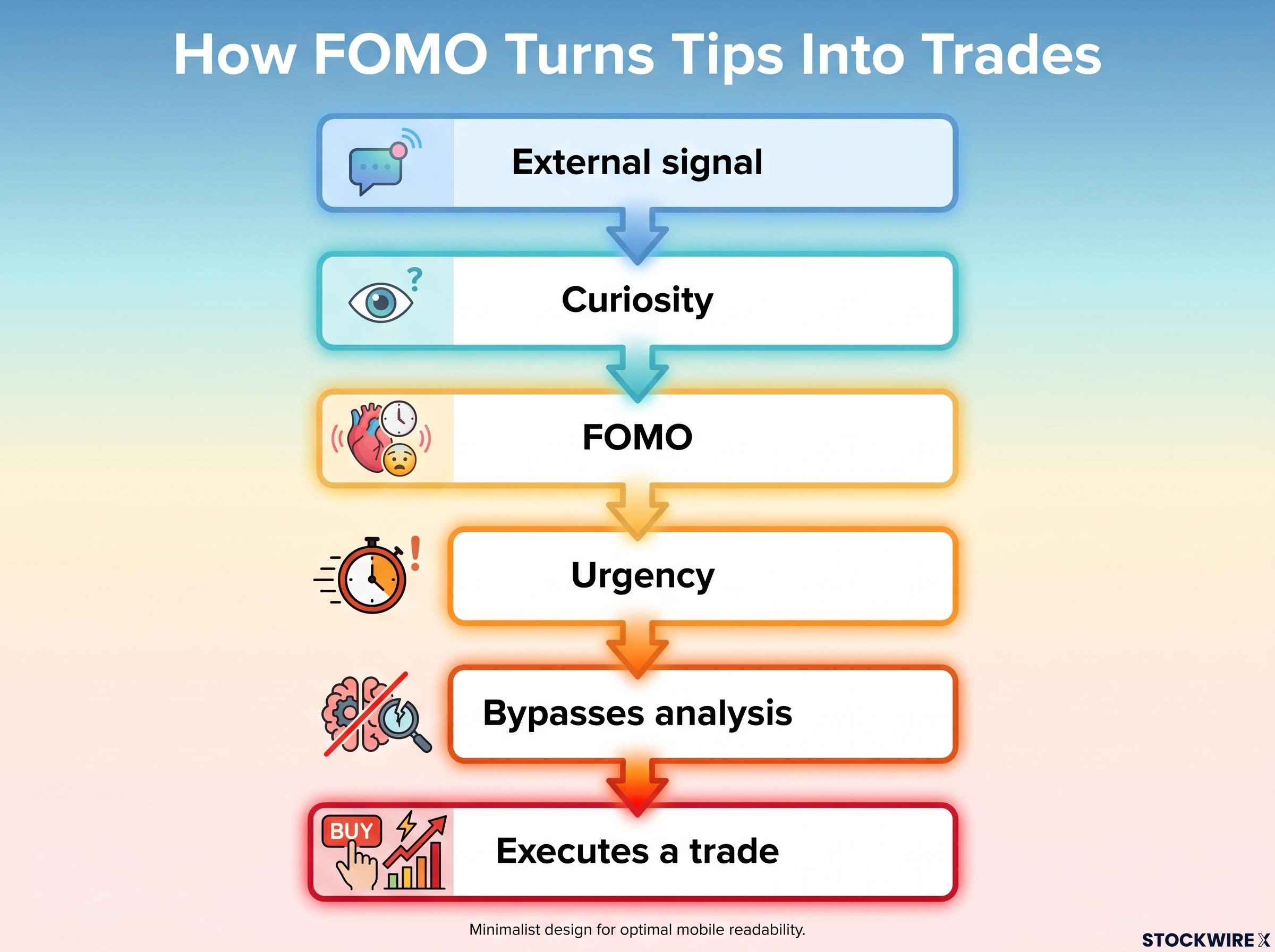
The chain typically runs as follows:
- An external signal arrives: a podcast mention, a social media post, or a conversation with someone who holds a position.
- The signal generates curiosity, which feels productive and analytical.
- Curiosity generates FOMO as the investor begins to imagine the opportunity passing.
- FOMO generates urgency, compressing the evaluation timeline from days or weeks to hours or minutes.
- Urgency bypasses analysis, replacing criteria-based evaluation with a desire to act before the moment passes.
- The investor executes a trade that was not part of any pre-existing plan.
Herd behaviour and social proof are well-documented behavioural finance forces. They are not personal weaknesses. They are cognitive biases that operate on professionals and retail investors alike. The danger is not the tip itself; it is the absence of a pre-existing evaluation framework. Any idea that arrives when no criteria exist has an outsized probability of being acted upon, because the only filter left is emotional conviction.
Loss aversion bias operates as a compounding tax on long-term returns; Morningstar’s ‘Mind the Gap’ research documents a behavioural shortfall of roughly 1-2 percentage points per year, driven almost entirely by investors selling near market lows and re-entering after prices have already recovered.
The difficulty of stock selection reinforces the point. According to SPIVA Australia data from S&P Dow Jones Indices, the clear majority of active fund managers underperform their benchmark over the long run. Community investor Alex cited an estimate that approximately 15% of professional managers outperform consistently over extended periods. If professionals with research teams, proprietary data, and full-time attention struggle to beat the market, an individual acting on a tip received over dinner faces long odds.
No individual stock tip, social media post, or informal conversation alone constitutes sufficient justification for adding a satellite position. The question is not whether the idea is interesting. The question is whether it meets criteria that already exist.
Social media and the informal investing conversation in Australia
Podcasts, Reddit communities, and group chats have expanded the surface area for informal tips reaching Australian retail investors. A recommendation that once required a phone call now arrives passively through a feed or notification. No dated Australian study quantifying FOMO-driven investing from social media contexts was confirmed in current research, so this observation remains qualitative and practitioner-level rather than statistical. The dynamic, however, is consistent with global behavioural finance findings on social proof amplification through digital networks.
Building your personal satellite framework before the tip arrives
The shift from diagnosis to action happens here. A framework is not a set of restrictions imposed from outside. It is a set of decisions the investor makes now, in a calm and deliberate moment, so those decisions do not need to be invented under pressure later.
The principle is pre-commitment: criteria defined before an opportunity arises are more reliable than criteria assembled in response to one. The following questions form the framework’s foundation:
Pre-committed investing strategies, including rules-based rebalancing and dollar-cost averaging, have documented performance advantages over discretionary approaches, with Vanguard Australia data suggesting meaningfully lower drawdowns under stress scenarios for investors who bind decisions to predetermined rules rather than in-the-moment judgment.
- What types of companies or assets am I willing to hold as a satellite? Define the universe before an idea narrows it for you.
- What minimum business quality standards do I require? This might include balance sheet health, leadership track record, or competitive positioning.
- What is my maximum satellite allocation as a percentage of my total portfolio? Set a ceiling that, if the satellite position went to zero, would not compromise the core strategy.
- How long am I willing to hold a satellite before reassessing? A time boundary prevents a losing position from becoming a permanent drag through inertia.
- Do I have a dedicated cash reserve for this purpose? Money set aside specifically for satellite deployment, separate from funds earmarked for regular investing or living expenses, is a practical pre-commitment device.
A tip alone is never sufficient justification for a satellite position. The question is whether the idea meets criteria that already exist.
Community investor Alex described maintaining a strategic cash reserve for deploying into either core holdings during broad market downturns or individual satellite positions at attractive valuations. This separation of funds prevents impulsive reallocation from the core.
A worked example: applying the framework to a real satellite decision
Alex’s Ryanair satellite position illustrates the framework in practice. The fundamental thesis rested on a debt-free balance sheet, capable executive leadership, and a fleet of aircraft acquired at reduced cost during the COVID-19 pandemic. A geopolitical conflict in the Middle East contributed to a share price decline of approximately 20-30%, which Alex interpreted as a temporary factor rather than a structural business impairment.
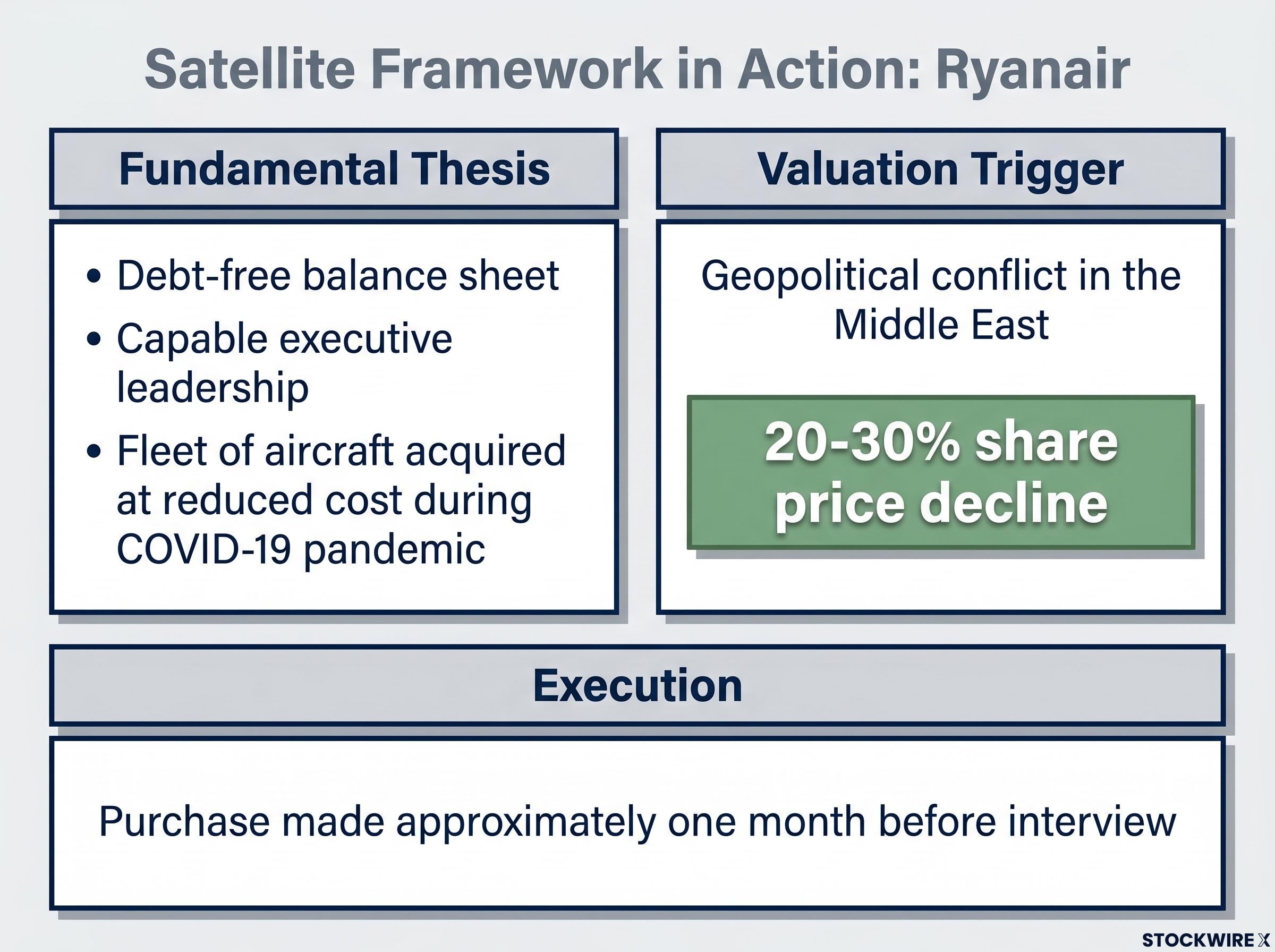
Each element maps to the framework: the business quality criteria were pre-defined (balance sheet strength, leadership), the valuation trigger was external rather than sentiment-driven (geopolitical price dislocation), and the position was funded from a dedicated cash reserve. The purchase was made approximately one month before the interview.
Alex acknowledged that outperforming the market consistently is unlikely. The value of the exercise, in Alex’s own framing, is process discipline and personal engagement, not guaranteed alpha.
Keeping the core intact: the ongoing discipline of not acting
The preceding sections have built toward a framework for acting wisely. This section makes a complementary argument: the harder and more valuable skill is sustained inaction on the core portfolio, and the satellite framework serves that goal too.
Gemma Mitchell has noted that staying invested is more difficult than beginning to invest. The initial decision to allocate money feels decisive and active. The years that follow require the investor to watch portfolio values fluctuate, absorb market drawdowns, and resist the urge to intervene. Foundational financial preparation is what makes that sustained participation possible: cash flow clarity, specific goals assigned to specific pools of money, and an emergency buffer that prevents market volatility from becoming a liquidity crisis.
Assigning a defined purpose to each portion of an investor’s capital, including a satellite allocation with clear boundaries, reduces the emotional volatility of watching numbers move. When every dollar has a role, a 5% market drawdown on the core does not feel like a signal to act; it feels like a temporary fluctuation within a structure designed to absorb it.
Over-monitoring amplifies reactive behaviour. Gemma Mitchell has recommended that investors limit how frequently they check portfolio performance, with some practitioners advising clients to remove brokerage apps from mobile devices when checking becomes compulsive. No Australian empirical study on monitoring frequency and behavioural outcomes was confirmed in current research, so this remains practitioner-level guidance rather than a statistical finding. The principle, however, is consistent with established behavioural finance research on myopic loss aversion.
The NBER research on myopic loss aversion, published by Benartzi and Thaler, established that investors who evaluate portfolios frequently are more likely to perceive losses and react to them, a finding that directly underpins practitioner advice to reduce how often performance is checked.
The practical disciplines for staying invested can be summarised:
Investors who want to stress-test their core allocation before defining their satellite boundaries will find our full explainer on ASX ETF diversification covers the structural concentration risk in domestic-only portfolios, how international ETFs like VGS and IVV fill the gaps the ASX leaves in technology and healthcare exposure, and where thematic satellite positions sit within that broader construction.
- Cash flow clarity: Know what is coming in and going out before allocating to investments.
- Goal assignment: Assign specific purposes to pools of capital so fluctuations do not trigger existential concern.
- Monitoring limits: Define how often portfolio performance will be reviewed, and enforce the boundary.
- Satellite boundaries: A defined satellite ceiling ensures active engagement cannot erode the core.
The investor who uses curiosity as a strength, not a liability
FOMO, the desire to engage, and the itch to participate are not liabilities. They are signals of genuine interest in investing. An investor who feels nothing when a stock tip arrives is not disciplined; they are disengaged. The question is whether that energy has a structure to flow through or whether it overflows into impulsive decisions.
The satellite allocation is not a concession to weakness. It is a deliberate design choice. It improves adherence to the overall strategy by giving the investor a legitimate arena for active participation. An investor who has defined their satellite criteria, set their allocation boundary, established a cash reserve, and limited their monitoring frequency has not simply managed FOMO. They have built a portfolio structure that can survive their own psychology over decades.
The value of a well-run satellite is not beating the market. It is building the habit of disciplined evaluation, a process that strengthens the investor’s relationship with their entire portfolio.
Gemma Mitchell’s framing of the satellite as a sanctioned outlet returns here as the closing anchor: the outlet is not a compromise. It is architecture. Community investor Alex’s own characterisation reinforces the point. The genuine outputs of a satellite position are process discipline and personal engagement. Alpha, if it arrives, is incidental. The framework is the product.
Your framework is ready: now let the market test it
The issue was never that investors feel FOMO. It was that most have no pre-built structure to evaluate what to do with it. The framework is straightforward: define criteria before a tip arrives, set a satellite boundary, maintain a cash reserve for deliberate deployment, and protect the core by limiting how often it is observed.
The next tip, podcast recommendation, or market movement is coming. An investor with a framework in place approaches it differently from one who does not. The difference is not willpower. It is preparation.
Readers who want to build their personal framework in the context of their full financial picture may benefit from speaking with a qualified financial adviser who can assess individual circumstances, goals, and risk tolerance.
This article is for informational purposes only and should not be considered financial advice. Investors should conduct their own research and consult with financial professionals before making investment decisions.