ASX Lithium Stocks Hit 52-Week Highs as Spodumene Tops $2,500
3 hrs ago


ANZ Group Holdings (ASX: ANZ) shares are down nearly 3% this morning, but there is no bad news behind that number. On 11 May 2026, the stock went ex-dividend for its AU$0.62 interim dividend, triggering a routine price adjustment that strips the dividend value from the share price for new buyers. The broader S&P/ASX 200 is also down approximately 1.5% today, adding general market weakness to the technical move. For the large base of retail shareholders watching the ANZ share price fall and wondering whether something has gone wrong, the answer sits in the mechanics of ex-dividend pricing, not in any deterioration of the bank’s fundamentals. What follows is a breakdown of exactly why the price fell, what ANZ’s strong H1 FY2026 results actually show, and what the $1.68 full-year dividend forecast means for shareholders weighing their next move.
ANZ opened at $35.93 this morning and quickly settled to $35.63, down from the previous close of $35.96. The decline is not a reaction to bad news. It is the mechanical consequence of the stock going ex-dividend for the AU$0.62 interim dividend (75% franked).
On an ex-dividend date, the share price adjusts downward by approximately the value of the dividend being detached from the share. New buyers from this date forward are no longer entitled to the interim payment. The price reflects that.
The remaining decline beyond the dividend amount aligns with the broader market. The ASX 200 sits at 8,744.40, down roughly 1.5% on the session.
Key trading data for 11 May 2026:
On an ex-dividend date, the share price adjusts to reflect that the dividend value has been detached from the shares for new buyers.
Misreading a routine ex-dividend drop as a negative signal is one of the most common errors among retail shareholders. The mechanism is purely technical.
Research across more than 500 S&P 500 firms confirms that ex-dividend price drops average approximately 99.8% of the payout size, which is precisely why the ex-dividend price mechanics behind today’s ANZ move are a transfer of embedded value rather than a loss event for existing shareholders.
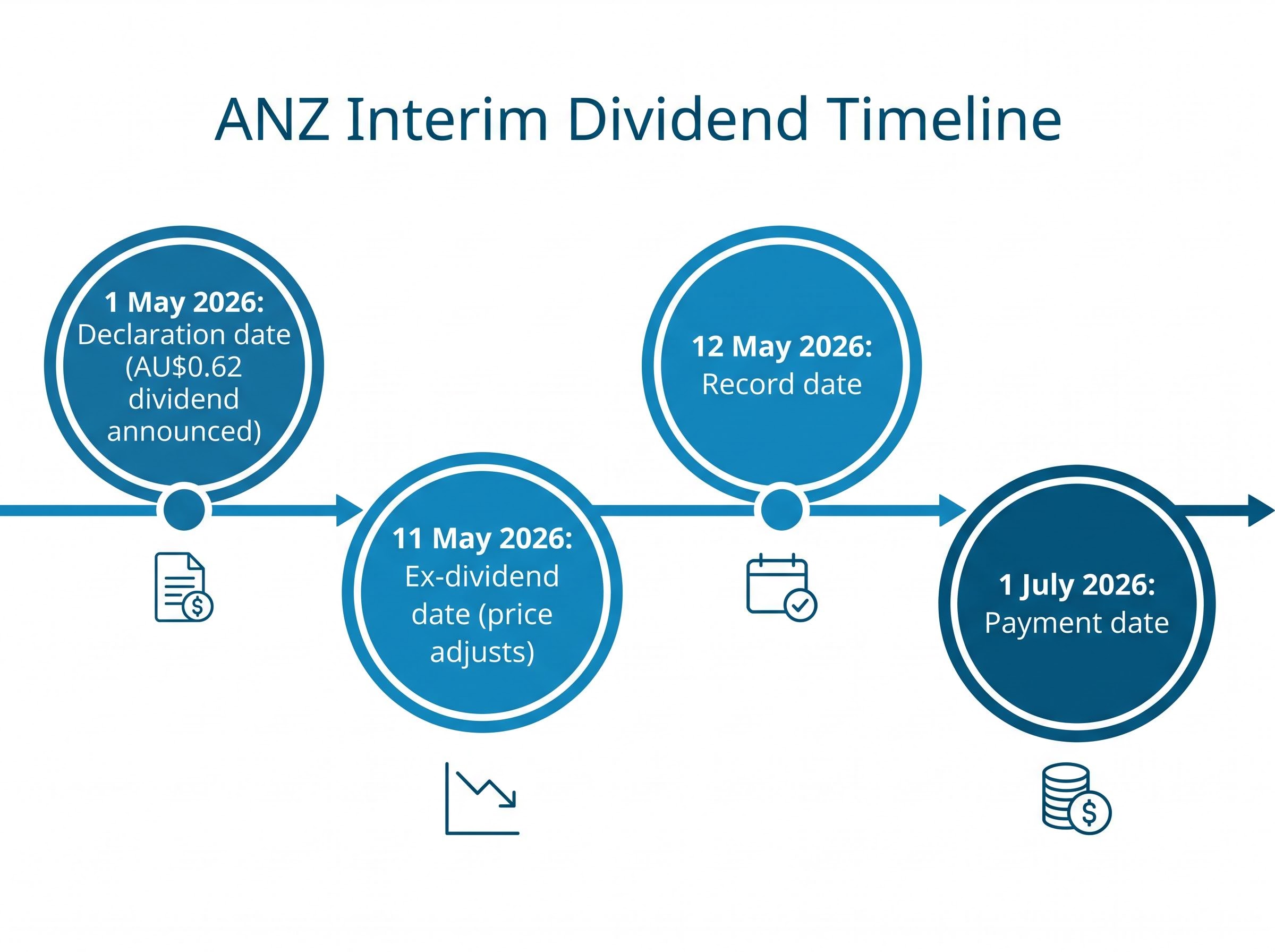
The ex-dividend date is a cut-off. Investors who purchase ANZ shares on or after 11 May 2026 will not receive the declared AU$0.62 interim dividend. That payment is reserved for shareholders recorded on the register at the close of the record date, 12 May 2026.
The market discounts the share price by approximately the dividend amount on the ex-dividend date because the dividend is no longer embedded in the share’s value for new purchasers. This is not a judgement on the company. It is an accounting adjustment that occurs across every dividend-paying stock on its ex-date.
The sequence for ANZ’s interim dividend follows four dates:
Franking credits represent company tax already paid by ANZ on its profits. Australian resident investors can use these credits to offset their personal tax liability, effectively reducing the tax owed on the dividend income.
The franking level has increased from a prior 70% to 75%, reflecting stronger earnings contribution from ANZ’s Australian domestic operations. For investors in lower marginal tax brackets, the after-tax value of a 75% franked $0.62 dividend exceeds its face value once the franking credit is applied at tax time.
Franking credit calculations follow the 30/70 formula, meaning a $0.62 cash dividend at 75% franking carries an attached credit of approximately $0.20, which eligible Australian investors apply against their tax liability or, in the case of SMSFs in pension phase, receive as a direct ATO cash refund.
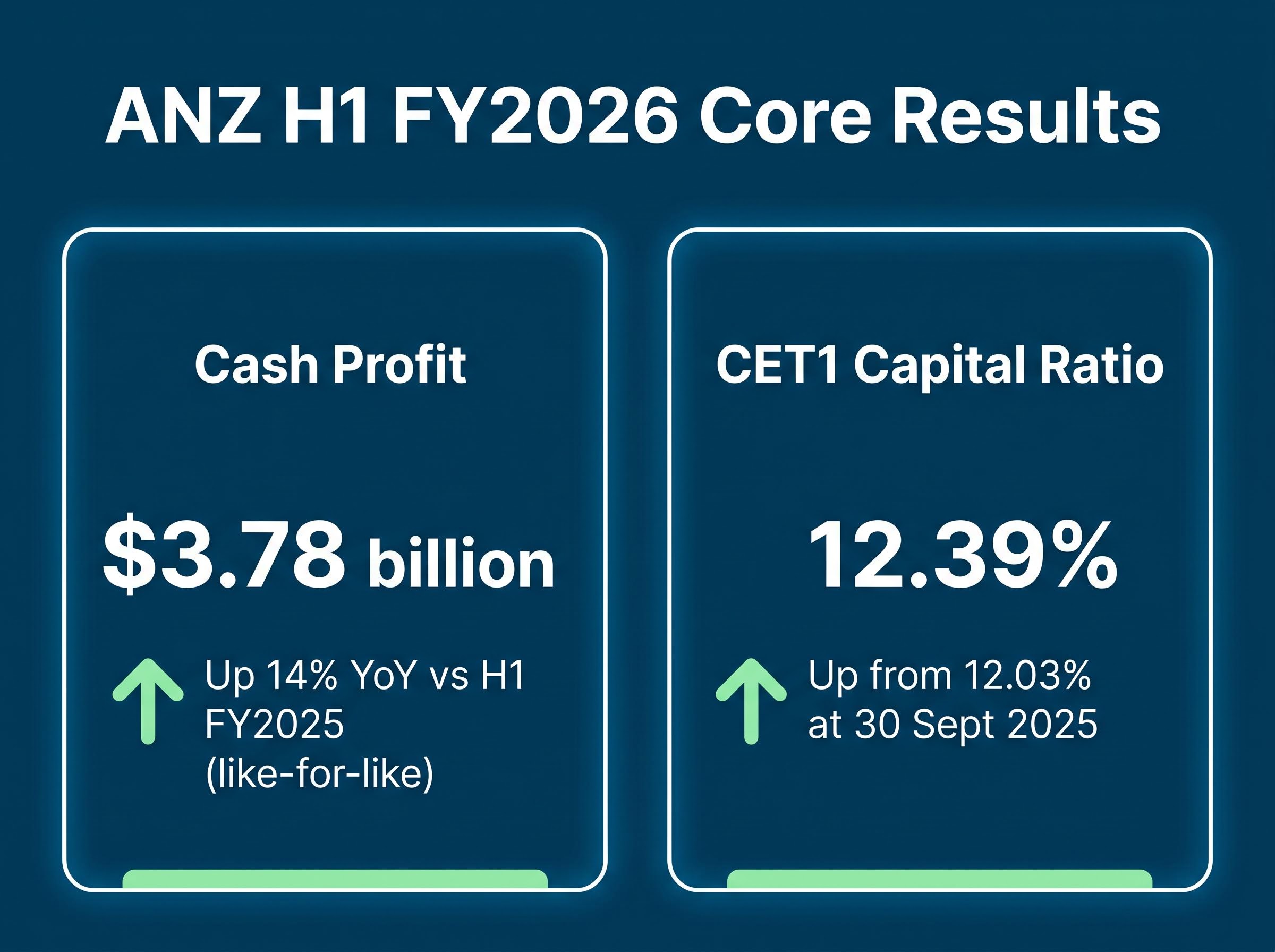
ANZ reported H1 FY2026 cash profit of $3.78 billion, up 14% year-on-year compared with H1 FY2025 on a like-for-like basis excluding significant items. This is the meaningful comparison. A separate half-on-half figure showing 70% growth versus H2 FY2025 has appeared in some coverage, but that comparison uses a non-standard period and overstates the trajectory.
The 14% year-on-year growth reflects genuine earnings momentum, not a flattering base effect.
H1 FY2026 cash profit rose 14% year-on-year on a like-for-like basis, the more meaningful benchmark for assessing ANZ’s earnings trajectory.
Balance sheet strength reinforced the result. The CET1 capital ratio (a measure of a bank’s core capital relative to its risk-weighted assets) improved to 12.39%, up from 12.03% at 30 September 2025. That increase signals capital generation, not just profit growth.
APRA’s Prudential Standard APS 110 sets the minimum CET1 ratio requirement for Australian authorised deposit-taking institutions, with ANZ’s current 12.39% sitting comfortably above the regulatory floor and providing the capital headroom that supports its ongoing dividend capacity.
On earnings day (1 May 2026), ANZ shares still dipped approximately 1.01% intraday to around $36.29, while the ASX 200 fell just 0.19% to roughly 8,680.50. The underperformance reflected disappointment that the interim dividend was maintained at $0.62 rather than increased, not concern about the underlying profit delivery.
| Metric | H1 FY2026 value | Comparison point |
|---|---|---|
| Cash profit | $3.78 billion | Up 14% vs. H1 FY2025 (like-for-like) |
| Statutory profit | $3.65 billion | H1 FY2026 |
| CET1 ratio | 12.39% | Up from 12.03% at 30 September 2025 |
| Earnings day reaction (1 May 2026) | ANZ down ~1.01% | ASX 200 down 0.19% |
The payment logistics for ANZ’s interim dividend:
At the current price of $35.63, ANZ’s trailing dividend yield sits at approximately 4.1%. The stock trades roughly 13% below its 52-week high of $41.00, reached on 13 February 2026, a gap that income-focused investors are weighing as they assess whether to accumulate.
The payout ratio of approximately 84% and dividend cover of roughly 1.0x sit at the upper end of typical bank payout norms. These figures are supported by $3.78 billion in H1 cash profit and a CET1 ratio of 12.39%, confirming that capital buffers are not under pressure.
Broker and analyst commentary broadly treats the current dividend level as sustainable within ANZ’s established income profile. The total shareholder yield stands at approximately 3.7%.
The arithmetic behind the $1.68 full-year forecast is straightforward:
The consensus estimate for ANZ’s H2 final dividend is AU$0.85 per share, which would bring the full-year total to $1.68.
On earnings day, some investors were disappointed that the interim was maintained at $0.62 rather than increased. That disappointment was a sentiment reaction, not a fundamentals problem. The full-year path to $1.68 remains intact, supported by H1 cash profit of $3.78 billion and a CET1 of 12.39% providing capital headroom for the second-half distribution.
Simply Wall St places ANZ’s fair value at A$36.66 (revised from $37.07), modestly above the current price of $35.63. Broker sentiment is mixed, with some neutral holds carrying targets around $38.14. The dividend growth rate sits at approximately -0.4%, effectively flat, suggesting the income profile is being maintained rather than expanded.
For income-focused shareholders, the $1.68 full-year figure is the number that anchors the total return expectation. It confirms that despite the earnings day sentiment dip, the annual dividend profile remains broadly intact.
Today’s decline combines two distinct forces: a mechanical ex-dividend adjustment and a broader market pullback. Neither carries negative information about ANZ’s business or dividend capacity.
At $35.63, the stock trades approximately 13% below its 52-week high of $41.00. Fair value estimates from Simply Wall St (A$36.66) and broker targets (approximately $38.14) cluster modestly above the current level. The H1 result delivered 14% year-on-year cash profit growth on a like-for-like basis, and the full-year dividend forecast of $1.68 remains credible.
The AU$800 million cost savings program, of which 49% had been completed by May 2026, represents one of the clearest near-term accountability checkpoints in ANZ’s investment case; the ANZ transformation milestones due by September 2026 and the Suncorp integration synergy targets not expected until FY2029 define the timeline over which the current valuation gap would need to close.
Three variables warrant monitoring through H2 FY2026:
Today’s price decline is a mechanical ex-dividend event, not a verdict on ANZ’s business or dividend sustainability. The H1 FY2026 result was genuinely strong on a like-for-like basis, with cash profit up 14% year-on-year. The interim dividend of AU$0.62 per share (75% franked) has been detached from the share price, and the full-year forecast of $1.68 remains credible based on consensus estimates and capital buffers.
Income-focused shareholders weighing accumulation at current levels should note that dividend-growth screening for payout sustainability and earnings quality has historically produced stronger long-run total returns than positioning purely on headline yield, a distinction that matters when the dividend cover sits at approximately 1.0x and the payout ratio approaches 84%.
The payment date of 1 July 2026 is approximately seven weeks away. The next material catalyst is the H2 result and final dividend announcement later in FY2026.
This article is for informational purposes only and should not be considered financial advice. Investors should conduct their own research and consult with financial professionals before making investment decisions.
When ANZ shares go ex-dividend, investors who buy the stock on or after that date are no longer entitled to the declared dividend payment. The share price typically falls by approximately the dividend amount on the ex-dividend date because the value of that payment has been detached from the share for new buyers.
The ANZ share price fell on 11 May 2026 due to two factors: a routine mechanical adjustment as the stock went ex-dividend for its AU$0.62 interim dividend, and a broader market decline of approximately 1.5% across the ASX 200. Neither factor reflects a deterioration in ANZ's business fundamentals.
The consensus full-year dividend forecast for ANZ in FY2026 is AU$1.68 per share, comprising the confirmed AU$0.62 interim dividend and an estimated AU$0.85 final dividend for the second half. This forecast is supported by H1 cash profit of $3.78 billion and a CET1 capital ratio of 12.39%.
ANZ's AU$0.62 interim dividend is 75% franked, meaning a franking credit of approximately $0.20 per share is attached to the cash payment. Eligible Australian investors can apply this credit to offset their personal tax liability, and SMSFs in pension phase can receive it as a direct ATO cash refund.
ANZ's dividend payout ratio is approximately 84%, with dividend cover of roughly 1.0x, which sits at the upper end of typical bank payout norms. Analysts broadly consider the dividend sustainable, supported by $3.78 billion in H1 FY2026 cash profit and a CET1 capital ratio of 12.39% that confirms capital buffers are not under pressure.