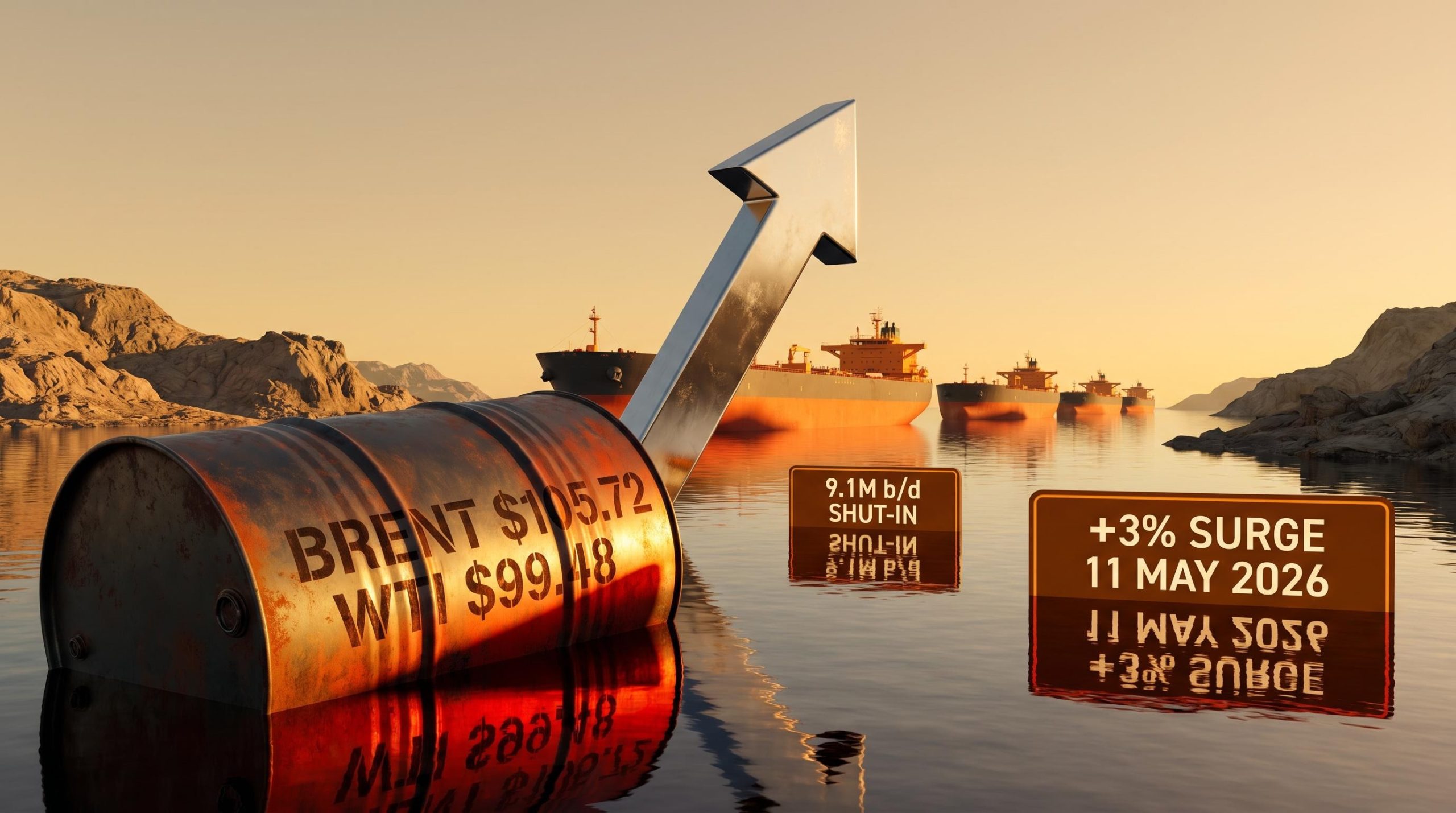
Crude oil prices surged more than 3% during the Asian session on Sunday, 11 May 2026, after President Trump rejected Iran’s latest diplomatic proposal, unwinding a week of cautious optimism that a Gulf shipping deal was within reach. Brent crude climbed to approximately $105.67-$105.72 per barrel during European hours, while West Texas Intermediate (WTI) opened near $99.41-$99.48 on NYMEX. The move erased the prior week’s decline in a single session.
The Strait of Hormuz has remained largely closed since the onset of the conflict, and the collapse of this negotiating channel removes the nearest off-ramp the market had been pricing in. What follows covers the specific terms that divided Washington and Tehran, how major producers are responding, where analysts see prices heading from here, and whether the Trump-Xi summit scheduled for 14-15 May offers any realistic path to de-escalation.
Why Trump walked away: the negotiating chasm that markets underestimated
The U.S. framework, as reported by the Wall Street Journal, demanded a multi-decade freeze on uranium enrichment, the removal of Iran’s highly enriched uranium stockpiles, and the elimination of critical nuclear infrastructure. In exchange, Washington offered phased sanctions relief and a cessation of military operations in the region.
The gap between those terms and what Tehran offered back was not a difference of degree. It was structural.
| Party | Core nuclear demand | Military/security demand | Economic demand |
|---|---|---|---|
| United States | Multi-decade enrichment freeze; removal of HEU stockpiles; elimination of nuclear infrastructure | Cessation of military operations (conditional) | Phased sanctions relief |
| Iran | Recognition of limited nuclear activities; partial HEU dilution; remainder transferred to third country | Full U.S. naval withdrawal from Hormuz area; security guarantees | Full and immediate sanctions removal |
What Tehran put on the table through Islamabad
Iran’s counteroffer, relayed through Pakistani intermediaries and reported by Axios (cited in WSJ, 11 May, 09:00 UTC), included an offer to dilute a portion of its highly enriched uranium and transfer the remainder to a third country. The mechanism itself represented an Iranian concession in form; no previous proposal had acknowledged a transfer of enriched material outside Iranian territory.
Trump characterised Tehran’s response as “wholly unacceptable.” Saudi Crown Prince Mohammed bin Salman described the rejection as “regrettable,” according to Reuters (11 May, 03:20 UTC). For traders, the distance between these two positions suggests that any future proposals will need to bridge a structural divide, not merely refine language.
The scale of Sunday’s reversal is easier to calibrate against the 7 May commodity repricing, when Brent dropped approximately 7.6% from $116.55 to $101.88 in a single session as peace framework reports removed a substantial share of the geopolitical war premium; Trump’s rejection of the Iranian counteroffer has now unwound the optimism that produced that sell-off.
When big ASX news breaks, our subscribers know first
Strait of Hormuz closure: the supply wound that will not stop bleeding
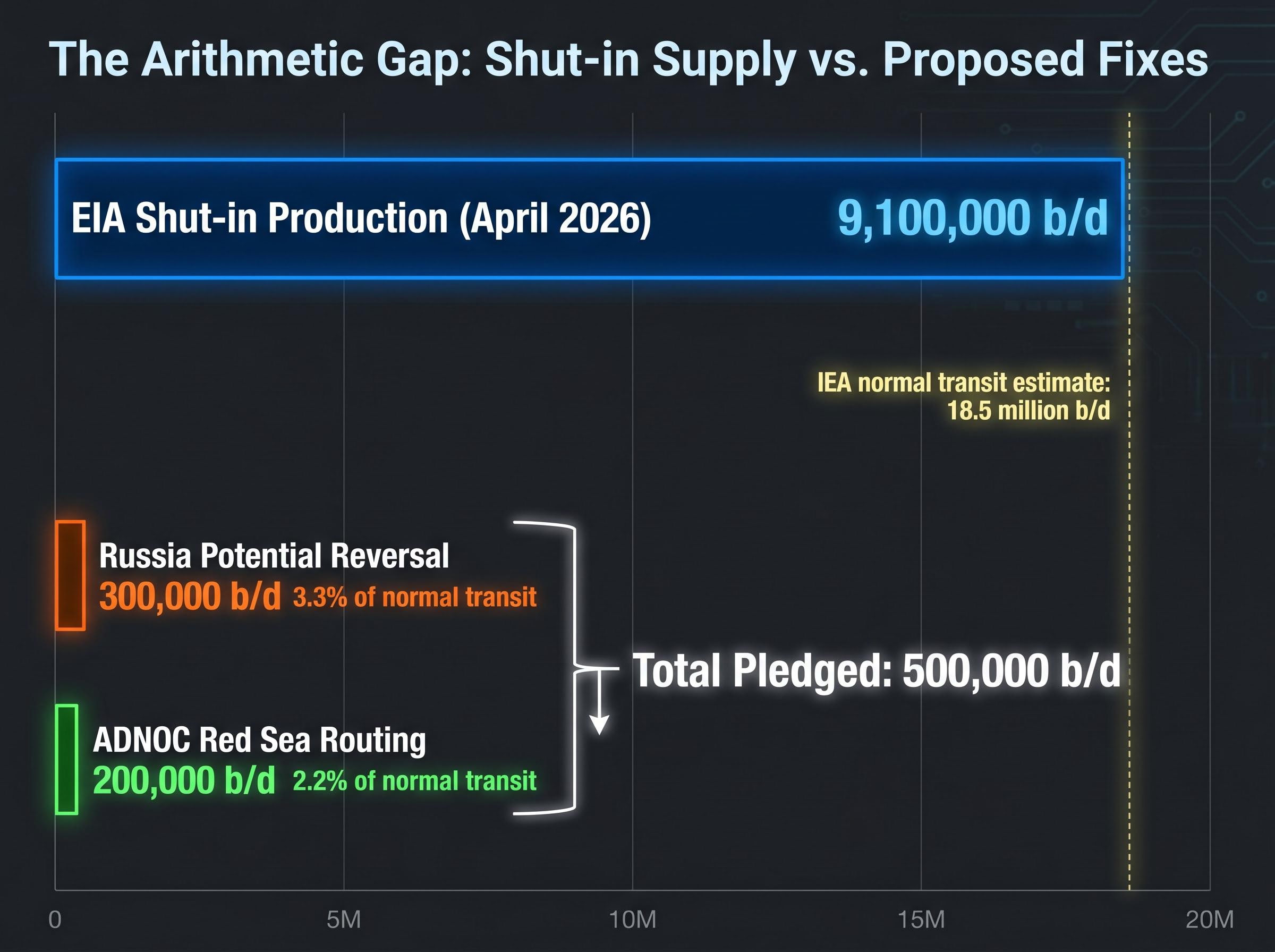
The physical scale of the disruption explains why the price surge is arithmetic, not sentiment. The International Energy Agency (IEA) estimates that 18.5 million barrels per day of seaborne trade normally transits the Strait of Hormuz. The U.S. Energy Information Administration (EIA) assessed production shut-ins at 9.1 million barrels per day as of April 2026.
Producers are attempting to route crude via Red Sea alternatives. ADNOC pledged an additional 200,000 barrels per day through those channels, according to the Financial Times (10 May, 23:50 UTC). That figure is less than 2.2% of the strait’s normal transit volume.
The downstream consequences are already visible at the pump:
- U.S. average gasoline prices have reached approximately $5 per gallon, per JPMorgan’s warning
- Global average gasoline prices are up 20-30% since April 2026
JPMorgan warned that U.S. gasoline could reach approximately $5 per gallon as the Hormuz disruption continues to compress global supply, with no near-term resolution in sight.
The gap between what alternative routes can supply (hundreds of thousands of barrels per day) and what the strait normally moves (tens of millions) illustrates why price pressure is not easing regardless of producer goodwill signals.
What the Strait of Hormuz actually controls, and why there is no quick substitute
The Strait of Hormuz is the narrow waterway between Iran and Oman through which a significant share of global seaborne oil and liquefied natural gas (LNG) flows. At its narrowest navigable point, the shipping channel is only a few kilometres wide, meaning it functions as a single chokepoint with no geographic alternative for tanker traffic exiting the Persian Gulf.
Alternative export routes exist. Overland pipelines and Red Sea rerouting can move some volume. But three factors prevent them from substituting at scale in the short term:
- Volume constraints: Existing alternative pipeline and port infrastructure can handle a fraction of the 18.5 million b/d (IEA estimate) that normally transits the strait
- Infrastructure readiness: Scaling pipeline throughput and loading capacity requires months of preparation, not days
- Insurance environment: Insurance syndicates have halted coverage for strait transit, raising the cost and complexity of any vessel attempting the route
Why the insurance freeze matters as much as the naval standoff
Even if political conditions shifted overnight, insurance market halts mean commercial shipping cannot immediately resume without a financial backstop. Goldman Sachs projected a minimum 4-6 week disruption if Iran maintains closure, citing ongoing naval patrols and the insurance freeze as twin constraints, according to Reuters (11 May, 06:30 UTC). Until insurers lift those halts, the physical reopening of the strait and its commercial reopening are two separate events.
The insurance withdrawal is not a secondary constraint on top of the naval standoff; it is the third pillar of what analysts have described as the Hormuz triple lock, combining US naval blockade operations, Iranian toll enforcement, and the near-total collapse of commercial war risk coverage into a single compounding mechanism that no single diplomatic gesture can undo.
OPEC+ scrambles, but the numbers do not add up
Saudi Arabia’s energy minister warned against “panic” in energy markets on 11 May. Russia signalled a possible reversal of 300,000 b/d in voluntary production cuts, per Reuters (11 May, 08:15 UTC). An emergency OPEC+ call is scheduled for 12 May, according to the Wall Street Journal (11 May, 09:30 UTC).
The rhetoric suggests urgency. The arithmetic tells a different story.
| Producer/group | Action announced | Volume (b/d) | Shortfall context |
|---|---|---|---|
| ADNOC (UAE) | Red Sea alternative routing | 200,000 | 2.2% of normal strait transit |
| Russia | Potential voluntary cut reversal | 300,000 | 3.3% of normal strait transit |
| OPEC+ (collective) | Emergency call scheduled 12 May | TBD | No formal adjustments as of 11 May |
| Shut-in production | EIA assessment (April 2026) | 9,100,000 | Baseline disruption |
Combined, ADNOC and Russia’s pledges total 500,000 b/d against 9.1 million b/d in shut-in production. Meanwhile, Saudi Aramco raised Asian crude prices by $2 per barrel, per Bloomberg (11 May, 06:00 UTC), a move that signals pricing power rather than market stabilisation. The 12 May OPEC+ call will be closely watched, but the volume gap suggests it is unlikely to deliver material price relief.
Goldman Sachs has modelled the supply-demand imbalance as a shift from a 1.8 million barrels per day surplus in 2025 to a 9.6 million barrels per day deficit in Q2 2026, the sharpest institutional projection on record, and the 12 May EIA report represents the first scheduled opportunity for markets to reprice against updated official figures.
Where analysts see Brent heading, and the scenarios that get it there
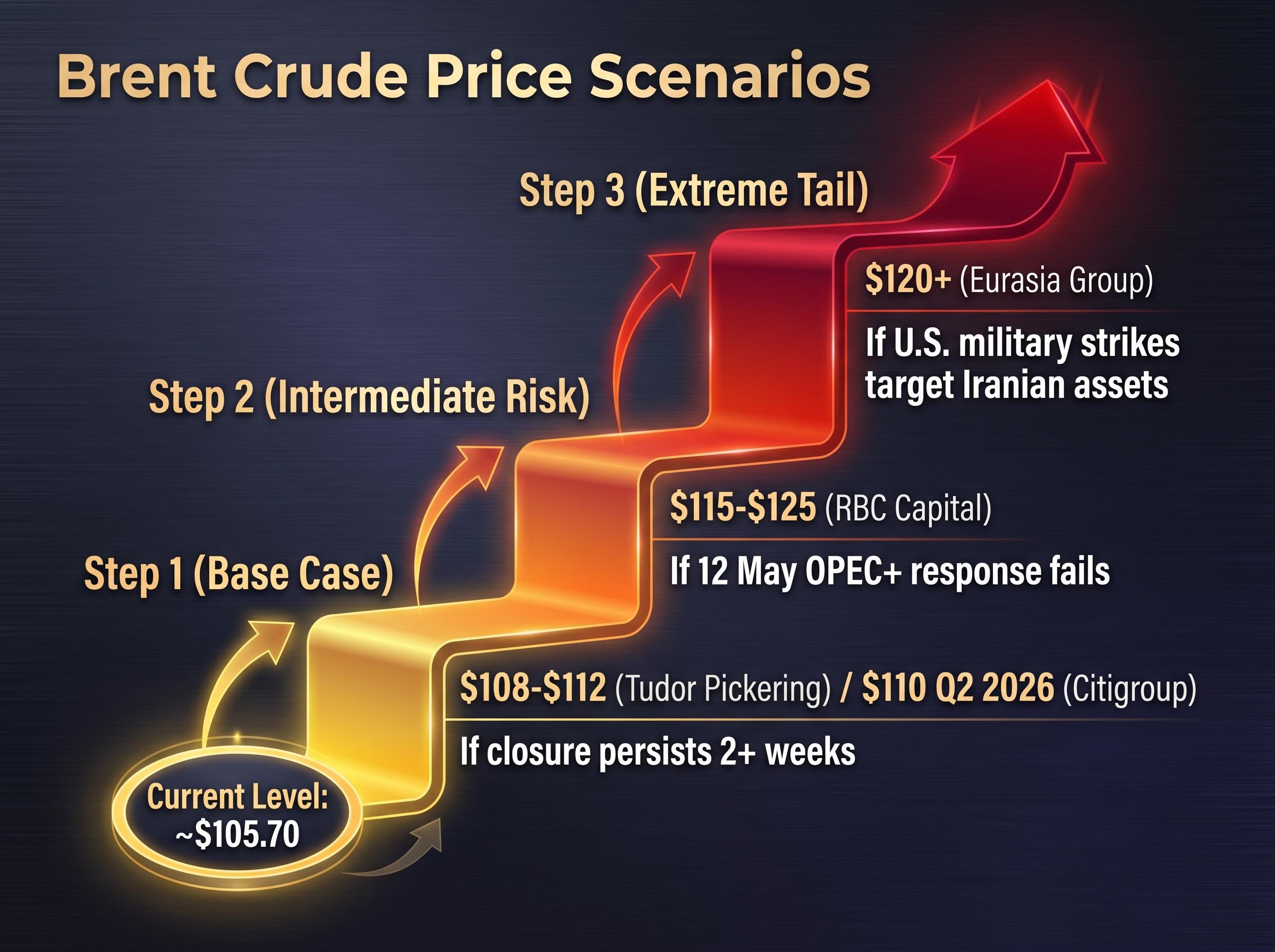
With Brent already trading near $105.70 per barrel, the market is partway up the first scenario tier. Analyst forecasts are not competing opinions; they are tiered outcomes tied to disruption duration and escalation risk.
- Base case ($108-$112 Brent): If the Hormuz closure persists for two or more weeks without a credible diplomatic opening, Tudor Pickering forecasts a $108-$112 range (Reuters, 10 May, 21:30 UTC), and Citigroup has raised its Q2 2026 Brent forecast to $110
- Intermediate risk ($115-$125 Brent): If the 12 May OPEC+ response fails to close the supply gap, RBC Capital models $115-$125 (Financial Times, 11 May, 08:45 UTC)
- Extreme tail ($120+ Brent): If U.S. military strikes target Iranian assets, Eurasia Group flags $120 or higher as a short-term outcome (WSJ, 11 May, 10:30 UTC)
Rystad Energy characterised the disruption risk as “indefinite” without Oman mediation, according to the Financial Times (11 May, 08:00 UTC), a stark counterpoint to the assumption that diplomatic momentum alone will cap prices.
The distance between current levels and the base-case ceiling is narrow. The distance between the base case and the extreme tail is wide, and dependent on decisions that could be made within days.
The Hormuz risk premium is not expected to decompress quickly even under a best-case diplomatic resolution: the IEA projects a two-year supply chain recovery timeline, and VLCC daily hire rates tracking approximately $110,000 per day signal that physical markets are pricing structural disruption rather than a temporary closure.
The Beijing variable: can the Trump-Xi summit change the math?
The Trump-Xi summit, rescheduled after a March postponement, is set for 14-15 May 2026 and remains on track. China’s substantial economic ties to Iran make Beijing a potential back-channel rather than a direct mediator, but the question is whether potential translates into action.
On 10 May, U.S. and Chinese officials held virtual talks in which Beijing urged de-escalation but offered no Iran-specific concessions, per the Financial Times (11 May, 04:15 UTC). Analysts have characterised the summit’s short-term oil market impact as neutral to bearish absent a breakthrough, though the fact the meeting is proceeding at all is modestly more constructive than a cancellation scenario.
Three factors will determine whether the summit moves the needle:
- China’s willingness to apply direct economic pressure on Iran
- Whether Iran retains any openness to a modified nuclear proposal
- Whether Trump enters Beijing with flexibility on the enrichment framework
A 3% surge is only the beginning if Hormuz stays shut
Brent at approximately $105 per barrel sits below even the base-case analyst consensus of $110 if the closure persists beyond two weeks. The market has repriced significantly, but if the diplomatic picture does not improve, further upside remains the path of least resistance.
Two variables will shape the next move. The 12 May OPEC+ emergency call is the nearest catalyst; a credible supply commitment above the current 500,000 b/d pledged would signal producer seriousness, while anything less confirms the arithmetic gap. The 14-15 May Beijing summit is the next diplomatic test, with any Iran-specific language in the communique carrying outsized significance.
Reuters noted “further gains on Hormuz risk premium” during the 11 May session. The signals to monitor in the coming days:
- OPEC+ outcome on 12 May: volume commitments versus rhetoric
- Summit communique language on Iran on 14-15 May
- Any Oman or Pakistani mediation signal indicating resumed contact
- Brent crossing or failing to cross the $110 threshold
This article is for informational purposes only and should not be considered financial advice. Investors should conduct their own research and consult with financial professionals before making investment decisions. These forward-looking price projections are subject to market conditions and various risk factors, and past performance does not guarantee future results.