
Tesla at 189x Earnings: a Stock Valuation Analysis Guide
25 mins ago


Artificial intelligence is attracting some of the largest corporate capital commitments in history. Microsoft, Alphabet, Amazon, and Meta Platforms have collectively pledged hundreds of billions of dollars to AI infrastructure, yet most Australian investors face a familiar problem: identifying which companies will still lead this theme in a decade is extraordinarily difficult. The ASX now offers a spectrum of ETF options that provide AI exposure, from the world’s cheapest broad market fund to dedicated AI-themed products, each with a meaningfully different cost and risk profile. All three ETFs covered here, IVV, NDQ, and GXAI, trade on the ASX today. By the end of this guide, readers will understand the structural case for ETFs over individual stock selection in thematic investing, and will have a clear comparison across fees, holdings, performance, and AI exposure purity to guide their own allocation decision.
The investment case for AI is genuine. Corporate capital expenditure on AI infrastructure, from data centres to semiconductor fabrication, is running at levels that have no precedent in the technology sector. Applications remain in early stages of widespread deployment as of 2026, and the addressable market continues to expand as enterprises adopt generative AI tools, autonomous systems, and machine learning analytics. The theme is credible, multi-decade, and structurally supported by spending that has already been committed.
AI infrastructure capital expenditure by the four largest hyperscalers is projected at $650 billion in 2026, a spending commitment that underpins the investment thesis for both broad index funds like IVV and dedicated hardware-focused products like GXAI, and whose eventual transition from deployment to monetisation will shape the earnings trajectory of every company in these portfolios.
The difficulty is not believing in AI. It is picking the winners.
The early internet era offers a sharp lesson. Investors who correctly identified the internet as a generational technology in the late 1990s still suffered catastrophic losses when the dot-com bubble collapsed in the early 2000s. Alphabet and Amazon survived and compounded wealth for decades. Yahoo, Pets.com, and dozens of other heavily funded internet companies did not. Identifying the technology correctly and identifying the winning company are two entirely different skills.
If the theme is likely to win but the individual winners are nearly impossible to select in advance, the structurally appropriate response is a vehicle that holds the field rather than a single horse. That is what passive ETFs are designed to do.
Market-cap weighting is the mechanism that makes broad index funds more than just diversified baskets. In a market-cap-weighted index, each company’s share of the fund is proportional to its total market value. When a company outperforms and its share price rises, it automatically grows its weighting in the index. When it underperforms, it shrinks.
This means the fund mechanically tilts toward the companies the market collectively endorses, without requiring a portfolio manager to predict those outcomes in advance. The investor who buys an individual AI stock must be right about both the technology and the specific company’s competitive position, margin structure, and management execution. The ETF buyer only needs the broader theme to hold.
The tension between individual stock selection versus index funds is not unique to the AI theme: passive index ETFs outperformed approximately 80% of active funds on a net-of-fees basis in 2025, a figure that frames the structural case for broad index exposure as a durable feature of market dynamics rather than a temporary condition driven by any single sector.
Even a broad S&P 500 fund like IVV has naturally become heavily weighted toward AI-oriented mega-caps because those companies have grown to dominate US equity market capitalisation. NVIDIA holds the top position in IVV at approximately 7.84% of the fund. In NDQ, it sits at roughly 8.7%. GXAI takes a different approach, skewing toward semiconductor hardware suppliers rather than concentrating on NVIDIA directly.
The implication is straightforward: investors do not need to buy a fund labelled “AI” to get substantial AI exposure. As AI valuations rise and fall, the index continuously reweights, functioning as a self-correcting barometer of which companies the market is pricing as winners.
IVV, NDQ, and GXAI represent three distinct points on a cost-versus-concentration spectrum. They are not three competing answers to the same question; they are three different questions about how much AI-specific conviction an investor wants to express.
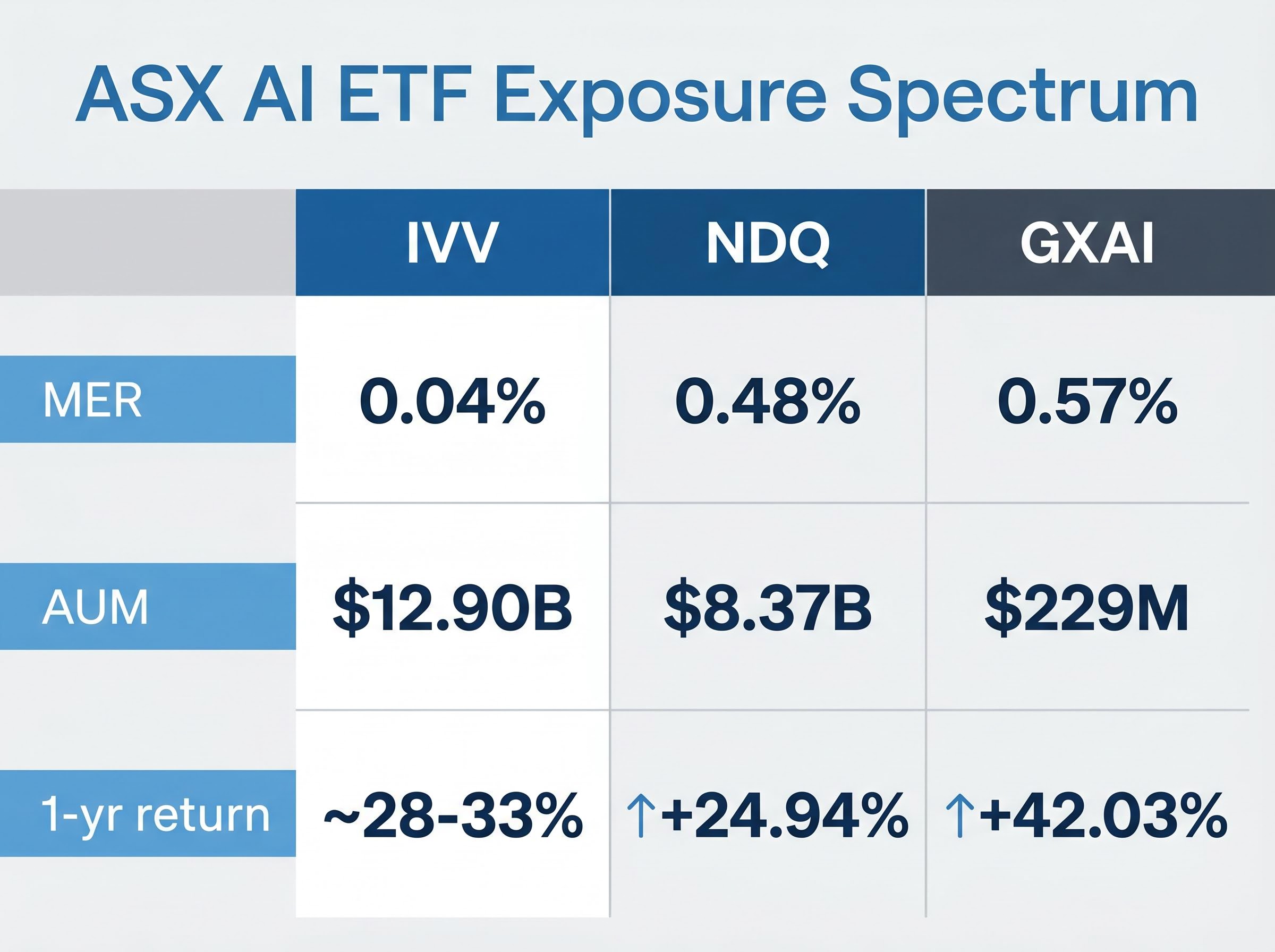
IVV (iShares S&P 500 ETF) offers exposure to the full S&P 500 at a management expense ratio (MER) of just 0.04%, the lowest fee of the three by a wide margin. With assets under management (AUM) of $12.90 billion, it is one of the largest ETFs on the ASX. NVIDIA is its top holding at approximately 7.84%, and the top ten holdings account for roughly 38.39% of the portfolio. AI exposure is embedded within a 500-company diversified structure.
NDQ (BetaShares Nasdaq 100 ETF) narrows the focus to the 100 largest non-financial companies on the Nasdaq, bringing the MER to 0.48% and AUM to $8.37 billion. Technology concentration is significantly higher. NVIDIA sits at approximately 8.7%, and eight of the top ten holdings are directly AI-relevant names.
GXAI (Global X Artificial Intelligence ETF) is the dedicated AI theme play, with an MER of 0.57%, AUM of $229 million, and an inception date of 8 April 2024. Its one-year return of 42.03% in AUD (to May 2026) is the highest of the three, but its holdings profile may surprise investors expecting a portfolio dominated by familiar AI headlines.
| Metric | IVV | NDQ | GXAI |
|---|---|---|---|
| MER | 0.04% | 0.48% | 0.57% |
| AUM (May 2026) | $12.90B | $8.37B | $229M |
| 1-year return (AUD) | ~28-33% | +24.94% | +42.03% |
| 3-year p.a. return (AUD) | ~20-23% | +24.17% | N/A (inception Apr 2024) |
| Currency hedged | No | No | No |
All performance figures are after fees and denominated in AUD. The absence of a three-year track record for GXAI reflects its April 2024 inception, a consideration explored further below.
The fund most explicitly labelled as an AI ETF does not hold NVIDIA as its top position. In fact, NVIDIA does not appear in GXAI‘s top five holdings at all.
Instead, GXAI‘s largest allocations as of May 2026 are:
Semiconductor memory concentration as a portfolio theme extends well beyond GXAI: the BetaShares ASIA ETF holds SK Hynix and Samsung together at over 37% of its portfolio, meaning Australian investors seeking Asian growth exposure through that fund are effectively making a similar infrastructure hardware bet, with the added complexity of unhedged currency risk and geopolitical exposure across the Taiwan Strait and South Korean export control dynamics.
The fund’s index construction tilts heavily toward semiconductor memory and hardware suppliers, the companies building the physical infrastructure that AI systems require regardless of which software platform or model architecture ultimately wins. This is not a flaw in the fund’s design. It is a deliberate index methodology choice that reflects a specific view: AI needs chips, memory, and networking hardware, and the companies supplying that infrastructure are a durable way to capture the theme.
Compare this with NDQ, where the top three holdings are NVIDIA at 8.7%, Apple at 7.1%, and Microsoft at 5.3%, names more commonly associated with the AI headlines retail investors follow. In IVV, NVIDIA holds the top position at approximately 7.84%.
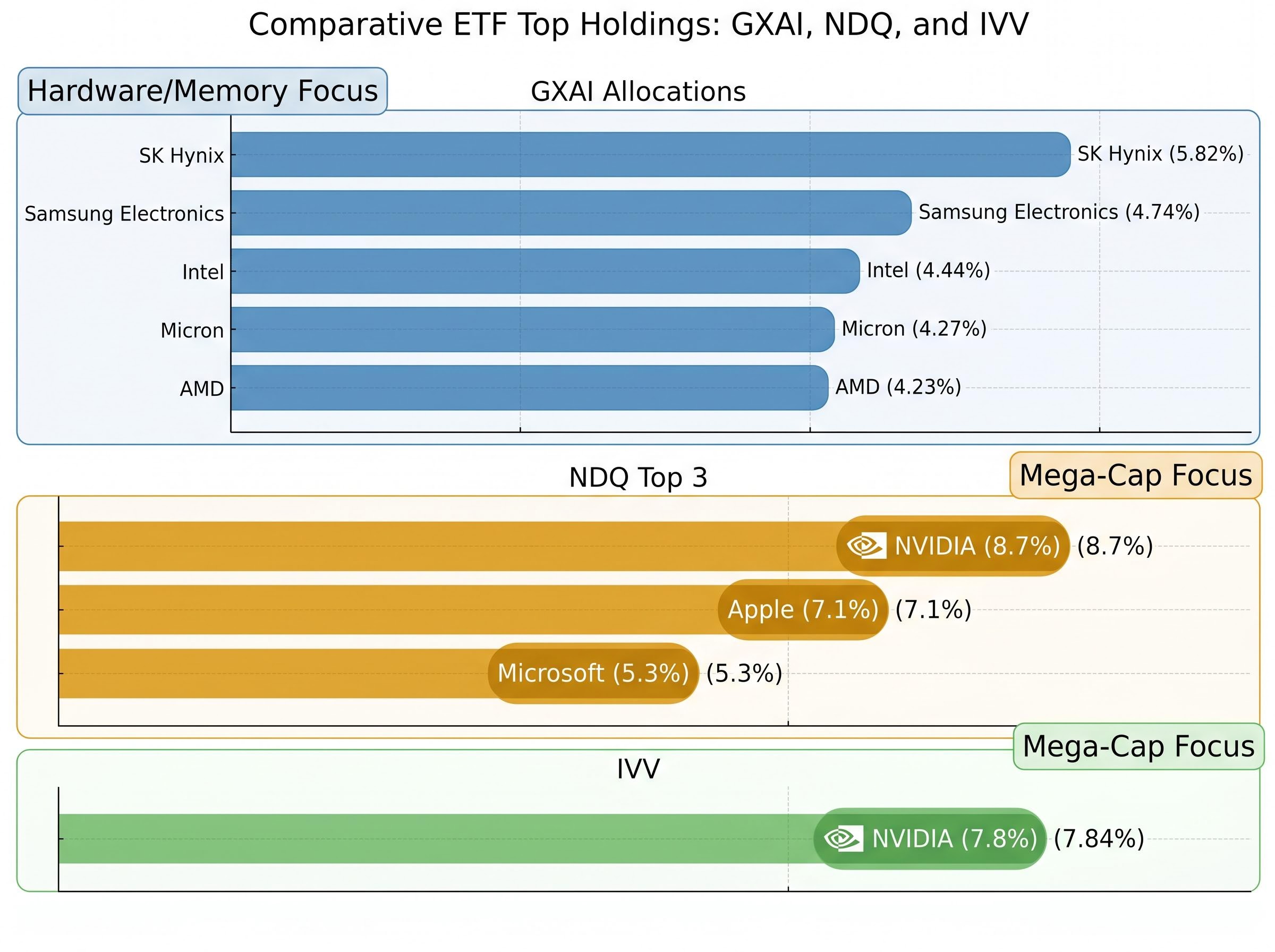
IVV and NDQ are effectively bets on the US technology sector broadly winning the AI era, with natural concentration in software companies and hyperscalers that dominate market capitalisation. GXAI is a bet specifically on AI infrastructure demand continuing to grow, with emphasis on the hardware and memory supply chain that underpins the technology.
These are complementary positions, not mutually exclusive ones. An investor building a portfolio could hold both a broad index fund and a smaller thematic allocation without contradicting their thesis.
GXAI‘s 42.03% one-year return in AUD is an attention-grabbing number. Before committing capital on the basis of that headline figure, three considerations deserve careful examination.
At 0.57% versus 0.04%, the fee gap between GXAI and IVV represents a 14x difference in annual cost. Over a 10-year holding period, that differential compounds meaningfully, particularly for Australian retail investors already paying brokerage of approximately $10-$20 per trade on platforms like CommSec or Pearler.
GXAI was launched on 8 April 2024, meaning its entire performance history spans approximately 25 months as of May 2026. No three-year track record exists for comparison. A single strong year in a rising AI market does not confirm the fund’s behaviour through a downturn, a sector rotation, or a period of AI sentiment cooling.
The behaviour gap in thematic funds, the divergence between a fund’s reported time-weighted return and the actual money-weighted return experienced by investors who buy near peak sentiment, is one of the most well-documented structural hazards in this category, with Morningstar estimating 2-3% annualised underperformance from poor investor timing alone.
Australian financial commentators have broadly framed the decision in consistent terms. According to analysis from Morningstar Australia, IVV and NDQ receive strong assessments for diversification and cost efficiency. Dedicated AI-themed funds attract more caution due to narrower mandates, higher turnover, and concentration in a single theme. The general adviser consensus positions GXAI as a satellite allocation, typically under 10% of a portfolio, for investors with high conviction in the AI infrastructure buildout.
The three risk considerations for GXAI in summary:
All three ETFs are unhedged, meaning AUD/USD movements affect returns equally across IVV, NDQ, and GXAI. Currency risk is not a differentiating factor in this comparison.
All three ETFs are listed on the ASX and can be purchased through standard Australian share trading platforms. There is no minimum investment beyond the cost of one unit.
The four practical steps to purchasing:
ASIC’s regulatory guide on exchange-traded products sets out the disclosure, licensing, and conduct obligations that ETF issuers such as BlackRock, BetaShares, and Global X Australia must satisfy before listing a product on the ASX, a framework that underpins the investor protections applicable to IVV, NDQ, and GXAI alike.
Tax considerations specific to Australian investors:
Currency risk applies to all three funds. A strengthening Australian dollar reduces AUD-denominated returns; a weakening dollar amplifies them.
The decision between IVV, NDQ, and GXAI is a function of conviction level and cost tolerance, not a question of which fund is objectively superior.
IVV suits investors who want incidental AI exposure within a diversified core holding at minimal cost. NDQ suits investors who want deliberate technology sector concentration with AI as a dominant theme. GXAI suits investors with high conviction in the AI infrastructure buildout who are comfortable with a narrower mandate, higher fees, and a shorter track record.
These positions are not mutually exclusive. A core IVV or NDQ holding combined with a small GXAI satellite allocation captures both the diversification benefit and the thematic concentration. The market-cap-weighted structure of all three funds means AI’s winners will grow their footprint in the index automatically, making continued monitoring less demanding than it would be for individual stock holdings.
No single ETF constitutes a complete portfolio strategy. Currency exposure, rebalancing frequency, and total portfolio allocation to technology themes are all decisions that benefit from professional financial advice tailored to individual circumstances.
This article is for informational purposes only and should not be considered financial advice. Investors should conduct their own research and consult with financial professionals before making investment decisions. Past performance does not guarantee future results.
Three leading ASX-listed AI ETFs are IVV (iShares S&P 500 ETF), NDQ (BetaShares Nasdaq 100 ETF), and GXAI (Global X Artificial Intelligence ETF), each offering a different level of AI concentration, cost, and risk profile.
Despite being explicitly labelled an AI ETF, GXAI's top holdings as of May 2026 are semiconductor memory and hardware suppliers including SK Hynix (5.82%), Samsung Electronics (4.74%), Intel (4.44%), Micron (4.27%), and AMD (4.23%), rather than the AI headline names many investors expect.
IVV charges an MER of just 0.04%, NDQ charges 0.48%, and GXAI charges 0.57%, meaning the fee gap between the cheapest and most expensive option represents a 14x difference in annual cost that compounds significantly over a 10-year holding period.
No, none of the three ETFs provide franking credits because their distributions are sourced from foreign income (primarily US equities); however, foreign income tax offsets may be available to reduce double taxation, and the standard 50% CGT discount applies for assets held longer than 12 months.
All three ETFs are listed on the ASX and can be purchased through standard Australian share trading platforms such as CommSec, SelfWealth, Stake, or Pearler by searching the relevant ticker, with typical brokerage costs of approximately $10-$20 per trade.



