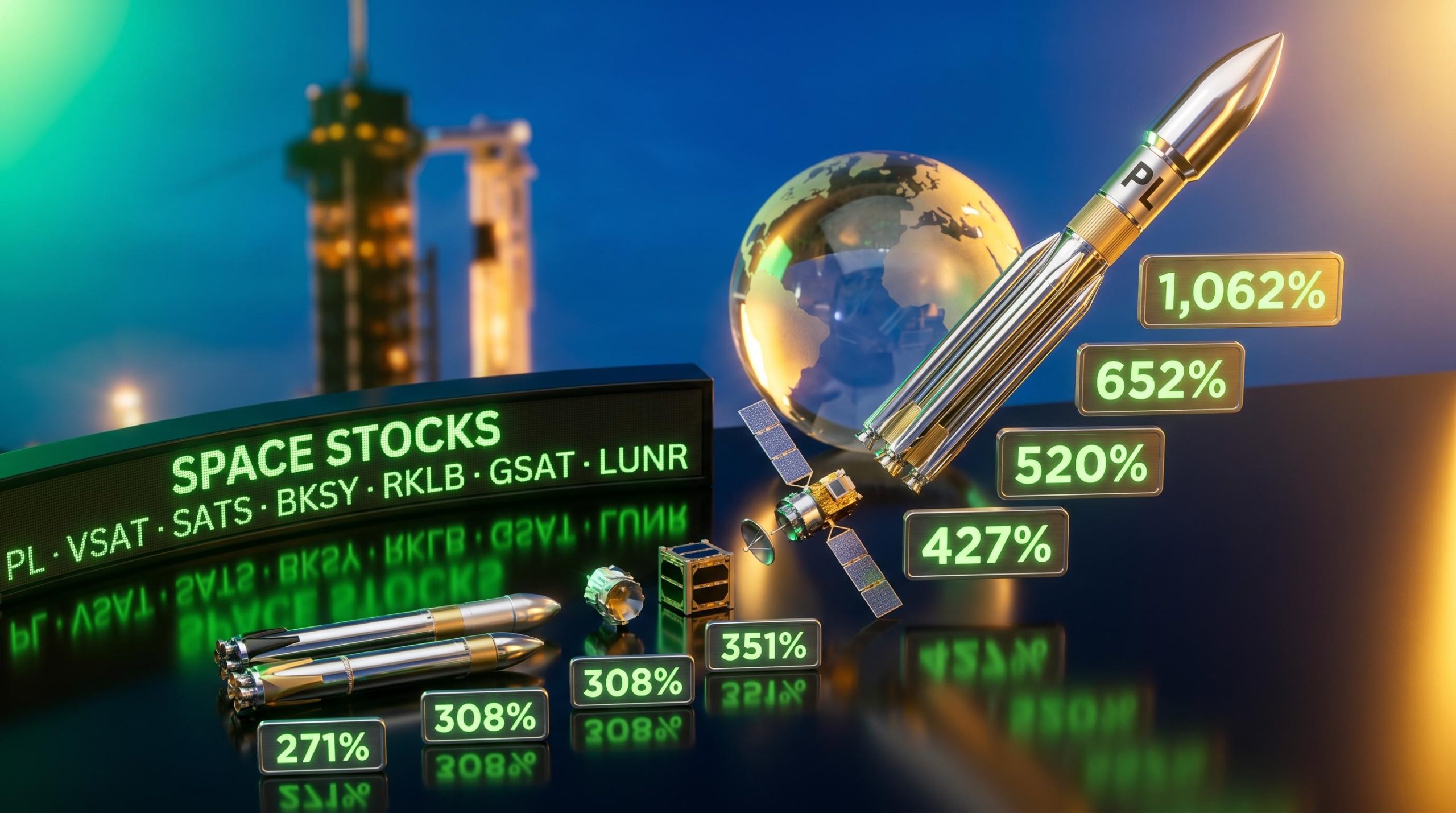
One stock in this group has returned over 1,000% in the past year. Another is up more than 600%. All seven are available right now through virtually any brokerage account in the United States.
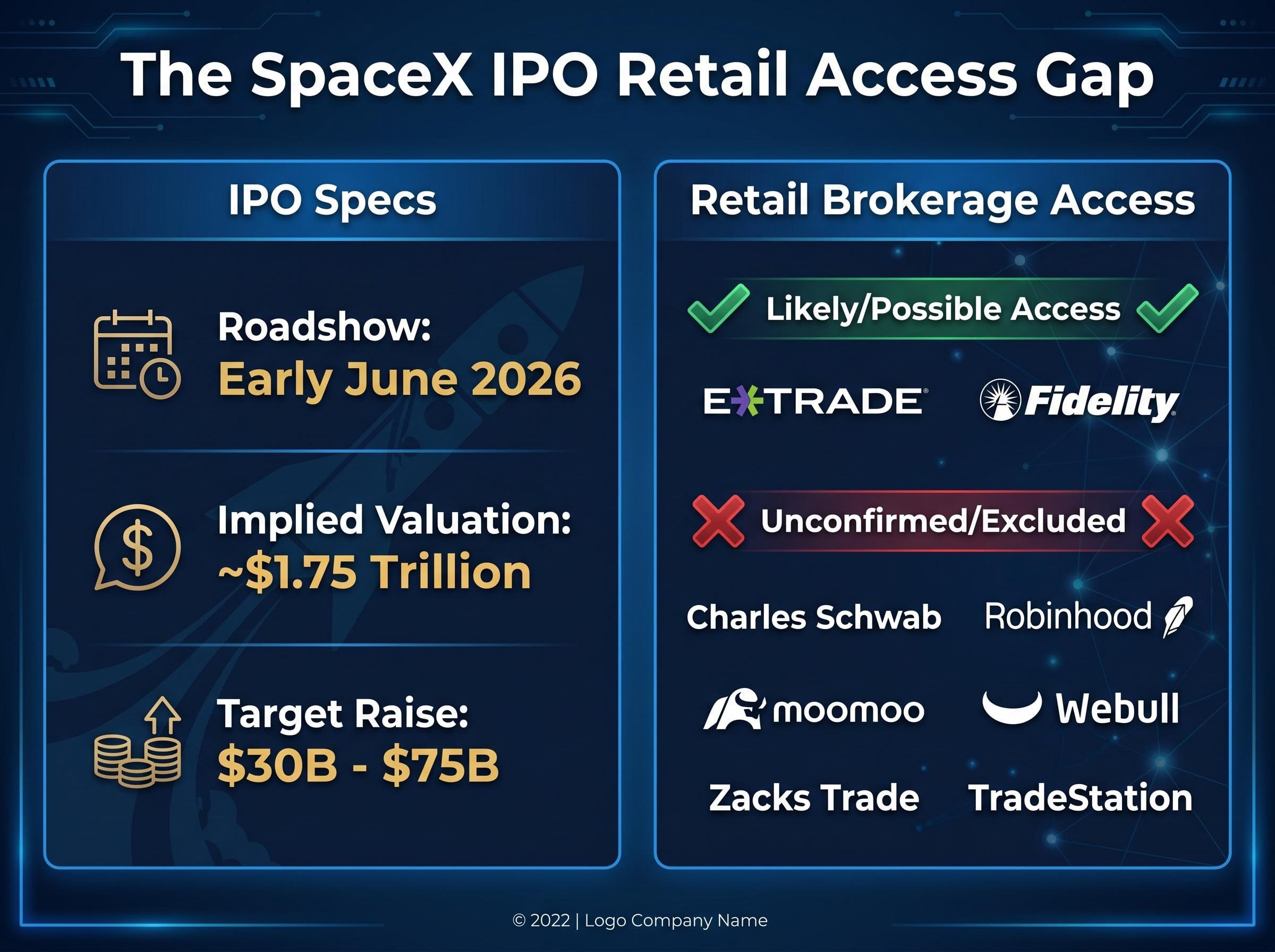
The SpaceX IPO, targeting a roadshow in early June 2026 and carrying an implied valuation near $1.75 trillion, has electrified retail investor interest in space stocks. But access to SpaceX shares at debut may be limited to **E*TRADE or Fidelity customers, leaving millions of investors at other brokerages watching from the sideline. That access problem has a solution already sitting on public markets: a cohort of publicly traded space companies with market caps above $1 billion** has delivered the kind of returns most investors associate with early-stage venture capital, not publicly listed equities.
What follows identifies seven publicly traded space-sector stocks with verified one-year returns ranging from 271% to over 1,000%, explains what each company does, and provides the context readers need to evaluate whether any of these names belong in a portfolio today.
Why the SpaceX IPO access problem is real and what it means for retail investors
Morgan Stanley is among the primary underwriters for the SpaceX offering, which positions its retail brokerage arm, **E*TRADE, as the likely lead retail distribution channel. Fidelity** is considered a secondary possibility for allocation access. Beyond those two, the picture narrows considerably.
The following major platforms have not been confirmed as participants in the SpaceX IPO:
- Charles Schwab
- Robinhood
- Moomoo
- Webull
- Zacks Trade
- TradeStation
That list covers millions of active retail accounts. SpaceX aims to raise above $30 billion, with some reports citing figures as high as $75 billion, yet the structural distribution of those shares may exclude the majority of self-directed investors.
There is also the question of whether IPO access, even if secured, translates to long-term outperformance.
The Nasdaq IPO long-run performance analysis found that almost two-thirds of new listings trail the broader market by year three, with most falling more than 10% behind, a base rate that applies regardless of the quality of the underlying business at debut.
A Nasdaq analysis of IPOs from 2010 to 2020 found that roughly two-thirds underperformed the broader market by year three.
That base rate does not make SpaceX a poor investment. It does make the case for evaluating existing public alternatives considerably stronger.
When big ASX news breaks, our subscribers know first
How to read these returns: what the space sector boom actually reflects
The one-year return figures in the sections ahead are real. They are also the product of specific conditions that readers should understand before treating any single number as a forward-looking signal.
The global space economy is projected to reach $1 to $1.8 trillion by 2040, according to industry analysis, providing the long-run demand backdrop for the entire sector.
The global space economy is projected to reach $1 to $1.8 trillion by 2040, a figure that supports the structural growth thesis even if near-term valuations correct.
SpaceX conducted approximately half of all orbital launches globally in 2025, underscoring how concentrated the sector’s operational capacity remains. That dominance, paired with the upcoming IPO, has created a sentiment wave that extends well beyond SpaceX itself.
The IPO halo effect explained
A landmark IPO in any sector tends to lift valuations across comparable public names as capital flows seek the next best available exposure. The SpaceX filing has functioned precisely this way. Seeking Alpha commentary specifically cites Rocket Lab (RKLB) and AST SpaceMobile (ASTS) as beneficiaries of this dynamic, and Roth Capital raised price targets for RKLB, Firefly Aerospace (FLY), and Intuitive Machines (LUNR) in April 2026.
Many of these stocks now carry high price-to-sales ratios, meaning valuations are pricing in future growth rather than current earnings. That is both the opportunity and the risk. The returns below are the result of genuine sector momentum and structural demand growth, amplified by a sentiment catalyst that may or may not persist at its current intensity.
The top performers: Planet Labs, Viasat, and EchoStar
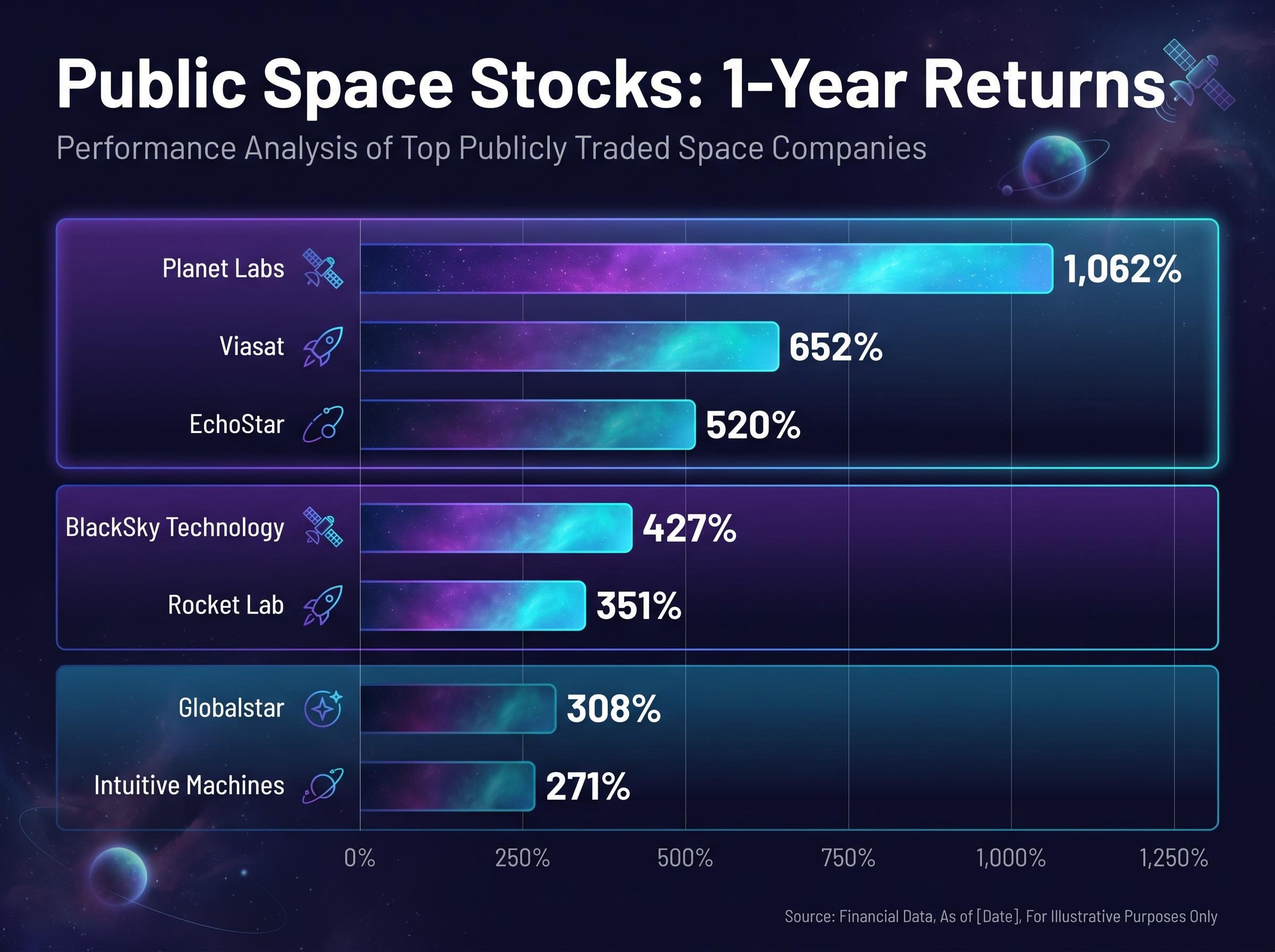
Planet Labs has returned approximately 1,062% over the past year. That is not a typo. The company operates an Earth observation satellite network that sells imagery and data analytics to government and commercial customers, a business model that scales with each satellite added to its constellation.
Viasat follows with a one-year return of approximately 652%, driven by its satellite communications business serving airlines, government agencies, and broadband customers. EchoStar rounds out the top tier at approximately 520%, with a satellite broadband and communications infrastructure model that has benefited from the broader sector rerating.
| Company | Ticker | Sector Focus | 1-Year Return (approx.) | Current Price (approx.) |
|---|---|---|---|---|
| Planet Labs | PL | Earth observation & data | 1,062% | $36.71 |
| Viasat | VSAT | Satellite communications | 652% | $65.91 |
| EchoStar | SATS | Satellite broadband & infrastructure | 520% | $123.14 |
The headline numbers earn attention. The question worth sitting with is what would need to remain true for these returns to continue: sustained government contract growth for Planet Labs, continued broadband demand expansion for Viasat, and a favourable competitive environment for EchoStar as SpaceX’s Starlink scales its own broadband offering. Each thesis has merit. None is guaranteed.
Strong mid-tier performers: BlackSky Technology and Rocket Lab
The returns on BlackSky Technology and Rocket Lab are smaller in percentage terms than the top three, but the business models underneath tell a different story about what kind of company each investor is actually buying.
BlackSky (BKSY) provides geospatial intelligence and satellite imagery services, primarily to government customers. Its one-year return of approximately 427% comes from a low base, with a year-to-date gain of roughly 300%. The magnitude reflects a rerating from deep-value territory rather than a steady operational ramp, a distinction that matters when assessing forward risk.
Rocket Lab (RKLB) is the most prominent pure-play public launch vehicle operator. Its one-year return of approximately 351% is built on something most space stocks cannot claim: meaningful revenue. The company reported Q4 2025 revenue of $602 million, and Roth Capital raised its price target in April 2026.
| Company | Ticker | Sector Focus | 1-Year Return (approx.) | Q4 2025 Revenue |
|---|---|---|---|---|
| BlackSky Technology | BKSY | Geospatial intelligence | 427% | Not disclosed |
| Rocket Lab | RKLB | Launch services & space systems | 351% | $602M |
Recent analyst actions on Rocket Lab include:
- Roth Capital raised its price target for RKLB in April 2026
- Seeking Alpha commentary highlighted RKLB as a buy, citing its revenue backlog
The difference between a valuation story and a revenue story is visible here. Rocket Lab generates the kind of quarterly revenue that supports a fundamental investment case, not just a momentum trade. For investors evaluating where operational substance sits within the space sector, this name warrants closer attention.
Emerging plays: Globalstar, Intuitive Machines, and AST SpaceMobile
These three names represent the frontier of the publicly traded space sector, where both the potential upside and the execution risk are at their highest.
Globalstar (GSAT) operates a satellite communications network and has returned approximately 308% over the past year, with a year-to-date return of roughly 350% from a low 2025 base. The magnitude of that move reflects a dramatic rerating rather than a proportional shift in operational fundamentals.
Intuitive Machines (LUNR) occupies a unique position as a primary contractor within NASA’s Commercial Lunar Payload Services (CLPS) programme, which funds commercial companies to deliver payloads to the Moon. Its one-year return of approximately 271% is tied directly to continued NASA lunar spending and successful mission execution.
| Company | Ticker | Business Focus | 1-Year Return (approx.) | Key Catalyst |
|---|---|---|---|---|
| Globalstar | GSAT | Satellite communications | 308% | Sector rerating from low base |
| Intuitive Machines | LUNR | NASA lunar payload services | 271% | CLPS contract pipeline |
| AST SpaceMobile | ASTS | Satellite-to-mobile broadband | ~53% YTD | Carrier partnerships & direct-to-device tech |
AST SpaceMobile: satellite broadband for every phone
AST SpaceMobile is building something no other company in this list is attempting: a broadband satellite network that connects directly to standard mobile phones without specialised hardware. The concept, if it scales, would turn every existing smartphone into a satellite-capable device through partnerships with major carriers.
That “if” is doing considerable work. The company’s high price-to-sales ratio is the primary counterargument analysts cite, and the technology remains in early commercial stages. Carrier partnerships provide the strongest validation signal for investors, but execution risk at this stage is real. The approximately 53% year-to-date return reflects conviction from investors willing to accept that uncertainty; the business model is differentiated enough to justify the premium only if delivery follows.
The SPAC wave of 2020-2022 brought dozens of early-stage space companies to public markets by bypassing the revenue thresholds required by conventional IPOs, a structural weakness that produced consistent post-merger price deterioration and, in Virgin Galactic’s case, a 99.7% loss from peak to current levels; space sector collapse risk of this magnitude is the benchmark against which any thesis on high price-to-sales names like AST SpaceMobile or Intuitive Machines must be tested.
This article is for informational purposes only and should not be considered financial advice. Investors should conduct their own research and consult with financial professionals before making investment decisions. Past performance does not guarantee future results.
The space race is already happening on public markets, with or without SpaceX
All seven stocks in this list are accessible through virtually any US brokerage account today, with no allocation lottery, no IPO waiting list, and no platform restriction. That structural advantage is worth repeating: the access barrier that defines the SpaceX IPO does not apply to a single name below.
Even for investors who do secure SpaceX allocation, the historical base rate is sobering. Roughly two-thirds of IPOs from 2010 to 2020 trailed the broader market by year three. The public alternatives are not consolation prizes; they are the sector’s growth story already in motion.
- Planet Labs (PL): ~1,062% one-year return; Earth observation and data analytics
- Viasat (VSAT): ~652% one-year return; satellite communications for airlines and government
- EchoStar (SATS): ~520% one-year return; satellite broadband infrastructure
- BlackSky Technology (BKSY): ~427% one-year return; geospatial intelligence services
- Rocket Lab (RKLB): ~351% one-year return; launch services with $602M Q4 2025 revenue
- Globalstar (GSAT): ~308% one-year return; satellite communications network
- Intuitive Machines (LUNR): ~271% one-year return; NASA lunar payload delivery
The $1 to $1.8 trillion space economy projection through 2040 suggests the sector’s long-run growth story is unlikely to be captured entirely by any single company, SpaceX included. The race is already happening on public markets. The question is not whether to watch it, but which names to evaluate first.
Investors who prefer diversified exposure rather than single-stock selection have a growing set of space ETF alternatives worth evaluating; comparable global funds including JEDI have returned over 172% in the past 12 months, and new vehicles tracking baskets of the same names covered in this article are entering the market ahead of the SpaceX IPO listing window.