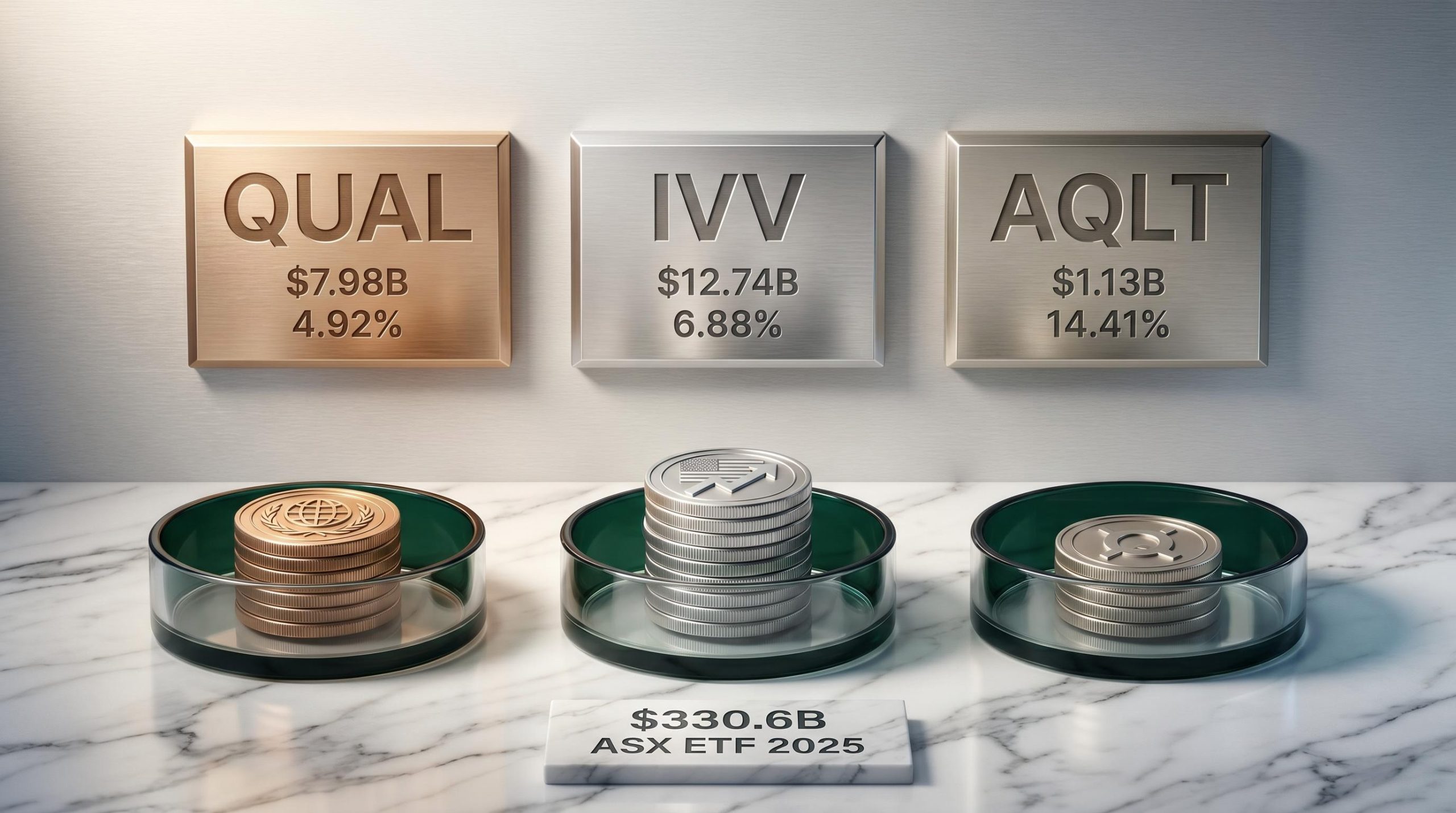
The Australian ETF industry crossed $330.6 billion in assets by the end of 2025, growing 34.2% in a single year. More choice, however, does not automatically produce better outcomes. Many investors are discovering that three well-chosen funds can do more work than a sprawling collection of overlapping positions.
With mid-2026 marking a natural portfolio review moment and passive investing continuing its structural rise among Australian retail investors, the question is no longer whether to use ETFs but which ones to combine and why. Quality-focused investing has emerged as a coherent framework for answering that question.
What follows profiles three ASX-listed ETFs, QUAL, IVV, and AQLT, explains the distinct role each plays in an ASX ETF portfolio, and shows why their combination forms a logical, complementary structure rather than a random selection.
Why fewer ETFs often build better portfolios
Holding seven or eight ETFs feels like diversification. In practice, many of those funds hold the same underlying securities in slightly different proportions, diluting purpose without reducing concentration risk.
A more effective approach gives each fund a distinct portfolio responsibility that the others do not replicate:
- International quality exposure (developed markets, excluding Australia)
- Broad US large-cap coverage (lowest possible cost)
- Domestic Australian quality (sector-differentiated home-market allocation)
When every position carries a clear role, concentration becomes a feature. The quality factor is what gives this three-fund combination its internal coherence: each fund, in its own geography, selects for companies with strong returns on equity, stable earnings, and conservative balance sheets.
The quality investing strategy is a systematic factor approach, not a subjective label: it targets companies scoring highest on return on equity, low debt, and earnings stability, which is precisely the methodology underpinning all three funds in this portfolio.
Morningstar characterises quality as “the fuzziest factor” but notes it has been “historically additive to returns over long investment horizons.”
The Australian ETF industry recorded approximately $48 billion in inflows during 2025, driven predominantly by equity ETFs, with projections estimating total assets surpassing $400 billion in 2026. As monthly inflows exceed $5 billion, the case for deliberate fund selection over accumulation grows stronger.
When big ASX news breaks, our subscribers know first
1. QUAL: The global quality anchor
What the fund screens for
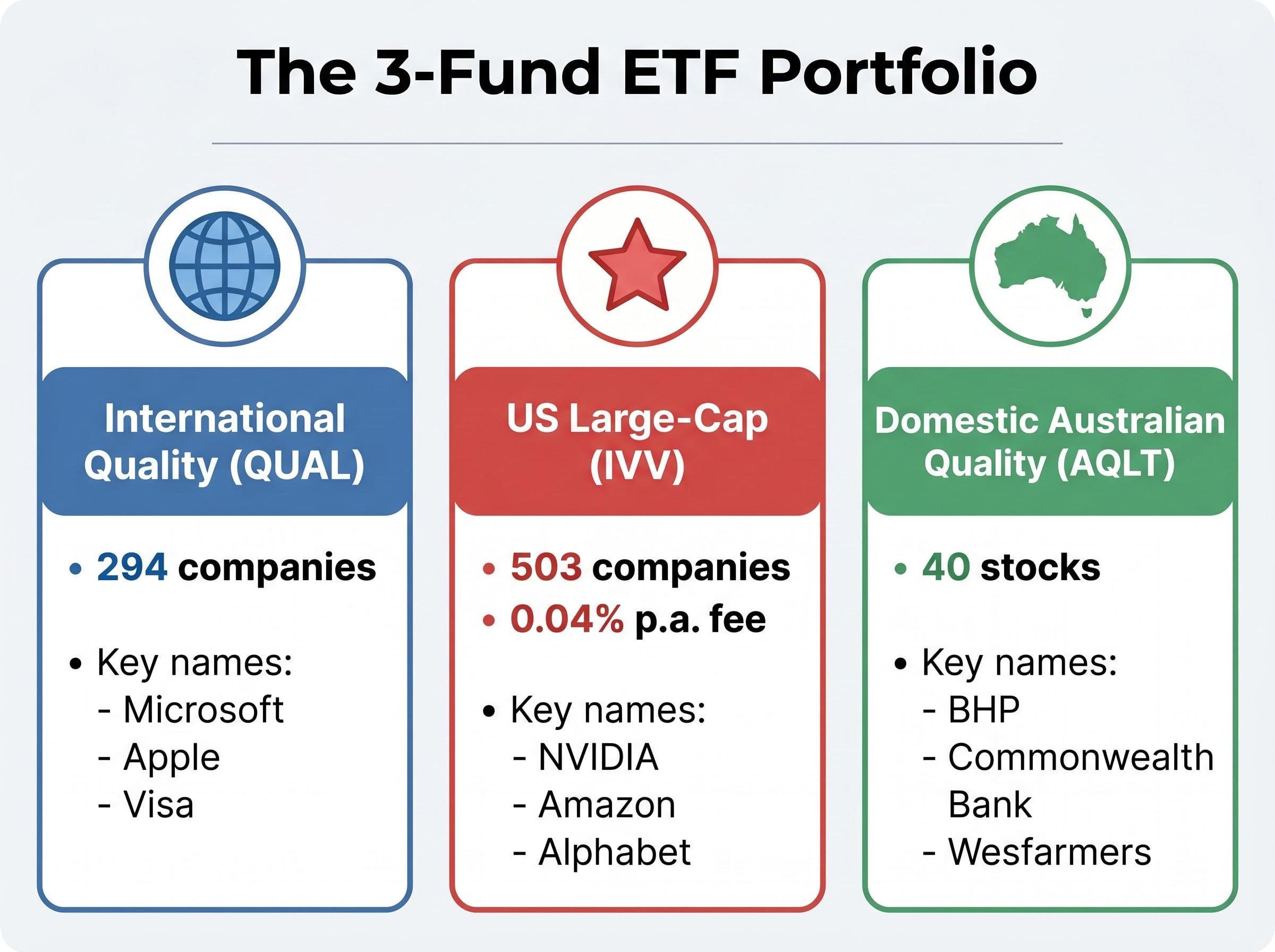
QUAL (iShares MSCI World ex Australia Quality ETF) does not simply buy an international index. It applies a three-metric screen, selecting companies with high return on equity, stable earnings growth, and low debt-to-equity ratios, to identify 294 of the world’s most financially disciplined businesses.
The result is a portfolio anchored by names such as Microsoft, Apple, and Visa: companies whose competitive positions tend to persist across economic cycles. This screening discipline is what separates QUAL from a generic global index fund and positions it as the portfolio’s stabilising layer.
Morningstar described QUAL as “a solid investment proposition, offering relatively low-cost exposure to high-quality global equities” (March 19, 2026).
VanEck analysts have also endorsed the fund’s approach as a sound long-term allocation for Australian investors seeking international quality exposure.
Performance in context
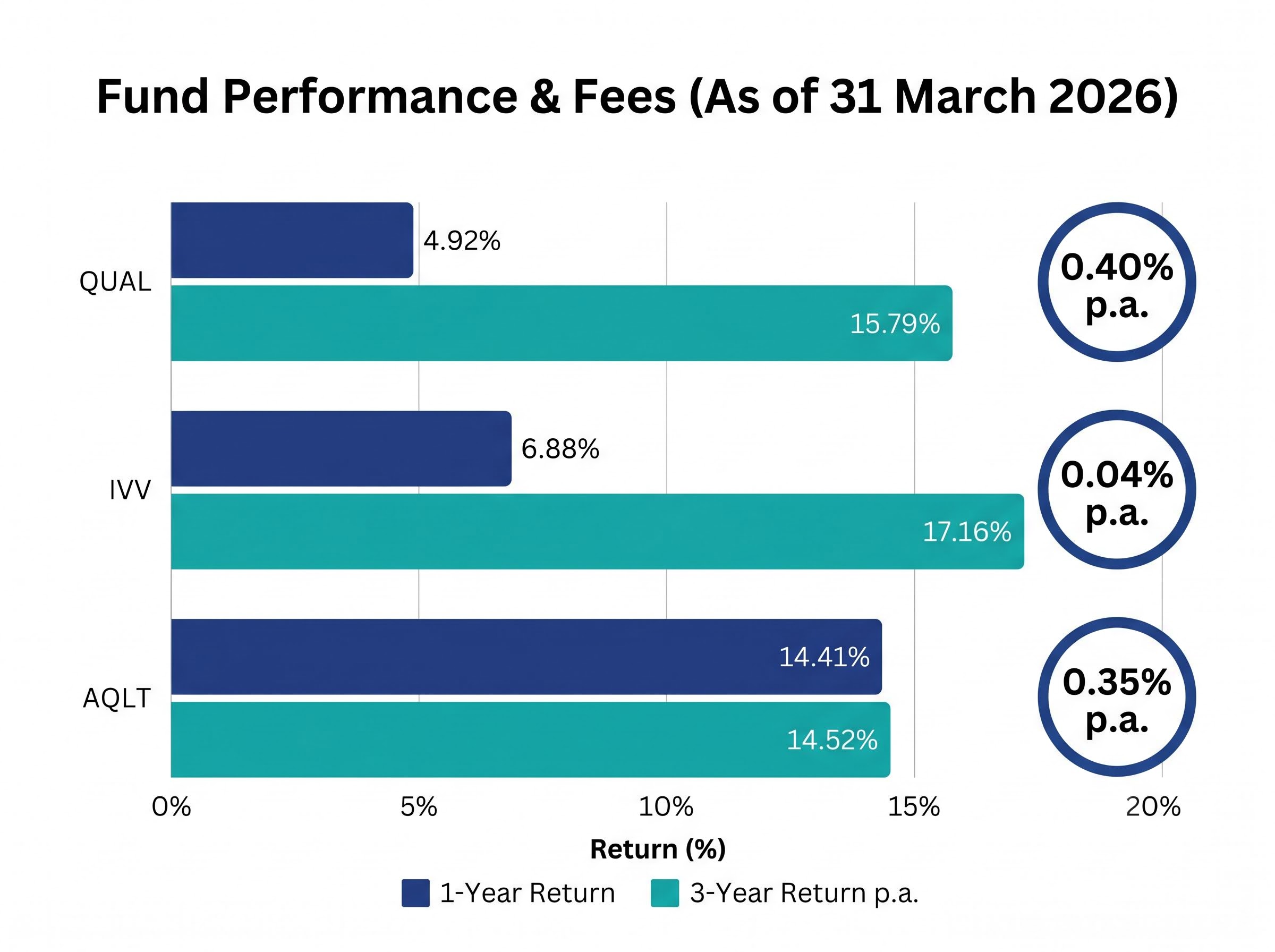
As of 31 March 2026, QUAL reported a 1-year return of 4.92%, a 3-year return of 15.79% p.a., and a 5-year return of 13.02% p.a. The fund manages $7.98 billion in total net assets at a management fee of 0.40% p.a.
Its 52-week range spans a high of $63.19 (reached 14 January 2026) to a low of $54.68 (30 April 2025), with the current NAV of approximately $59.77 sitting about 5.41% off the peak.
The quality factor underperformed globally in Q1 2026, registering as the weakest among major factors. That short-term volatility is a known characteristic of factor investing, not a structural concern. The three-year and five-year return figures suggest the methodology delivers on its promise over full market cycles.
The quality factor in elevated-risk markets has a well-documented historical pattern: companies with strong return on equity, low leverage, and stable earnings have tended to outperform during economic contractions, a characteristic that becomes particularly relevant when market valuations and macro sentiment diverge sharply.
2. IVV: Owning the world’s largest market for almost nothing
A management fee of 0.04% p.a. That figure is not a typo. IVV (iShares S&P 500 ETF) charges four basis points annually to hold 503 of the largest US-listed companies, making it one of the cheapest equity ETFs on the ASX.
The strategic logic is straightforward. The S&P 500 is a self-selecting index: as companies grow, their weighting increases; as they shrink, they fall away. The investor does not need to predict which companies will lead. The index handles that over time.
As of 31 March 2026, IVV reported a 1-year return of 6.88%, a 3-year return of 17.16% p.a., and a 5-year return of 14.15% p.a. The fund manages $12.74 billion in total net assets.
Notable holdings include:
- NVIDIA (NVDA)
- Amazon (AMZN)
- Alphabet (GOOGL)
The 52-week range runs from a high of $70.08 to a low of $57.40, with the current price around $66.52.
Practical consideration: IVV has been Australian-domiciled since September 2018 (original inception 15 May 2000), meaning it is subject to Australian tax rules rather than US withholding tax arrangements, a meaningful advantage for Australian investors.
The international ETF allocation shift among Australian retail investors accelerated sharply in Q1 2026, with global equity funds overtaking domestic products as the most purchased category for the first time on record; that structural realignment is the broader context within which combining QUAL and IVV as international components has become an increasingly common portfolio construction choice.
3. AQLT: Quality investing applied to the ASX
An Australian equity allocation does not have to mean buying the ASX 200 and accepting its heavy tilt toward banks and miners. AQLT (BetaShares Australian Quality ETF) offers something meaningfully different.
What makes AQLT different from the ASX 200
AQLT holds just 40 stocks, selected by the Solactive Australia Quality Select Index using the same quality principles applied by QUAL: high return on equity, low leverage, and earnings stability. The result is a portfolio that shares some of the ASX 200’s largest names, including BHP (BHP), Commonwealth Bank (CBA), and Wesfarmers (WES), but weights them according to financial quality rather than market capitalisation alone.
This gives the portfolio philosophical consistency across geographies. Whether investing internationally through QUAL or domestically through AQLT, the selection criteria remain aligned.
BetaShares analysts have endorsed the fund’s quality-screening approach as a way to access Australian equities with reduced exposure to the ASX’s structural sector biases.
Fund data and recent performance
As of 31 March 2026, AQLT reported a 1-year return of 14.41% and a 3-year return of 14.52% p.a., outpacing both QUAL and IVV over the trailing twelve months. The fund manages $1.13 billion in total net assets at a management fee of 0.35% p.a.
Its 52-week range runs from $30.49 to $36.00, with a current NAV of $33.60.
A five-year return figure is not available. AQLT launched on 4 April 2022, making it the newest of the three funds. That shorter track record is worth noting honestly; it means less data to evaluate through a full market cycle. The performance recorded so far, however, suggests the quality-screening methodology translates effectively to the domestic market.
How these three funds work together as a system
Viewed individually, each fund is a solid holding. Viewed together, their roles sharpen.
QUAL provides international quality exposure with a developed-markets, non-Australian focus. IVV delivers broad US large-cap coverage at the lowest cost available. AQLT contributes domestic Australian equity allocation with sector differentiation away from the ASX 200’s banking and mining concentration.
The overlap question is worth addressing directly. IVV and QUAL both hold international equities, and some US large-cap names appear in both. Their selection philosophies, however, are fundamentally different: IVV weights by market capitalisation; QUAL screens for financial quality. That distinction means the two funds serve different purposes even where individual securities overlap.
The combined management cost remains low. At 0.40%, 0.04%, and 0.35% respectively, even the most expensive of the three is a fraction of typical active fund fees. Together, the three funds represent approximately $21.85 billion in total assets, providing the liquidity and institutional scale that supports confident long-term holding.
| Fund | Asset Class | Management Fee | Fund Size | 1-Year Return |
|---|---|---|---|---|
| QUAL | Global Quality Equities (ex-AU) | 0.40% p.a. | $7.98B | 4.92% |
| IVV | US Large-Cap Equities | 0.04% p.a. | $12.74B | 6.88% |
| AQLT | Australian Quality Equities | 0.35% p.a. | $1.13B | 14.41% |
ASIC’s Regulatory Guide 282 (RG 282), released in November 2025, provides updated guidance on exchange-traded products and issuer obligations, reinforcing the compliance framework within which these funds operate.
Tax, costs, and practical considerations for Australian investors
A portfolio’s pre-tax return is only part of the picture. For Australian investors, three practical considerations can meaningfully affect net outcomes:
- CGT discount eligibility: Gains on disposal of ETF units are subject to capital gains tax, but investors holding units for more than 12 months qualify for the 50% CGT discount. This aligns naturally with a quality-focused, buy-and-hold philosophy.
- Franking credit relevance for AQLT: As an Australian equity ETF, AQLT’s distributions may include franking credits, providing a tax-efficient income component for Australian tax residents that the two international funds cannot replicate.
- IVV’s domicile advantage: Since its Australian domicile conversion in September 2018, IVV is subject to Australian tax rules rather than US withholding tax arrangements, simplifying the tax position for domestic holders.
The ATO guidance on calculating CGT confirms that the 50% discount applies to assets held by Australian resident individuals for at least 12 months, making the buy-and-hold structure of a quality ETF portfolio particularly tax-efficient relative to strategies that involve frequent rebalancing.
Holding ETF units for more than 12 months unlocks the 50% CGT discount, reinforcing the case for a patient, quality-driven approach rather than frequent trading.
These are not footnotes. Tax treatment is a genuine return driver, and understanding how CGT and franking credits interact with this portfolio structure can influence long-term outcomes as much as fund selection itself.
Investors wanting to extend this three-fund quality framework into other asset classes will find our full explainer on ASX ETFs for Australia’s inflation environment, which assesses six funds across income, diversification, and liquidity categories against the current 4.6% CPI backdrop, with specific yield and fee data for each.
This article is for informational purposes only and should not be considered financial advice. Investors should conduct their own research and consult with financial professionals before making investment decisions. Past performance does not guarantee future results.
Quality over quantity: the case for staying the course in 2026
A three-fund portfolio built on a coherent quality philosophy is a deliberate construction, not a minimal-effort compromise. Each fund earns its place by carrying a responsibility the others do not replicate.
The quality factor’s underperformance in Q1 2026 is a reminder that factor investing requires patience. The long-term return data for both QUAL and IVV, spanning five years and beyond, supports that patience with evidence.
As mid-2026 approaches, the framework introduced here offers a practical lens for portfolio review. Evaluate each holding against a single question: what distinct role does it play, and what would be lost if it were removed? If the answer is unclear, the position may be adding complexity without purpose.
Fewer, better-chosen funds. That remains the strongest argument for quality.