Why Two NAB Valuation Models Produce Such Different Answers
11 mins ago

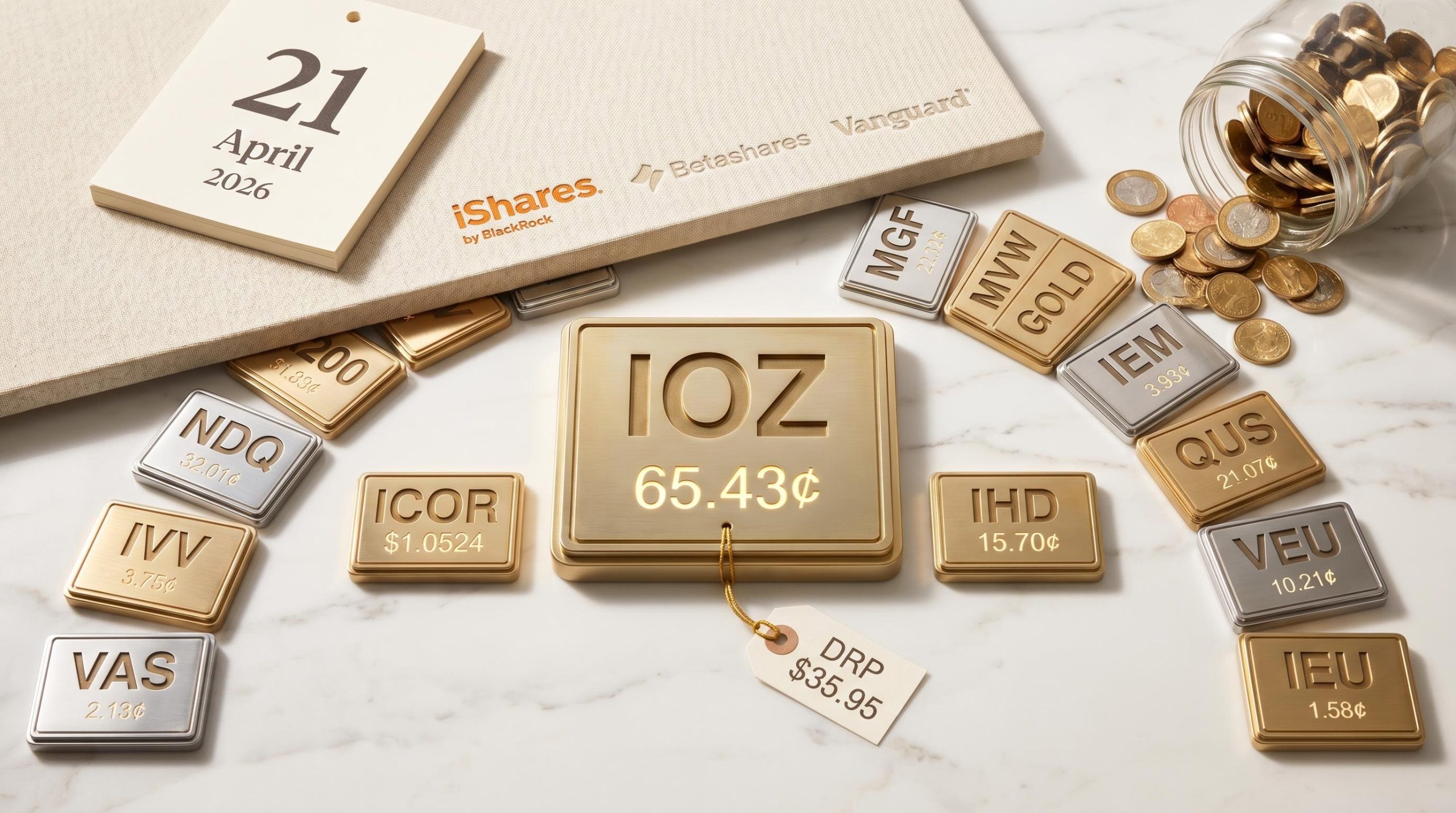
BlackRock’s iShares range paid out distributions across 15 ASX-listed ETFs on 21 April 2026, with per-unit amounts ranging from 15.70 cents (IHD) to $1.0524 (ICOR). The April 2026 distribution season proved one of the most concentrated quarterly payout windows for ASX ETF investors, with iShares, Betashares, and Vanguard all settling payments within a 24-hour window on 20-21 April. For income-focused retail investors, this period demands active attention: verifying cash receipts, checking Dividend Reinvestment Plan (DRP) allocations, and understanding what published DRP unit prices mean relative to the market prices visible on a trading screen. What follows is the complete iShares distribution table for April 2026, a breakdown of how DRP pricing works, the broader multi-provider context, and the practical steps investors should take to reconcile their holdings.
The table below presents the confirmed per-unit distribution amounts and DRP prices for all 15 iShares ASX-listed ETFs that paid in the April 2026 cycle.
Two payment date variations apply:
| ASX Code | Fund Name | Distribution (cents per unit) | DRP Price |
|---|---|---|---|
| ALTB | iShares Australian Listed Bond ETF | 65.43 | $95.48 |
| BILL | iShares Treasury ETF | 41.48 | $100.38 |
| GLIN | iShares Global Listed Infrastructure ETF | 16.70 | $31.77 |
| GLPR | iShares Global Listed Property ETF | 19.50 | $27.70 |
| IAF | iShares Core Composite Bond ETF | 80.61 | $100.65 |
| ICME | iShares Credit Income Active ETF | 57.17 | $99.43 |
| ICOR | iShares Core Corporate Bond ETF | 105.24 | $93.52 |
| IESG | iShares ESG Aware Australian Shares ETF | 28.44 | $31.24 |
| IGB | iShares Government Bond ETF | 40.52 | $96.61 |
| IHD | iShares S&P/ASX Dividend Opportunities ETF | 15.70 | $17.28 |
| ILB | iShares Inflation Linked Bond ETF | 43.33 | $126.16 |
| ILC | iShares S&P/ASX 20 ETF | 31.72 | $35.18 |
| IOZ | iShares Core S&P/ASX 200 ETF | 65.43 | $35.95 |
| ISEC | iShares Secured Credit Active ETF | 49.66 | $100.33 |
| IYLD | iShares Yield Plus ETF | 42.24 | $98.87 |
IOZ’s distribution of 65.43 cents per unit is the confirmed figure sourced from Motley Fool Australia’s 21 April 2026 coverage. An earlier circulating figure of 32.53 cents is incorrect. IOZ’s net asset value (NAV) stood at $34.89 as of 29 April 2026, reflecting the expected post-distribution decline.
The first reaction many investors have when checking their DRP allocation is that the price looks wrong. The figure does not match the live ASX quote, and it does not match the post-distribution NAV either. This is by design.
DRP unit prices are calculated by the fund manager using a volume-weighted average price (VWAP) over a defined period around the record date. The result is a blended price that reflects actual trading activity across multiple sessions, not a single snapshot of the live market at the moment of reinvestment.
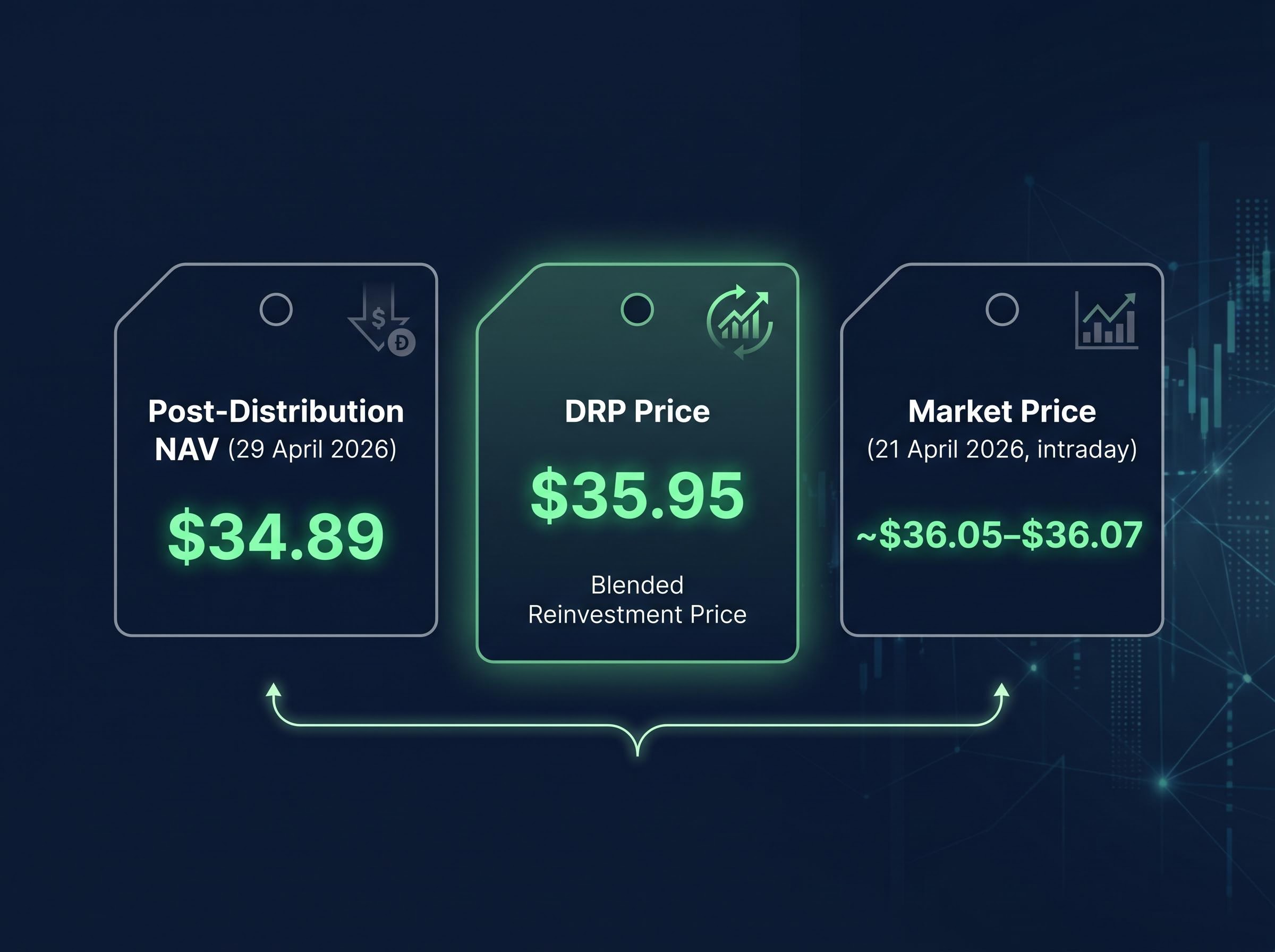
The gap becomes concrete when examining IOZ across three reference points:
| IOZ Price Reference | Amount |
|---|---|
| DRP Price | $35.95 |
| Market Price (21 April 2026, intraday) | ~$36.05-$36.07 |
| Post-Distribution NAV (29 April 2026) | $34.89 |
A similar pattern applies to IAF, where the DRP price of $100.65 sat above the fund’s trading price of approximately $100.32 on 20 April 2026. Both examples illustrate that three legitimately different price points can coexist for the same fund.
New units issued under the DRP are typically allocated within a few business days after the payment date. The DRP price is locked before that allocation occurs, meaning the price at which an investor receives new units was determined days earlier. This timing lag is another reason the DRP price will not match whatever the fund is trading at on the day the new units appear in a brokerage account.
The iShares cohort was not the only group settling payments last week. Betashares and Vanguard both paid distributions on 20 April 2026, one day before the bulk of the iShares range.
The following funds are confirmed as having paid within this window:
Per-unit distribution amounts for these Betashares and Vanguard funds were not confirmed in available sources at the time of publication. Investors holding positions in these ETFs should verify receipts directly via the respective fund manager’s investor relations pages or their brokerage platform.
This clustering of payments across providers is a normal feature of the quarterly distribution calendar. April, July, October, and January are consistently the most active months for income-focused investors to reconcile, as multiple providers tend to settle within the same week.
The Australian ETF market reached an estimated $340-$350 billion in assets under management as of April 2026, with Betashares forecasting growth beyond $500 billion by end-2028, a scale that makes the quarterly distribution calendar increasingly consequential for millions of retail income portfolios.
An ETF distribution is the passing through of income earned by the fund’s underlying portfolio to unit holders. For an equity ETF like IOZ, that income comes primarily from dividends paid by the companies in the S&P/ASX 200. For a bond ETF like IAF, it comes from interest payments on the fixed income securities held. Most ASX-listed ETFs distribute on a quarterly schedule.
The distribution cycle follows four key dates:
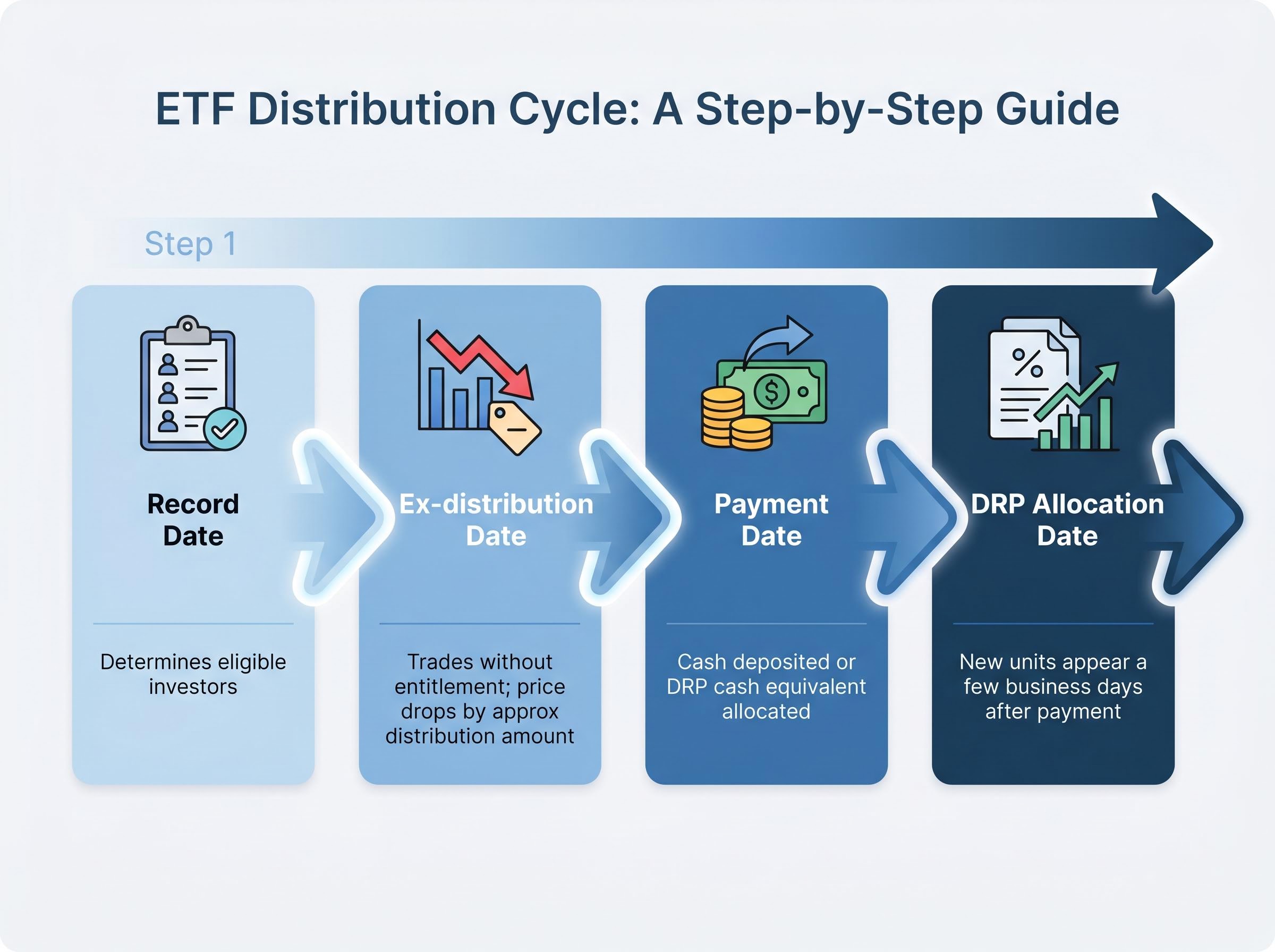
The price drop on the ex-distribution date is not a loss. It reflects value that has been extracted from the fund’s NAV and transferred directly to investors. The total value of the investment (units plus cash received) remains the same immediately after the distribution.
IOZ provides a useful illustration. Its distribution of 65.43 cents per unit, combined with a post-distribution NAV of $34.89 as of 29 April 2026, is consistent with the expected ex-distribution adjustment following the 21 April payment. Bond ETFs such as IAF follow the same mechanics but may settle on slightly different dates within each quarterly window.
Knowing the distribution amounts is one part of the equation. Deciding what to do with them is another.
Taking distributions as cash preserves flexibility. The income can be directed toward rebalancing an overweight position, covering personal expenses, or investing in a different fund entirely. The DRP, by contrast, automates compounding by reinvesting the distribution into additional units without incurring brokerage costs, though it can create small fractional unit positions that complicate portfolio tracking over time.
Income-focused ETF selection in the current environment extends beyond yield figures alone; with Australia’s CPI at 4.6% and the RBA cash rate at 4.10%, the real after-inflation return from a fund’s distribution becomes the more relevant measure, and several of the bond ETFs in this iShares cohort sit within that yield range.
| Dimension | Cash Distribution | DRP Reinvestment |
|---|---|---|
| Cash flow impact | Income received as cash | No cash received; reinvested into units |
| Brokerage cost | No cost on receipt; cost applies if reinvested manually | No brokerage cost on reinvestment |
| Tax liability | Taxable in year received | Equally taxable in year received |
| Compounding effect | Requires manual reinvestment | Automatic; compounds without investor action |
One point that catches many investors off guard: both cash distributions and DRP reinvestments are taxable events in Australia in the income year received. The Australian Taxation Office (ATO) treats DRP units as if the investor received the cash and immediately used it to purchase new units. The tax liability exists even when no cash was physically received.
The ATO guidance on ETF taxation confirms that DRP distributions are assessable income in the financial year they relate to, regardless of whether the investor physically receives cash, meaning the tax obligation arises at the time of the distribution event rather than at the point of any subsequent sale.
DRP participation for iShares ETFs is managed through Computershare Australia, the fund’s registry. Changes to DRP elections must typically be made before the record date for the following quarter. Investors who wish to switch between cash and reinvestment for the July 2026 cycle should check Computershare’s online portal or contact the registry directly well in advance of the next record date.
The next quarterly distribution cycle for most ASX ETFs is expected to fall in July 2026. Investors should consider setting a calendar reminder to check ex-distribution dates for each fund they hold approximately two weeks before the expected payment window.
For the April 2026 round, the following checklist captures the post-distribution actions to complete now:
Standing resources for future distribution data include BlackRock Australia’s distribution notices, Betashares and Vanguard investor relations pages, and ASX company announcements.
Investors wanting to assess whether their current iShares holdings are generating adequate real returns above Australia’s 4.6% CPI will find our dedicated guide to building an inflation-aware ETF portfolio useful; it walks through a three-layer framework spanning defensive income, real-return fixed income, and global growth equities with specific fund recommendations and yield comparisons.
This article is for informational purposes only and should not be considered financial advice. Investors should conduct their own research and consult with financial professionals before making investment decisions.
ASX ETF distributions are the passing through of income earned by a fund's underlying portfolio to unit holders, sourced from dividends for equity ETFs or interest payments for bond ETFs, and are typically paid on a quarterly schedule following a record date, ex-distribution date, and payment date cycle.
DRP prices are calculated using a volume-weighted average price (VWAP) over a defined period around the record date, meaning they reflect blended trading activity across multiple sessions rather than a live market snapshot, which is why the DRP price, the intraday market price, and the post-distribution NAV can all differ simultaneously.
Yes, the Australian Taxation Office treats DRP units as if the investor received the cash distribution and immediately used it to buy new units, making the distribution assessable income in the financial year it relates to regardless of whether any cash was physically received.
ICOR (iShares Core Corporate Bond ETF) paid the highest per-unit distribution in the April 2026 cycle at 105.24 cents per unit, with a DRP price of $93.52.
The next quarterly distribution cycle for most ASX ETFs is expected in July 2026, and investors should check ex-distribution dates for each fund they hold approximately two weeks before the expected payment window.