
Crude Drops 4% on Hormuz Hopes, but the Deal Isn’t Done
9 hrs ago


Vanguard launched two new ASX-listed ETFs in the first quarter of 2026, VTEK and V500, joining the established VEU to give Australian investors the building blocks for a genuinely global, low-cost portfolio from a single issuer. Most Australian retail investors hold the majority of their equity exposure in domestic shares, a market structurally concentrated in financials and resources. Gaining diversified global coverage has historically required products from multiple providers or access to international brokerage accounts.
That calculus shifted in March 2026. This guide explains how three ASX-listed Vanguard ETFs can be combined into a coherent portfolio framework, what each fund contributes, how costs compare to alternatives, and what Australian investors need to consider, from currency risk to tax treatment, before committing capital.
The ASX is not small. It is, however, concentrated. Financials, materials, and real estate dominate the index, leaving Australian-only investors structurally underexposed to the sectors driving global returns.
What a domestic-heavy portfolio is missing:
The ASX accounts for roughly 2% of global equity market capitalisation. A domestic-only portfolio is, by default, a concentrated geographic and sector bet.
The structural concentration described above is not a theoretical concern; ASX home bias has been measurable for decades, with Australian retail portfolios historically allocating far more than the country’s 2% share of global market capitalisation would justify on a neutral weighting basis.
This is not a criticism of Australian equities. It is a structural reality that requires a deliberate correction. The US market alone has historically been a consistent contributor to global investment returns, underpinned by innovation, scale, and deep capital markets. Vanguard’s March 2026 ETF launches, adding both thematic and broad-market products to its ASX range, signal that institutional providers now recognise Australian retail demand for that exposure.
Vanguard Australia’s home country bias research quantifies the consequences of this concentration, showing that Australian investors who overweighted domestic equities through 2023 missed material returns generated by international markets, particularly in technology and healthcare sectors that the ASX underrepresents.
The solution is not abandoning the ASX. It is complementing domestic holdings with targeted international allocations.
A three-ETF portfolio works when each fund covers a distinct role without significant overlap. The combination of VTEK, V500, and VEU divides responsibility along three lines: sector concentration, broad market breadth, and geographic diversification.
VTEK provides exposure to approximately 300 technology companies across developed and emerging markets. V500 tracks 500 of the largest US-listed companies spanning technology, healthcare, industrials, financial services, and consumer goods. VEU covers international markets outside the United States, including Europe, Asia, and emerging economies.
Together, the three funds address technology sector exposure, US large-cap breadth, and global ex-US diversification in a single portfolio.
ETF portfolio composition among Australian retail investors has shifted materially, with Millennials now allocating approximately 70% of their holdings to ETFs and international equity funds attracting $17.3 billion in inflows during 2025, compared with $10.6 billion into domestic Australian equity ETFs over the same period.
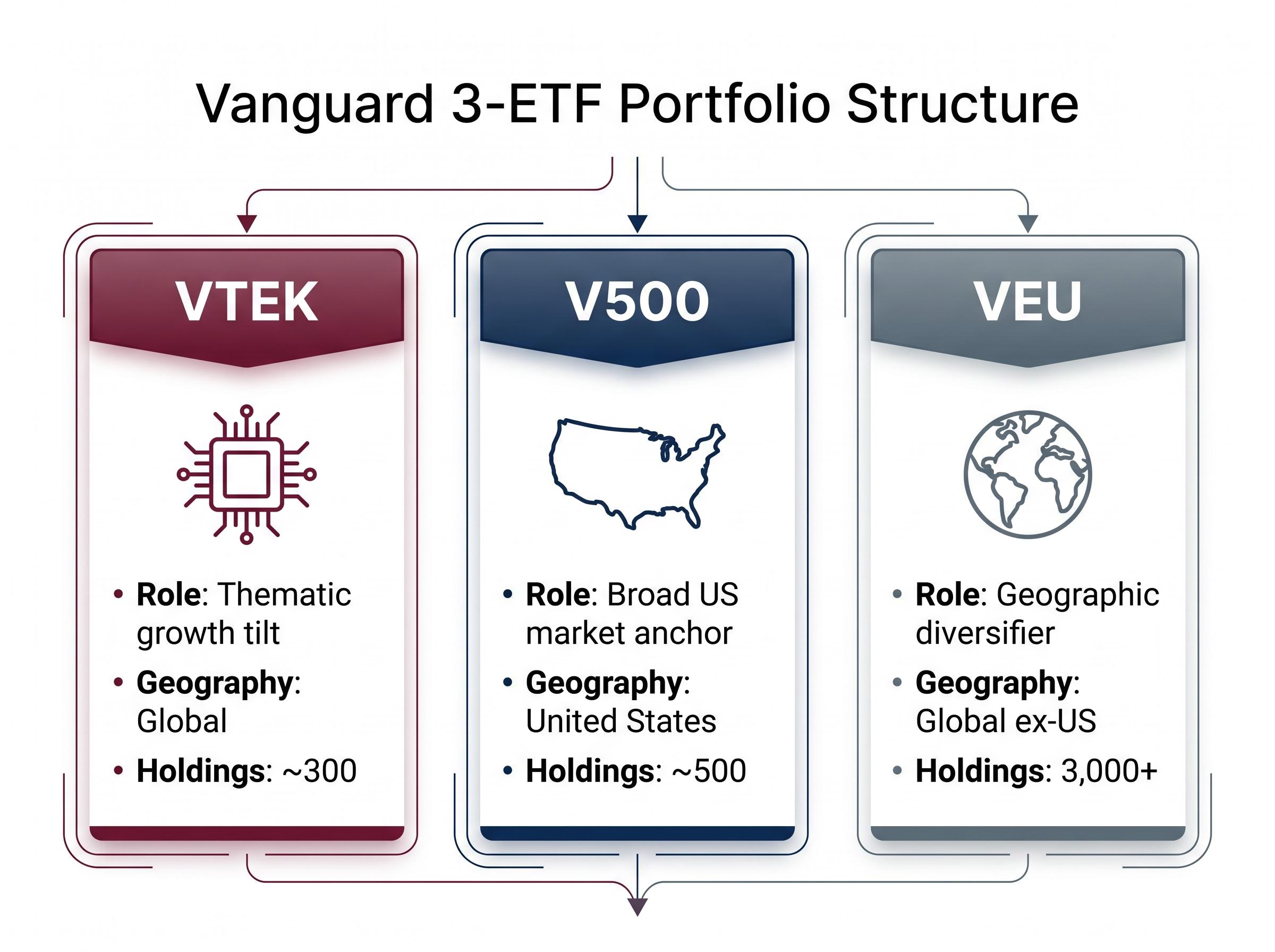
| ETF Ticker | Fund Name | Portfolio Role | Geographic Scope | Sector Emphasis |
|---|---|---|---|---|
| VTEK | Vanguard Global Technology Index ETF | Thematic growth tilt | Global (developed + emerging) | Technology |
| V500 | Vanguard S&P 500 US Shares Index ETF | Broad US market anchor | United States | Multi-sector |
| VEU | Vanguard All-World ex-US Shares Index ETF | Geographic diversifier | Global ex-US | Multi-sector |
The tension a growth-oriented investor needs to manage sits between VTEK and V500. VTEK adds return potential and concentration risk simultaneously. V500 and VEU help offset that risk by distributing capital across sectors and geographies.
V500 already includes large-cap US technology companies through its S&P 500 tracking. Adding VTEK does not introduce purely additive holdings; it creates a deliberate overweight to global technology.
This is a known design choice, not a flaw. Investors who want more technology exposure than a standard S&P 500 allocation provides can use VTEK to tilt intentionally. Those who prefer a market-weight tech allocation may choose to reduce their VTEK weighting or omit it entirely.
V500 tracks 500 of the largest US-listed companies, providing diversified exposure across technology, healthcare, industrials, financial services, and consumer goods in a single fund. It launched on 3 March 2026, and its management expense ratio (MER), the annual fee charged as a percentage of assets, is estimated at 0.07-0.10% per annum based on comparable Vanguard products. Investors should verify the confirmed figure via Vanguard Australia’s product page or product disclosure statement (PDS).
VEU captures international markets outside the United States, including Europe, Asia, and emerging economies. These regions tend to outperform at different stages of the economic cycle than the US, meaning VEU provides returns that are less correlated with V500. Its confirmed MER is 0.08% per annum, and its net asset value (NAV) as of 24 April 2026 was $112.20.
VTEK targets approximately 300 technology companies globally, with position-size limits on individual holdings to reduce single-stock concentration risk. It launched on 25 March 2026 with a confirmed MER of 0.23% per annum. Its NAV as of 23 April 2026 was $55.7692. A recent downturn in technology share prices has made valuations within this sector more appealing, though short-term price movements should be interpreted with caution.
| ETF Ticker | MER (% p.a.) | Launch Date | Approx. Holdings | Status |
|---|---|---|---|---|
| VTEK | 0.23% | 25 March 2026 | ~300 | Confirmed |
| V500 | 0.07-0.10% | 3 March 2026 | ~500 | Estimated |
| VEU | 0.08% | Established | 3,000+ | Confirmed |
VTEK and V500 both launched in March 2026. Neither fund has a meaningful performance track record as of 30 April 2026. Investors should not rely on short-term price movements when evaluating these products.
Cost is the one variable entirely within an investor’s control before capital is committed. The three Vanguard ETFs sit at the low end of ASX-listed management fees, but the blend matters because each fund carries a different MER.
A worked example illustrates the blended cost:
That blended figure sits below many single-fund alternatives, though VTEK’s 0.23% MER is the primary cost driver. Increasing the VTEK allocation raises the portfolio’s overall expense; reducing it brings the blended cost closer to 0.08%.
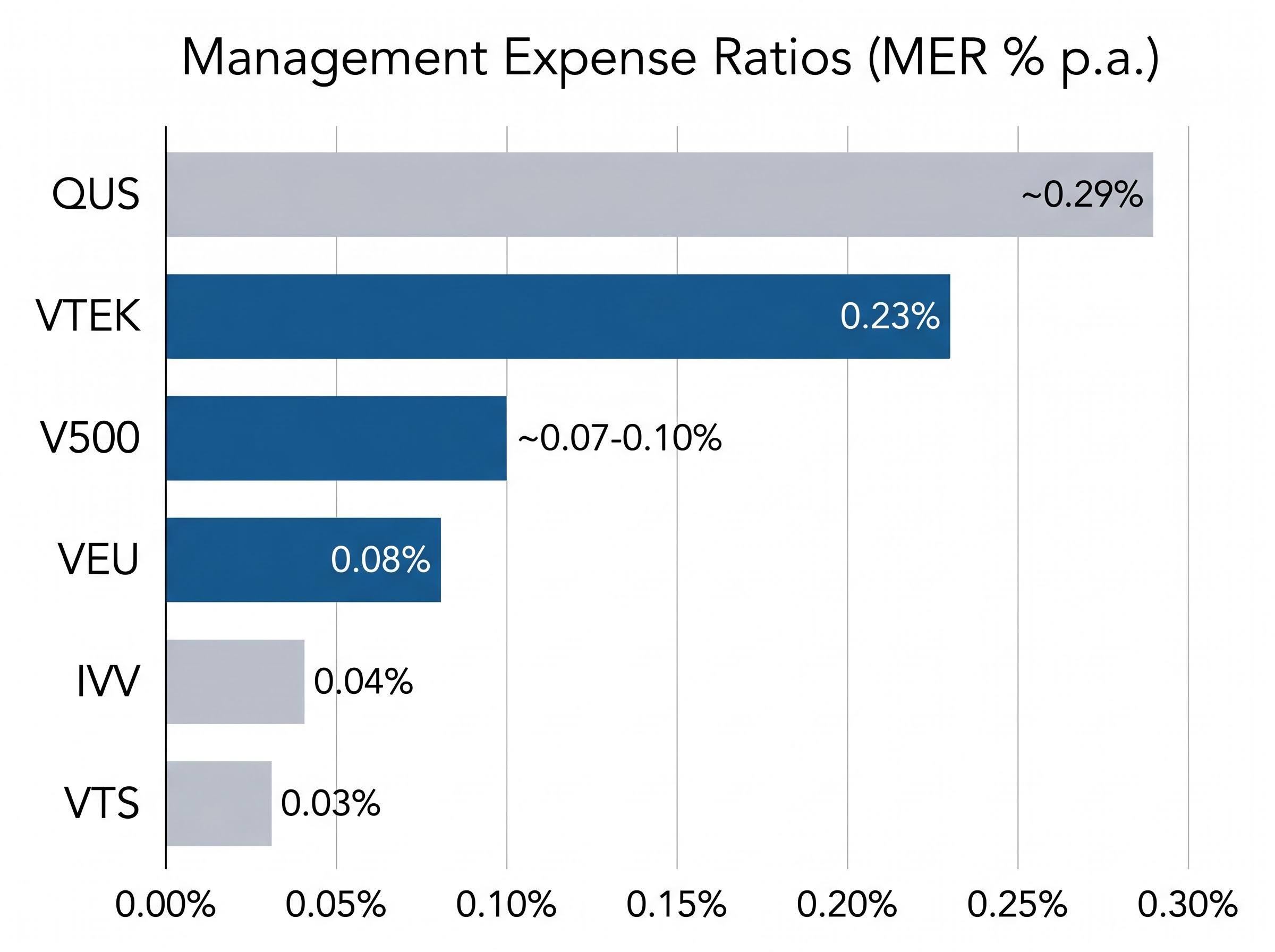
| ETF Ticker | Issuer | Exposure | MER (% p.a.) | Notes |
|---|---|---|---|---|
| VTEK | Vanguard | Global technology | 0.23% | Highest MER of the three |
| V500 | Vanguard | S&P 500 | ~0.07-0.10% | Estimated; verify via PDS |
| VEU | Vanguard | Global ex-US | 0.08% | Confirmed |
| IVV | iShares | S&P 500 | 0.04% | Lowest-cost S&P 500 on ASX |
| QUS | BetaShares | S&P 500 Equal Weight | ~0.29% | Different weighting methodology |
Investors prioritising cost above brand consistency may achieve a lower blended MER by substituting IVV (at 0.04%) for V500. VTS, Vanguard’s existing Total US Market ETF at 0.03% per annum, offers another ultra-low-cost comparison point, though it tracks a broader index than the S&P 500.
Product specifications tell only part of the story. Three practical considerations affect after-tax, after-currency returns for Australian investors.
None of the three ETFs are hedged to the Australian dollar. A strengthening AUD reduces the AUD value of international returns even when the underlying assets perform well in local currency terms. Over long holding periods, currency movements tend to average out, but over shorter periods they can materially affect portfolio valuations.
Vanguard launched VTKH alongside VTEK on 25 March 2026, which appears to be a hedged variant of the global technology exposure. Investors with strong currency views may wish to investigate this alternative.
The performance gap created by hedged versus unhedged ETF performance widened noticeably in early 2026, as the AUD appreciated from approximately 0.6777 in January to around 0.7153 by mid-to-late April, producing materially different year-to-date returns for investors who held currency-hedged products compared with those who did not.
Australian equity ETFs such as VAS distribute dividends that carry franking credits, reducing the investor’s tax liability. International ETFs, including VEU, VTEK, and V500, do not attract franking credits. Instead, foreign income tax offsets may apply to partially offset withholding tax paid in the source country.
The distinction matters for after-tax returns, particularly for investors in higher tax brackets. The Australian Taxation Office (ATO) provides guidelines on foreign income tax offsets, and Vanguard Australia publishes annual tax statements for each ETF. Consulting a tax professional is recommended for individual circumstances.
The VTEK, V500, and VEU combination provides technology sector exposure, US large-cap breadth, and global ex-US diversification in three low-cost, ASX-listed funds from a single issuer. The confirmed MERs are 0.23% for VTEK, 0.08% for VEU, and an estimated 0.07-0.10% for V500.
All three ETFs trade on the ASX, meaning they can be purchased through any standard Australian brokerage account with no need for an international trading platform.
Allocation ratios are a personal decision driven by risk tolerance, investment horizon, and existing portfolio composition. There is no single formula that applies uniformly. The framework above provides the architecture; the weightings require individual judgement.
For investors wanting to stress-test this framework against market drawdowns, our full explainer on building a three-layer ASX portfolio examines how cash, income, and equity layers interact during sharp selloffs, including the March 2026 period when the S&P/ASX 200 fell 7.8% and Australian ETF investors committed $5.6 billion to the market at the same time.
Recommended next steps:
ASIC’s regulatory guide on exchange traded products sets out the disclosure obligations that issuers must meet through Product Disclosure Statements, the document Australian investors should consult to verify confirmed MERs, distribution policies, and fund objectives before committing capital to any ASX-listed ETF.
This article is for informational purposes only and should not be considered financial advice. Investors should conduct their own research and consult with financial professionals before making investment decisions. Past performance does not guarantee future results.
Vanguard launched two new ASX-listed ETFs in early 2026: VTEK (Vanguard Global Technology Index ETF), which launched on 25 March 2026, and V500 (Vanguard S&P 500 US Shares Index ETF), which launched on 3 March 2026, joining the established VEU (Vanguard All-World ex-US Shares Index ETF).
Each fund covers a distinct role: VTEK provides a thematic tilt toward approximately 300 global technology companies, V500 offers broad US large-cap exposure across 500 companies and multiple sectors, and VEU diversifies across international markets outside the United States, including Europe, Asia, and emerging economies.
VTEK carries a confirmed MER of 0.23% per annum, VEU has a confirmed MER of 0.08% per annum, and V500 has an estimated MER of 0.07-0.10% per annum, which investors should verify via Vanguard Australia's product disclosure statement.
No, VTEK, V500, and VEU do not attract franking credits because they hold international assets; however, foreign income tax offsets may partially offset withholding tax paid in the source country, and investors should consult a tax professional for their specific circumstances.
Yes, Vanguard launched VTKH alongside VTEK on 25 March 2026, which appears to be a hedged variant of the global technology exposure, making it an option for investors concerned about Australian dollar appreciation reducing their international returns.