International ETFs overtook domestic ETFs as the most purchased category on the Selfwealth by Syfe platform in Q1 2026. That single data point, drawn from the platform’s Quarterly Investor Pulse report published in April 2026, captures a shift that has been building for years but has now crossed a measurable threshold. Australian retail investors are moving beyond home bias, and the evidence is no longer anecdotal. It is structural. Driven by the ASX’s sectoral concentration, growing platform accessibility, and a macroeconomic environment that has made global diversification feel less optional, the reallocation is showing up across multiple data sources and across every generational cohort. What follows is an analysis of why this is happening, how different generations are approaching it, and what the data signals about the maturation of retail investing in Australia in 2026.
Why the ASX alone is no longer enough for Australian investors
The Australian Securities Exchange accounts for a small fraction of global market capitalisation. That is not a temporary condition. The ASX’s composition is structurally weighted toward banks and resource companies, a concentration that has persisted for decades and shows no sign of reversing. For investors whose portfolios sit entirely within that universe, the result is chronic underexposure to entire sectors of the global economy.
ASX concentration risk, the structural overweighting toward financials and resources that leaves domestic-only portfolios with minimal exposure to technology, healthcare, or advanced manufacturing, has become one of the most frequently cited motivations behind the rotation into international index products among retail investors in 2026.
Home bias research in Australian equity portfolios has documented persistent overweighting of domestic securities even where risk-adjusted returns favour international diversification, providing the academic foundation for why the Q1 2026 shift toward international ETFs represents a meaningful behavioural departure from historical norms.
International ETFs address this gap directly. Through a single trade on an Australian platform, investors can access sectors that the domestic market does not meaningfully represent:
- Technology: Large-cap software, semiconductor, and cloud infrastructure companies listed primarily in the United States and Asia
- Healthcare and biotechnology: Global pharmaceutical and medtech firms with pipeline diversity unavailable on the ASX
- Defence: Multinational defence contractors, accessed through products such as the BetaShares Global Defence ETF (ARMR)
- Consumer and industrial conglomerates: Diversified multinationals spanning retail, logistics, and advanced manufacturing
The Selfwealth by Syfe Quarterly Investor Pulse for Q1 2026 identified four primary trends among its user base: a growing preference for international ETFs, generational convergence in portfolio construction, declining enthusiasm for gold, and increasingly reactive trading patterns. BetaShares’ March 2026 ETF Review corroborated the demand picture, reporting record inflows into the Australian ETF market with international funds leading on diversification-driven buying. The structural limitation is now widely understood, and investors are acting on it.
When big ASX news breaks, our subscribers know first
The inflection point: international ETFs now lead Australian retail buying
The shift did not arrive overnight. Australian ETF market assets grew 31.7% year-over-year to March 2026, according to GlobalX, extending a five-year compound annual growth rate of 26.3%. International funds have been gaining share within that expansion for several consecutive quarters. The Q1 2026 data from Selfwealth by Syfe, where international ETFs surpassed domestic ETFs in purchase volumes for the first time, marks the point where the trend crossed from directional to dominant.
Issuer-level data confirms this is not a single-platform anomaly. Vanguard reported record inflows into global equities as a top retail allocation category in 2026. BetaShares’ March 2026 review documented record industry-wide inflows, with international funds attracting the strongest diversification-motivated demand. The BetaShares/Investment Trends report found that approximately 80% of ETF investors plan to increase their ETF holdings through 2026.
Approximately 80% of Australian ETF investors plan to increase their ETF holdings in 2026, according to the BetaShares/Investment Trends report, reflecting broad structural confidence in the vehicle regardless of short-term market sentiment.
Specific products illustrate the intent behind the flows. ATEC attracted dip-buying interest from retail investors seeking technology-adjacent exposure following volatility, while ARMR captured demand for global defence sector allocation amid geopolitical uncertainty.
Gold’s declining role in Australian retail portfolios is a parallel signal worth noting: despite bullion prices exceeding US$3,000 per ounce in early 2026, transaction volumes for gold fell sharply on major platforms, suggesting that the appetite for risk-on international growth equities has displaced even elevated-price defensive assets as the preferred hedge against domestic market concentration.
| ETF | Category | Q1 2026 Signal | Data Source |
|---|---|---|---|
| ATEC | Technology / Growth | Dip-buying interest following volatility | Selfwealth by Syfe Q1 2026 |
| ARMR | Global Defence | Rising allocation amid geopolitical demand | Selfwealth by Syfe Q1 2026 |
| Broad International Index ETFs | Global Equities | Record inflows; top retail category | BetaShares, Vanguard, GlobalX |
What generational convergence actually looks like in 2026
The assumption that younger investors favour speculative individual stocks while older cohorts stick to blue chips turns out to be wrong, or at least incomplete. Selfwealth by Syfe’s Q1 2026 data shows that Gen Z and Gen X have converged on nearly identical portfolio structures: approximately 50% allocated to ETFs and 50% to individual stocks.
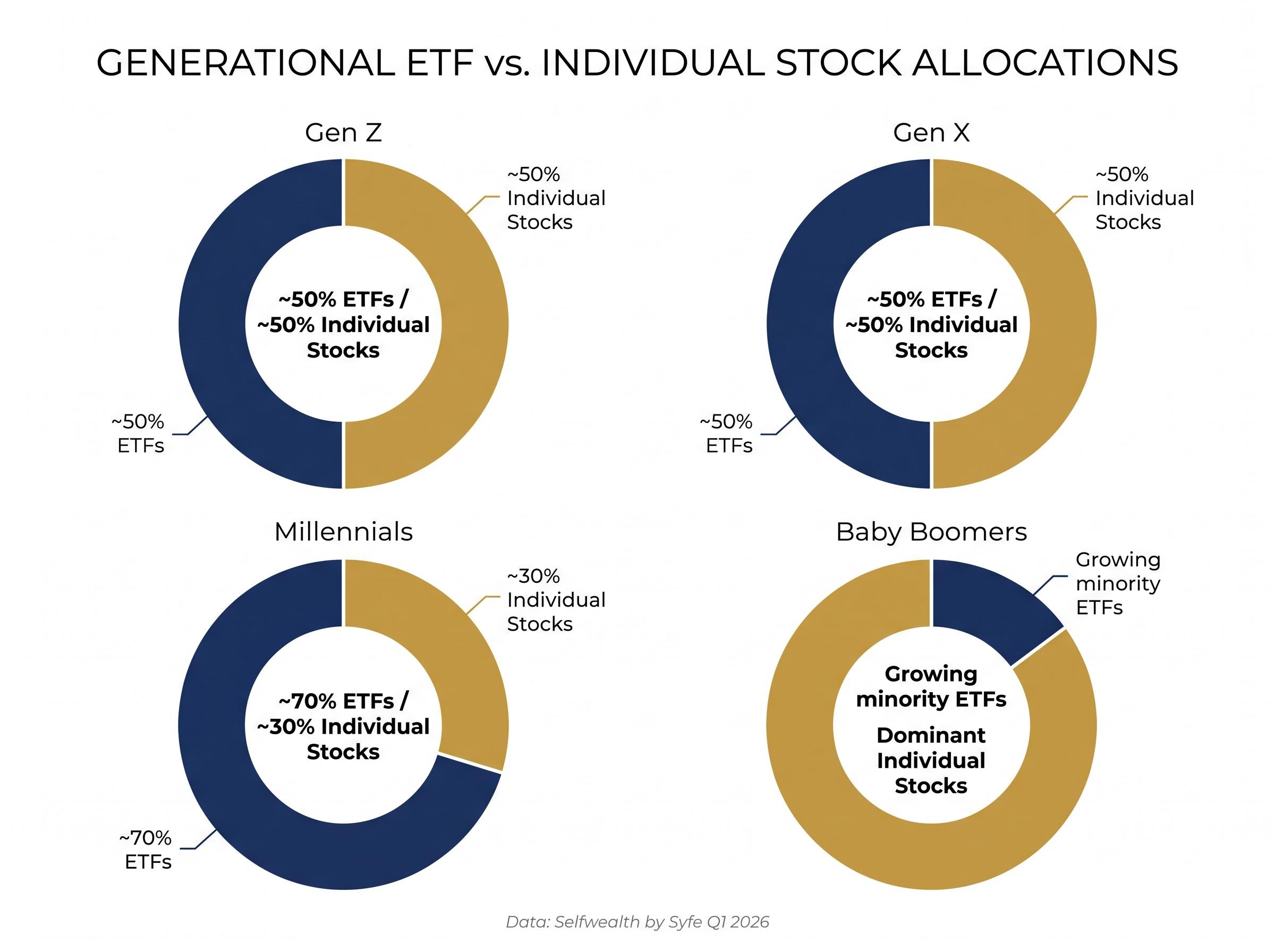
That Gen Z resembles Gen X is the counterintuitive finding. Social media narratives have emphasised younger investors’ appetite for meme stocks and speculative positions, yet the platform data tells a different story. Gen Z investors are splitting their portfolios evenly between passive diversification and active stock selection, a structure that mirrors the approach of a cohort two decades older.
Millennials are the outlier. With approximately 70% of portfolios allocated to ETFs, they are the most ETF-heavy generation, suggesting a cohort that came of age during the post-GFC era of low-cost passive investing and has internalised the model more deeply than any other. Baby Boomers, meanwhile, continue to favour direct stock ownership but are progressively adding ETFs as a diversification layer. The Livewire Markets 2026 survey characterised the broader shift as moving “from power users to all-in allocators.”
| Generational Cohort | Approximate ETF Allocation | Approximate Individual Stock Allocation | Notable Characteristic |
|---|---|---|---|
| Gen Z | ~50% | ~50% | Balanced despite assumptions of speculative bias |
| Millennials | ~70% | ~30% | Most ETF-heavy cohort; post-GFC passive adoption |
| Gen X | ~50% | ~50% | Converged with Gen Z on portfolio structure |
| Baby Boomers | Growing minority | Dominant | Progressively adding ETFs to direct holdings |
The convergence reframes ETF adoption as a structural feature of modern Australian retail investing across the life cycle, not a demographic quirk confined to digitally native cohorts.
How macroeconomic events are reshaping retail investor behaviour in real time
The Reserve Bank of Australia raised the cash rate by 25 basis points to 4.10% on 17 March 2026. Within weeks, trading activity on the Selfwealth by Syfe platform fell by more than 20%. The chilling effect was immediate and measurable, concentrated among investors with heavy exposure to rate-sensitive ASX sectors such as banks and property.
International ETFs as an inflation hedge against the ASX’s concentrated financial and mining sectors represent a framing that has gained traction among retail investors in 2026, particularly as the RBA’s tightening cycle compressed returns in rate-sensitive domestic sectors and made the diversification case harder to ignore.
Contrast that with what happened roughly a year earlier. When the United States announced sweeping tariff measures in April 2025, trading volumes on the same platform doubled.
Trading volumes on Selfwealth by Syfe doubled during the US tariff announcement in April 2025, a pace of reactive activity that underscored the speed at which macroeconomic developments now translate into retail order flow.
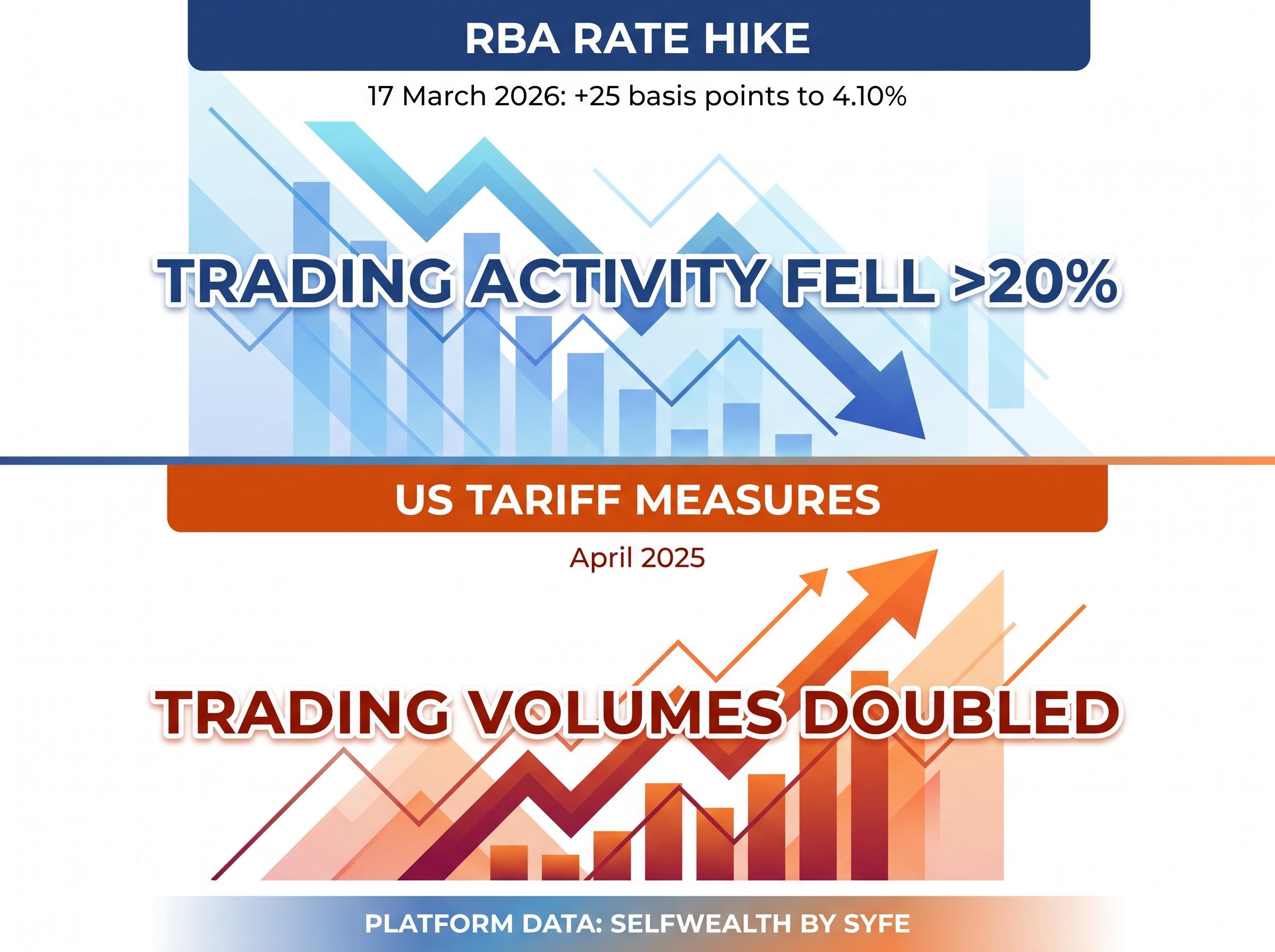
The two episodes reveal an investor base operating with a hair-trigger sensitivity to macroeconomic signals. Volumes spike on geopolitical shock and contract on domestic monetary tightening. Yet beneath this reactive surface, a separate pattern persists.
The Livewire Markets 2026 survey found that ETF investors continued accumulating positions even while holding broadly bearish market outlooks. Two behavioural paradoxes emerge from the data:
- Bearish sentiment coexisting with persistent ETF buying, suggesting ETFs function as structural portfolio anchors rather than sentiment-driven trades
- Volume spikes on volatility events coexisting with ongoing accumulation patterns, indicating short-term reactivity layered on top of long-term discipline
The implication is that a cohort of Australian retail investors is developing the capacity to hold structural positions through volatility, even as their trading behaviour on the margins remains highly responsive to macro events.
Understanding ETFs: why they have become the default vehicle for global exposure
An exchange-traded fund is a pooled investment product that holds a basket of securities and trades on a stock exchange like an individual share. Buying one unit of an international ETF gives an investor exposure to dozens or hundreds of companies across multiple countries, without needing to open foreign brokerage accounts or manage individual positions in overseas markets.
Four structural advantages explain why ETFs have become the preferred vehicle for Australian investors seeking global exposure:
- Diversification: A single ETF can spread risk across hundreds of companies, sectors, and geographies
- Cost efficiency: Management fees on passive index ETFs are typically a fraction of those charged by active fund managers
- Liquidity: ETFs trade on the ASX during market hours, meaning investors can buy and sell with the same ease as domestic shares
- Sector accessibility: International ETFs open access to technology, healthcare, defence, and consumer sectors that the ASX does not meaningfully represent
The five-year compound annual growth rate of 26.3% in Australian ETF market assets reflects sustained structural adoption, not a short-term trend. Platform improvements, reduced trading costs, and growing investor education have lowered the barriers that once confined ETF usage to institutional portfolios.
Hedged versus unhedged: the currency question Australian investors are asking
When an Australian investor buys an ETF holding US-listed shares, the returns are affected by both the performance of those shares and the movement of the Australian dollar against the US dollar. A hedged international ETF removes this currency variability by using financial instruments to neutralise exchange rate movements, so the investor’s return mirrors the underlying share performance alone.
An unhedged ETF preserves the foreign currency exposure. If the Australian dollar weakens against the US dollar, unhedged returns improve; if the Australian dollar strengthens, they diminish. Hedged products often carry slightly higher management costs to cover the hedging process.
Given the Australian dollar’s historical volatility against the US dollar, this is a genuine portfolio decision rather than a technical footnote. Investors accessing global markets through ETFs are increasingly weighing this choice as part of their allocation process, with currency exposure featuring prominently in retail sentiment analysis from Q1 2026.
What this structural shift signals about Australian retail investing in 2026 and beyond
Several reinforcing trends are now pointing in the same direction. Home bias is declining as investors recognise the ASX’s structural limitations. Generational convergence is making ETF adoption a cross-demographic default. Reactive trading behaviour coexists with persistent accumulation. Platform accessibility continues to improve. The 80% of ETF investors who plan to increase holdings through 2026, according to the BetaShares/Investment Trends report, represent a forward indicator that the trend has further to run.
The BetaShares ETF investor intentions report found that international equities ranked as the top category for planned future allocations among Australian ETF investors, reinforcing the Q1 2026 platform data showing international funds crossing into the lead position by purchase volume.
The Livewire Markets 2026 survey characterised the Australian retail shift as moving “from power users to all-in allocators,” a qualitative marker that the ETF is no longer a niche instrument but a core portfolio building block.
International ETFs leading retail purchase volumes as of Q1 2026 confirms what issuer data from BetaShares, Vanguard, and VanEck has been signalling: the strategic case for sustained international allocation is now mainstream among Australian retail investors.
The maturation carries risks that warrant acknowledgement:
- Thematic ETF chasing: Products like ARMR and ATEC attract tactical dip-buying that can undermine diversification logic if treated as speculative positions rather than portfolio building blocks
- Overtrading in reactive environments: Volume spikes around macro events may erode returns through transaction costs and poorly timed entries
- Currency misalignment: Investors in unhedged international positions face AUD volatility that can amplify or offset underlying returns in ways that are poorly understood at the retail level
The data does not point to a single neat conclusion. It points to a retail investor base that is structurally more sophisticated than it was five years ago, and still developing the discipline to match.
The case for discipline when markets reward reaction
The evidence accumulated across Q1 2026 paints a clear picture: Australian investors are diversifying beyond the domestic market in a more deliberate and structurally informed way than at any prior point. The shift toward international ETFs as a core portfolio layer, rather than a speculative satellite, represents genuine maturation.
The differentiating factor between investors who benefit from this shift and those who undermine it is discipline. In an environment where macro events can double trading volumes overnight, holding course through volatility is where long-term portfolio outcomes are determined. International ETF exposure as a structural layer, complemented by individual stock selection rather than substituted by it, aligns with the direction the data supports.
As platform accessibility, market awareness, and cross-generational investing habits continue to mature, the structural shift toward global diversification appears likely to deepen through the remainder of 2026 and beyond.
Investors wanting to translate the structural ETF shift into a concrete portfolio framework will find our dedicated guide to systematic investing strategies for Australian investors useful; it covers dollar-cost averaging into diversified index products, how to balance domestic income assets with international growth allocations, and how automated platforms can reduce the behavioural costs of reactive trading in volatile macro environments.
This article is for informational purposes only and should not be considered financial advice. Investors should conduct their own research and consult with financial professionals before making investment decisions. Past performance does not guarantee future results.