Australian retail investor trends usually follow a predictable pattern during periods of domestic economic tightening, moving capital toward physical safe havens and defensive dividend yields. In the first quarter of 2026, that established playbook fractured entirely. Surging inflationary pressures and a renewed series of Reserve Bank of Australia rate hikes triggered a massive, counter-intuitive rotation into international technology funds. This fundamental transition reveals how the current market environment is forcing a revaluation of what constitutes a protective asset class. By dissecting these generational allocation shifts, market participants can identify modern strategies for building resilient portfolios that do not rely on outdated defensive posturing. The data from early 2026 demonstrates that surviving local market volatility now requires structural global exposure.
The Q1 2026 Rotation Away From Traditional Safe Havens
The standard reaction to rising domestic borrowing costs involves capital preservation, yet early 2026 transaction data demonstrates a complete abandonment of this defensive positioning. Precious metal acquisitions, which peaked during the market instability of late 2025, experienced a measurable and sustained decline throughout the March quarter. According to Selfwealth platform data, gold acquisition transactions fell to constitute a lower percentage of overall platform trading activity. Capital that traditionally flowed into physical wealth stores rotated aggressively into risk assets, signalling a broader recovery in consumer optimism despite local economic headwinds.
Geopolitical friction and energy inflation actively influence how global conflict reallocates capital, pushing market participants away from passive commodity holding and toward scalable equities that can adapt to sudden supply shocks.
Sourcing Global Growth
This capital rotation found its primary destination in foreign-focused exchange-traded funds, specifically those offering heavy exposure to the technology and healthcare sectors. Australian investors actively sought growth outside the domestic market, driven by the appeal of scalable global operations that are insulated from local consumption slowdowns. As a result of this reallocation, international ETFs officially overtook domestic funds as the most purchased category on retail platforms in early 2026.
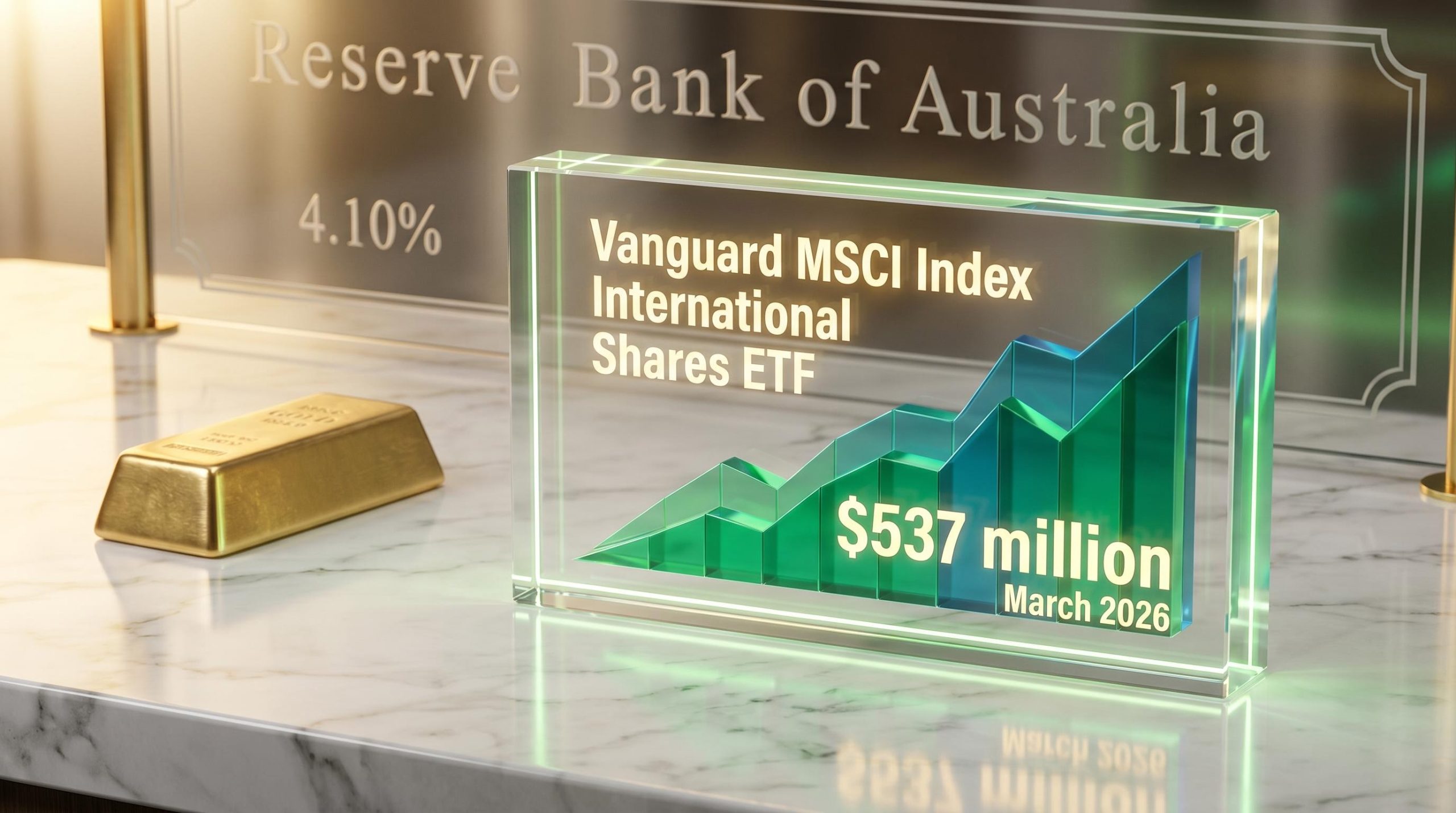
Fund Inflows Highlight the Shift The Vanguard MSCI Index International Shares ETF recorded inflows exceeding $537 million in March 2026, illustrating the massive scale of domestic capital moving toward global technology weightings.
The sheer volume of these inflows indicates that retail participants no longer view global equities as supplementary growth allocations. The reader evaluating their own portfolio weightings can observe exactly where early 2026 capital is flowing. Clinging to traditional defensive assets while this rotation accelerates may result in missing out on substantial global market momentum.
When big ASX news breaks, our subscribers know first
Deconstructing Portfolio Defence: Why International ETFs are the New Hedge
Understanding this shift requires examining why geographic diversification now functions as a primary inflation hedge. The Australian Securities Exchange remains heavily concentrated in the financial and mining sectors, creating a structural home bias that leaves domestic portfolios vulnerable during local rate hike cycles. When the Reserve Bank of Australia raises the cash rate, the subsequent pressure on domestic mortgage holders directly impacts the earnings potential of local retail banks and consumer-facing businesses. By holding capital exclusively in domestic equities, investors amplify their exposure to these specific local vulnerabilities.
Broad-market international funds solve this concentration risk by providing built-in currency diversification and access to sectors entirely absent from the local index. Modern investors increasingly treat global technology exposure as a necessary structural growth engine rather than a speculative risk add-on.
A primary catalyst for this shift is the massive AI infrastructure investment occurring globally, which is redirecting hundreds of billions of dollars toward advanced data centres and physical hardware companies primarily listed overseas.
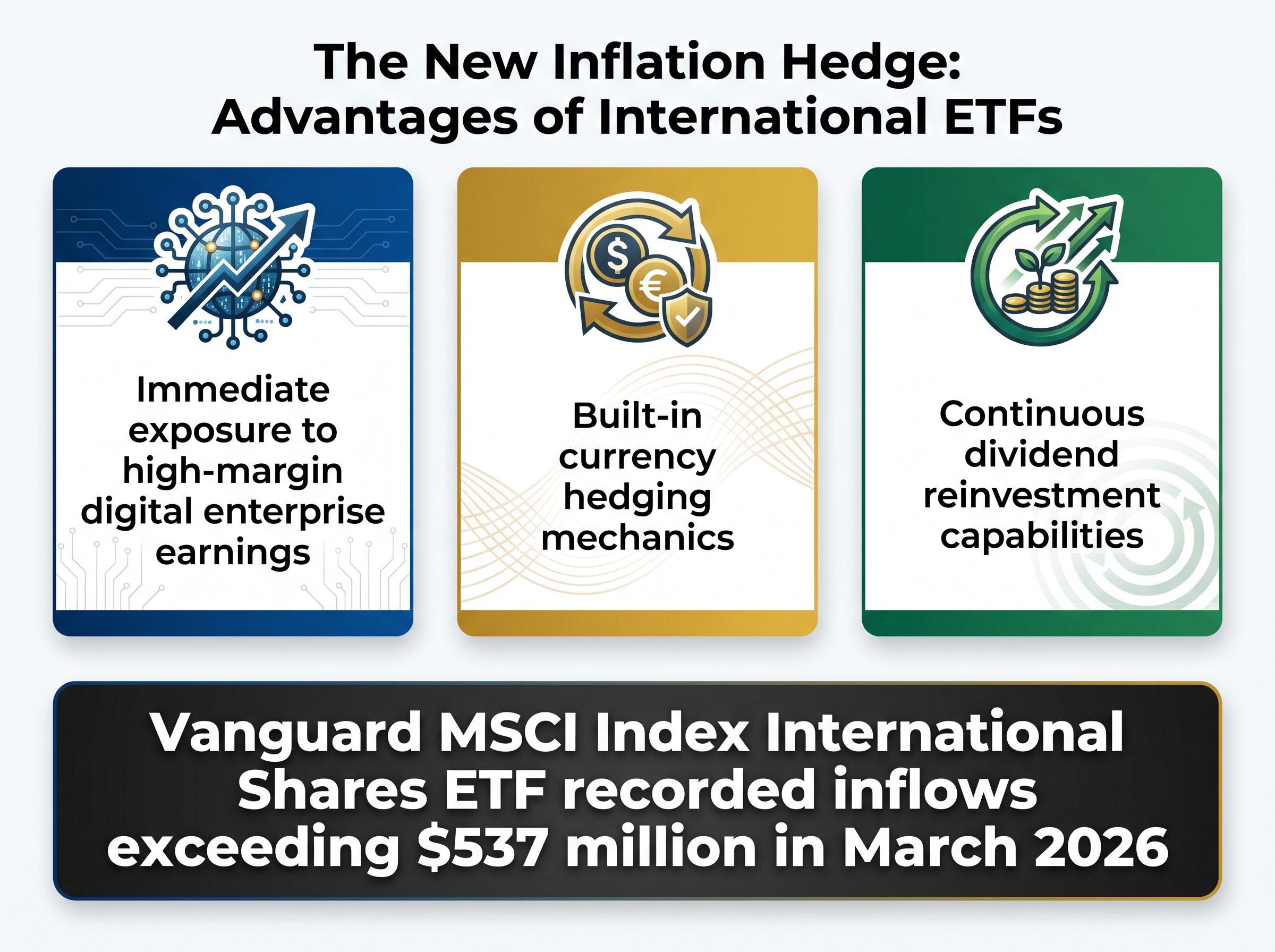
The structural advantages of international ETFs over physical gold holdings include:
Immediate exposure to high-margin digital enterprise earnings that scale independently of physical supply chains. Built-in currency hedging mechanics that protect purchasing power when the Australian dollar weakens against global reserves. * Continuous dividend reinvestment capabilities that compound capital, unlike static precious metal holdings that generate no yield.
This foundational shift transitions wealth generation from the passive storage of physical assets to the active ownership of expansionary global networks. Recognising these mechanics equips investors with the logic needed to evaluate their geographic weightings before examining the specific demographic trends driving the adoption rates.
The Millennial and Gen Z Allocation Divide
The aggregate shift toward international exposure masks distinct tactical differences between younger investment cohorts. A demographic breakdown of early 2026 portfolio construction reveals that Millennials and Generation Z share a unified strategy of prioritising overseas markets over the Australian Securities Exchange, but their execution methods diverge sharply. These digitally native age brackets are integrating passive tracker products much faster than older generations, yet they split on the optimal ratio of passive funds to active stock selection.
Millennial accounts demonstrate an aggressive adoption of automated diversification, dedicating approximately 70% of their portfolios to exchange-traded products. This cohort favours sweeping allocations to global tech-heavy funds, using index products to capture broad international momentum. Conversely, Generation Z participants maintain a highly balanced approach, holding an exact 50/50 split between individual equities and passive funds. This younger demographic pairs the safety of broad-market international ETFs with targeted stock picking in emerging global sectors.
Executing this balanced methodology often involves deploying a disciplined dollar-cost averaging strategy to remove emotional bias when allocating capital into volatile international tech sectors.
| Demographic Cohort | Primary Portfolio Construction Principle | Passive ETF Allocation | Individual Stock Allocation | Geographic Preference |
|---|---|---|---|---|
| Millennials | Aggressive automated diversification via broad-market vehicles | 70% | 30% | International technology and healthcare |
| Generation Z | Balanced stock picking paired with core index tracking | 50% | 50% | International markets and specific global sectors |
By observing these precise asset splits, modern market participants gain a practical template for balancing passive broad-market exposure with active global stock selection. The data confirms that neither cohort relies on domestic concentration to build their long-term wealth foundations.
Institutional Volumes and Reserve Bank Policy Pressures
These retail portfolio recalibrations are not occurring in isolation; they are happening against a backdrop of record-breaking institutional hedging. The retail shift toward international assets coincides directly with intense volatility in domestic interest rate markets. Modern digital trading environments demonstrate hypersensitivity to central bank announcements, and the events of early 2026 triggered divergent reactions across the retail and institutional sectors. While retail investors sought safe harbour in global technology, institutional capital flooded the domestic derivatives market to manage immediate interest rate risks.
The subsequent RBA monetary policy statement underscored the necessity of these institutional hedges by confirming that inflation had picked up materially, requiring immediate intervention to stabilise domestic pricing.
The sequence of institutional volume spikes and policy announcements in March 2026 illustrates the sheer market weight driving these asset rotations:
- Institutional trading platforms recorded an increase in transaction quantities coinciding with American import duty announcements in early March 2026.
- The Australian Securities Exchange futures market reached a record high on 11 March 2026, executing 4.04 million contracts in a single session.
- The Reserve Bank of Australia implemented a heavily contested cash rate hike to 4.10% on 17 March 2026, following a close 5-4 committee vote.
- Internal platform metrics indicated that retail trading engagement decreased immediately following the borrowing cost increase.
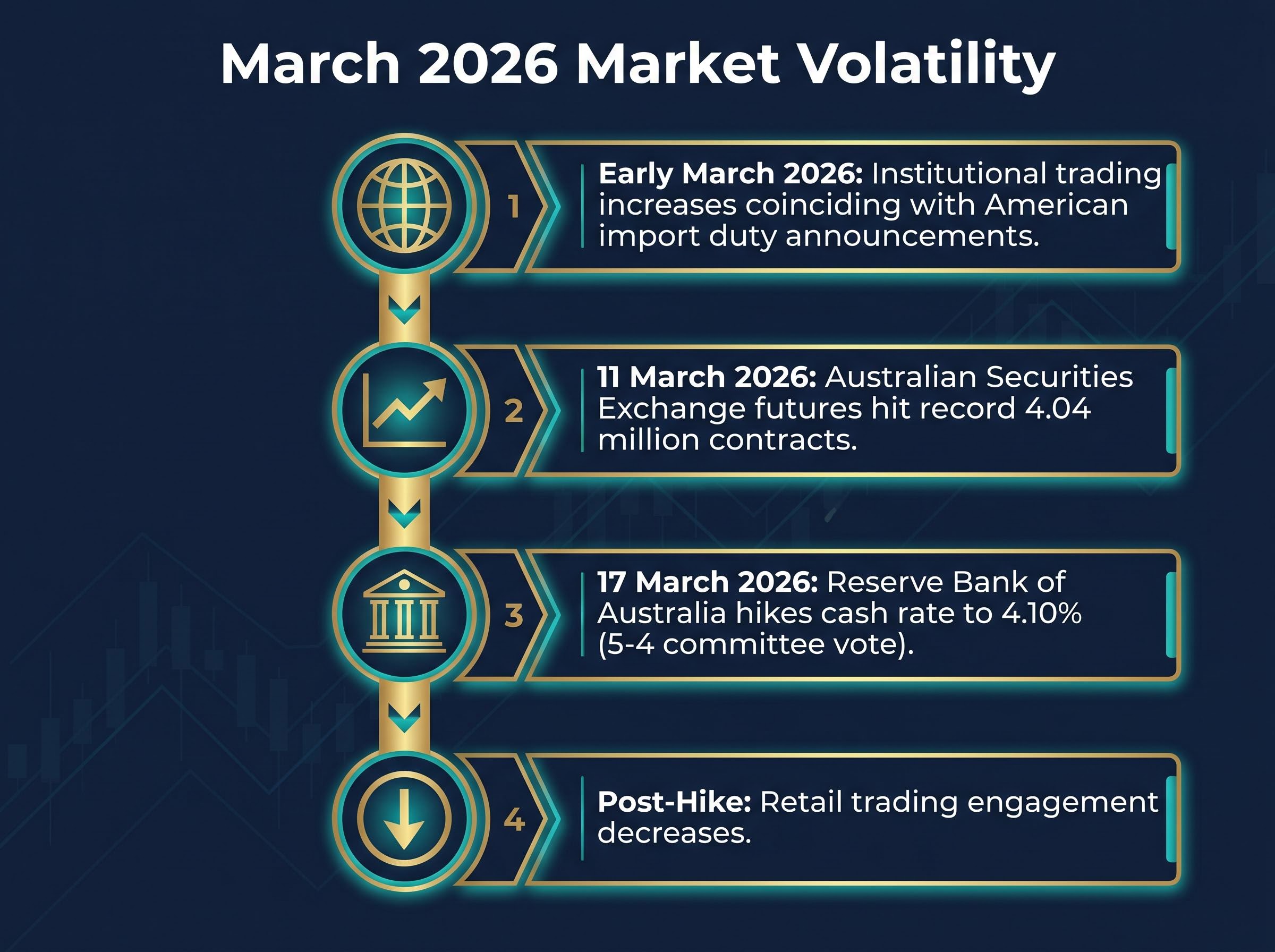
This chronological progression reveals a clear divergence in strategy. Institutional participants absorbed the local rate shock by shattering domestic futures volume records, while retail capital responded by stepping back from local trading and accelerating its rotation into international equities.
The sheer scale of the institutional hedging activity underscores the fragility of domestic economic conditions. When over 4 million derivative contracts change hands in a single day, it signals deep institutional uncertainty regarding local inflation trajectories. The retail investor cannot compete with this level of institutional manoeuvring in domestic interest rate markets. Instead, their transition toward international funds serves as a structural bypass, allowing retail capital to sidestep local institutional volatility entirely.
Recalibrating Wealth Strategies for the Rest of 2026
The data from the first quarter of 2026 confirms a definitive move away from domestic equity concentration and physical safe havens. Surviving modern inflation clearly requires structural global exposure rather than a reliance on static defensive holdings. The allocation splits demonstrated by younger demographics provide a clear roadmap for modern wealth preservation, highlighting the necessity of looking beyond the local financial and mining sectors. Market participants should review their current asset mix in light of these revelations, measuring their local concentration against the growing institutional volatility. Building a resilient portfolio for the remainder of the year demands accepting that international expansion is now the baseline requirement for adequate portfolio defence.
For investors actively adjusting their geographic exposure, our dedicated guide to asset allocation strategies for 2026 walks through the mechanics of capturing international equity discounts while securing essential domestic yield.
Disclaimer: This article is for informational purposes only and should not be considered financial advice. Investors should conduct their own research and consult with financial professionals before making investment decisions. Past performance does not guarantee future results. Financial projections are subject to market conditions and various risk factors.