AstraZeneca’s £300M UK Investment Reverses 2025 Retreat
38 mins ago


April 2026 presents a striking contrast for domestic portfolios, with the Reserve Bank of Australia holding the cash rate at 4.10% just as global geopolitical tensions threaten a new wave of economic disruption. The recent suspension of global petroleum trade has rapidly shifted market concerns from standard price growth to severe stagflation risks. This dual pressure of elevated borrowing costs and constrained supply chains threatens traditional asset allocations.
Investing during inflation requires a strategic approach that balances capital protection with opportunistic positioning. What follows is a clear, actionable framework to navigate elevated interest rates and market volatility. By identifying new growth opportunities and protecting existing wealth, market participants can adapt their portfolios for this complex macroeconomic environment.
Price growth acts as an invisible drain on portfolio purchasing power. When supply chain constraints limit the availability of goods, consumer demand bids up prices and reduces the real value of capital returns.
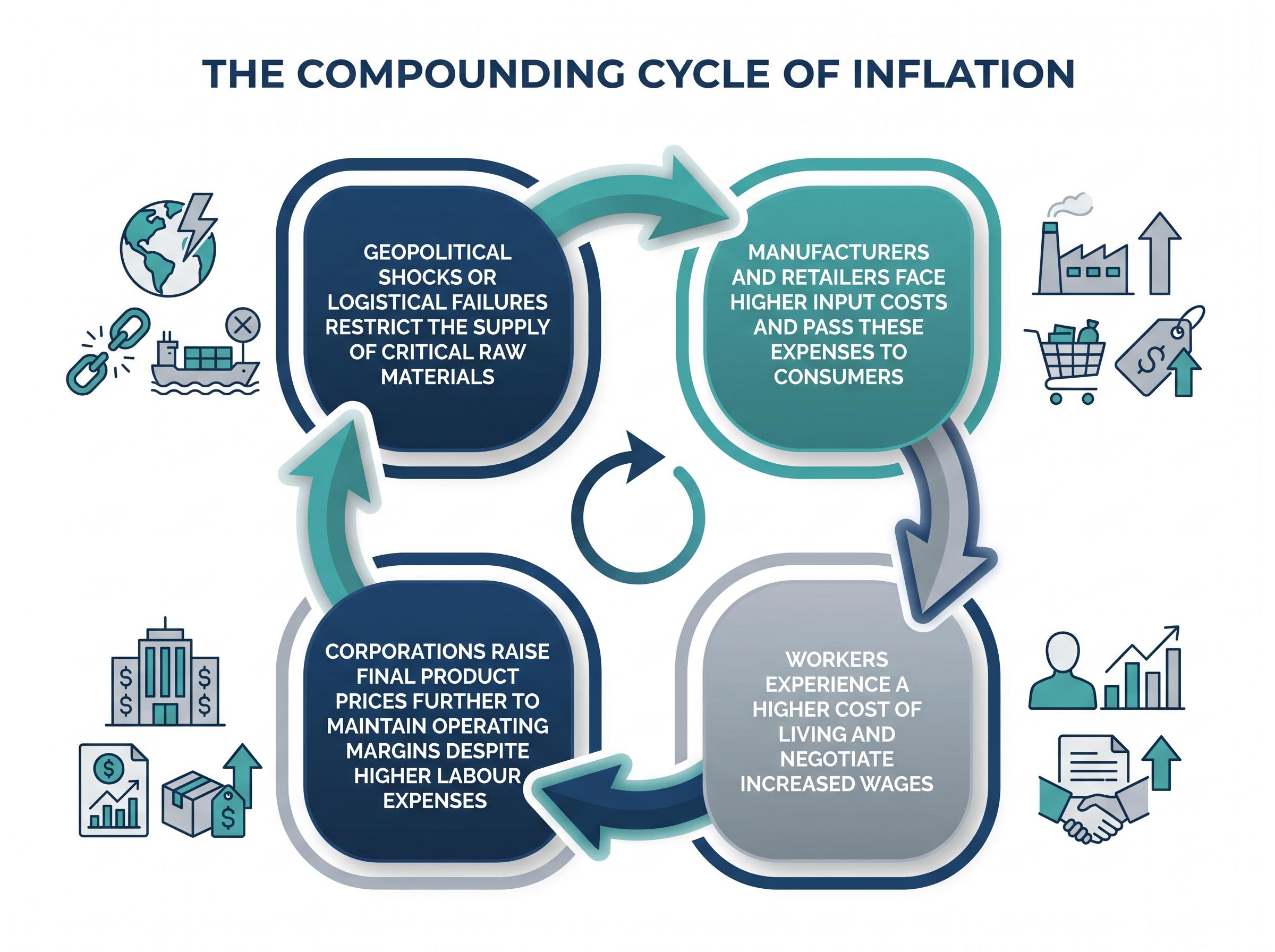
The compounding cycle of inflation typically follows a distinct pattern that erodes real investment returns:
Research from the International Monetary Fund notes that true economic output expansion typically decreases for every single percentage point that price growth surpasses the 3% baseline. This dynamic forces authorities to intervene.
The foundational IMF working paper on inflation thresholds validates this dynamic, demonstrating that when price growth exceeds this target range in developed nations, it actively suppresses broader economic output.
Central banks manipulate benchmark borrowing costs to regulate economic demand and stabilise prices. The Reserve Bank of Australia utilises elevated interest rates as its primary tool to restrict consumer spending and corporate borrowing.
Achieving a soft landing without triggering negative growth remains historically difficult. Historical analysis shows that past aggressive monetary tightening measures successfully reduced broad price growth, but these same measures triggered severe economic contraction.
Economists often reference the Taylor Rule benchmark for these interventions. This guideline requires authorities to elevate interest rates for each single percentage point of surplus inflation. Understanding this framework equips market participants to recognise why their portfolios lose real value. This knowledge helps distinguish between nominal gains and true wealth accumulation during high-rate cycles.
The theoretical models of monetary policy collided with geopolitical reality early this year. The suspension of global oil and gas trade in the Middle East has created an immediate stagflationary event, simultaneously pushing inflation higher while constraining domestic economic growth.
Australian headline inflation reached 3.7% year-on-year in February 2026. Reserve Bank of Australia forecasts now predict a rise to 4.2% by mid-year.
This energy shock alters traditional investment assumptions because it creates direct pass-through costs that consumers cannot easily avoid. Transport costs rose 8.9% in March 2026, with energy analysts warning that diesel prices could soon surpass $3 per litre.
| Economic Indicator | Current Rate (Q1 2026) | Forward Forecast | Market Impact |
|---|---|---|---|
| Headline Inflation | 3.7% | 4.2% (Mid-year) | Erodes real portfolio returns |
| RBA Cash Rate | 4.10% | 4.85% (Expected peak) | Increases corporate borrowing costs |
| Transport Costs | +8.9% | Diesel passing $3/litre | Drives supply chain inflation |
| S&P/ASX 200 | -7.8% | Continued volatility | Depresses domestic equity valuations |
| Consumer Confidence | 67.8 points | Historic lows persist | Constrains retail spending |
The psychological toll of these macroeconomic pressures has triggered a severe deterioration in consumer sentiment. The ANZ-Roy Morgan consumer confidence measure sits at a historically low 67.8 points. Domestic equities have absorbed the immediate negative reaction, with the S&P/ASX 200 sinking 7.8% in March 2026. By contextualising this immediate market shock, investors can separate short-term panic from long-term trends and objectively assess their current portfolio vulnerabilities.
The late April ANZ-Roy Morgan consumer confidence data highlights how persistent inflation expectations are severely dampening household sentiment, directly limiting discretionary retail spending across the Australian economy.
Elevated borrowing costs penalise borrowers but heavily reward capital providers. Higher interest rates present a significant opportunity for yield generation within the defensive portion of a portfolio, reframing the current environment as a tool for wealth preservation.
Broad-based passive bond strategies face headwinds under current conditions. Rising global bond yields caused the Bloomberg Aggregate Bond Index to return negative 1.8% for March 2026.
This broad index underperformance is further complicated by underlying corporate credit deterioration, as rising default rates in leveraged loan markets prompt institutional capital to aggressively reallocate risk away from highly indebted firms.
Strategic Expert Consensus Portfolio managers advise that outperformance is unlikely to be driven by the same traditional assets that led markets over the past decade. Targeted allocations are now required.
Rather than broad indices, targeted tenors and opportunistic positioning offer better protection. The Australia 10-Year Government Bond Yield sits at 5.02% as of late April 2026. A tactical approach to these long-duration bonds carries interest rate sensitivity risks, but it offers substantial potential rewards if rates eventually decline.
Expert analysis from institutional wealth managers suggests that interest rates elevated primarily by supply constraints historically decline. Locking in yields above 5.0% provides a clear strategy for generating reliable income. This shows market participants exactly where to allocate capital safely while waiting for domestic equity markets to stabilise.
Market volatility creates a mathematical advantage for scheduled accumulation strategies. While domestic inflation dominates the news cycle, maintaining international equity exposure allows portfolios to capture global factors that exert downward pressure on consumer prices abroad.
Disinflationary global trends are actively countering energy-driven inflation. These include ongoing artificial intelligence advancements and decreasing American property rental costs. Furthermore, petroleum futures are currently exhibiting backwardation, a pricing structure signalling that immediate delivery expenses exceed long-term pricing, which indicates market expectations that the supply shock will eventually normalise.
Allocating capital to international equities requires selecting cash-generative businesses with strong pricing power that can pass costs directly to consumers. Characteristics of these resilient entities include: High gross margins that provide a buffer against rising input expenses. Low capital intensity, reducing the need for continuous debt financing at elevated rates. Dominant market share in non-discretionary sectors. Consistent dividend payment histories supported by free cash flow.
Dollar-cost averaging transforms severe market downturns from a source of anxiety into a systematic growth method. Purchasing assets at scheduled intervals reduces the overall impact of volatility by acquiring more shares when prices fall and fewer when prices rise.
This disciplined accumulation is particularly valuable when offshore indices appear fully priced despite elevated recession probability estimates, ensuring investors do not deploy all their capital at potential market peaks.
Analyst guidance recommends disciplined capital allocation through consistent, scheduled intervals to optimise wealth accumulation. Increasing allocation amounts during significant market declines accelerates long-term recovery metrics. This approach gives market participants a reliable framework to acquire undervalued assets without attempting to perfectly time the market bottom.
Unprecedented geopolitical shocks require balancing physical hedges with the optionality of liquid cash reserves. Traditional inflation hedges like precious metals remain central to defensive positioning, but their performance can be unpredictable during stagflationary events.
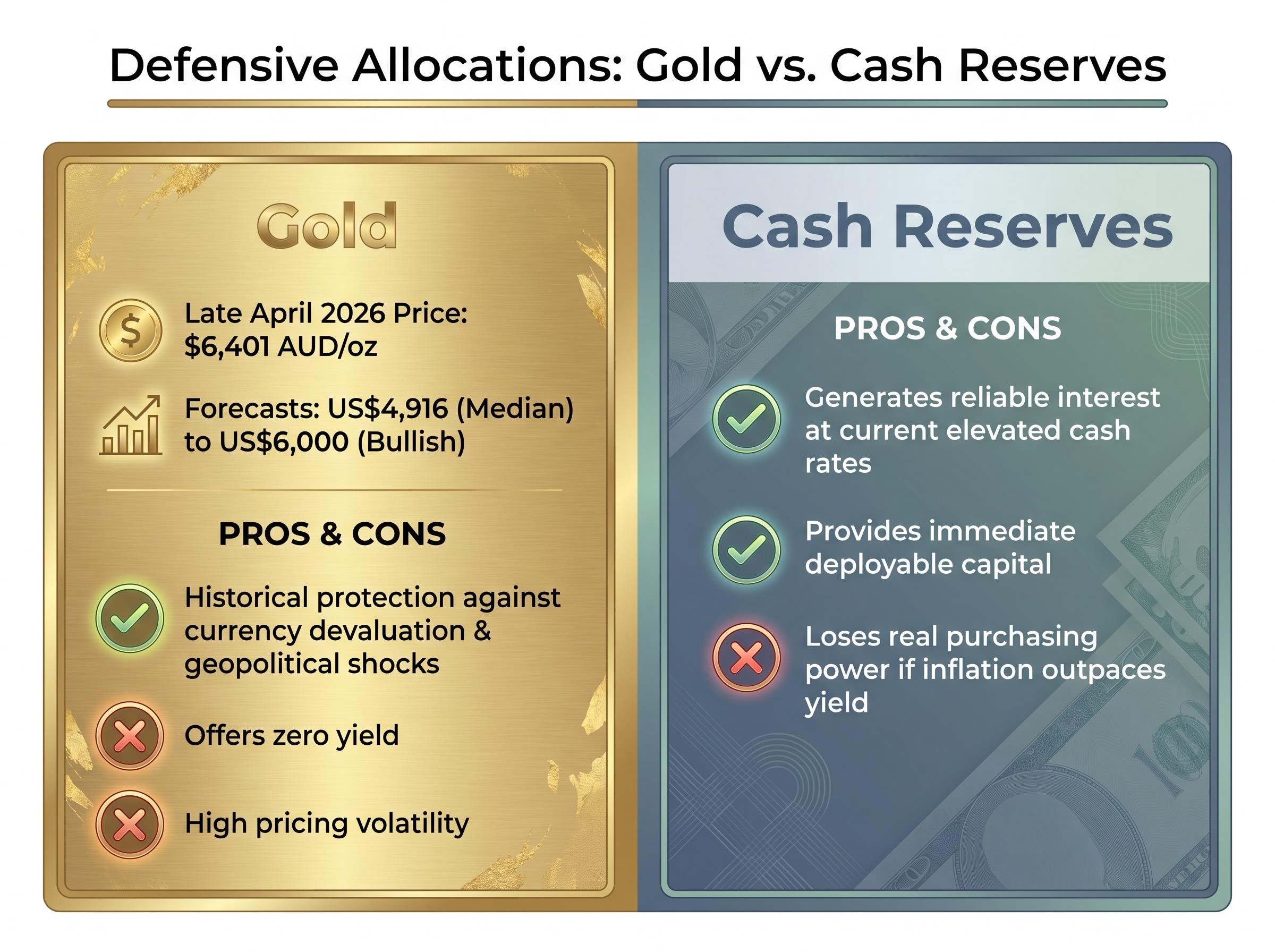
Gold is trading at $6,401 per ounce (Australian dollars) as of late April 2026. Analyst projections show a wide variance for the metal’s trajectory, with median forecasts projecting a drop below US$4,916, while bullish forecasts project a rise up to US$6,000 amid continued global uncertainty.
Much of this bullish sentiment relies on structural central bank accumulation, which establishes a significant price floor and provides downside protection even if interest rates remain higher for an extended period.
Wealth platforms consistently advise the preservation of highly liquid capital reserves alongside these physical assets. The distinct roles of these defensive allocations include: Gold: Provides historical protection against currency devaluation and geopolitical shocks, but offers zero yield and carries high pricing volatility. Cash Reserves: Generates reliable interest at current elevated cash rates and provides immediate deployable capital, but loses real purchasing power if inflation outpaces yield.
This balanced approach delivers a final layer of portfolio protection. It hedges against worst-case scenarios while keeping dry powder ready for future market opportunities.
Surviving stagflation requires active adaptation rather than passive endurance. Successfully navigating the current macroeconomic environment depends on balancing high-yield fixed income, targeted international equities, and defensive liquidity.
Market shocks historically present the most significant wealth-building opportunities for disciplined investors. Maintaining a long-term perspective prevents reactive decisions driven by temporary geopolitical disruptions or peak inflation readings. By applying a systematic framework to capital allocation, portfolios can absorb the immediate impacts of elevated rates while capturing the upside of eventual normalisation.
This article is for informational purposes only and should not be considered financial advice. Investors should conduct their own research and consult with financial professionals before making investment decisions.
Stagflation is a period characterized by high inflation, slow economic growth, and high unemployment; in April 2026, it poses a concern due to elevated interest rates and global supply chain disruptions impacting Australia.
Investors can protect portfolios by allocating to high-yield fixed income, targeted international equities, and maintaining defensive liquidity in cash and precious metals, as advised for the April 2026 market.
As of April 2026, the Reserve Bank of Australia's cash rate is 4.10%, which aims to restrict consumer spending and corporate borrowing, influencing investment returns and market liquidity.
Dollar-cost averaging mitigates market volatility by systematically purchasing assets at scheduled intervals, acquiring more shares when prices are low and fewer when prices are high.
International equities allow Australian portfolios to capture global disinflationary trends, such as AI advancements and decreasing American rental costs, countering domestic energy-driven inflation.