
Etsy acquired Depop for $1.625 billion in 2021, a premium valuation driven by peak e-commerce enthusiasm and a rush toward platform aggregation. Five years later, the execution of the Etsy Depop sale for approximately $1.2 billion establishes a stark financial contrast that forces a re-evaluation of sector capital allocation. As of late April 2026, this divestiture has fundamentally reshaped the competitive positioning of two legacy e-commerce platforms.
The transaction allows one company to shed corporate weight while handing the other an immediate demographic pipeline. Independent e-commerce analysts view the agreement not as a distressed liquidation, but as a deliberate uncoupling of mismatched corporate structures. This analysis breaks down why removing a high-growth subsidiary was mathematically necessary for the seller, how eBay plans to weaponise the Gen Z demographic shift, and the commercial outlook for the US resale sector.
Etsy’s Core Resurgence Following the Subsidiary Spin-Off
The first quarter 2026 earnings report provided immediate financial vindication for the executive decision to remove Depop from the corporate structure. Shedding the subsidiary actually accelerated the company’s core engine, demonstrating that concentrated operational focus can outweigh the nominal loss on a historical acquisition. Overall transaction volumes and active merchant counts expanded unexpectedly in the weeks directly following the restructuring announcement.
Wall Street analysts responded positively to this renewed management focus, driving an initial equity value increase immediately after the financial results went public. Investors recognised that the initial market reaction to a divestiture loss is secondary to the operational leverage gained by returning capital to a highly profitable core competency. The market rewarded the clarity of a single-platform operational model over the complexity of managing distinct subsidiary brands.
The resulting Q1 2026 earnings report validated this strategy by exceeding revenue forecasts to hit $631.3 million, effectively halting a two-year decline in active purchasers across the core marketplace.
The Q1 2026 financial outcomes demonstrate this acceleration across multiple performance categories:
Quarterly Revenue: Beat aggregate analyst estimates. Transaction Volumes: Total marketplace transaction values advanced, representing an annual increase compared to the previous corresponding period. Profitability Metrics: Adjusted EBITDA achieved a highly efficient profitability ratio. Forward Outlook: Projected full calendar year 2026 transaction expansion was upgraded to the low single digits, indicating sustained momentum.
Past performance does not guarantee future results. Financial projections are subject to market conditions and various risk factors.
When big ASX news breaks, our subscribers know first
Strategic Capital Allocation: Why E-Commerce Platforms Shed High-Growth Assets
Corporate divestitures in the technology sector often involve selling an asset below its purchase price to buy long-term flexibility. Evaluating this transaction requires shifting perspective from a narrative of failure to one of strategic capital reallocation. Taking a nominal historical loss on an asset sale can mathematically result in a stronger overall balance sheet and better shareholder returns.
This occurs because shedding a subsidiary eliminates associated operating expenses, allowing the parent company to retain higher net profit margins. The April 2026 corporate filings detail how the parent company characterised 2025 as a “refocusing year” to reset operational budgets and streamline corporate governance.
The roughly $1.2 billion transaction valuation provides a significant cash infusion that redirects resources away from peripheral market expansion. Management deliberately chose capital efficiency over maintaining a complex multi-brand portfolio.
CEO Commentary on Corporate Strategy “This transaction allows us to focus exclusively on growing the Etsy marketplace,” stated Chief Executive Officer Kruti Patel Goyal regarding the renewed corporate alignment.
Reinvesting the Divestiture Proceeds
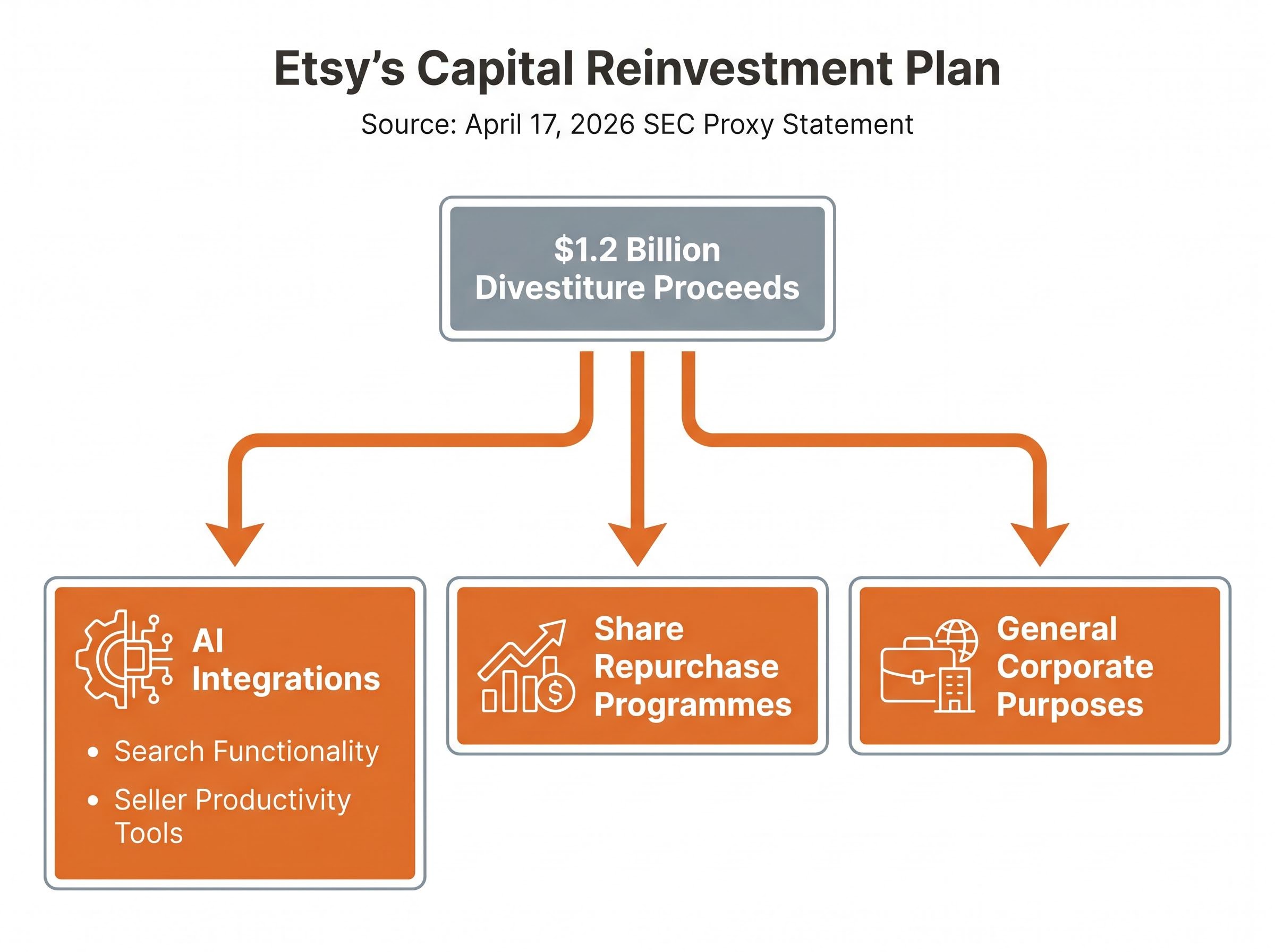
The incoming liquidity from the transaction is scheduled for specific deployment channels rather than general corporate treasury holding. According to the April 17, 2026 SEC proxy statement, management will direct funds toward aggressive artificial intelligence integrations within the primary marketplace.
These technical upgrades target search functionality and seller productivity tools. The remaining proceeds are earmarked for broader share repurchase programmes and general corporate purposes. This capital allocation strategy rewards existing shareholders immediately while funding the technological infrastructure needed to protect the company’s competitive moat against larger retail aggregators.
The formal capital allocation schedules published within Etsy’s official SEC filings outline how management will execute these stock buybacks alongside its core technology investments throughout the fiscal year.
eBay’s Demographic Acquisition and Integration Roadmap
The transaction functions entirely differently from the buyer’s perspective, representing an aggressive demographic acquisition rather than a structural simplification. The acquisition is a deliberate strategy by eBay to dominate the consumer-to-consumer pre-loved fashion sector by absorbing a massive Gen Z user base. The legacy platform is functionally purchasing market share and a younger demographic pipeline rather than attempting to build a competing youth-oriented platform from scratch.
Depop brings demographic metrics that make it an irresistible target for a legacy platform seeking modern relevance in a crowded retail sector. In 2025, Depop generated approximately $1 billion in Gross Merchandise Sales (GMS), delivering nearly 60% year-on-year US GMS growth. The platform currently supports 7 million active buyers, with 90% falling under the age of 34, alongside 3 million active sellers.

This concentrated user base provides immediate access to a demographic cohort that legacy platforms have historically struggled to capture. The operational integration plan focuses on pairing this youthful momentum with established global infrastructure. Management intends to scale the subsidiary by plugging it into a mature logistical network.
| Strategic Component | Depop Contribution | eBay Infrastructure Provision |
|---|---|---|
| Demographic Reach | Gen Z dominance (90% under 34) | Global buyer network exposure |
| Growth Trajectory | 60% YoY US GMS growth (2025) | Capital for sustained scaling |
| Operational Mechanics | Trend-driven merchant base | Advanced cross-listing capabilities |
| Logistics & Trust | High volume peer transactions | Financial services and Authenticity Guarantee |
Regulatory Tripwires and the Path to Final Closure
The definitive agreement signed in February 2026 remains subject to active international antitrust scrutiny. While the strategic alignment appears complete on paper, specific legal and regulatory tripwires make this massive deal theoretically fragile until final approval is secured. Commercial stakeholders must accurately price the risk of the acquisition collapsing before finalisation, as regulatory intervention remains a material possibility.
The UK Competition and Markets Authority (CMA) initiated an initial information-gathering phase in April 2026 to evaluate potential impacts on regional competition. The regulatory body opened an invitation for public comments to assess whether the merger substantially lessens competition in the UK market. The transaction includes structural protections written directly into the deal terms, insulating the seller if regulators ultimately block the acquisition.
The timeline progression includes several definitive milestones that dictate the deal’s operational rhythm:
- February 18, 2026: Initial definitive agreement signed and publicly announced.
- May 8, 2026: Deadline for public comments submitted to the UK CMA.
- Q2 2026: Target closing period, pending successful antitrust approvals.
- November 15, 2026: Initial Outside Date for deal completion.
- February 15, 2027: Extended Outside Date if regulatory reviews require additional time.
If the deal fails due to antitrust issues, eBay owes a $90 million breakup fee to the seller. An additional $70 million fee applies for other specific termination events, providing a financial floor for the risk involved.
Mapping the New Hierarchy of US E-Commerce
This single transaction bifurcates the US marketplace environment into highly specialised domains, ending an era of broad platform generalisation. Once the regulatory processes conclude, the macroeconomic battlefield will feature distinct, non-overlapping trajectories for the two companies involved. Retail investors gain a strategic roadmap for evaluating sector allocations based on this permanent separation of corporate powers.
Etsy deepens its competitive moat in artisanal, craft, and vintage goods, effectively abandoning the fast-fashion resale war. The company’s projected twelve-month profitability estimates serve as proof of this specialised model’s commercial viability. Conversely, eBay accelerates an aggressive consolidation of the broader apparel resale market, leveraging its extensive shipping networks to process high-volume fashion transactions that require logistical scale to remain profitable.
For retail investors attempting to forecast the macroeconomic headwinds facing both marketplace models, our deep-dive into US recession risk and consumer strength examines how rapid savings depletion and historically low consumer sentiment could suppress the mass-market spending volumes these platforms rely on.
Implications for Multi-Platform Merchants
Independent sellers must adapt their operations to accommodate these diverging corporate strategies for the remainder of 2026. Merchants focused on handmade goods face an environment driven by AI-powered search and core marketplace investments. These operators will need to optimise product listings for algorithmic discovery rather than relying on social momentum.
Fashion resellers must align with a logistics-heavy infrastructure push. The continued integration of cross-listing tools will blur the technical lines for multi-platform merchants, allowing sophisticated operators to distribute inventory across both ecosystems while managing separate fee structures.
The Final Ledger on Retail Consolidation
The divestiture represents a mutual win scenario where capital efficiency triumphed over empire-building. Taking a nominal historical loss allowed the seller to immediately validate a strategy of subtraction by addition through strong Q1 2026 performance. Simultaneously, the buyer secured an irreplaceable demographic asset that accelerates its relevance in the highly competitive secondary fashion market.
The impending regulatory decisions in mid-2026 serve as the final hurdle for this definitive industry realignment. These statements regarding regulatory timelines, profitability estimates, and market share capture are forward-looking and subject to change based on macroeconomic developments.
This article is for informational purposes only and should not be considered financial advice. Investors should conduct their own research and consult with financial professionals before making investment decisions.