AI Disruption in Tech: the $2T Legacy Software Repricing
2 mins ago


The jarring contrast between the S&P 500 pushing past 7,200 on 24 April 2026 and the simultaneous closure of the Strait of Hormuz presents a complex market paradox. Approaching geopolitical risk investing requires more than surface-level observation, yet US equity markets have seemingly insulated themselves from the escalating Iran conflict. The severe supply chain disruptions that followed the waterway’s blockade have barely registered on domestic growth projections.
This divergence leaves market observers questioning the structural integrity of the current equity rally as a wide gap emerges between maritime logistics and stock buyer optimism. What follows is a comprehensive breakdown of why retail market participants are currently ignoring these external threats. The analysis will also reveal what institutional capital movements suggest about the market’s true underlying vulnerability to external shocks.
The surging retail optimism observed throughout April 2026 stands in stark opposition to mounting external threats in the Middle East. The American Association of Individual Investors survey from 23 April 2026 showed retail investors holding a decisively bullish outlook on equities. This persistent confidence masks a deeper analytical paralysis regarding how geopolitical uncertainty is actually traded in modern markets.
Market technicians identify a significant structural gap in the current pricing architecture. Because the Iran conflict has not yet inflicted immediate or measurable corporate earnings damage, a false sense of security has permeated equity valuations. Investors simply lack established frameworks for pricing sudden, cascading supply shocks that originate outside the traditional economic cycle.
Market Commentary “The current market structure reveals an inability to price uncertainty, as investors lack established frameworks for pricing sudden geopolitical shocks,” noted Craig Johnson, Chief Market Technician at Piper Sandler.
This collective inability to quantify external threats explains the current surface-level stability of major indices. Capital remains deployed because the algorithmic and human systems managing it have no historical precedent for pricing this specific confluence of events. A sudden recalibration could prove severe once a definitive pricing framework emerges and the true cost of the disruption is calculated.
Looking at previous supply disruptions provides context for this complacency, revealing how heavily algorithmic trading is underpricing stock market risk when traditional economic data appears temporarily stable.
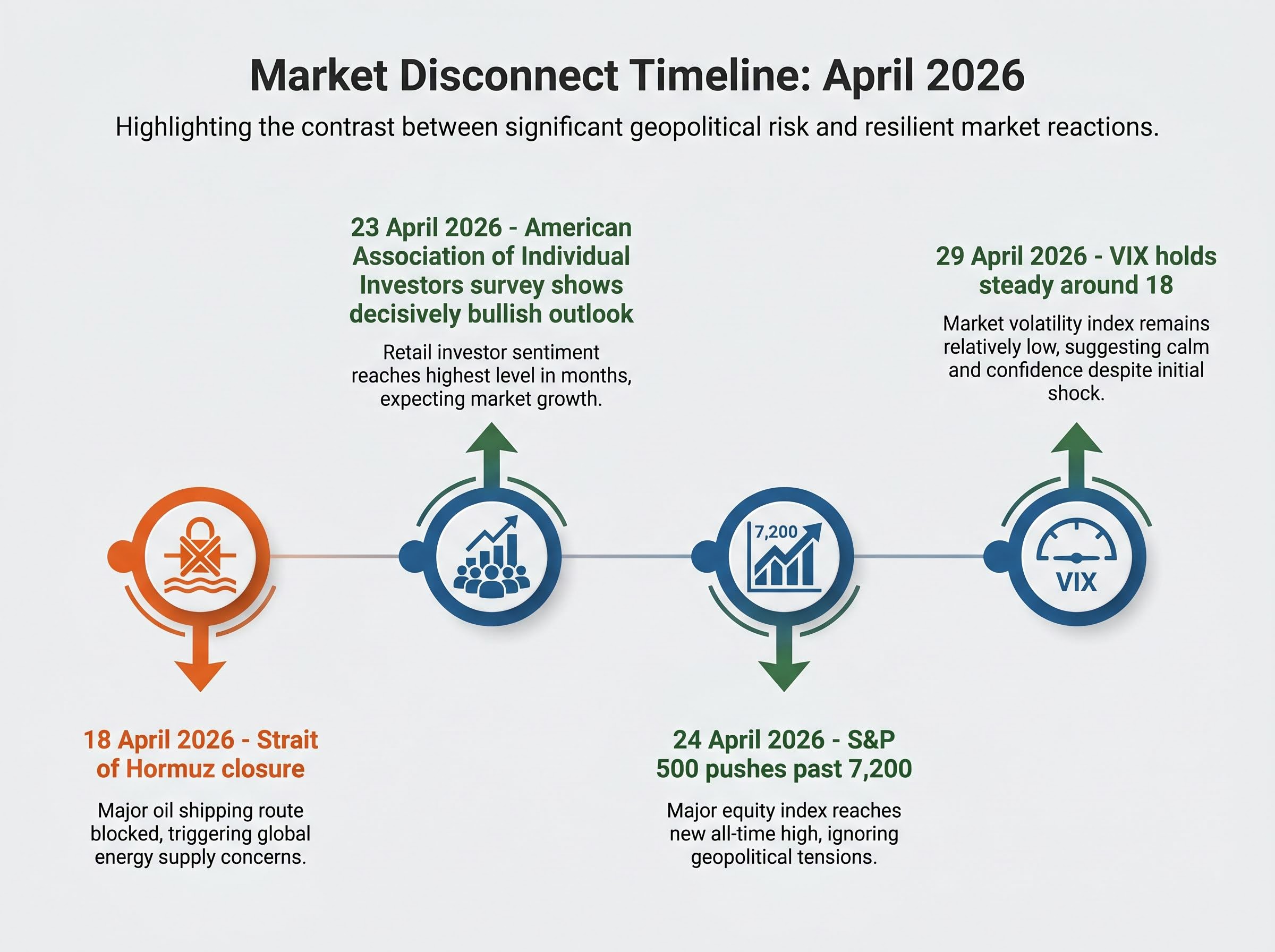
The stability of the VIX underscores this widespread complacency. The volatility index held steady around 18 through 29 April 2026, accompanying the S&P 500 as it climbed roughly 5% earlier in the month. This suppressed volatility reading suggests that traders are treating the Middle East escalation as a contained, regional issue rather than a global macroeconomic catalyst.
Short-term options metrics are likely masking these mounting tail risks. Options markets currently focus on immediate transactional horizons, heavily weighting upcoming domestic earnings reports while discounting the probability of a structural energy crisis.
Understanding how energy shocks filter through developed economies requires examining the invisible transmission mechanism between a blocked trade route and a depleted bank account. The market impact of a severe oil shock is structurally delayed rather than entirely absent. A distinct, predictable lag exists between wholesale commodity spikes at international terminals and retail consumer behaviour adjustments at the local level.
The Dallas Fed economic models detailing the transmission mechanism of oil shocks demonstrate exactly how wholesale crude spikes take several weeks to fully materialize in retail gasoline prices and broader inflation metrics.
Following the 18 April 2026 Strait of Hormuz closure, wholesale energy markets reacted with immediate aggression. WTI crude surged rapidly to trade between $96 and $100 per barrel. Brent crude simultaneously surpassed the critical $100 threshold to trade at $112.83 per barrel, signalling severe distress in global supply networks.
Paul Donovan, Chief Global Economist at UBS, explicitly warned that developed economies like the US have not yet absorbed the full economic weight of this conflict. Retail supply chains operate on forward contracts, meaning the petrol arriving at local stations today was purchased at prices locked in months ago.
Current retail resilience is functioning entirely on borrowed time. A recent Bank of America report showed aggregate consumer expenditure plummeting, a metric that equity bulls frequently cite as proof of economic strength. However, this headline spending is largely supported by temporary savings drawdowns, which act as an artificial bridge masking underlying economic deterioration.
During periods of acute inflation, consumers typically exhaust liquid savings before drastically altering their purchasing habits. This behavioural buffer creates a dangerous illusion of economic stability for equity investors monitoring headline retail data. The eventual exhaustion of these savings accounts will trigger a sudden, aggressive contraction in discretionary spending.
Investors must watch energy-driven inflation metrics rather than headline spending to anticipate the coming market correction. By the time consumer spending data formally contracts, the underlying corporate revenue streams will have already sustained significant damage.
| US Equity Highs | Oil Price Surges | Consumer Sentiment Drops |
|---|---|---|
| S&P 500 reached 7,205.33 points | WTI Crude hit $96 to $100 per barrel | Sentiment index bottomed at 47.6 |
| Index climbed 5% through April 2026 | Brent Crude reached $112.83 per barrel | Record low reading for April 2026 |
High-level economic theory frequently obscures harsh retail realities. The US consumer economy is currently exhibiting a pronounced K-shaped divergence in spending patterns. While high-income households maintain their discretionary spending power, lower-income groups face severe budgetary destruction due to escalating basic living costs.
This economic divide is starkly reflected in the record low consumer sentiment index reading of 47.6 recorded in April 2026. UBS data indicates that lower-income households are experiencing disproportionate reductions in disposable income as the cost of basic necessities climbs. The primary pressure points accelerating this divide include specific, compounding economic stressors:
Escalating retail fuel costs heavily impacting daily commute budgets Sustained high borrowing rates on compounding credit card debt * Sticky baseline inflation on non-discretionary grocery items
This consumer divide directly connects to upcoming Q2 corporate earnings vulnerabilities. The K-shaped divergence was already distinctly visible throughout the Q1 earnings reporting season. Wall Street banks including JPMorgan and Goldman Sachs significantly outperformed expectations on trading revenue, successfully capitalising on institutional market volatility.
Conversely, consumer-facing firms issued highly cautious outlooks for the remainder of the year, signalling clear distress in their customer base. This divergence reveals which specific sectors of the equity market are most vulnerable to the hidden consumer recession. Investors can use this data to aggressively stress-test their own portfolio exposures against the rapidly weakening retail foundation.
Small business sentiment has also softened significantly despite relatively stable labour conditions. These enterprises operate on razor-thin margins that cannot absorb sustained increases in baseline operating costs or transport fees. Their growing pessimism provides a leading indicator for broader corporate vulnerability as the year progresses.
The assumption that broad market indices will remain elevated ignores the reality that consumer spending drives the vast majority of domestic economic activity. When the bottom half of the consumer base abruptly halts discretionary purchases to cover surging fuel and grocery bills, the resulting revenue shock will aggressively filter upward into broader corporate earnings projections.
For investors wanting to unpack the disconnect between headline retail figures and household reality, our deep-dive into US consumer resilience data explores the rapid depletion of personal savings rates and how the K-shaped economic divide is distorting aggregate spending metrics.
While retail participants celebrate index milestones, institutional capital is quietly building substantial defensive positions. Major US financial institutions have issued highly specific warnings regarding persistent inflation and overstretched equity valuations in recent weeks. The smart money is aggressively shifting toward active hedging strategies in response to a volatile new era of global fragmentation.
US Bank outlined its 2026 perspective by warning that structural energy shocks will systematically raise global borrowing costs. The institution explicitly labelled sticky inflation as absolute kryptonite to current equity valuation multiples. Morgan Stanley added significant weight to the cautionary chorus, warning that sky-high market optimism is a precarious tightrope walk, continually threatened by domestic populism and unpredictable global flashpoints.
The macroeconomic environment requires entirely new tracking mechanisms for risk assessment. BlackRock assesses that the ongoing Middle East escalation marks the formal beginning of a new 2025 to 2026 geopolitical era, defined by transactional foreign policy. The asset manager recommends that investors actively track these paradigm shifts via dedicated geopolitical risk indices rather than traditional economic indicators.
The official BlackRock Geopolitical Risk Indicator methodology provides a quantitative framework for measuring market attention to these specific external threats, allowing analysts to gauge when sentiment finally begins pricing in the supply chain reality.
The historical data from previous geopolitical flashpoints demonstrates that short-dated volatility consistently spikes when supply chains ruptures. CME Group analysts note that while tactical options currently show some bullish upside targets above 8,000 for the S&P 500, these positions remain heavily guarded. Institutional players are paying premium prices for downside protection while maintaining their long exposures.
These top-tier institutions provide highly actionable blueprints for immediate capital preservation. The recommended defensive mechanisms include:
Following these institutional blueprints allows capital allocators to construct resilient portfolios ahead of the anticipated market repricing.
The central tension between record equity highs and the unpriced risks of the Middle East conflict defines the current market environment. While broad market indices have temporarily absorbed the shock of the Strait of Hormuz closure, the delayed economic impacts of surging global commodity prices will inevitably arrive on corporate balance sheets.
Current equity stability is an artificial product of psychological complacency and temporary consumer savings drawdowns. The transition from wholesale supply chain disruption to retail demand destruction is an irreversible process of weeks and months, not days. Waiting for the damage to become visible in headline earnings reports is a fundamentally flawed investment approach.
This severe macroeconomic disconnect underscores the absolute necessity of proactive risk management before the broader market wakes up to the geopolitical reality. Adjusting portfolio allocations ahead of the anticipated earnings recalibration remains the most prudent path forward for capital preservation.
This article is for informational purposes only and should not be considered financial advice. Investors should conduct their own research and consult with financial professionals before making investment decisions. Past performance does not guarantee future results, and financial projections are subject to market conditions and various risk factors.
Geopolitical risk investing involves assessing and incorporating the potential impacts of international political events, conflicts, and policy changes on financial markets and investment portfolios.
US equity markets are showing a psychological blind spot, lacking established frameworks to price sudden, cascading supply shocks from geopolitical events that have not yet inflicted immediate corporate earnings damage.
Institutional investors are building defensive positions through tactical options hedging, executing defensive sector rotation into utilities and consumer staples, and allocating capital to energy ETFs to capitalize on supply shocks.
The K-shaped divergence refers to a split in spending patterns where high-income households maintain discretionary spending, while lower-income groups face severe budgetary destruction from escalating basic living costs and high borrowing rates.