How Dual-Class Shares Put $24 Billion in Gulf Capital at Arm’s Length
22 hrs ago


The S&P 500 delivered a cumulative total return of 305% over the past decade, yet the valuations underpinning that run now sit at levels exceeded only during the dot-com era. That tension, between genuine structural strength and elevated concentration risk, is exactly why a growing number of U.S. investors are looking beyond domestic borders.
As of April 2026, stretched domestic valuations coincide with rising geopolitical complexity, assertive U.S. trade policy, and a significant federal debt load. The question for most investors is no longer whether to diversify internationally but how to do it simply and cheaply. The Vanguard VXUS ETF is one of the most widely held answers to that question, offering broad international equity exposure in a single, low-cost fund.
What follows is a complete explanation of what VXUS is, what it holds, how it compares to alternatives, and how a modest allocation fits into a domestic-heavy U.S. portfolio without adding meaningful complexity or cost.
The case for U.S. equities is genuine. Deep capital markets, strong property rights, an entrepreneurial culture, and global dominance across technology, defence, energy, and pharmaceuticals have rewarded domestic investors for decades. A 305% cumulative total return over the prior ten-year period through April 2026 is not an accident; it reflects structural advantages that most other economies cannot replicate at scale.
The problem is not that those advantages have disappeared. The problem is that the market’s current price already reflects them, and then some. According to Motley Fool analysis published 27 April 2026, S&P 500 valuations have reached levels exceeded only during the dot-com era. That does not guarantee poor forward returns, but it raises the stakes considerably for anyone whose portfolio depends entirely on a continuation of recent performance.
Several macroeconomic headwinds add further weight to the concentration concern:
International allocation is not about abandoning the U.S. thesis. It is about adding a risk-management layer that insulates a portfolio against scenarios where domestic performance reverts toward historical norms.
Investors wanting the full macro picture behind this shift will find our full explainer on the international stock rotation currently underway, which covers the $75 billion in outflows from US equity funds, Vanguard’s decade-long return projections for international versus domestic equities, and the dollar-weakness tailwind analysts expect to amplify unhedged international returns through 2026.
VXUS, the Vanguard Total International Stock ETF, is a passively managed fund designed to do one thing: provide exposure to international equities while excluding U.S. stocks entirely. It tracks the FTSE Global All Cap ex-US Index, a benchmark that captures small, mid, and large-cap companies across both developed and emerging markets outside the United States.
That index methodology is why the fund holds an unusually large number of individual securities: 8,794 as of 31 March 2026. The breadth is intentional. Rather than concentrating in a handful of large international names, VXUS spreads its exposure across the full market-capitalisation spectrum of every investable non-U.S. market.
The mechanics of VXUS are straightforward for anyone already familiar with index fund portfolio construction, where passive market-cap weighting, low expense ratios, and broad diversification are the defining features that separate long-term compounders from actively managed alternatives.
Three facts anchor the fund’s profile:
The fund’s NAV stood at $82.32 as of 24 April 2026, with a share price of $82.36 as of 27 April 2026 and a 52-week range of $63.23 to $84.48.
Expense ratio: 0.05% That translates to $0.50 per year on every $1,000 invested, making VXUS one of the cheapest vehicles available for comprehensive international equity exposure.
The international-only mandate is the fund’s defining strategic feature. For investors who already hold a U.S. equity fund such as VTI, VXUS adds geographic diversification without duplicating any domestic exposure.
VXUS covers both developed and emerging markets, and the distinction matters. Developed markets, including Europe, Japan, Australia, and Canada, tend to offer relative stability and consistent dividend income. Emerging markets, including Taiwan, South Korea, China, and India, offer higher growth potential at the cost of greater volatility.
The FTSE Global All Cap ex-US Index includes both, weighted by market capitalisation. That means VXUS investors receive exposure to both risk profiles in a single fund, without needing to make a separate allocation decision between developed and emerging market products. For a current breakdown of specific country weights and sector splits, Vanguard’s VXUS fund page under the Portfolio and Management tab provides the most up-to-date detail.
The fund’s top three individual positions, according to Motley Fool reporting from 27 April 2026, illustrate the quality of companies international diversification provides access to:
These are not obscure foreign companies. They are foundational players in the global technology supply chain that underpins even U.S. technology sector performance. Because the fund holds nearly 9,000 securities, no single position dominates; the top holdings represent the index’s natural market-cap weights rather than concentrated bets.
The most common decision point for U.S. investors entering international exposure for the first time is the choice between VXUS and VT, the Vanguard Total World Stock ETF. The distinction is straightforward but consequential.
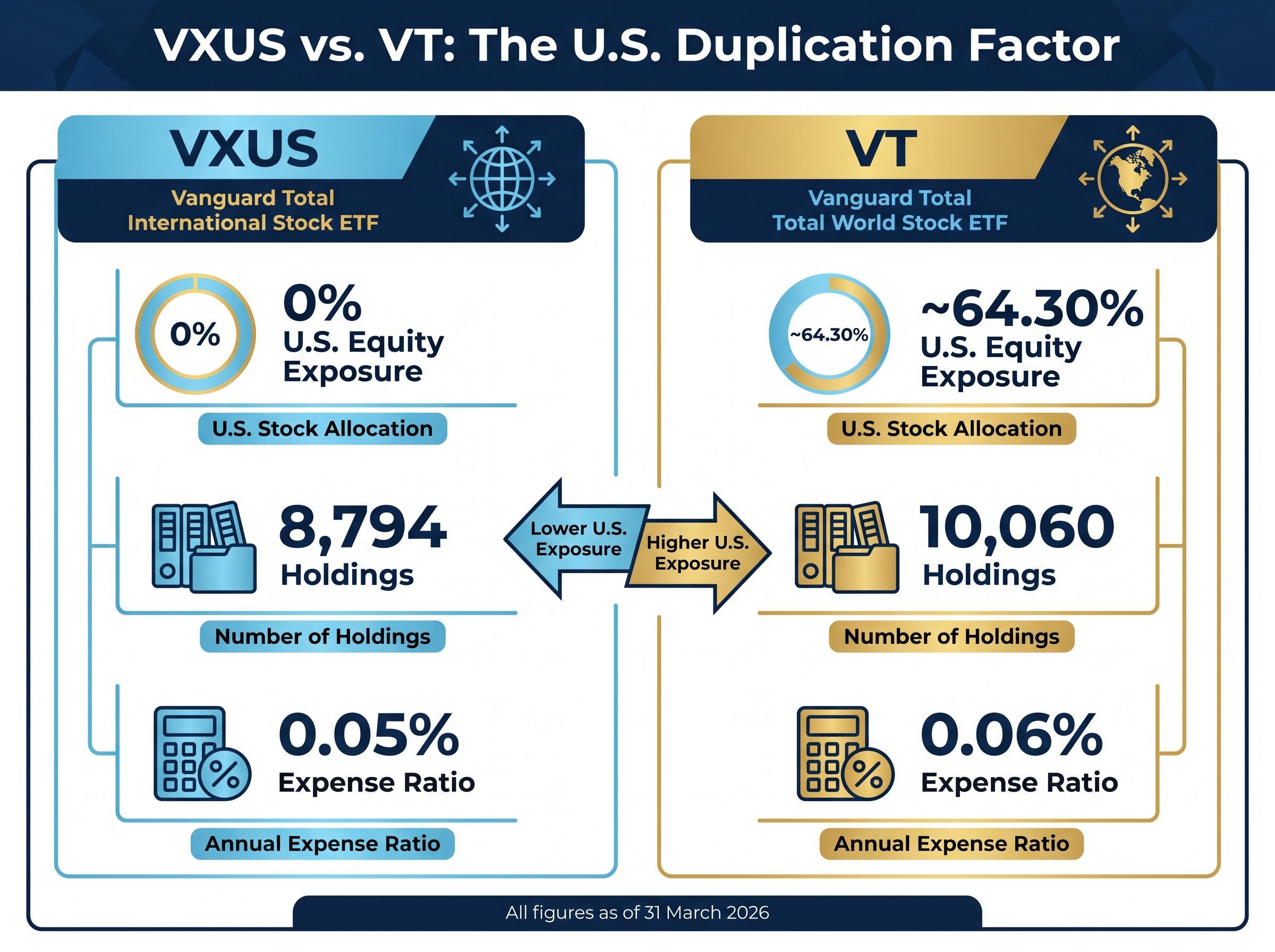
VT holds 10,060 securities and provides global coverage, but approximately 64.30% of its allocation sits in North America, predominantly the United States. It is a global fund, not a pure international fund.
| Fund | Holdings | Expense Ratio | U.S. Equity Exposure |
|---|---|---|---|
| VXUS | 8,794 | 0.05% | 0% |
| VT | 10,060 | 0.06% | ~64.30% |
All figures as of 31 March 2026.
The duplication problem is the critical issue. An investor who already holds VTI or a similar U.S. equity fund and then adds VT is effectively doubling their domestic exposure. VXUS avoids this entirely because it holds zero U.S. equities.
VTI’s Magnificent Seven concentration is the domestic counterpart to the geographic concentration VXUS addresses; Nvidia, Apple, and Microsoft alone account for 16.7% of VTI’s portfolio, meaning the pair of funds together still carries meaningful technology sector exposure even after the international layer is added.
“Investors who already hold a U.S. equity fund and add VT are doubling their domestic exposure. VXUS avoids that problem entirely.”
VEA (Vanguard FTSE Developed Markets ETF) and IXUS (iShares Core MSCI Total International Stock ETF) also compete in this space. VEA covers only developed markets, excluding emerging market exposure. IXUS offers a similar total international mandate to VXUS but tracks an MSCI index rather than the FTSE benchmark. For current expense ratios and AUM on both, investors should consult Vanguard’s VEA profile and iShares’ IXUS product page directly. VXUS’s combination of comprehensive market coverage (including emerging markets) and a 0.05% expense ratio makes it a strong default for cost-conscious diversifiers.
According to analysis by Neil Patel published by Motley Fool on 27 April 2026, a 5% international allocation serves as a research-supported starting point for U.S. investors who want geographic diversification without meaningfully altering their portfolio’s risk profile.
At a current share price of approximately $82.36, here is what a 5% VXUS allocation looks like at common portfolio sizes:
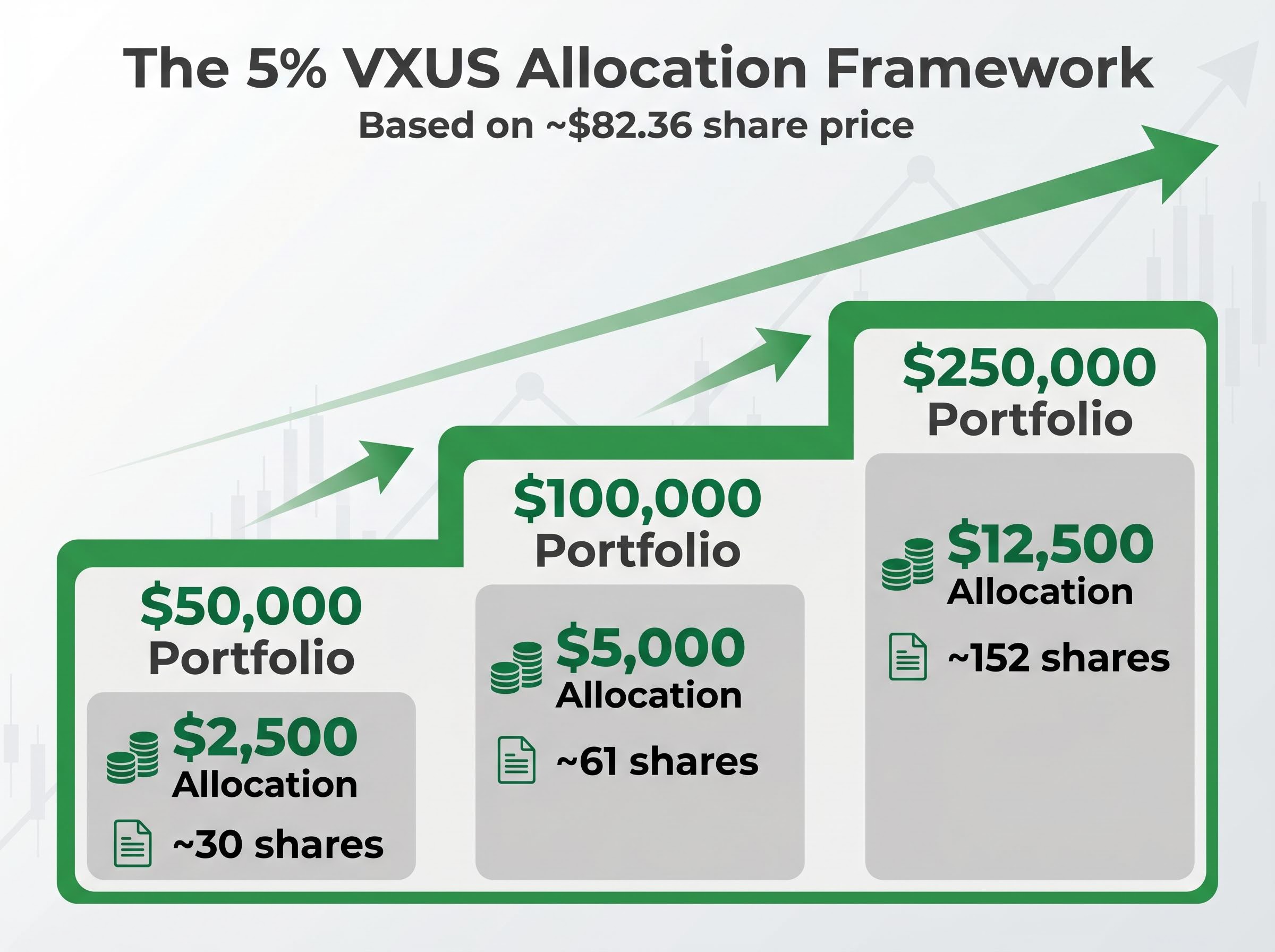
| Portfolio Size | 5% Allocation | Approximate VXUS Shares |
|---|---|---|
| $50,000 | $2,500 | ~30 shares |
| $100,000 | $5,000 | ~61 shares |
| $250,000 | $12,500 | ~152 shares |
The mechanics are simple. VXUS trades like any equity ETF and requires no minimum investment beyond the cost of one share. It is available through all major U.S. brokerage platforms.
Morningstar awards VXUS a High Process Pillar rating (confirmed as of 14 October 2025), reflecting the fund’s low-cost, broadly diversified passive approach.
The fund’s annualised NAV returns as of 31 March 2026 provide useful context:
Over ten years through September 2025, VXUS outperformed its category average by approximately 80 basis points, an edge attributable largely to its 0.05% expense ratio compounding over time.
Past performance does not guarantee future results. International equity returns are influenced by currency movements, geopolitical conditions, and global growth cycles, all of which are inherently variable.
Every constructive case for a fund deserves an honest counterweight. VXUS carries risks that are structurally distinct from those of a domestic equity portfolio, and investors should understand three in particular:
The fund’s 52-week price range of $63.23 to $84.48 illustrates the degree to which VXUS can move within a single year, reflecting both currency and market volatility. For a comprehensive treatment of risk disclosures, including liquidity considerations and capital gains distribution history, Vanguard’s official risk disclosures on the VXUS fund page provide the most authoritative source.
“At a 5% allocation, currency and geopolitical shocks affect a small slice of the portfolio. The question is not whether these risks exist but whether their scale is proportionate to the diversification benefit.”
For a 5% position specifically, these risks are materially bounded. A 10% drawdown in VXUS at a 5% allocation weight produces a 0.5% impact on overall portfolio value. The diversification benefit does not require the risks to be absent; it requires them to be proportionate.
Portfolio rebalancing strategies during geopolitical volatility matter particularly for investors who add an international allocation and then face a drawdown event: the discipline of holding through short-term losses rather than selling into them is what determines whether the diversification benefit actually compounds over the investment horizon.
U.S. equity dominance over the past decade is real, historically justified, and reflected in portfolio allocations across the country. But concentration in a single geography at historically elevated valuations is a risk worth managing, not ignoring. VXUS provides a straightforward, low-cost mechanism to add international breadth without introducing complexity.
The 5% allocation framework offers a concrete, low-friction entry point. At approximately $82 per share and a 0.05% expense ratio, the cost of establishing a geographic hedge is minimal relative to the concentration risk it addresses.
International equity performance will be shaped by dollar trends, global growth dynamics, and geopolitical developments that remain inherently unpredictable. A modest VXUS position is not a bet on international outperformance; it is a hedge against the scenario where domestic outperformance does not continue indefinitely.
Investors should consult Vanguard’s VXUS fund page for current holdings, geographic breakdown, and performance data before making any investment decision.
This article is for informational purposes only and should not be considered financial advice. Investors should conduct their own research and consult with financial professionals before making investment decisions.
The Vanguard VXUS ETF (Vanguard Total International Stock ETF) is a passively managed fund that tracks the FTSE Global All Cap ex-US Index, providing exposure to approximately 8,794 securities across both developed and emerging markets outside the United States, with zero domestic equity allocation.
VXUS carries an expense ratio of just 0.05%, which works out to $0.50 per year on every $1,000 invested, making it one of the cheapest vehicles available for comprehensive international equity exposure. The fund trades like any equity ETF with no minimum investment beyond the cost of a single share.
VXUS holds zero U.S. equities and is a pure international fund, while VT (Vanguard Total World Stock ETF) allocates approximately 64.30% of its portfolio to North America, predominantly the United States. Investors who already hold a U.S. equity fund like VTI should use VXUS rather than VT to avoid doubling their domestic exposure.
Analysis cited in the article from Motley Fool (April 27, 2026) identifies a 5% international allocation as a research-supported starting point for U.S. investors, adding geographic diversification without meaningfully altering the portfolio's overall risk profile. At a 5% weight, even a 10% drawdown in VXUS would produce only a 0.5% impact on total portfolio value.
The three primary risks are currency risk (a strengthening U.S. dollar can erode returns even when foreign stocks perform well), geopolitical and emerging market risk (particularly from holdings in Taiwan, South Korea, and China), and short-term tariff-driven volatility stemming from U.S. trade policy as of April 2026. The fund's 52-week price range of $63.23 to $84.48 illustrates how significantly it can move within a single year.