
What the International Stock Rotation Means for Your Portfolio

Key Takeaways
- International stocks outperformed the S&P 500 by double-digit percentage points in 2025, triggering $75 billion in outflows from US equity funds over six months through February 2026.
- Vanguard projects 5–7% annual returns for international stocks over the next decade, compared to just 4–5% for US equities, suggesting structural long-term advantages for global diversification.
- Low-cost ETFs such as VXUS and IXUS provide US investors with instant, diversified access to 8,700+ international stocks across developed and emerging markets at minimal cost.
- Analysts expect prolonged US dollar weakness in 2026, which would amplify returns on unhedged international positions through favourable currency conversion.
- Most major institutions recommend a 20–40% international allocation, with iShares, Morningstar, and Schwab all identifying specific regional opportunities in Asia, Europe, Japan, and Latin America.
US investors are rotating billions of dollars into international stocks after watching overseas markets outperform domestic equities throughout 2025 and into 2026. The MSCI All Country World Index ex-USA outperformed the S&P 500 by double-digit percentage points in 2025, with the rally continuing robustly into early 2026. This performance gap has prompted a significant capital reallocation, with $75 billion withdrawn from US equity funds over six months through February 2026.
The shift reflects more than short-term performance chasing. Vanguard’s decade-long outlook projects 5-7% annual returns for international stocks compared to 4-5% for US equities, suggesting structural advantages favouring global diversification. With analysts expecting prolonged US dollar weakness and international markets trading at attractive valuations, the case for investing in international stocks extends well beyond recent outperformance.
Why US Investors Are Turning to International Stocks in 2026
International developed and emerging market stocks delivered substantial outperformance against US benchmarks through 2025 and into early 2026. The S&P 500 rose 14% over the 12 months through February 2026, lagging gains in Japan, Europe, China, and South Korea. This performance divergence created a compelling case for portfolio diversification beyond US-centric holdings.
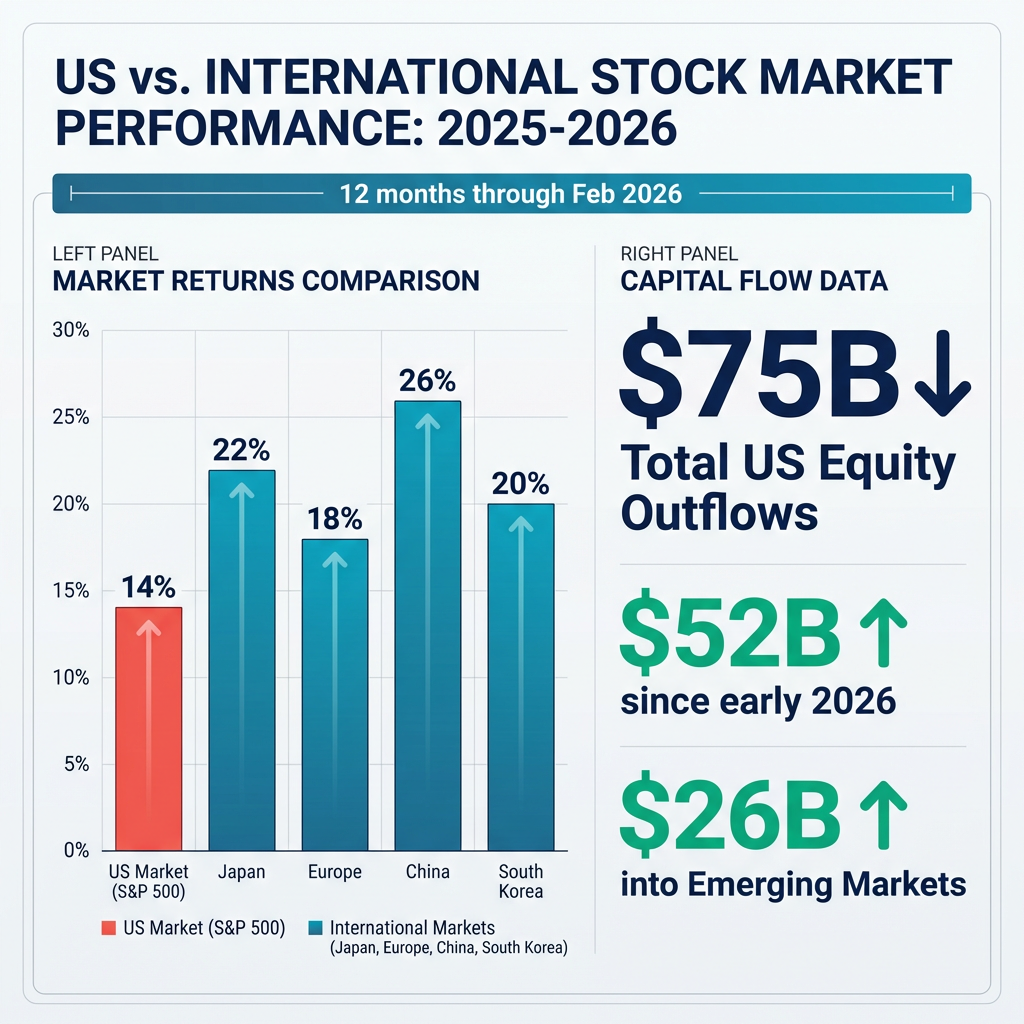
Capital flows reflect this shift in investor sentiment. $75 billion exited US equity funds over six months through February 2026, with $52 billion of those outflows occurring since early 2026 alone. These funds rotated primarily into overseas markets, with emerging markets receiving $26 billion in new allocations. The rotation represents actual investor behaviour rather than theoretical portfolio construction.
> Expert Commentary
> “International stocks are winning,” according to Schwab commentary at the end of 2025, validating the trend US investors are responding to with significant capital deployment.
When big ASX news breaks, our subscribers know first
What Are International Stocks and How Do They Work?
International stocks represent equity ownership in companies headquartered outside the United States. These investments provide exposure to different economic cycles, industries, and growth patterns compared to US-based companies. Investors gain access to business operations in foreign economies, diversifying beyond domestic market concentration.
The SEC’s official guidance on international investing considerations outlines regulatory perspectives on currency fluctuations, differing accounting standards, and political risks that US investors encounter when purchasing foreign securities.
The distinction between developed and emerging markets matters for portfolio construction. Developed international markets include established economies with mature financial systems: Japan, the United Kingdom, Germany, France, Canada, and Australia. Emerging markets are economies still developing their financial infrastructure whilst experiencing faster growth: China, Brazil, South Korea, India, Mexico, and Taiwan. Each category offers distinct risk and return profiles.
US investors typically access international stocks through exchange-traded funds rather than purchasing individual foreign shares directly. These ETFs trade on US exchanges just like domestic stocks, providing instant diversification across hundreds or thousands of companies. VXUS (Vanguard Total International Stock ETF) exemplifies this approach, holding 8,700+ stocks across developed and emerging markets with a 0.05% expense ratio.
Benefits of Adding International Stocks to Your Portfolio
US equity markets have become heavily concentrated in mega-cap technology stocks, creating single-market risk for portfolios weighted entirely towards domestic holdings. International stocks provide exposure to different sectors, economies, and market cycles, reducing portfolio dependence on any single market’s performance.
The US mega-cap technology concentration dynamics have created portfolio risks that extend beyond sector exposure, affecting free cash flow generation and overall market resilience even as these companies maintain dominant market positions.
The strategic advantages of international diversification extend across multiple dimensions:
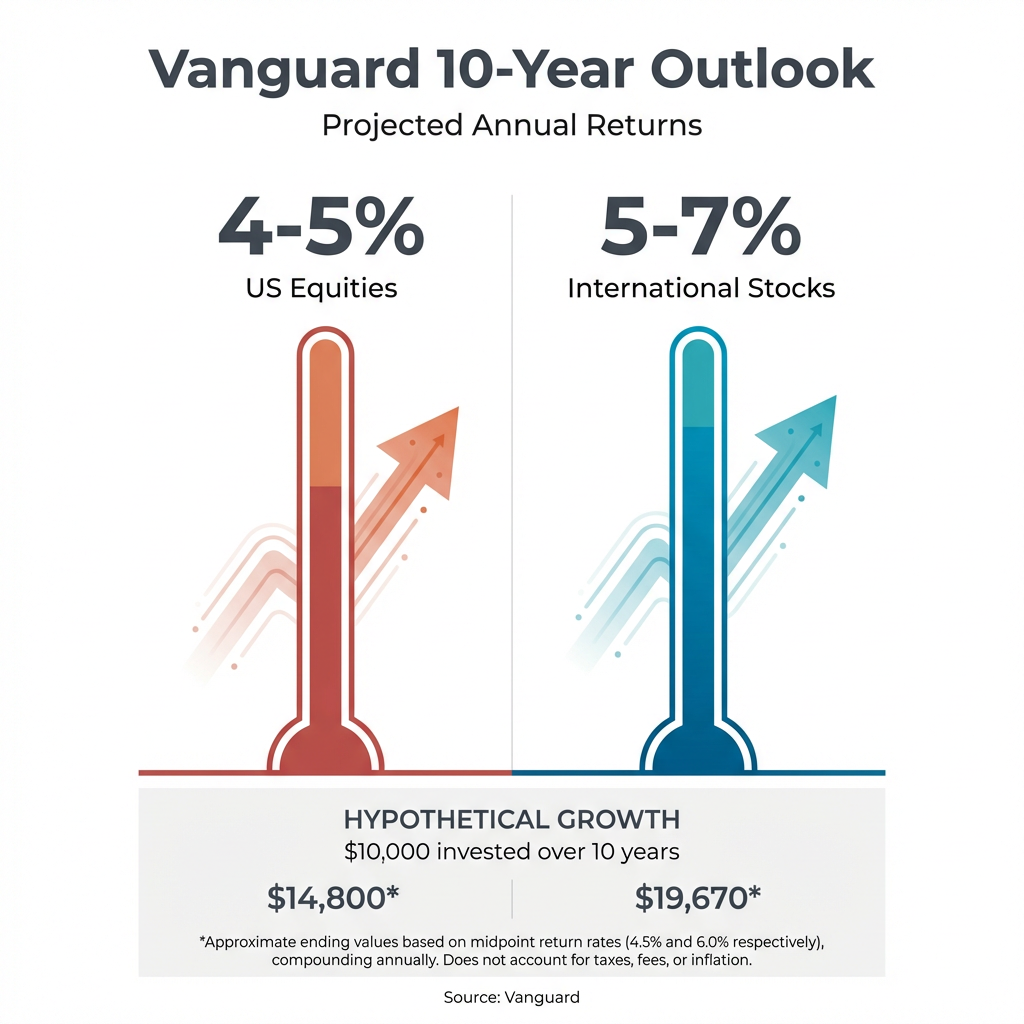
- Higher expected returns: Vanguard projects 5-7% annual returns for international stocks over the next decade compared to 4-5% for US equities, reflecting valuation gaps and earnings growth trajectories
- Diversification away from US mega-cap concentration: International markets offer sector exposure beyond technology-dominated US indices
- Income potential: International dividend ETFs yielded approximately 3.1% over the 12 months through February 2026, providing meaningful income advantages
- Currency tailwinds: Weaker US dollar periods boost returns for unhedged international holdings when foreign currencies appreciate
- Access to faster-growing economies: Emerging markets offer exposure to economies experiencing structural development and urbanisation
These projections derive from Vanguard’s institutional research on international equity diversification, which examines historical patterns, valuation metrics, and global portfolio optimization across multiple decades of market data.
Currency dynamics create an additional return layer for international investors. When the US dollar weakens against foreign currencies, international investments gain value when converted back to dollars. Analysts expect prolonged USD weakness in 2026 based on anticipated Federal Reserve rate cuts and fiscal dynamics, creating a potential tailwind for unhedged international positions.
Best International Stock ETFs for US Investors
Low-cost ETFs serve as the primary vehicle for international investing, trading on US exchanges whilst offering instant diversification across hundreds or thousands of companies. These funds charge minimal fees and provide efficient access to global markets. Broad international ETFs form the foundation before investors consider tactical regional additions.
| ETF Ticker | Focus | Key Features |
|---|---|---|
| VXUS | Total International | 0.05% expense ratio, 8,700+ stocks across developed and emerging markets including Japan, UK, China, India |
| IXUS | Total International | Broad developed and emerging market access with low-cost structure |
| IEMG | Emerging Markets Only | Comprehensive emerging market exposure for investors wanting higher EM allocation |
| IGRO | International Dividends | 30+ countries with dividend growth focus for income-oriented investors |
Starting with a total international fund like VXUS or IXUS provides core exposure with automatic allocation across developed and emerging markets. Investors wanting to overweight emerging markets can add IEMG alongside a core holding. Income-focused investors might consider IGRO for its dividend emphasis across more than 30 countries.
How Much Should You Allocate to International Stocks?
Vanguard and Schwab guidance suggests 20-40% international exposure as a reasonable range for most US investors. The appropriate allocation depends on individual risk tolerance, time horizon, and existing exposure through US multinationals with significant global operations. This framework provides a starting point rather than a universal prescription.
Several factors influence the optimal international allocation decision:
- Time horizon: Longer investment horizons can accommodate more international exposure and its associated volatility, particularly in emerging markets
- Risk tolerance: Emerging markets offer higher growth potential but greater short-term volatility compared to developed international markets
- Existing exposure: Many US large-cap companies derive significant revenue from international operations, providing indirect global exposure
- Income needs: International dividend ETFs can supplement income strategies for investors prioritising yield
- Conviction level: Starting with smaller allocations allows investors new to international markets to build comfort gradually
The split between developed and emerging markets within the international allocation requires consideration. iShares/BlackRock currently prefers emerging markets over developed markets, particularly EM Asia for AI infrastructure investment themes. Morningstar identifies specific opportunities in Brazil, China, and Mexico amongst emerging markets, plus the UK and Europe in developed markets. A balanced approach suits most investors, with tactical tilts based on individual conviction and research.
The next major ASX story will hit our subscribers first
Where Experts See Opportunity in 2026
Multiple major institutions identify compelling opportunities in international markets based on valuations, earnings growth trajectories, and structural factors. Schwab highlights attractive valuations and superior earnings growth internationally compared to US markets. This represents expert perspective rather than guaranteed outcomes, providing context for allocation decisions.
Regional opportunities identified by analysts include:
- Emerging Market Asia: iShares favours this region for AI infrastructure investment themes and accelerating earnings growth relative to developed markets
- South Korea: Led $26 billion in emerging market inflows with technology sector strength attracting significant capital
- Brazil: Commodity positioning and favourable valuations have attracted substantial investor interest throughout the rotation
- Japan: Outperformed the S&P 500 through February 2026, benefiting from corporate governance reforms and policy support
- Europe and UK: Morningstar identifies specific upside potential based on attractive valuations relative to historical averages
Geopolitical uncertainties have tempered but not reversed international ETF flows into 2026. US-China trade dynamics require ongoing monitoring, and volatility remains a factor in emerging markets. Broad diversification across regions reduces country-specific risk compared to concentrated single-country positions.
Geopolitical developments including the Iran energy crisis have created short-term volatility across global markets, yet have not fundamentally reversed the structural case for international diversification built on valuation gaps and earnings trajectories.
Getting Started: A Practical Approach
Implementing an international allocation requires systematic execution rather than market timing attempts. The following steps provide a framework for beginning or expanding international stock exposure:
- Determine your target international allocation: The 20-40% range serves as a common starting point based on expert guidance
- Select a core broad international ETF: VXUS or IXUS provide foundation exposure as total international funds
- Consider adding specialised exposure: Emerging market-focused or regional ETFs suit investors with specific convictions and higher risk tolerance
- Implement gradually: Phased deployment over several months reduces timing risk for investors new to international markets
- Rebalance annually: Systematic rebalancing maintains target allocations whilst capturing performance differentials
- Stay informed without overreacting: Monitor global developments whilst avoiding headline-driven portfolio changes
Investment professionals caution against making abrupt portfolio changes during periods of elevated market volatility. Headline-driven reactions can compromise long-term financial objectives. Global equity markets have historically demonstrated recovery patterns and offer diversification advantages. The goal centres on building a resilient portfolio for the long term rather than chasing short-term performance.
Before deploying capital across multiple regions, investors new to global markets benefit from understanding proven strategies for investing during market volatility that apply across domestic and international holdings alike.
This article is for informational purposes only and should not be considered financial advice. Investors should conduct their own research and consult with financial professionals before making investment decisions.
Frequently Asked Questions
What are international stocks and why should US investors consider them?
International stocks are shares in companies headquartered outside the United States, offering exposure to different economies, sectors, and growth cycles. US investors are increasingly considering them because overseas markets outperformed the S&P 500 by double-digit percentage points in 2025, and Vanguard projects 5–7% annual returns for international stocks over the next decade compared to 4–5% for US equities.
What is the best international stock ETF for US investors in 2026?
VXUS (Vanguard Total International Stock ETF) is widely cited as a strong core holding, offering exposure to 8,700+ stocks across developed and emerging markets at a minimal 0.05% expense ratio. IXUS is a comparable alternative, while IEMG suits investors wanting dedicated emerging market exposure.
How much of my portfolio should I allocate to international stocks?
Vanguard and Schwab guidance suggests a 20–40% international allocation as a reasonable range for most US investors, depending on risk tolerance, time horizon, and existing indirect global exposure through US multinationals. Investors new to international markets are advised to start smaller and scale up gradually.
Which international markets are analysts most bullish on in 2026?
iShares favours Emerging Market Asia for AI infrastructure themes, while Morningstar highlights Brazil, China, Mexico, the UK, and Europe for attractive valuations. Japan and South Korea have also drawn significant capital, with South Korea leading $26 billion in emerging market inflows.
How does a weaker US dollar affect international stock returns?
When the US dollar weakens against foreign currencies, unhedged international investments gain additional value when returns are converted back to dollars. Analysts expect prolonged USD weakness in 2026 due to anticipated Federal Reserve rate cuts and fiscal dynamics, creating a potential tailwind for international holdings.


