#
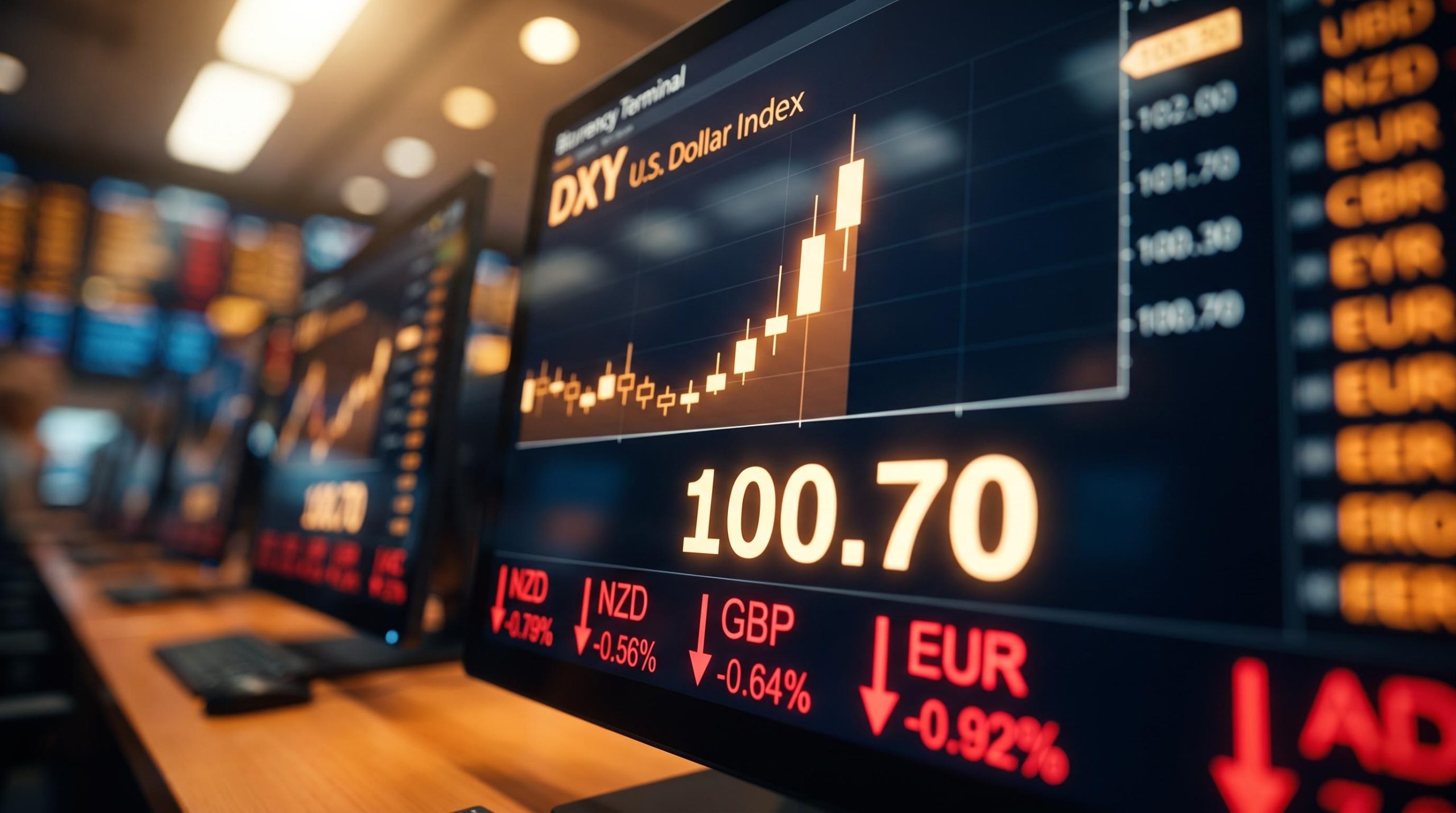
The US Dollar Index pushed to a dominant seven-week peak during Wednesday’s Asian trading session, crossing the 100.70 threshold as capital flooded back into American assets.
The catalyst was not subtle. A unified chorus of Federal Reserve officials spent the week warning that persistent supply shocks and hot demand could force further rate hikes, and currency markets took them at their word.
That hawkish signalling from central bank policymakers has done more than lift the Greenback against a single rival. It has driven broad-based strength across every major currency pair, from the euro to the New Zealand dollar.
Derivative markets are now pricing near-certainty for at least one more tightening move before the year closes. The relationship between the US dollar and Fed rate hikes is currently the single most important trade in global macro.
Here is how aggressively capital is rotating back toward dollar assets, what the officials controlling monetary policy actually said this week, and why the current rally carries a built-in expiration date heading into the fourth quarter.
Broad-based dollar rally sweeps Asian trading session
The advance was clean and it was universal. The DXY climbed roughly 0.15% during Wednesday trading to sit near the 100.70 level, extending a run that had already carried the index to an intraday high of 100.564 the previous Friday.
The current advance builds on a pattern that had already been taking shape: the prior DXY breakout above 100 was triggered by a unanimous Fed hike, Middle East geopolitical risk, and a technical structure that had been coiling for weeks.
What stands out is not the magnitude of any single move. It is the breadth.
The dollar strengthened against every major peer on the day, with no exceptions. The New Zealand dollar took the hardest hit, sliding 0.42% against the Greenback, while the British pound weakened 0.20% and the euro gave up 0.16%.
Here is the full spread across the major pairs on the session.
| Currency Pair | Direction | Intraday Move (%) |
|---|---|---|
| USD/EUR | USD stronger | +0.16% |
| USD/GBP | USD stronger | +0.20% |
| USD/JPY | USD stronger | +0.13% |
| USD/CAD | USD stronger | +0.12% |
| USD/AUD | USD stronger | +0.19% |
| USD/NZD | USD stronger | +0.42% |
When every foreign currency weakens against the dollar simultaneously, that tells you something specific. This is not isolated trouble in New Zealand or Britain. It is a pure domestic momentum play, driven by the American yield advantage pulling money out of everything else. According to Brown Brothers Harriman analyst Elias Haddad, the dollar’s climb is underpinned by exactly that: a US growth and yield edge over the euro, pound, and yen. For your portfolio, the read is straightforward. Money is chasing dollar-denominated returns right now, and it is doing so aggressively.
Supply shocks and demand heat trigger central bank chorus
The market kinetics did not appear from nowhere. They followed a coordinated week of hawkish messaging from inside the Federal Reserve, and the tone was noticeably harder than recent communications.
Chicago Fed President Austan Goolsbee delivered the sharpest warning. He cautioned that the central bank cannot ignore repeated, persistent supply shocks, and made clear a single quarter-point rise might not be enough if inflation is being driven by something more enduring than energy prices.
“Monetary policy could become increasingly aggressive and front-loaded if demand is assessed as running too hot,” Goolsbee warned, framing the risk that the Fed may need to act faster and harder than markets currently assume.
That is a meaningful vulnerability flag. Goolsbee’s focus on lasting supply factors, rather than one-off price spikes, is the tell here. If the pressure is structural, the Fed keeps rates restrictive even as growth cools.
The other voices reinforced the baseline. St. Louis Fed President Alberto Musalem stated that additional increases may be necessary to bring inflation back toward the Fed’s target.
The weight markets assign to any individual Fed comment depends heavily on the FOMC voting structure: regional presidents who are not currently voting members can signal intent but cannot bind policy, a distinction that matters when parsing the Goolsbee, Musalem, and Barkin comments that drove this week’s dollar move.
Richmond Fed President Thomas Barkin echoed the intent, describing a recent hike as support for restoring price stability while leaving the door open to more. A Barchart report noted that Barkin, alongside Boston Fed President Susan Collins, flagged that inflation pressures could stay elevated.
For you, the takeaway is uncomfortable but clear. When policymakers anchor their concern to supply-side factors, you should expect restrictive rates to persist even if headline growth begins to slow. This is not a Fed looking for an excuse to ease.
Markets price near certainty for a late-year tightening move
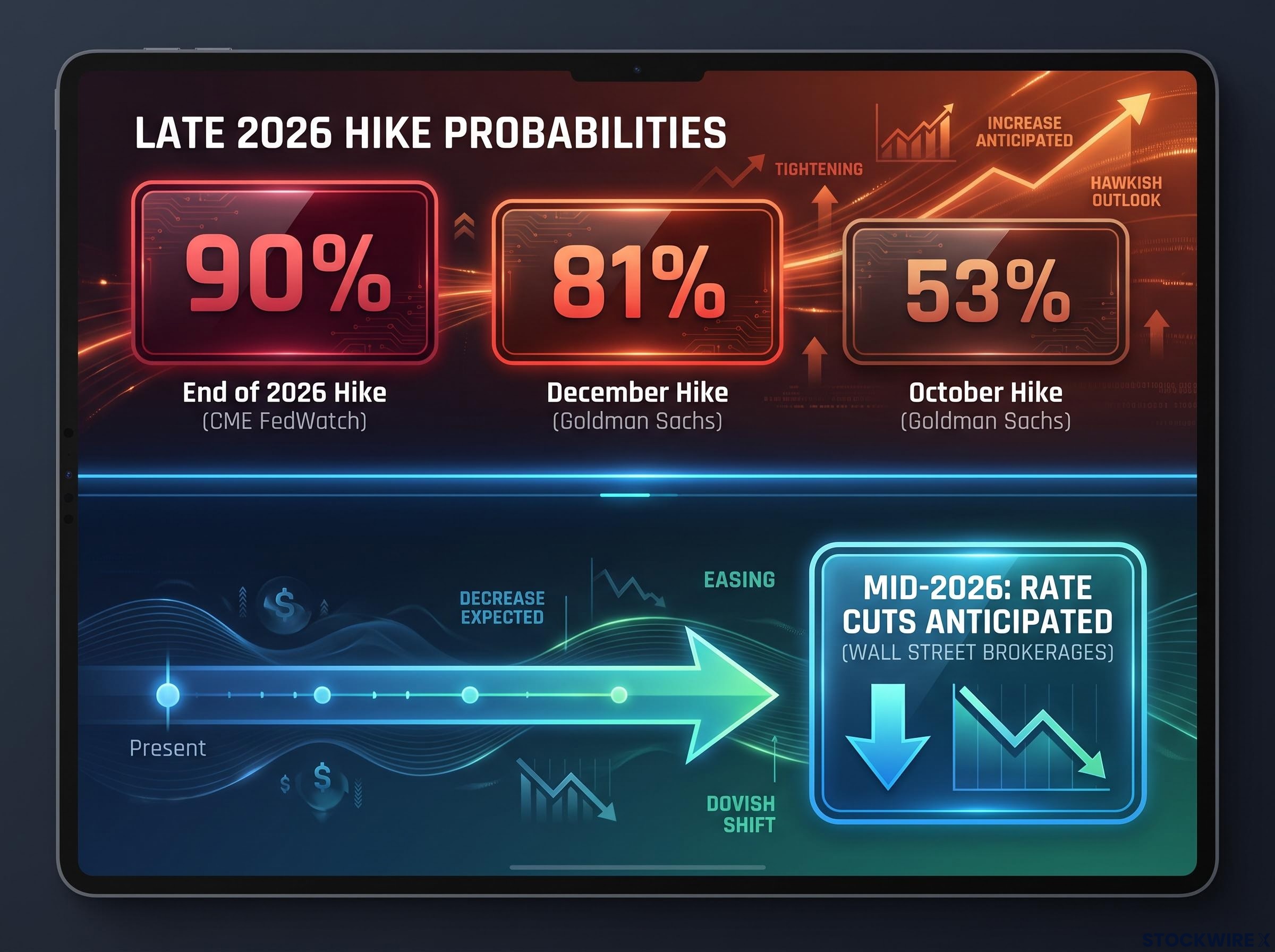
Derivative markets have absorbed the messaging almost completely. According to the CME FedWatch Tool, futures pricing now reflects roughly a 90% probability of at least one further rate increase before the end of 2026. Reuters confirmed the same figure following the latest Fed policy decision.
Derivative markets have absorbed the messaging almost completely. According to the CME FedWatch Tool, futures pricing now reflects roughly a 90% probability of at least one further rate increase before the end of 2026.
But the certainty frays once you look at which meeting delivers the move. Goldman Sachs has called for an October hike, and market pricing at the time put the odds at 53% for October against a firmer 81% for December. The near-term conviction is real; the timing is contested.
July CPI and the rate outlook were already diverging before this week’s hawkish chorus: headline inflation cooled to 3.4% but Morgan Stanley’s framework held that no cuts would arrive before 2027, meaning the data and the policy path were already on a collision course that this week’s rhetoric has only sharpened.
Institutional projections reveal timeline friction
Here is where the dominant narrative meets its counterweight. The same Reuters coverage that flagged one more 2026 hike also noted that major brokerages have pencilled in rate cuts beginning by mid-2026, putting a definitive expiration date on the current yield advantage.
That contrast is the whole story. Weigh the two forces:
- Near-term tightening risk: A 90% probability of one more hike, an aggressive October thesis from Goldman, and hawkish Fed rhetoric all supporting the dollar right now.
- Mid-2026 easing forecast: Wall Street brokerages anticipating cuts that would erode the yield differential and cap, or reverse, the rally.
The steepness of this pricing curve should tell you the trade is highly concentrated. A single soft domestic labour reading could reprice those probabilities fast, and momentum trades this crowded tend to unwind sharply rather than gently. The rally has a ceiling, and the market has already sketched where it sits.
Watching the data curve as the tightening cycle peaks
The dollar’s immediate strength and its finite shelf life are two sides of the same trade. Higher rates are supporting the Greenback now, but the same institutions pricing near-certain hikes are already forecasting cuts by mid-2026.
That makes the coming economic releases decisive. Inflation and labour data will either validate the 90% hike probability or force a rapid repricing that removes the dollar’s yield support. Watch those prints closely; they are the hinge.
The asymmetric risk in the DXY cuts in both directions: a single soft labour or inflation print could reprice the 90% hike probability sharply lower, while a hot reading must still fight through technical resistance before translating into a sustained dollar extension.
For capital allocation in a peaking rate environment, the implication is to treat current dollar strength as powerful but temporary. The yield advantage that is drawing money in today has a projected end date, and positioning should account for the reversal, not just the rally.
This article is for informational purposes only and should not be considered financial advice. Investors should conduct their own research and consult with financial professionals before making investment decisions.
Past performance does not guarantee future results. Financial projections are subject to market conditions and various risk factors, and these statements are speculative and subject to change based on market developments.