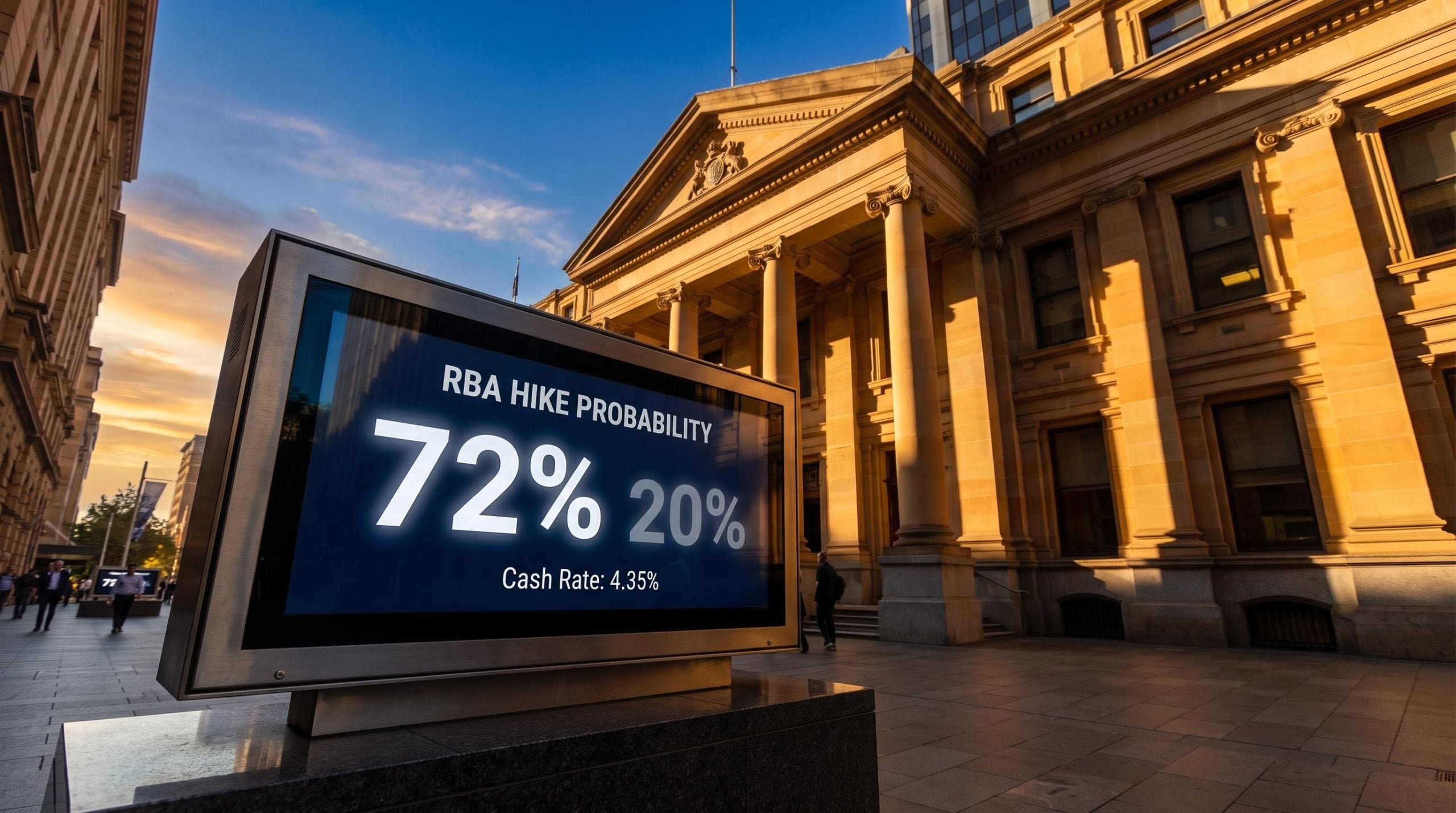
Markets spent most of September pricing a roughly 20% chance of an RBA rate rise. Then, in less than a week, that figure jumped to somewhere between 72% and 95%, depending on which futures desk you ask. That kind of repricing does not happen in a vacuum.
The catalyst is a synchronised wave of central bank tightening playing out across the globe, with the Bank of Japan, the European Central Bank (ECB), and the Bank of England all moving within the same fortnight. Energy prices near US$100 a barrel are feeding directly into the inflation calculus for every major economy, Australia’s included.
The RBA Board meets on 29 September 2026, and one data release, the ABS August employment figures due just days before, could prove decisive.
This piece lays out what is driving the global tightening consensus, what Australia’s own data is saying, and what the arguments on each side of the RBA’s decision actually look like when tested against the evidence. After reading it, you will have a clear framework for what to watch in the days before the decision, and what a hike or a hold would signal about where the cash rate goes next.
How the world’s major central banks moved in lockstep this month
Start with Japan, because it is the most striking. The Bank of Japan lifted its policy rate to 1.25% during the week of 17-24 September 2026, the highest setting in more than 31 years. For a central bank that spent a generation defined by ultra-loose policy, that is not a routine adjustment; it is a statement about how far the inflation problem has travelled.
The ECB was already ahead of it. In September 2026 the bank raised its deposit rate by 25 basis points to 2.50%, its second hike in three months, and pointed directly at energy-driven inflation as the reason.
The Bank of England did not move, holding at 3.75%, but the tone was hawkish. Three of nine Monetary Policy Committee members voted for a change, and the bank flagged rising inflation risk rather than fading concern.
The Bank of England’s September MPC minutes confirm that three of nine committee members voted for an immediate rate change, and that the majority framing explicitly flagged rising inflation risk as the dominant concern, a hawkish tilt even from a bank that ultimately held.
Read together, that is not three separate national stories. It is a coordinated shift in posture.
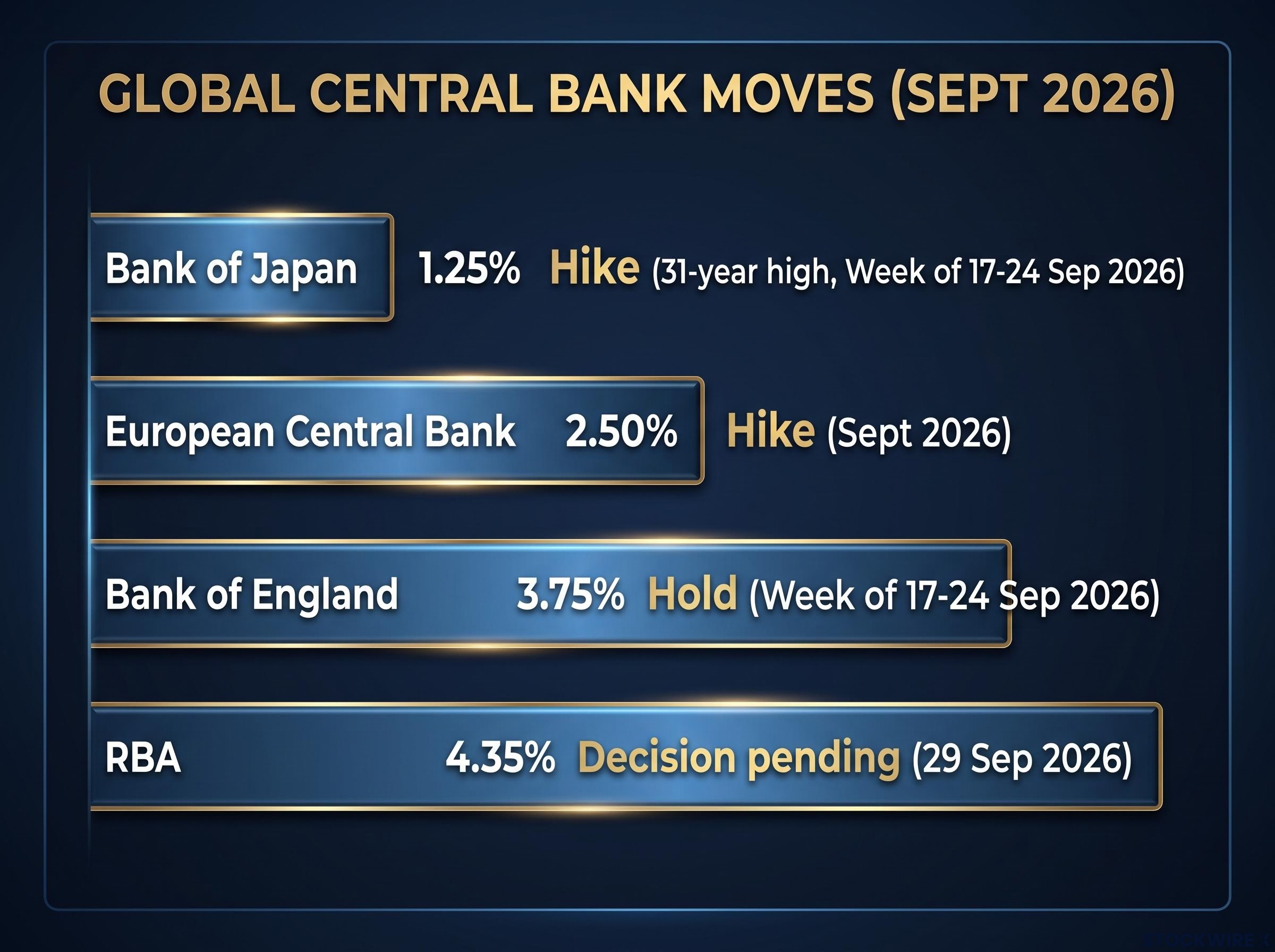
| Central bank | Current policy rate | Most recent action | Date |
|---|---|---|---|
| Bank of Japan | 1.25% | Hike (31-year high) | Week of 17-24 Sep 2026 |
| European Central Bank | 2.50% | Hike (2nd in 3 months) | September 2026 |
| Bank of England | 3.75% | Hold (hawkish signals) | Week of 17-24 Sep 2026 |
| RBA | 4.35% | Decision pending | 29 Sep 2026 |
The common variable underneath all of it is oil.
The energy thread Brent crude traded at US$104.80 per barrel on 10 September 2026, according to Reuters Breakingviews, elevated enough to push euro-zone energy inflation to 14.3% year-on-year in August, up from 10.3% in July.
That energy pressure is why euro-zone headline inflation rose to 3.2% year-on-year in August 2026 (final estimate, per KBC), up from 2.9% in July. The same barrel of oil is feeding every one of these decisions at once.
The mechanism connecting all this to the RBA runs through three live channels. Higher global energy prices push imported inflation into Australia. Higher overseas rates weaken the Australian dollar if the RBA lags, which lifts import costs further. And a perception that every major peer is tightening raises the pressure on the RBA not to look dovish, for fear of capital outflows.
What this tells you is that holding rates steady is not the neutral, risk-free option it might appear. In an environment where three major central banks have moved or leaned hawkish inside a fortnight, standing still carries its own cost. That is a large part of why market pricing has swung from below 20% to above 70% in weeks.
When big ASX news breaks, our subscribers know first
What Australia’s own data is actually saying about inflation and jobs
Two domestic surprises sit at the centre of the RBA’s problem, and both point toward tightening. Underlying inflation ran higher than the RBA expected in the July figures. And the economy grew a little faster than the bank forecast in the June quarter.
Those are precisely the two readings a central bank fears most: home-grown inflation that will not fall on schedule, paired with growth that gives the economy room to absorb higher rates. Selfwealth strategist Rob Wilson CFA points to this pair as the core rationale behind the market’s repricing.
The jobs picture that supports a hike, and the one that complicates it
The labour market is where the case genuinely splits. On the strong side, the evidence is real and recent.
- ANZ Job Ads rose 2.5% month-on-month in August 2026, after a revised 1.9% gain in July, signalling continued demand for workers.
- Deloitte Access Economics reports the economy added 102,600 jobs over the prior three months.
- The official ABS unemployment rate has hovered around 4.5%, which Deloitte describes as broadly in balance.
- Deloitte notes recent job strength has been matched by stronger labour supply, which is what has kept unemployment stable.
That reads like a labour market with room for the RBA to push. But there is a competing set of signals.
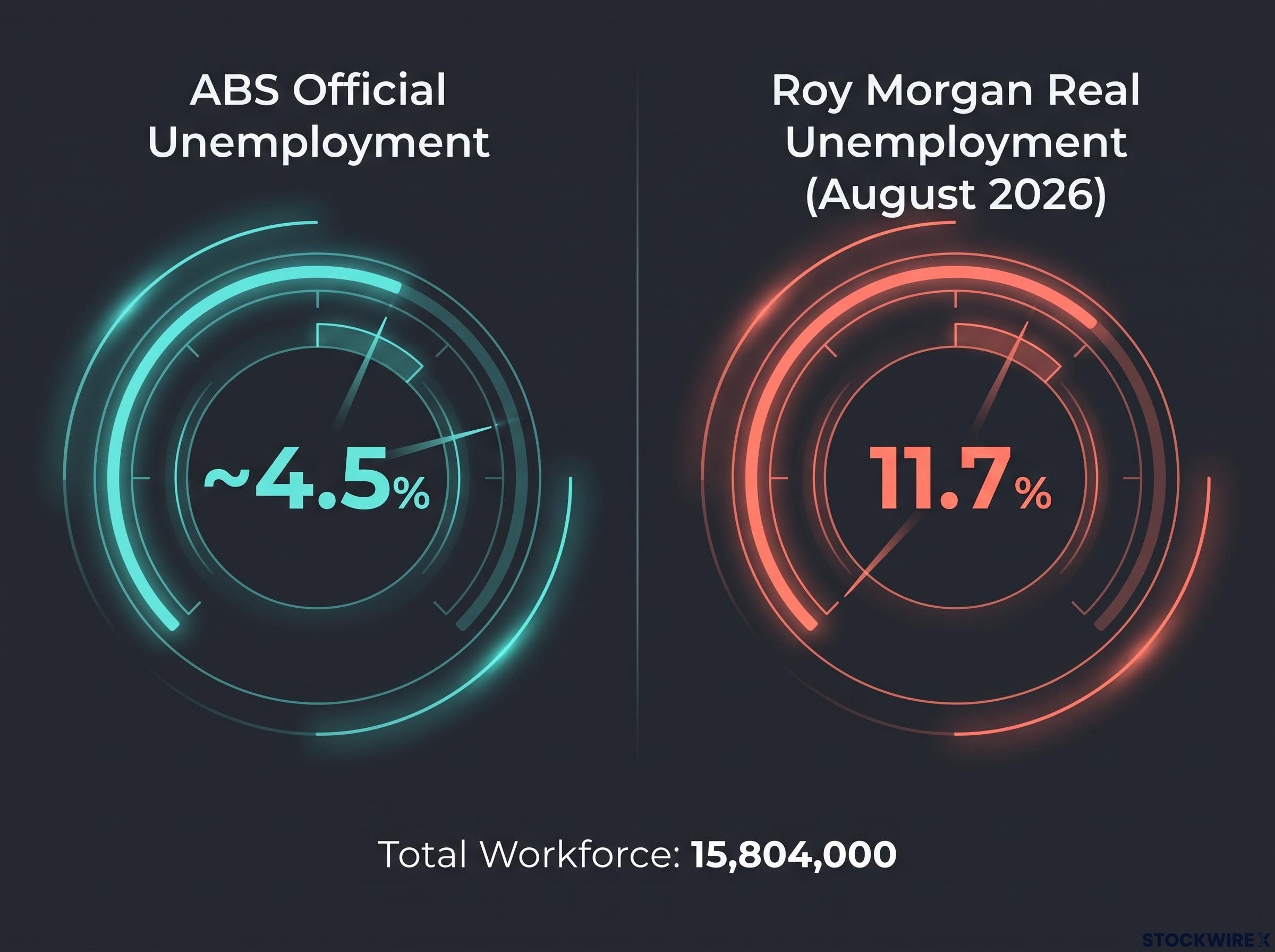
The alternative reading Roy Morgan’s independent real unemployment series put the figure at 11.7% in August 2026, up 0.1 percentage points on the prior month, across a workforce of 15,804,000 people.
Deloitte’s forward view adds to the caution. It forecasts employment growth slowing from 1.3% in 2025-26 to 0.9% in 2026-27, with unemployment drifting toward 4.7% by the end of 2026.
Even the more hawkish named forecasts frame this cautiously. RBC’s head of economics and rates strategy, Robert Thompson, sees the cash rate peaking at 4.85%, which he describes as the highest since before rates were slashed after the 2008 global financial crisis. That is a call for tightening, but it is also an acknowledgement of how far the cycle would have run.
The employment reading the ABS will not tell you
The gap between 4.5% and 11.7% comes down to what each measure counts. The ABS headline rate captures people actively looking for work and available to start. Roy Morgan’s real unemployment measure is broader, folding in discouraged workers who have given up searching and those who are underemployed, meaning they want more hours than they can get.
The August figure of 11.7% is therefore not an error against the official number; it is a wider lens. What it tells you is that the labour market the RBA sees in its models may look materially healthier than the one many workers are actually experiencing, and that distinction shapes how much further tightening the economy can genuinely absorb.
For you as an investor, the ABS August Labour Force release, due 25 September 2026, is the data event of the week. It is the last significant domestic input before the Board deliberates. A strong headline number would likely cement hike expectations; a weak one could inject real uncertainty into what markets currently treat as near-settled.
The July jobs miss, a near-28,000 shortfall versus consensus that briefly collapsed September hike odds before the subsequent rebound in ANZ Job Ads and August hiring data, is a reminder that a single monthly print can reprice the entire rate path in either direction.
The case for hiking and the case for holding, put plainly
Both sides of this decision are backed by evidence, and neither is a straw man. Here is each argument on its own terms.
| Case for hiking | Case for holding |
|---|---|
| Underlying inflation ran above the RBA’s July forecast | Deloitte forecasts employment growth slowing to 0.9% in 2026-27 |
| June quarter GDP grew faster than the RBA projected | Jobs and Skills Australia notes OECD labour markets broadly weakening |
| ANZ Job Ads up 2.5% in August; unemployment near 4.5% | Roy Morgan real unemployment at 11.7% signals hidden slack |
| Governor Bullock frames rates as “just back to normal” | ECB expects energy inflation to fall sharply in 2027 |
| RBC’s Thompson now sees a September hike; 4.85% peak | Deloitte sees unemployment drifting to 4.7% by end-2026 |
The institutional signal on the hike side is the most specific piece of evidence available.
The Governor’s framing At a parliamentary hearing, RBA Governor Michele Bullock described interest rates as “just back to normal” after years of ultra-low settings, per ABC News. The broadcaster noted the appearance left many economists convinced the bank would hike at the 29 September meeting.
The hold case leans on the forward-looking data rather than the current readings. Deloitte’s forecast of slowing employment growth, Jobs and Skills Australia’s observation that unemployment is rising and labour shortages easing across OECD economies, and the ECB staff view that energy inflation will peak near the end of 2026 before falling sharply in 2027 all point the same way. If the current inflation shock is largely energy-driven and transient, tightening hard into it risks compounding a labour slowdown that is already visible.
The precedent for RBA divergence from global peers cuts both ways: when the RBA hiked to 4.35% in May 2026 while the Fed, ECB, and Bank of England all held, consumer sentiment fell to 80.1 and retail spending contracted 0.8% month-on-month, a demand compression that now sits inside the hold case.
That analytical dispute is exactly what the spread in market pricing reflects. Estimates ran from 72% (Selfwealth, 21 September) to 95% (LSEG via ABC News, 18 September), with futures trackers at 88-92% on 22-23 September, and the original Selfwealth commentary sitting near 80% as of 24 September.
Treat that spread as a live gauge of uncertainty, not noise. It measures how much weight the market thinks the RBA will place on transient energy inflation versus forward-looking labour softening.
The test to apply when the data lands is simple. A strong August employment print, especially a firm headline number alongside continued job ads strength, tips the balance decisively toward a hike. A soft print, or a rise in the official unemployment rate toward Deloitte’s projected path, reopens the hold case that markets have largely closed.
Why the synchronised tightening cycle raises the stakes for Australian investors
Step back from whether the RBA moves, and think about what the move means for a portfolio. A hike would lift the cash rate from 4.35% to 4.60%, the highest point in the current cycle.
But the more important number is what comes after. RBC’s Thompson has a peak of 4.85% in his base case, which means at least one named strategist is already pricing a further move in November. Markets are less committed, putting the probability of a November follow-on hike at 37% (LSEG via ABC News, 18 September 2026).
Markets are pricing a path, not a point A 37% implied probability of a November hike tells you the market is not treating 29 September as an isolated event. It is pricing a trajectory.
That distinction matters because positioning only for the next meeting underestimates how the tightening cycle is being framed. The practical implication is a higher-for-longer scenario for rate-sensitive assets, bank stocks, fixed-income duration, and any heavily leveraged balance sheet, that is now being treated as the base case rather than a tail risk.
The currency channel makes this self-reinforcing. If the RBA holds while the ECB, Bank of Japan, and US Federal Reserve tighten, the Australian dollar faces downward pressure. A weaker dollar lifts imported inflation, which can make a future hike more likely, not less. Brent crude at US$101.81 per barrel on 22 September 2026 (TradingEconomics) keeps that imported-inflation risk live in the background.
The Australian dollar drivers most relevant to this cycle, RBA policy relative to peers, iron ore pricing, and global risk sentiment, interact in ways that make the currency channel self-reinforcing: a hold decision that widens the rate differential to the ECB and Bank of Japan simultaneously weakens the AUD and lifts imported inflation, which feeds back into the very inflation calculus the RBA is weighing.
Three data triggers deserve your attention in the final week of September, ordered by how close they sit to the decision.
- ABS August employment release (25 September 2026): the last domestic input, and the single reading most likely to confirm or unsettle hike expectations.
- US PCE inflation data (late in the week of 24 September 2026): the first gauge of US price pressures after the Fed’s recent action, relevant because it shapes the global tightening backdrop and the currency channel.
- Oil prices: with Brent near US$100, further movement feeds directly into the imported-inflation calculus the RBA is weighing.
What the 29 September decision will tell investors about the rate peak
Whatever the RBA does, the decision resolves into two clearly different forward paths. Here is how each one reads.
If the RBA hikes to 4.60%:
- It aligns Australia with the global tightening wave and validates the market’s repricing from below 20% to above 70%.
- The live question becomes whether this is one more move toward RBC’s 4.85% peak, or the start of a pause.
- The answer sits in the post-meeting statement, not the rate number itself.
If the RBA holds at 4.35%:
- It signals a willingness to diverge from global tightening momentum.
- It places more weight on forward-looking labour softening, Deloitte’s 4.7% unemployment forecast being the downside the hold case is protecting against, and on the view that energy-driven inflation is transient.
- That itself carries a message about a lower medium-term rate path.
The single most useful thing to watch is not the rate. It is the language.
Whether the RBA hikes or holds, the post-meeting statement’s framing around data dependence and future meetings will tell you more about the terminal rate than the decision itself. Treat that statement as the primary signal to interpret.
The forward guidance language from each RBA decision has carried more information than the rate number itself throughout this cycle; at the May 2026 meeting, a statement that neither committed to a pause nor signalled a fourth hike left Q2 CPI and labour data as the decisive inputs, exactly the same interpretive framework the 29 September statement will require.
The next seven days are the highest-information window in the Australian rate cycle since early 2026. Two data releases and one central bank decision will together define the rate path for the rest of the year and set the context for every rate-sensitive call between now and 2027.
This article is for informational purposes only and should not be considered financial advice. Investors should conduct their own research and consult with financial professionals before making investment decisions.
Forecasts and probability figures cited are drawn from named sources as of mid-to-late September 2026. Past performance does not guarantee future results, and these projections are subject to market conditions and various risk factors.