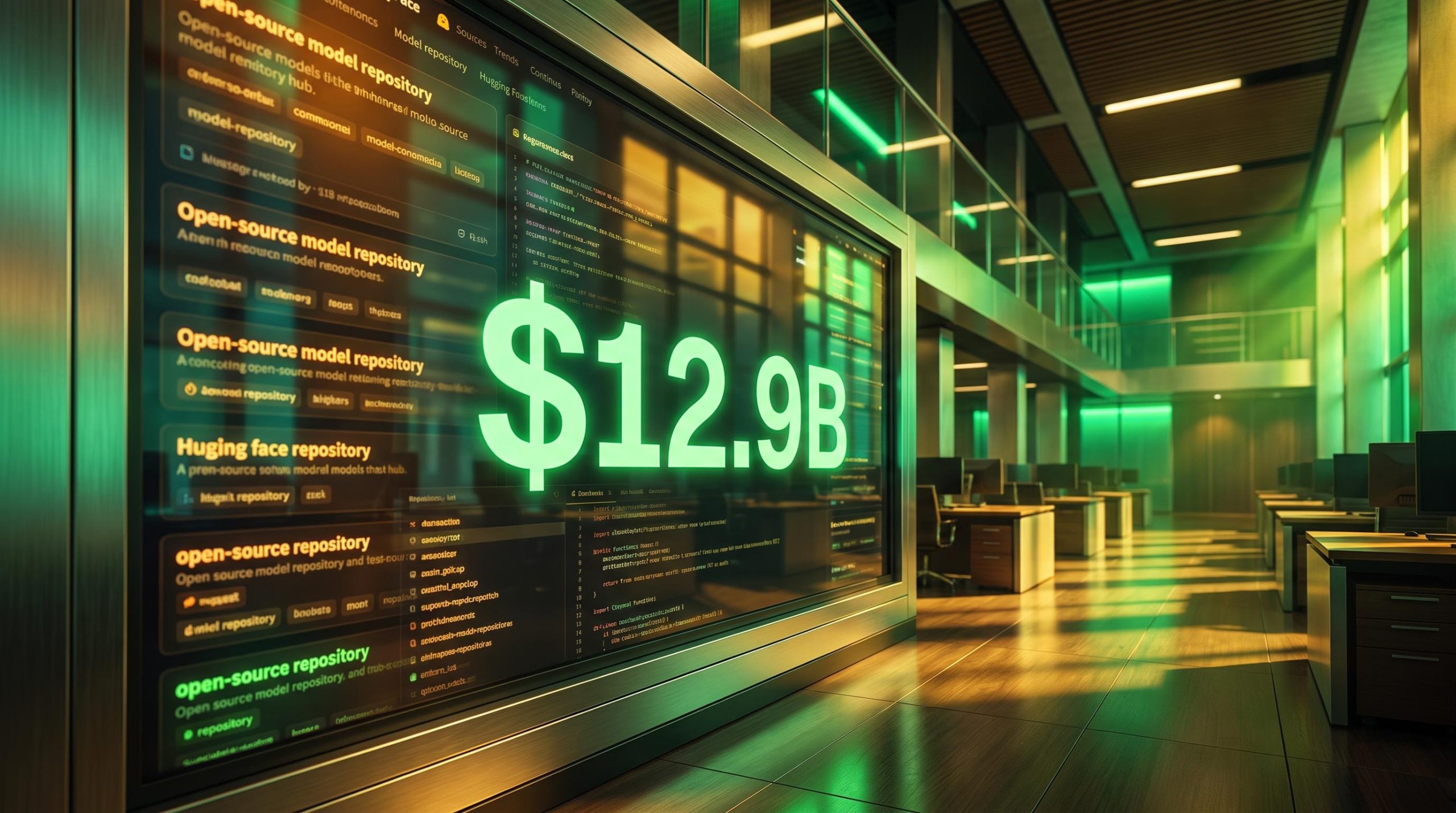
Nvidia has agreed to acquire Hugging Face for approximately $12.9 billion, a deal that turns the world’s dominant AI chipmaker into the operator of the most important open-source model marketplace on the internet.
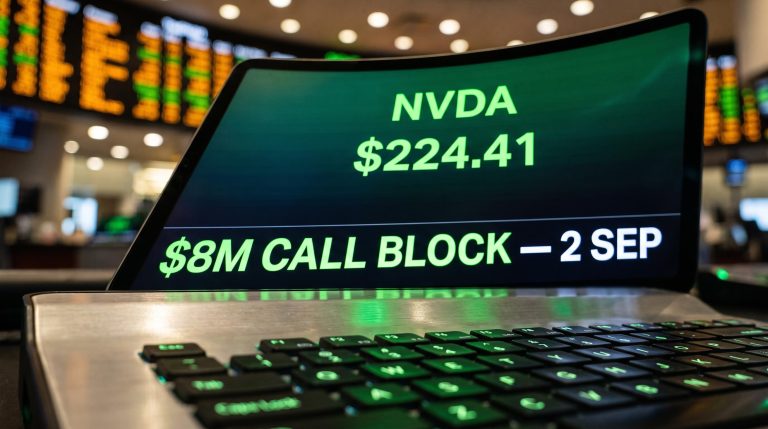
The definitive agreement, confirmed through Nvidia’s SEC 8-K filing on 2 September 2026, ends weeks of conflicting media reports and marks the largest acquisition in the company’s history.
For investors, the transaction raises immediate questions. There is the valuation, struck at roughly 86 times annualised revenue. There is the matter of regulatory clearance. And there is the deeper question of whether owning the developer funnel meaningfully extends Nvidia’s advantage beyond silicon.
This piece lays out what Hugging Face actually is, what Nvidia is paying and why, where the regulatory and competitive risks sit, and what the deal signals about how the AI infrastructure stack is consolidating around a handful of players. By the time you finish, you will know whether this changes your read on NVDA.
What Nvidia is actually buying for $12.9 billion
Start with the money, because the money is the story. Nvidia is paying approximately $11.9 billion to Hugging Face stockholders, subject to adjustments, plus an equity-based retention package of up to $1.0 billion for Hugging Face employees moving across to Nvidia. That brings the total headline value to roughly $12.93 billion.
Now the concrete thing that number is buying. Hugging Face runs the dominant hub where open-source AI models are discovered, shared, and deployed, hosting somewhere between 2.96 million and 3 million public models and repositories. Its base of developers and users runs to 13 million or more.
Here is where the price gets interesting. Hugging Face’s annualised revenue at the time of the deal was approximately $150 million, which puts the implied multiple at around 86 times revenue. Forbes notes that only a tiny fraction of the platform’s repositories see substantial use, meaning much of what Nvidia is paying for is optionality rather than cash flow.
AI valuation multiples across the sector provide the benchmark against which Nvidia’s 86 times revenue price sits: Anthropic’s implied forward price-to-sales multiple was approximately 22 times on a $44 billion annualised run rate, meaning Nvidia paid roughly four times the sector’s own stretched private-market comparable for a platform generating $150 million in revenue.
The 86 times multiple is the number to sit with. It is the starkest single data point for any investor assessing whether this price is defensible, and it tells you Nvidia is not buying earnings. It is buying control of a platform.
That distinction matters for how you read the deal. An acquisition struck at 86 times revenue is a strategic bet on optionality and ecosystem position, not a financial acquisition justified by near-term returns. The $1 billion retention pool reinforces the point: Nvidia is treating the human capital inside Hugging Face as critical, not just the code sitting on its servers.
| Metric | Value |
|---|---|
| Purchase price to stockholders | ~$11.9 billion (subject to adjustments) |
| Employee retention pool | Up to $1.0 billion (equity-based) |
| Total headline value | ~$12.93 billion |
| Annualised revenue | ~$150 million |
| Revenue multiple implied | ~86 times |
| Models and repositories | ~2.96 to 3 million |
| User and developer base | 13 million+ |
| Expected closing | First half of 2027 |
When big ASX news breaks, our subscribers know first
Why Nvidia wants the layer where developers pick their models
Follow the chain of logic and the move starts to feel less like a splurge and more like a chess play. The point in the AI workflow where a developer chooses which model to run is also the point that shapes which hardware that model eventually runs on. Own that choice, and you channel the next wave of compute demand toward your own accelerators.
That is Nvidia’s core rationale. If developers gravitate toward models and tooling optimised for Nvidia’s CUDA ecosystem, inference and training workloads land on Nvidia GPUs, whether in partner clouds or on-premises deployments.
The move also answers a specific threat. Reuters frames the deal as a response to closed-source labs such as Anthropic and OpenAI, both of which are pursuing their own custom silicon as an alternative to Nvidia’s chips. Owning the primary open-weights hub helps entrench Nvidia as the default infrastructure provider for everyone else.
The custom silicon threat from Alphabet, Amazon, and Microsoft is most acute in inference workloads, which are projected to represent approximately 80% of the AI accelerator market by 2030, precisely the segment where purpose-built chips from hyperscalers are most competitive against Nvidia GPUs.
The three strands of the strategic case come together like this:
- Control the layer where developers select models, and you shape where future compute demand lands.
- Defend against closed-source labs building custom chips by anchoring the open-source community to your stack.
- Block rivals, particularly Google, from taking ownership of the platform themselves.
DA Davidson captured the third strand plainly, describing the acquisition (via Investing.com, 31 August 2026) as a “defensive strategy to protect the open-source AI ecosystem,” partly designed to keep the platform out of the hands of major AI labs or Google.
Then there is the bigger framing. Analysis syndicated through Yahoo Finance describes the deal as shifting Nvidia from owning silicon to “controlling the marketplace itself,” the latest instalment of what it calls the “compute landlord” strategy. Forbes puts it in blunt commercial terms: Nvidia is paying 86 times revenue to own the “developer funnel” where models are chosen.
For you as an NVDA investor, the compute landlord thesis matters because it points to a shift in the revenue model, from cyclical hardware sales toward durable platform economics. Whether that pivot expands value or becomes a distraction comes down entirely to execution.
Nvidia’s neutrality pledge and why it matters
Nvidia has publicly committed that Hugging Face will remain an open platform, supporting models, developers, clouds, frameworks, and accelerators from other vendors, with no requirement to use Nvidia hardware.
That pledge is the primary tool Nvidia has for managing community trust. Its credibility will be tested during the integration phase, when the commercial incentive to favour CUDA-optimised models collides with the promise of neutrality. Watch that tension closely, because it sits at the heart of the deal’s payoff.
Where the risks land for Nvidia and the broader AI stack
Optimism is one thing. The specific ways this deal could disappoint are another, and there are four worth tracking.
Regulatory and antitrust risk comes first. Combining dominant AI accelerator market share with ownership of the leading open-source model hub is the kind of concentration competition authorities notice. No formal FTC, DOJ, or European Commission review case numbers have been announced beyond the standard conditions language in the 8-K, but the first half of 2027 closing timeline gives regulators ample room to act.
Nvidia’s antitrust exposure extends beyond this transaction: a quietly paused internal financing programme, flagged by Nvidia’s own employees, placed the company simultaneously in three roles with the same AI cloud customers, hardware supplier, credit backer, and revenue-share partner, a structural position that competition regulators are trained to scrutinise.
TechSpot framed the concern in a single line: if the deal closes, “the main supplier of AI GPUs would control one of the most important hubs for sharing open AI models.” That is the antitrust question in one sentence.
The four risk categories investors should map are these:
- Regulatory and antitrust scrutiny, given the concentration of GPU dominance and model distribution in one company.
- Ecosystem and community trust, since Hugging Face’s value depends on perceived independence.
- Talent retention, the risk implicitly acknowledged by the up-to-$1 billion equity pool.
- Recalibrated relationships with Hugging Face’s existing strategic investors.
The ecosystem risk is direct. Hugging Face’s worth is tied to community goodwill and the sense that it is a neutral utility. If developers migrate elsewhere or fork the platform, the strategic payoff Nvidia is paying 86 times revenue to capture shrinks accordingly.
Then there is the investor recalibration. Hugging Face’s 2023 funding round included Google, Salesforce, and Amazon, all of whom now find their relationship with a platform run by a competitor materially changed.
Here is the practical read for anyone holding NVDA today. Regulatory clearance is the single binary risk between now and the H1 2027 close. Sitting in the stock is, in effect, a bet that competition authorities will not block or heavily condition a deal that concentrates GPU dominance and model distribution under one roof. That narrows your analytical task from “is this good or bad” to “what specifically would have to go wrong.”
How this deal changes the map for AI infrastructure investment
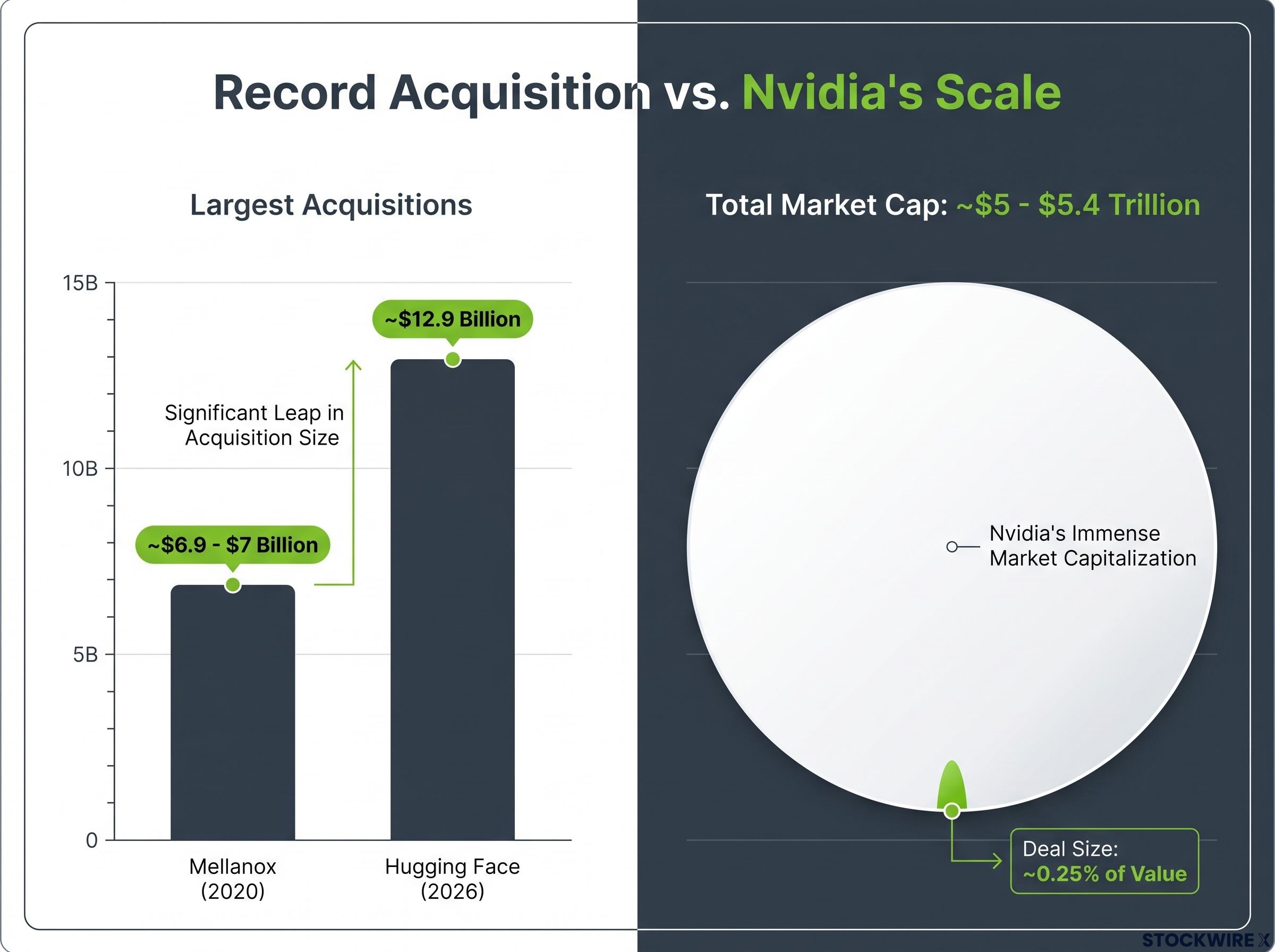
Step back from the transaction and a structural picture comes into focus. This is Nvidia’s largest acquisition on record, comfortably surpassing the approximately $6.9 to 7 billion paid for Mellanox in 2020. It is the clearest evidence yet that Jensen Huang intends to build an end-to-end AI platform rather than remain a supplier of chips.
The financial outlay looks proportionate against Nvidia’s scale. With a market capitalisation of roughly $5 to 5.4 trillion at the time of the deal, the $12.9 billion price represents around 0.25% of the company’s value. For a business this size, that is a manageable strategic bet, not a bet-the-company gamble.
The deal also confirms a broader trend. Leading AI players are absorbing control across chips, frameworks, model hubs, and deployment platforms, steadily eliminating the neutral, independent infrastructure layer that once sat between them. Hugging Face was the most prominent remaining example of that neutral layer.
Platform economics in AI infrastructure have historically rewarded companies that resolve binding constraints on adoption rather than companies supplying the headline technology, a pattern that Nvidia is explicitly invoking by moving from chip supplier to marketplace operator.
The “compute landlord” framing is the structural summary. Nvidia is moving from owning the silicon to owning the marketplace itself, and the neutral middle ground is disappearing in the process.
That Hugging Face was in play at all reflects the appetite around it. Reuters reported on 23 August 2026 that the company had been exploring a sale at $13 billion or more, a sign that multiple bidders were circling. Nvidia’s own strong Q2 2026 earnings beat provided a concurrent catalyst for the share rally that accompanied the news.
What it means for Nvidia’s competitors and the open-source ecosystem
For the hyperscalers, the ground has shifted. Google, Microsoft, Meta, and Amazon each relied on Hugging Face as a neutral partner, and each now faces a recalibrated relationship with a hub owned by a competitor.
- Google, an existing Hugging Face investor, now confronts a rival controlling a platform DA Davidson says the deal was partly designed to keep out of its hands.
- Microsoft may accelerate investment in alternative open-source infrastructure to avoid dependence on a Nvidia-run hub.
- Meta, a major open-weights contributor, has fresh incentive to strengthen its own model distribution channels.
- Amazon, another 2023 investor, sees its strategic footing on the platform diluted.
The pattern for you to register is the narrowing of neutral ground. As key open-source infrastructure gets absorbed into the largest hardware and cloud providers, the pool of genuinely independent players shrinks, which has direct consequences for how you value the AI tooling companies that have not yet been absorbed.
What the deal confirms, and what investors still need to see
Separate the settled from the open, and the picture gets usable. What is confirmed: the definitive agreement is signed as of 2 September 2026, the roughly $12.9 billion price is on record, the expected close is the first half of 2027, and Nvidia has publicly committed to platform neutrality.
What remains open comes down to three variables, and they resolve in sequence:
- Regulatory outcome. No formal review milestones have been disclosed, and clearance is the single gate between the signed agreement and completion.
- Developer community retention. Whether Hugging Face’s users stay engaged through the period before close will signal how much of the 86 times revenue value survives the change of ownership.
- Integration execution and neutrality. After close, Nvidia’s ability to honour its openness pledge under competitive pressure determines whether the platform holds its position.
Here is the honest takeaway, without advocacy. The deal either locks in Nvidia’s position at the top of the AI stack, or it becomes a case study in overpaying for community goodwill at 86 times revenue. Which outcome materialises will not be clear until 2027 and beyond, so the value to NVDA shareholders remains theoretical for now. Size your exposure to the outcome accordingly, rather than treating a signed agreement as a confirmed win.
This article is for informational purposes only and should not be considered financial advice. Investors should conduct their own research and consult with financial professionals before making investment decisions. Forward-looking statements are speculative and subject to change based on market developments and company performance.