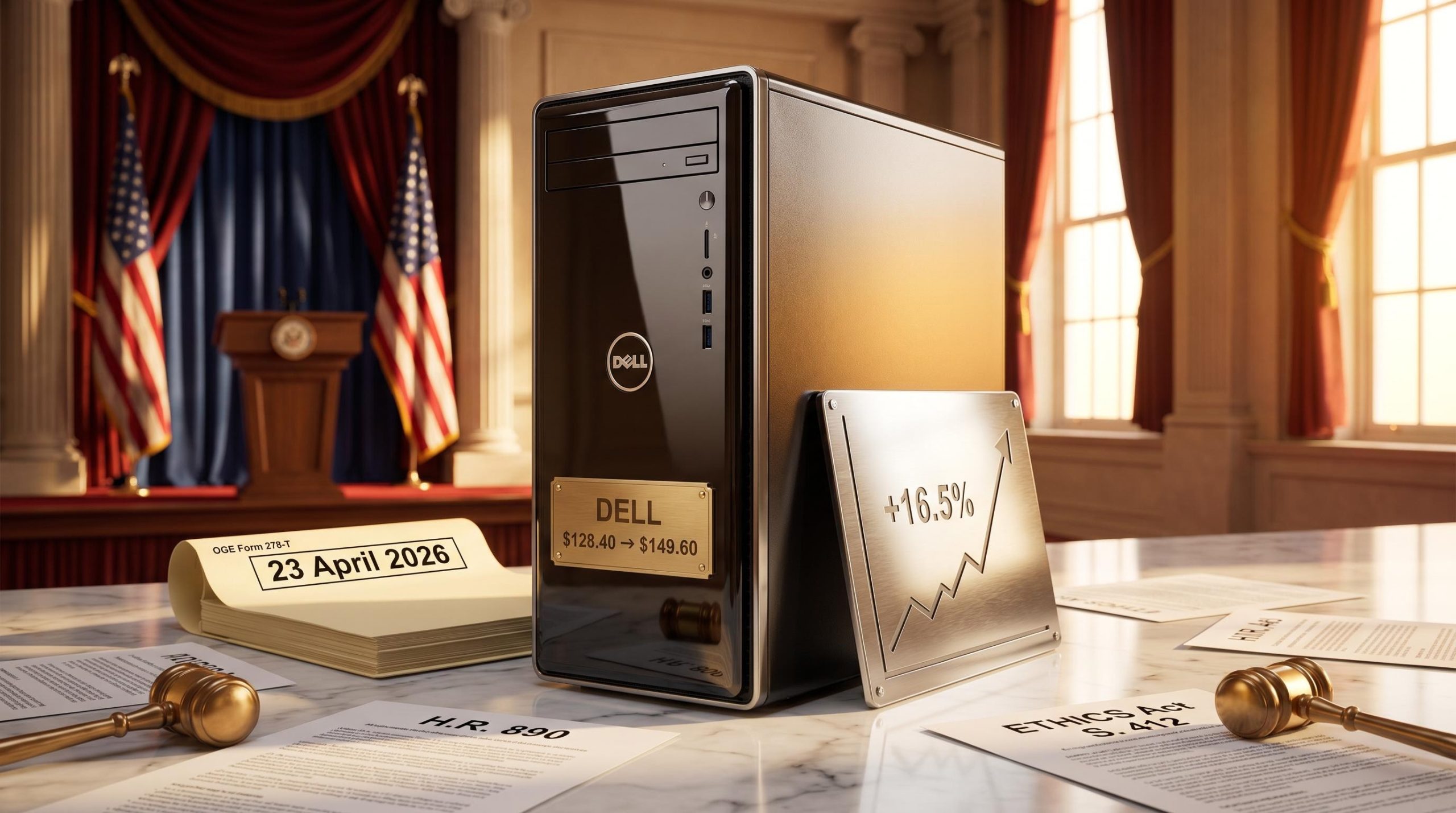
Three months after purchasing up to $5 million in Dell Technologies stock, President Donald Trump stood in the White House East Room on 5 May 2026 and called Dell hardware “the best damn hardware for American workers,” then directed federal agencies to prioritise Dell in procurement bids. The February 10 purchase, buried in Trump’s 23 April Office of Government Ethics (OGE) Form 278-T filing, surfaced publicly today, days after DELL shares surged more than 7% following the endorsement. Trump holds his individual stock portfolio outside a blind trust, meaning he retains direct financial exposure to price movements in every company he publicly promotes. What follows is a breakdown of the verified timeline, the disclosure system that made the trade visible but not illegal, the measurable financial gain, the ethics complaints and legislative response now in motion, and where the evidence stands as of 14 May 2026.
The timeline that ethics watchdogs say speaks for itself
The sequence of dates tells its own story. Four events, spread across three months, form the factual spine of the controversy:
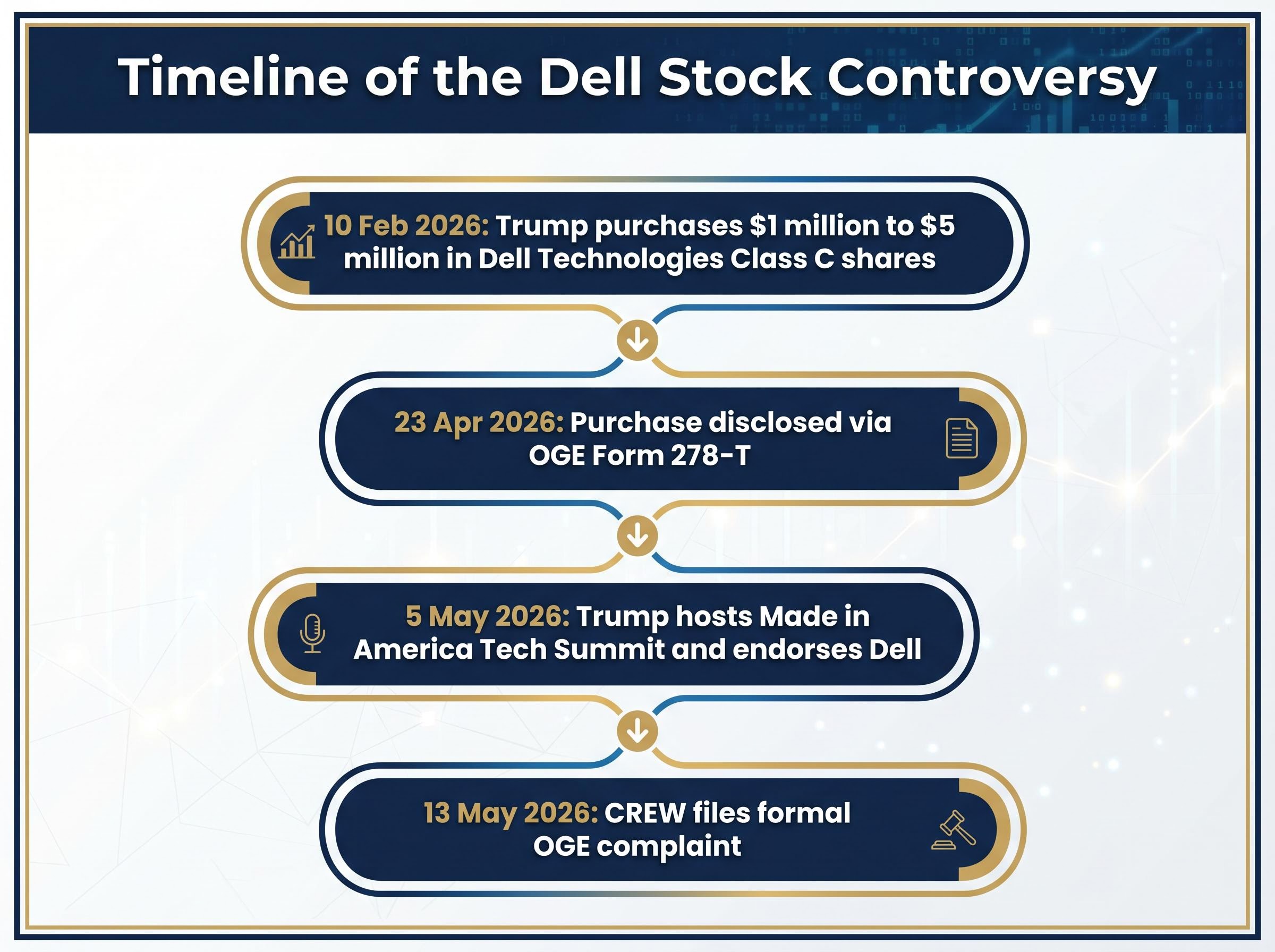
- 10 February 2026: Trump purchases Dell Technologies Class C shares, valued between $1 million and $5 million. DELL closes at $128.40.
- 23 April 2026: The purchase is disclosed via OGE Form 278-T, filed within the required 30-day window. No public attention follows.
- 5 May 2026: Trump hosts the “Made in America Tech Summit” at the White House, endorsing Dell hardware and directing federal procurement toward the company. DELL rises 4.2% intraday to $142.50.
- 13 May 2026: Citizens for Responsibility and Ethics in Washington (CREW) files a formal OGE complaint, calling the situation a “textbook emoluments violation.”
By 14 May, DELL stood at $149.60, a 16.5% total return from the purchase date. The White House did not dispute the dates, the purchase amount, or the sequence of events when asked.
White House Press Secretary Karoline Leavitt, 14 May 2026: “President’s investments are transparent via OGE filings. Dell endorsement reflects their American innovation, not vice versa.”
When big ASX news breaks, our subscribers know first
What OGE financial disclosures are, and what they cannot do
OGE Form 278-T is a periodic transaction report required for senior executive branch officials. When a qualifying trade occurs, the officeholder has 30 days to file. Trump’s 23 April filing for a 10 February purchase fell within that window. The form is public record. In principle, anyone can look it up.
Disclosure, however, is not prohibition. The form makes trades visible after the fact; it does not restrict them, delay them, or require pre-clearance. A president can buy stock in a company on Monday, endorse that company on Tuesday, and the disclosure system treats both events as compliant so long as the paperwork arrives on time.
The OGE Form 278-T filing requirements set a 30-day reporting window for qualifying transactions, making trades visible in the public record while placing no restriction on when or whether a senior official may execute them.
Why the STOCK Act does not apply to the president
The Stop Trading on Congressional Knowledge Act, passed in 2012, bars members of Congress and executive branch employees from trading on material non-public information. It does not cover the president or vice president.
Lawrence Lessig of Harvard told CNN on 13 May: “STOCK Act doesn’t cover presidents. Time to fix that.”
**Richard Painter, NYU, in Politico on 14 May 2026:** “Three months from buy to endorse screams conflict; no blind trust means Trump profits directly.”
Painter, a former ethics lawyer in the George W. Bush administration, noted that no existing federal statute would have prevented the Dell purchase or required divestment before the endorsement.
How Dell shares moved after the White House endorsement
The price progression from purchase to present traces a clear trajectory, with the White House event as the inflection point.
| Date | DELL Price | Change | Trading Note |
|---|---|---|---|
| 10 Feb 2026 | $128.40 | Purchase date | Disclosed in 23 April OGE filing |
| 5 May 2026 | $142.50 | +4.2% intraday | White House endorsement event |
| 6 May 2026 | $148.20 | +4.0% | 3x average daily volume on 5-6 May |
| 8 May 2026 | $152.80 | +7.2% from 5 May close | Post-event peak |
| 14 May 2026 | $149.60 | -2.1% from peak | Settled after broader market dip |
Trading volume spiked to three times the daily average on 5-6 May, according to Bloomberg terminal data and Investor’s Business Daily, indicating the endorsement moved more than sentiment. DELL’s year-to-date return stands at +28%.
No formal procurement contract was announced at the event, placing the price movement in the context of a directional policy signal rather than a signed deal.
Federal procurement as a market signal carries real financial weight: the Pentagon’s 2026 decision to assemble a seven-vendor defense AI coalition after collapsing a single $200 million Anthropic contract demonstrated how procurement direction, even before a contract is signed, reshapes which companies hold structural advantages and how their equity is priced.
The Dell-Intel pattern raises broader questions about Trump’s portfolio
Dell was not an isolated purchase. Trump’s Q1 2026 OGE filings reveal a broader portfolio rotation that critics argue runs parallel to his administration’s technology policy decisions.
Intel and the government equity stake connection
Trump expanded his Intel holdings in early March 2026, following the U.S. government’s 2025 decision to acquire an equity stake in the domestic chipmaker. Commerce Secretary Howard Lutnick said on 13 May: “Trump buys winners. Intel/Dell fuel U.S. dominance post-bailout.”
Simultaneously, Trump’s disclosures show divestments from legacy large-cap technology names, with Amazon, Meta, and Microsoft each reduced in the $5 million to $25 million bracket during Q1 2026. The capital moved into semiconductor and AI positions:
- NVIDIA: $1 million to $5 million
- Broadcom: $1 million to $5 million
- Synopsys: $1 million to $5 million
- Cadence Design Systems: $1 million to $5 million
- Texas Instruments: $1 million to $5 million
Public Citizen’s 14 May report characterised the Dell stake as part of a pattern of “unprecedented self-dealing” rather than an isolated transaction, connecting it directly to the Intel bailout timeline and the administration’s semiconductor policy agenda.
The Dell pattern is not isolated: presidential trade delegation signals have become a recurring mechanism for moving individual semiconductor and hardware stocks, with Micron surging more than 20% over two sessions after Micron CEO Sanjay Mehrotra’s inclusion in Trump’s China delegation raised market access expectations in ways no formal policy announcement had yet confirmed.
Congressional action and legislative reform efforts
Three active bills seek to close the gap that allows presidential stock trading. All are sponsored by Democrats. No Republican-led legislation on the subject has advanced.
| Bill Name | Sponsor | Status | Key Provision |
|---|---|---|---|
| Presidential Stock Trading Ban Act (H.R. 890) | Rep. Spanberger (D-VA) | Passed House 225-210 on 15 March 2026; stalled in Senate HELP Committee | Bans presidents and VP from active trading; mandates blind trusts |
| ETHICS Act (S. 412) | Sen. Warren (D-MA) | Advanced Senate Judiciary 12-10 on 28 April 2026; cloture failed 49-51 on 10 May 2026 | Expands STOCK Act to cover the president; requires divestment |
| No Presidents Above the Law Act (S. 1123) | Sen. Whitehouse (D-RI) | Hearing held 4 March 2026; no floor vote scheduled | Criminal penalties for undisclosed conflicts; Dell and Intel cited in markup |
Senate Minority Leader Mitch McConnell blocked a cloture vote on the ETHICS Act on 10 May, with the motion failing 49-51. The bill cannot advance to a full Senate vote without clearing that threshold.
Sen. Ron Wyden (D-OR), in a letter to the OGE Director on 12 May 2026: Wyden demanded a formal investigation into the Dell purchase and endorsement timeline, calling it “a test of whether this office exists to protect the public or to provide cover.”
Rep. Jamie Raskin (D-MD) introduced a House resolution on 14 May condemning what he termed “Trump’s stock-pumping presidency.” House Oversight Committee Democrats issued a subpoena for White House visitor and communication logs related to the Dell procurement discussions on the same day.
For readers wanting to understand the broader constitutional landscape in which the Dell ethics debate sits, our full explainer on judicial limits on executive authority examines how two federal courts dismantled the broadest pillars of executive trade power in three months, a pattern of legal constraint that reform advocates argue should extend to presidential stock trading and procurement direction.
What has actually been established, and what remains unproven
The Dell controversy has generated significant political heat. Separating confirmed facts from unproven allegations is necessary for any clear-eyed assessment of where the matter stands.
What public records confirm
- Trump purchased between $1 million and $5 million in DELL stock on 10 February 2026.
- The purchase was disclosed via OGE Form 278-T on 23 April 2026, within the required filing window.
- Trump publicly endorsed Dell hardware on 5 May and directed federal agencies to prioritise Dell procurement.
- DELL shares rose 16.5% from the purchase date to 14 May, generating an estimated unrealised gain of $165,000 to $823,000.
- Trading volume spiked to three times the daily average following the endorsement.
What has not been established
No evidence of a formal arrangement between Trump and Dell prior to the purchase has surfaced in any public record as of 14 May. The SEC Chair stated to Reuters on 14 May that the agency is “monitoring for insider trading signals but presidents exempt from standard rules.” No formal SEC investigation has been announced. The OGE had not formally responded to CREW’s complaint as of today.
CREW characterised the situation as a “textbook emoluments violation.” That characterisation has not been tested in any legal proceeding.
A disclosure system built for transparency, not prevention
The OGE filing made Trump’s Dell purchase technically visible. The White House cited this visibility as evidence of propriety. “President’s investments are transparent via OGE filings,” Leavitt said on 14 May.
CREW and Public Citizen argue the opposite conclusion from the same fact: transparency without prohibition is insufficient when a president can buy stock in a company, endorse that company from the White House podium, and direct federal procurement toward it without triggering any enforceable prohibition.
The Dell endorsement fits a broader pattern in which markets reprice on presidential intent rather than confirmed outcomes: calibrated positioning on policy signals, rather than signed deals or enacted legislation, has become the dominant challenge for investors navigating the current administration’s communication style across trade, technology, and procurement.
Reform legislation exists. The Senate has blocked its advancement. The STOCK Act does not apply to the president. No blind trust requirement is in force.
The estimated unrealised gain on the Dell position, between $165,000 and $823,000 based on the 16.5% return on the disclosed $1 million to $5 million range, is modest by the standards of presidential wealth. The structural question it exposes is not.
CREW, in its 13 May OGE complaint: The organisation characterised the Dell purchase and endorsement sequence as a “textbook emoluments violation,” the most direct allegation filed to date in the controversy.
This article is for informational purposes only and should not be considered financial advice. Investors should conduct their own research and consult with financial professionals before making investment decisions.